You probably don’t know your Hyundai’s onboard AC charger, not the EVSE, caps your Level 2 charging speed. To choose right, match EVSE amps to that limit and your panel using NEC’s 125% continuous-load rule. Decide plug‑in vs hardwired, confirm SAE J1772, and insist on UL/ETL and outdoor ratings. Smart scheduling can cut TOU costs. Choose wrong and you risk code issues—here’s how to size safely and avoid expensive mistakes.
Key Takeaways
- Match EVSE output to your Hyundai’s onboard charger kW; select equal or higher amperage to avoid AC charging bottlenecks.
- Confirm SAE J1772 connector in North America, or use a UL-listed Tesla-to-J1772 adapter that preserves pilot and proximity signals.
- Size electrical circuit per NEC 125% continuous-load rule; e.g., 40A EVSE on 50A breaker; future-proof for a 60A branch (48A).
- Choose plug-in for 32–40A with proper receptacle, or hardwired for 48A; verify UL 2594/2231 listings and integrated GFCI/CCID20.
- Select suitable cable length (18–25 ft), outdoor rating (NEMA 3R/4), smart features (scheduling, load sharing), and check rebates and TOU programs.
Know Your Hyundai’s Onboard Charger Rating
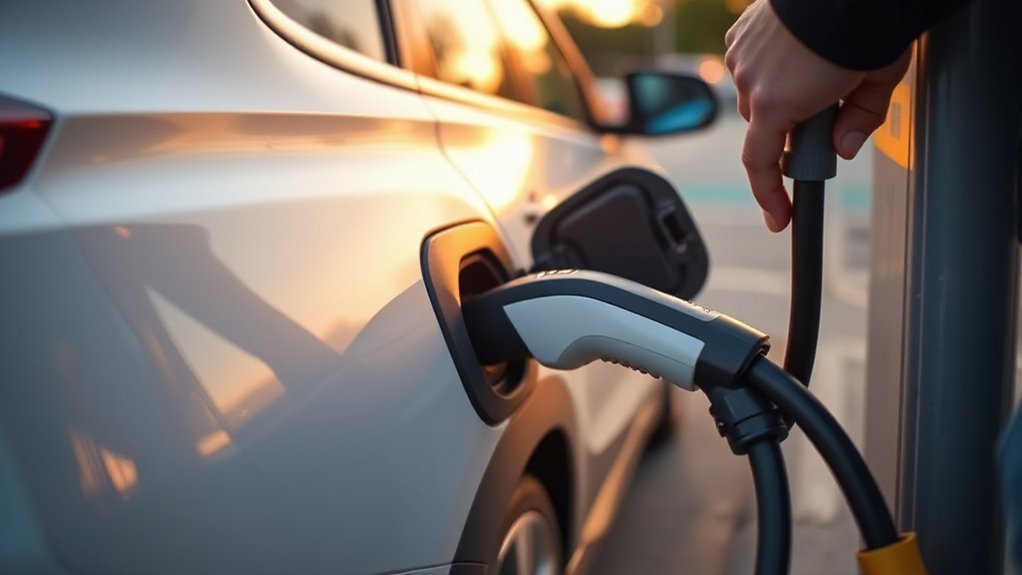
How much power can your Hyundai actually accept on AC? Your EV’s onboard charger (OBC) sets the cap, not the wall unit. Check manufacturer specs for the OBC kW rating (e.g., 7.2 kW, 10.8 kW). On Level 2, that translates to the maximum continuous current the car will draw at nominal 240 V. The EVSE advertises a pilot per SAE J1772; your Hyundai negotiates and then limits draw to the lower of the pilot or the OBC. Choose an EVSE whose output equals or exceeds the OBC so you’re not bottlenecked. Verify UL listing and temperature-derating data. Review owner’s manual notes on charge limits and thermal management. After firmware updates, recheck specs; OEM patches can alter charge curves, limits, and scheduling behavior and timers.
Matching Charger Amps to Your Electrical Panel
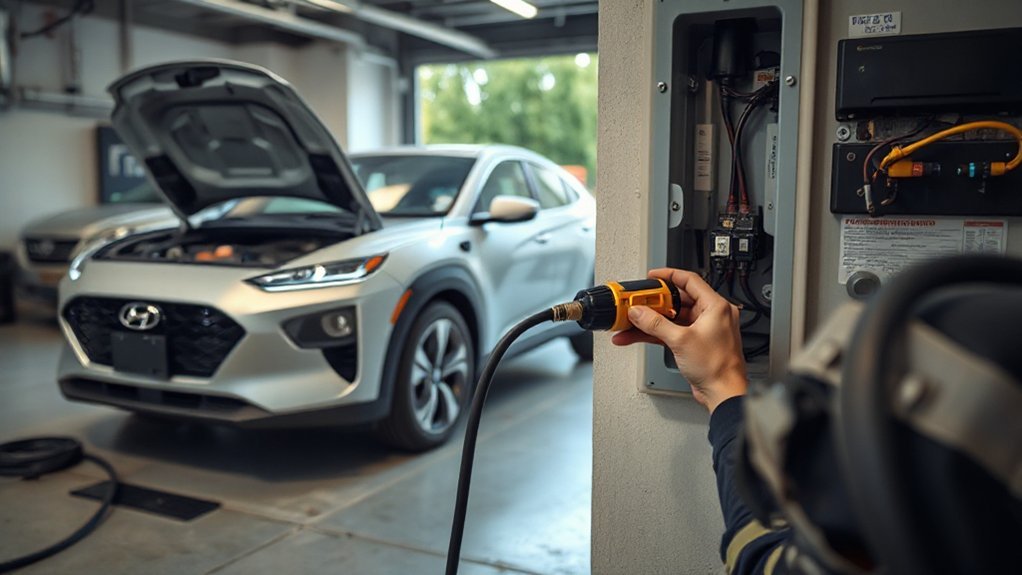
Why start by verifying your service rating and spare capacity? Because your panel’s main rating, feeder loads, and continuous-load limits dictate the maximum EVSE amperage you can safely support. Apply the 125% rule for continuous loads: a 40A charger requires a 50A breaker and wiring sized accordingly. Review panel documentation, conduct a load calculation per NEC updates and Article 220, and confirm spare breaker spaces.
Verify service capacity first: apply the 125% continuous-load rule, size a 40A EVSE to a 50A breaker, and confirm NEC 220 load calc and spaces.
- Check service size (100A, 150A, 200A) and main breaker rating; note existing large loads.
- Perform an NEC 220 load calc, including demand factors and continuous-load multipliers.
- Verify conductor and breaker sizes against the EVSE nameplate and temperature ratings.
- Confirm grounding, bonding, and AFCI/GFCI requirements; document findings and permit.
Schedule final inspection before energizing the circuit.
Plug-In vs. Hardwired: Which Installation Fits Your Home
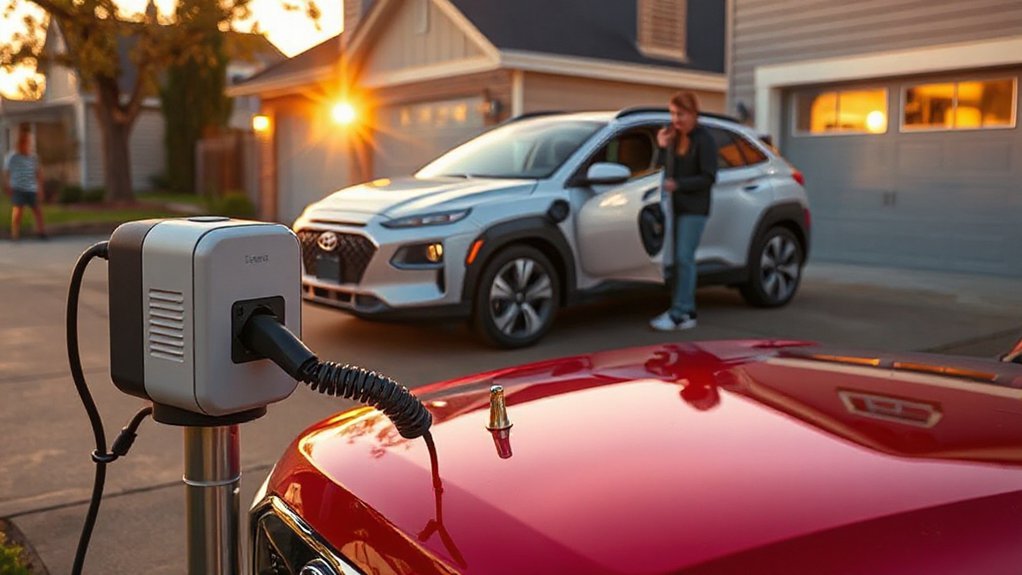
You’ll first check if a properly located 240 V receptacle (e.g., NEMA 14‑50) is available within the EVSE cord reach; if not, plan a hardwired unit or a new outlet with correct enclosure, mounting height, and in‑use cover outdoors. Match power needs to amperage: a 32 A plug‑in EVSE typically uses a 40 A circuit, while a 48 A hardwired unit needs a 60 A circuit per the 125% continuous‑load rule. Verify NEC compliance with a dedicated circuit, correct breaker and conductor sizing, grounding/GFCI as required, and choose hardwired for higher output, longer runs, or to reduce receptacle heat and plug wear.
Outlet Location and Availability
Where you mount the charger—and whether a code-compliant 240V outlet already exists—often decides plug-in vs. hardwired. Assess garage accessibility, wall space, and cable reach to your Hyundai’s charge port. If you park curbside, plan for street parking constraints, conduit routing, and outdoor ratings. Plug-in units need a properly placed NEMA 14-50 or 6-50 receptacle; hardwired units let you land conductors exactly where needed. Both must meet NEC requirements, use GFCI protection where required, and maintain working clearances.
- Mount within cord length; avoid trip hazards; use strain relief and hooks.
- Outdoors, choose NEMA 3R/4 enclosures and in-use covers; UV-rated.
- Seal penetrations with listed sealants, support conduit, and maintain drip loops on entries.
- Keep equipment above flood level; verify permits, inspections, and labeling with your AHJ.
Power Needs and Amperage
Although many Hyundai EVs can accept roughly 11 kW on AC, match the charger’s output to your home’s capacity and code limits first. Size by the 125% continuous-load rule: a 40A breaker feeds a 32A EVSE; a 60A breaker feeds 48A. If you need portability, use a plug-in unit on a dedicated NEMA 14-50. For higher continuous load, select hardwired.
| Option | Circuit | Notes |
|---|---|---|
| Plug-in 32A | 40A | Portable; verify receptacle rating |
| Hardwired 48A | 60A | Best for sustained loads |
| Future-ready 60A EVSE | 100A | Plan service upgrade |
Confirm panel load calcs, conductor gauge, GFCI where required, and amp tolerance under temperature. Hardwire to minimize voltage drop and peak currents. Set EVSE limits to protect wiring.
Connector Compatibility: J1772 and Adapters
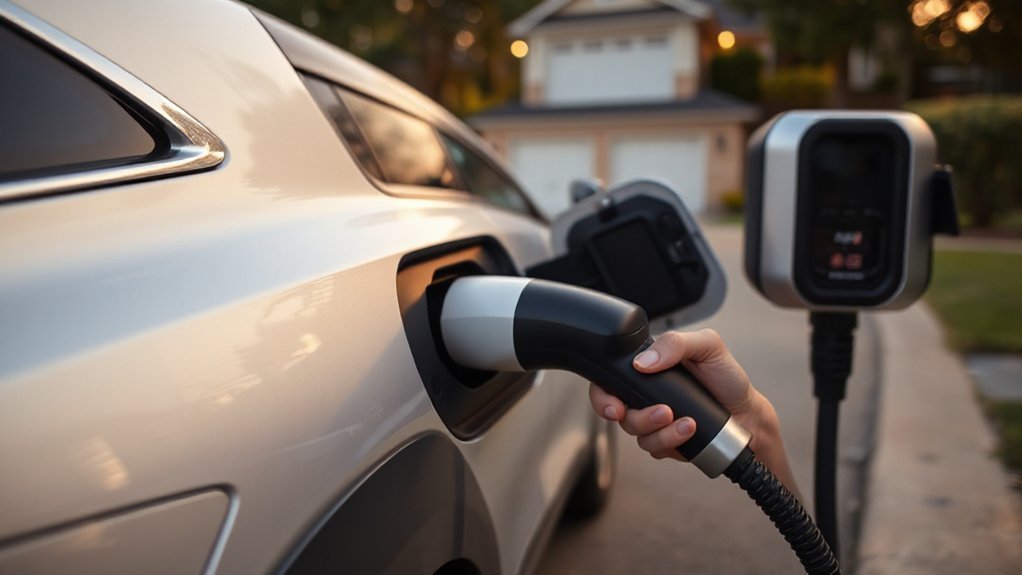
How do you make sure your Hyundai EV mates safely with a Level 2 charger? In North America, your Hyundai’s AC inlet is J1772, so choose an EVSE with a J1772 coupler or a certified adapter. Verify compliance with International Standards (SAE J1772, UL 2594, UL 2231, NEC 625) to guarantee safe signaling, grounding, and GFCI. If you use a Tesla-to-J1772 adapter, confirm it’s UL-listed, rated ≥40 A, and maintains the proximity/pilot signals. Check your owner’s manual for Warranty Implications before using third‑party adapters.
- Confirm full latch engagement and strain relief; never defeat the trigger.
- Inspect pins, seals, and IP rating; keep connectors dry and debris-free.
- Test ground-fault protection at installation and before routine use.
- Avoid damaged or counterfeit adapters.
Smart Features That Make Charging Easier


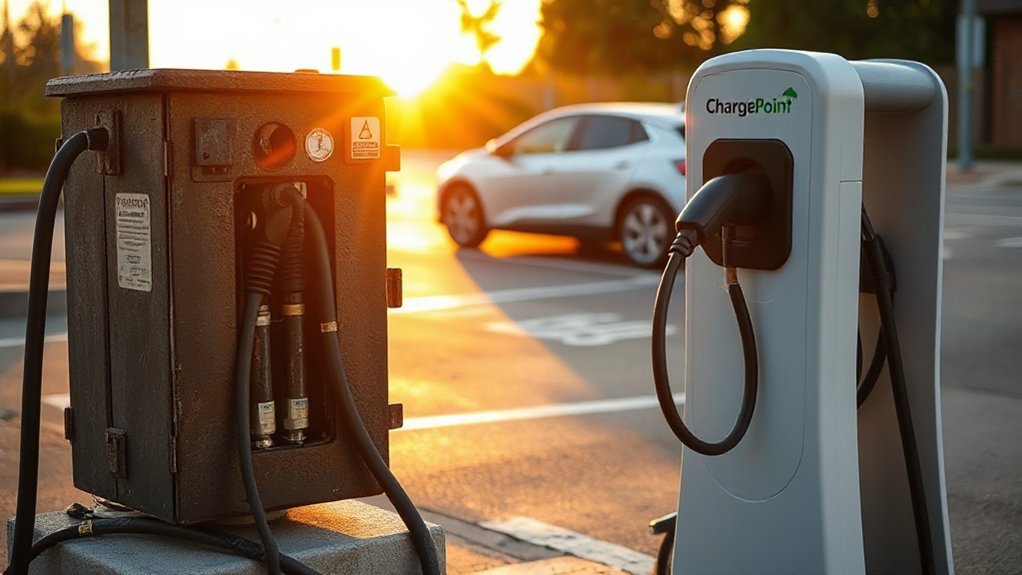

Beyond connector fit and safety listings, smart EVSE features can reduce cost and add protection. You want load management, scheduled charging, and user authentication. Use Wi‑Fi or Ethernet for firmware updates and secure control. Demand-response integration lets you follow utility rate signals. Voice Control streamlines start/stop without handling the app when hands are full. Smart Notifications alert you to faults, session completion, and unexpected disconnects, so you can act fast. Set per-user RFID or PIN to prevent unauthorized use.
| Feature | Function |
|---|---|
| Scheduled charging | Aligns with off-peak rates; caps start/stop windows |
| Load sharing | Divides amperage safely across two or more EVs |
| Fault alerts | Pushes Smart Notifications for GFCI trips or overcurrent |
| Access control | RFID/PIN authenticates users; logs sessions |
| Voice Control | Hands-free commands; confirms state speaker |
Outdoor Readiness, Safety Ratings, and Certifications

Why risk nuisance trips and corrosion outside? Choose a Level 2 charger rated for outdoor duty. Verify its NEMA enclosure type and Ingress Protection (IP) code; IP65 or better resists jets and dust. Confirm a dedicated GFCI or integrated CCID20 per UL 2231. Check UL 2594 listing for EVSE and compliance with NEC 625. If you’re in freezing climates, review operating temperature range and UV-resistant housings. Demand Third party Certifications, not self-declarations. Document installations with photos and keep manuals accessible.
- Verify labels: UL Listed or ETL Listed; match model to documentation.
- Choose NEMA 3R/4X or IP65+ enclosures; stainless fasteners and gaskets.
- Size the 240V branch circuit per NEC 625: breaker, wire gauge, and derating.
- Add Type 2 surge protection and bond grounding; torque-check terminations.
Cable Length, Holster Design, and Mounting Options

You’ll pick a cable length (typically 18–25 ft) that reaches your Hyundai’s charge port without crossing walkways, and you’ll maintain the specified bend radius and strain relief per the manufacturer/UL 2594—never use extension cords. Mount the EVSE on a rigid surface with corrosion‑rated hardware, route the cable to avoid physical damage, and manage slack to prevent tripping, in line with NEC 625. Choose a holster that securely locks the J1772/NACS coupler, fits your connector, and sits within an ergonomic/ADA reach range (about 15–48 in) to reduce stress on the cable.
Optimal Cable Length
How long should your Level 2 cable be for a Hyundai EV? Select a length that reaches the charge port with modest slack while avoiding walkways and sharp bends. For most garages, 18–25 feet meets reach needs and stays within typical UL/NEC limits (12–25 ft). Longer cords raise voltage drop and conductor temperature at 40–48 A, so size the circuit appropriately and never use extensions. Keep the connector off the floor and maintain strain relief.
- Measure parking offsets, door swing, and port location for consistent reach.
- Verify listing: UL 2594/2251 cords and connectors, NEMA 3R or better.
- Plan cable routing for tripping avoidance and aesthetic integration.
- Right-sizing supports safer daily use and can improve resale impact.
Document measurements for installer and future adjustments later.
Mounting and Holster Fit
Where should you locate the EVSE and holster so cable length works, the connector stays protected, and people don’t trip?
Mount the EVSE 18–48 in. above finished floor per NEC 625; keep the holster reachable and clear of door swings. Fasten to a stud or listed pedestal, and use NEMA 3R/4 enclosures outdoors. Verify Vehicle clearance for front, rear, or side ports; avoid cable stretch and tripping loops. Choose a holster that captures the J1772 nozzle, shields contacts, and provides strain relief. Route the cable on a dedicated hook; keep it off the ground. Maintain drip loops and a GFCI-protected branch circuit. Plan Aesthetic integration: align with façade lines, conceal conduit in UV-rated raceways, and label disconnect. Provide egress, lighting, and snow/ice standoff zones.
Future-Proofing for Higher Power and Next Vehicles
Planning for higher power and future models means sizing the installation, not just the EVSE. Specify conductor, conduit, and overcurrent capacity for a 60A branch (48A continuous) even if you start with 32–40A. Perform NEC 220 load calcs, apply the 125% continuous-load rule, and leave panel space for a dedicated 2‑pole breaker. Choose outdoor‑rated components, integral GFCI, and surge protection. Favor modular infrastructure and firmware‑updatable units that can support vehicle to grid and bidirectional standards (UL 9741/IEEE 1547) when available.
- Run oversized conduit and a pull string to simplify future cable upgrades.
- Install a junction box and service disconnect within line of sight.
- Specify copper THHN/THWN‑2 conductors with wet‑location ratings.
- Verify Wi‑Fi/Ethernet, OCPP, and replaceable cable design for maintenance later.
Rebates, Tax Credits, and Utility Programs
You can reduce total installed cost by using federal and state incentives for EVSE and permitting when you select NEC-compliant equipment and document code-approved installation. Verify eligibility criteria—UL/ETL listing, ENERGY STAR (where required), hardwired circuit sizing, load calculations, and a licensed electrician—before you buy. Enroll in your utility’s Time-of-Use rate and set the charger or vehicle to charge off-peak to cut operating cost and limit grid stress.
Federal and State Incentives
Before installation, evaluate federal, state, and utility incentives that can offset a code-compliant Level 2 EVSE for your Hyundai. Confirm the federal 30% credit for EVSE and necessary service upgrades, and check stackable state rebates. Document Eligibility requirements: UL-listed charger, permitted work, licensed installer, and NEC-compliant wiring. Track Application deadlines, pre-approval needs, and required paperwork (permit, inspection, itemized invoice). Retain serial numbers, photos, and load calculations to substantiate scope and safety. Estimate incentive caps and any taxable effects before signing a contract. Confirm residency, site ownership, and meter status before you apply online.
- Verify qualified equipment lists and approved models.
- Obtain written utility or agency pre-approval before purchase.
- Schedule final inspection promptly to trigger rebate payment.
- Submit complete applications within the window; keep confirmations.
Time-of-Use Rates
Why enroll in a Time-of-Use (TOU) rate for home charging? You shift load to cheaper, lower-demand hours, maximizing off peak advantages and reducing grid stress. Pair TOU with a Level 2 charger that supports scheduled charging and UL-listed components. Verify conductor sizing, GFCI protection, and breaker ratings per NEC 625.
| Plan Type | Typical Off-Peak Window | Notes |
|---|---|---|
| TOU-EV | 11 pm–7 am | Lowest kWh cost |
| TOU-Whole Home | 9 pm–6 am | Broader coverage |
| Critical-Peak | Utility signaled | Avoid events |
Account for seasonal pricing and weekend exceptions in your utility’s tariff. Enroll through your utility’s portal, then set your Hyundai app or charger to off-peak. Combine TOU with rebates, tax credits, and demand-response incentives to lower total cost safely. Confirm utility meter compatibility and retain documentation for inspections and audits.
Cost Breakdown, Sizing Examples, and Installer Tips
Most installations hinge on three factors: cost, correct circuit sizing, and code-compliant workmanship. Expect hardware at $400–$800, labor at $600–$2,500, and potential panel upgrades at $1,500–$3,000. Use Financing Options and incentives to offset costs; weigh Warranty Considerations on the EVSE and labor. Size the circuit at 125% of continuous load per NEC 625/210. For examples: 32A EVSE → 40A breaker; 40A → 50A; 48A → 60A. Verify conductor ampacity per NEC 310.16 and 75°C terminations. Choose hardwired units for 48A circuits, and verify breaker AFCI compatibility with manufacturer documentation first.
Costs, correct sizing, and code-driven workmanship define reliable EVSE installations
- Pull a dedicated, GFCI-protected circuit; permit and inspect every job.
- Perform a dwelling load calculation before adding 40–60A.
- Use NEMA 3R enclosures outdoors; label disconnects.
- Torque lugs to spec; bond and test before energizing.
Conclusion
Now you can spec a Level 2 EVSE with confidence: match EVSE amps to your Hyundai’s onboard charger, verify SAE J1772, and size conductors and breakers per NEC’s 125% continuous-load rule. Choose UL/ETL-listed gear, weather-rated enclosures, and smart scheduling to exploit TOU rates. Pick plug-in or hardwired to fit your panel. Future-proof to 48 A where feasible. One image: a 9.6 kW charger adds roughly 30 miles per hour—if installed safely by a qualified electrician.