You could spend $100k or $800k—and both can be smart, depending on fees ($25k–$75k), charger mix, utility make‑ready, and site prep. You’ll model demand charges, networking, maintenance, and insurance to target sub‑6‑year payback, but utilization risk and permitting delays can sink returns. NEVI grants, federal credits, and financing can change IRR by double digits. Here’s how to stack incentives, structure debt, and stress‑test cash flow before you commit…
Key Takeaways
- Total upfront investment per site $75k–$500k+, including franchise fee $25k–$75k, hardware, site work, utility make‑ready, permits, and software.
- Ongoing costs: maintenance 2–4% of hardware, networking/cyber $23–$75 per port/month, insurance $1.5k–$4k/year, demand charges can be 20–50% of bills.
- Franchise economics: royalties 5%–8% and marketing 2%–4%, but brand traffic can lift sessions 20–40% and lower customer acquisition 50–70%.
- Financing and incentives (2025): stack federal credits, NEVI/state grants, and utility programs to cut capex up to ~50%; mind Buy America and prevailing wage compliance.
- Performance targets: ≥98% uptime, DCFC breakeven 12–18% utilization, payback under 6 years with >15% IRR; negotiate rent, demand‑charge mitigation, and revenue‑share caps.
What Drives the Upfront Cost: Fees, Hardware, Site Prep, Utilities, Permits, Software
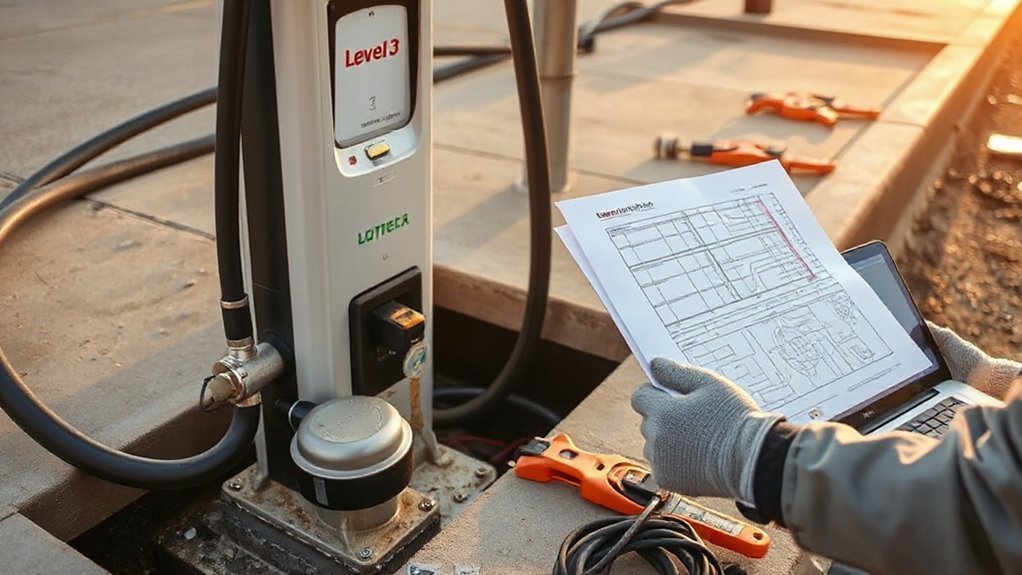
Map the big levers first: total upfront for an EV charging franchise typically spans $75,000–$500,000+ per site, driven by (1) franchise and licensing fees ($25,000–$75,000), (2) hardware—Level 2 at $3,000–$8,000 per port vs. DC fast at $35,000–$150,000 per dispenser, (3) site prep and utilities. You’ll budget civil work based on trenching requirements, conduit runs, bollards, and ADA upgrades; expect $10,000–$150,000 depending on distances and paving. Utility make-ready—transformers, panels, and service—can add $20,000–$200,000, with long lead times a schedule risk. Permits, engineering, and inspections typically run $5,000–$40,000. Commissioning, networking setup, and initial software licenses add $2,000–$15,000. Prioritize equipment warranties and spare parts to de-risk downtime. Model ROI by sensitivity-testing utilization, capex incentives, and construction contingencies. Validate interconnection timelines and easements to avoid costly redesigns later.
Ongoing Operating Expenses: Maintenance, Networking, Insurance, Demand Charges
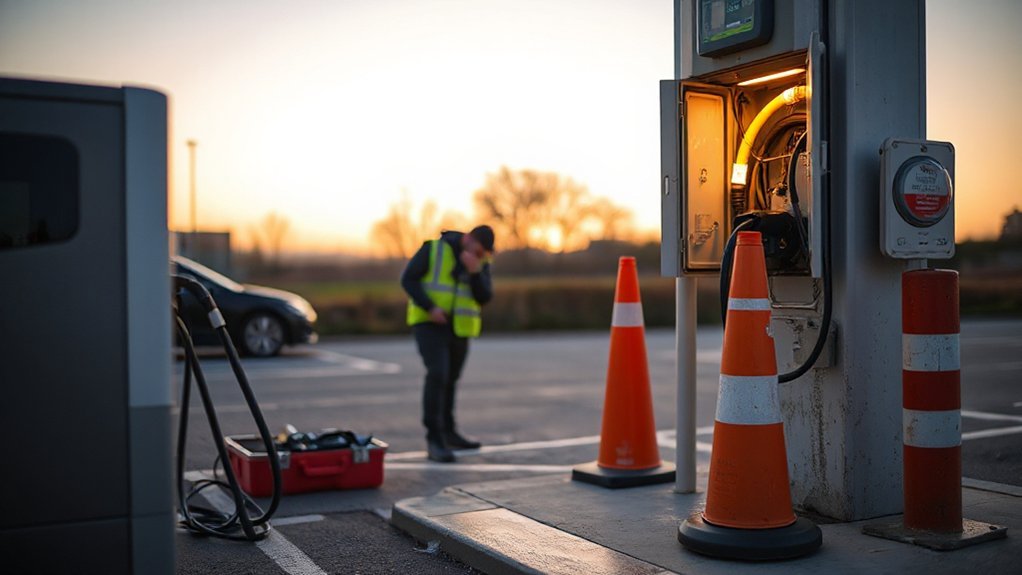
Upfront capex sets the baseline; your cash flow hinges on recurring costs you can forecast and control. Budget 2–4% of hardware value annually for Preventive Maintenance—inspections, connector replacements, filter swaps—plus a 0.5–1% reserve for unscheduled repairs. Networking and software run $18–$60 per port per month, including uptime monitoring and payment processing; add $5–$15 per port for Cybersecurity Upgrades and periodic penetration tests. Insure equipment, liability, and business interruption: expect $1,500–$4,000 per DCFC site per year, higher in coastal or high-traffic locations. Demand charges can equal 20–50% of your utility bill during peak months; mitigate with power limits, staggered charging, or 30–80 kWh storage. Track cost per kWh sold; target sub-$0.12 operating cost to maintain margin at competitive retail rates. Audit invoices monthly to optimize.
Franchise vs. Independent: Cost Structures, Control, Brand, Obligations
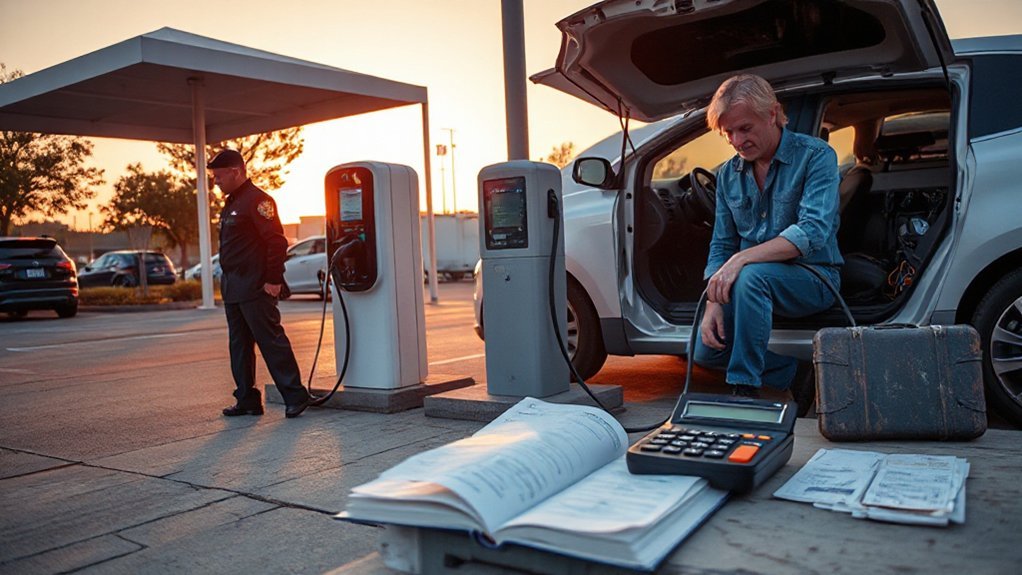
You’ll weigh upfront and ongoing fees: a franchise often adds a $25k–$75k entry fee plus 5%–8% royalties and 2%–4% marketing, while an independent avoids these but must self-fund software, support, and customer acquisition. You trade autonomy for brand control and obligations—approved hardware/vendors, pricing and promo rules, reporting, and uptime SLAs—which can reduce execution risk but constrain pivots. For ROI, model payback under demand swings and fee escalators: a franchise can speed ramp and trust, whereas an independent needs more marketing spend and working capital to close the gap.
Upfront and Ongoing Fees




How do the numbers compare when you buy into a franchise versus go independent? Expect higher upfront fees with franchises ($25k–$75k) plus build-out, but you’ll trade that for negotiated hardware pricing and marketing pools. Independents avoid royalties, preserving margin, yet face retail equipment pricing and slower payback. Model total cost of ownership over your contract durations; stress-test cash flow under 10–20% utilization swings and energy price escalation clauses. Target sub-6 year payback and >15% IRR after maintenance, networking, and demand charges.
| Cost Element | Franchise (typical) | Independent (typical) |
|---|---|---|
| Upfront fee | $25k–$75k | $0 |
| Royalties/Net revenue share | 5%–8% | 0% |
| Networking & software | $600–$1,200/port/yr | $300–$1,000/port/yr |
| Maintenance & parts | $1,000–$2,000/port/yr | $1,200–$2,500/port/yr |
Compare net cash yield monthly; sensitivities to downtime and demand charges often ultimately decide which path maximizes ROI.
Brand Control and Obligations
Because brand drives utilization, the real trade‑off is control versus obligations. In a franchise, you accept standardized pricing, hardware specs, uptime SLAs (e.g., 97–99%), and Marketing approvals; in exchange, the network’s app traffic can lift sessions 20–40% and cut customer acquisition cost by 50–70%. You must follow Trademark enforcement, data-sharing, and refurbishment cycles, which can add 1–2% of revenue annually. Independents keep tariff flexibility, dynamic pricing, and vendor choice, but you’ll fund marketing, interoperability, and roaming fees, and risk lower occupancy (30–50% until brand equity matures). Model the ROI: if network demand adds 0.6 sessions/port/day at $0.38/kWh and 28 kWh/session, the uplift can cover royalties; if your site already hits 6+ turns/day, independence may maximize margin and optionality after utility rates and capex recovery.
Financing, Incentives, and Tax Credits: 2025 Programs and How to Stack Them

While upfront capex can strain returns, 2025 financing and incentives can cut your net project cost by 40–80% if you stack them correctly and legally. Start with federal AFV refueling credit (up to 30% per site), NEVI/state grants (up to 80%), utility make‑ready, and bonus depreciation. Apply Grant Stacking rules: avoid double‑counting and basis reductions. Layer SBA 7(a)/504, PACE, equipment leases, green‑bank loans, and Equity Crowdfunding to trim equity. Validate eligibility, prevailing wage, and Buy America. Build a compliance calendar and escrow contingencies to protect IRR.
| Feeling | Financial impact |
|---|---|
| Relief | Capex minus 50% via credits/grants |
| Confidence | Cheaper capital lowers WACC 150–300 bps |
| Caution | Noncompliance claws back awards |
| Urgency | First‑come programs deplete fast |
Document sources, model basis reductions, and lock milestones before equipment orders finalize.
Revenue Models, Utilization Assumptions, and Payback Timelines

Although EV charging revenue seems straightforward, your returns hinge on pricing structure, utilization ramp, energy costs, and uptime. Model revenue as price x sessions x kWh; run sensitivities. Early months run 5–15% utilization, rising to 20–35% by year 2 with strong reliability. Customer segmentation matters: commuters value time, fleets predictability, travelers availability. Incorporate seasonal demand, tariff spikes, and downtime risk.
- Pricing: time-/kWh-based, idle fees, membership; target blended ARPU $8–$18 DCFC, $2–$6 Level 2.
- Utilization: breakeven commonly ≥12–18% DCFC; each +5% can cut payback by 6–9 months.
- Energy costs: demand charges can consume 25–45% of revenue; mitigate via load management.
- Uptime: 98% vs 94% can shift EBITDA margin by 5–8 pts.
- Payback: DCFC 3–6 years; Level 2 4–8, assuming capex, incentives, and 2–3% customer churn.
2025 Benchmarks, Sample Budgets, Location ROI Drivers, and Negotiation Tactics

Anchor your plan to five benchmarks: installed capex per port ($180k–$350k for a 150 kW DCFC; $5k–$15k for Level 2), cost per kW ($1,200–$2,400 DCFC), target utilization (DCFC 15–30% by year 2; Level 2 8–15%), uptime (≥98%), and site rent as a share of revenue (≤8–12%). Build sample budgets: a two-port 150 kW site at $520k–$700k all-in; utility make-ready 10–25%; O&M 3–5% of revenue; networking $200–$400/port/month. Stress-test cash flows at ±5¢/kWh pricing and ±5% utilization. Prioritize locations with strong local demographics, a high walkability score, grocery/retail anchors, 24/7 lighting, and power capacity. Negotiate: rent step-downs below 10% until utilization exceeds 20%, utility demand-charge mitigation, revenue-sharing caps, cure periods on uptime SLAs, and equipment rebates assignable to you. Include termination rights and exclusivity radius protections.
Conclusion
You’re ready to model this like an infrastructure mini-P&L. Budget $25k–$75k for franchise fees and $75k–$500k+ per site, then plan OPEX for maintenance, networking, insurance, and volatile demand charges. Stack NEVI, 30C, state rebates, and low‑cost debt to cut capex 30%–70% and target 15%–25% IRR with 6‑year payback at 10%–20% utilization. Stress‑test tariffs, uptime SLAs, and make‑ready risks. Negotiate revenue guarantees, trenching caps, and support so cash flows scale like lanes opening on a freeway.