Most franchisors require 10–20 year site control and a utility capacity check before they’ll sign you. You’ll also model utilization, layer incentives (e.g., NEVI), and review FDDs to validate fees, SLAs, and support. Banks usually expect 20–30% equity and permits can add months if zoning and interconnection aren’t planned early. If you want bankable unit economics and a compliant launch, the order you execute next will decide your ROI…
Key Takeaways
- Assess market and site feasibility: EV density, AADT corridors, 20–45 min dwell, utility capacity ≥1–2 MVA within 300 ft, zoning and flood risk.
- Compare franchisors: audited FDD Item 19, uptime SLAs, data security, exclusivity/territory terms, fees, termination triggers, and performance thresholds.
- Secure site control and host agreements: long-term lease, easements, signage, access, O&M allocation, revenue share floors, and non‑disturbance.
- Build pro forma and financing: capex/opex, incentives, tariffs and demand charges, depreciation, utilization scenarios, lender covenants, and a 10–15% contingency.
- Plan permits, interconnection, and delivery: permit matrix, AHJ approvals, utility make‑ready and transformer placement, schedule commissioning, and document as‑builts.
Assess Local EV Demand and Site Feasibility

How will the site make money while staying compliant? Start by quantifying local EV adoption: registered EVs per ZIP, annual growth, charger-to-EV ratio. Map Commuter Flows using DOT traffic counts and dwell times; target corridors with high AADT and 20–40 minute stops. Evaluate Retail Proximity: groceries, gyms, and quick-service within 200–500 feet to monetize wait time via parking, upsells, and partnerships. Model utilization: projected sessions/day, kWh/session, tariff rates, demand charges, and uptime SLAs. Stress-test ROI with 15–30% sensitivity on energy costs and throughput. Verify zoning, ADA access, fire code clearances, and utility interconnection timelines and fees. Prioritize sites with three-phase capacity and future-proof conduit. Score candidates objectively, then secure LOIs, data-sharing rights, and signage easements. Document assumptions and benchmarks to justify capital allocation decisions.
Compare Franchise Models and Evaluate Franchisors

Compare ownership and revenue‑sharing models by quantifying your capex, opex, fee stack, and expected EBITDA, then stress-test payback under utilization scenarios (e.g., 15%, 25%, 40%). Evaluate franchisors for transparency and compliance: audited FDD Item 19, uptime SLAs, data-security controls, and adherence to the FTC Franchise Rule. Scrutinize territory and exclusivity terms—radius, encroachment protections, performance thresholds, and termination triggers—to protect unit economics and prevent cannibalization.
Ownership vs. Revenue-Sharing
While both models can scale your EV charging footprint, ownership prioritizes control and asset value, whereas revenue-sharing emphasizes capital efficiency with contractual constraints. You’ll quantify capex, payback, and risk. Ownership gives depreciation, stronger collateral, and clearer liability allocation; revenue-sharing lowers upfront spend but adds fee leakage and governance reviews. Model cash flows after incentives and tax implications, including ITC timing and state rebates.
| Dimension | Ownership | Revenue-Sharing |
|---|---|---|
| Capex/ROI | High capex; 14–20% IRR with 70% utilization | Low capex; 8–14% IRR, sensitive to fee splits |
| Opex/Control | You set pricing, uptime SLAs, vendors | Operator manages; you audit KPIs |
| Compliance/Risk | You carry permits, warranties, cyber | Shared duties; require indemnities, audits |
Negotiate data access, tariff pass-through, and minimum uptime to protect sustainable returns. Validate metering accuracy, settlement, and reporting controls.
Territory and Exclusivity Terms
Because territory and exclusivity terms drive unit economics, you should quantify how encroachment risk, development schedules, and carve‑outs affect utilization and IRR.
Model station density by zip code, traffic counts, and charger mix to estimate session capture rates. Require a protected radius or minimum distance, plus limits on corporate or third‑party installations within your area. Tie development schedules to objective milestones; negotiate remedies for franchisor delays that degrade NPV. Define carve‑outs narrowly (fleet, highway corridors, utility partnerships) and cap their share of traffic within the territory. Scrutinize Renewal Clauses: duration, fee escalators, performance thresholds, and reversion risks. Specify data access, audit rights, and geo‑fencing enforcement, with liquidated damages for breaches. Detail Dispute Resolution steps, venue, and interim relief to stop encroachment promptly. Align incentives.
Understand Costs, Incentives, and Unit Economics

Quantifying every cost driver up front anchors ROI and keeps you compliant. Build a pro forma that itemizes hardware, software, make-ready electrical work, networking, permitting, insurance, and franchise fees. Use Depreciation Modeling for chargers, transformers, and civil work to align book/tax schedules with IRS MACRS rules and bonus depreciation where eligible. Layer Maintenance Forecasting for parts, labor, firmware, and uptime SLAs to estimate lifecycle OPEX.
Model revenue by connector and dwell time: sessions/day, kWh/session, price/kWh, idle fees, subscriptions, and roaming. Incorporate payment processing take rates, utility tariffs, demand charges, and time-of-use arbitrage. Apply federal and state incentives as contra-capex or refundable credits, with clawback assumptions. Stress-test utilization (10–40%) and uptime (97–99.9%) to confirm breakeven, IRR, and covenant coverage. Document assumptions to satisfy audit trails.
Secure Locations, Host Agreements, and Site Control

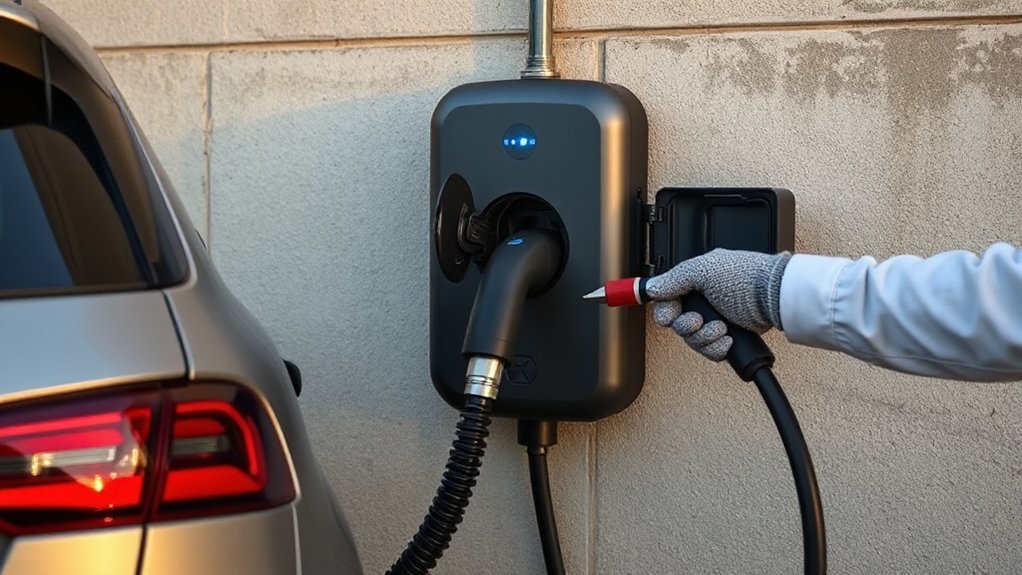



You apply strict site selection criteria—traffic counts, dwell time, grid capacity, utility rates, and amenity proximity—to maximize utilization and revenue. You negotiate host leases with clear CAPEX/OPEX allocation, uptime SLAs, revenue-share tiers, term/renewal, easements, and parking enforcement to protect ROI. You secure site control with documented compliance on zoning, ADA, interconnection, permits, easements, and right‑of‑way to cut risk and financing delays.
Site Selection Criteria
When selecting sites for an EV charging franchise, prioritize locations that maximize throughput and minimize risk while meeting code and contractual requirements.
You evaluate AADT, turn-in access, visibility to drive sessions per stall. Verify zoning, ADA path-of-travel, setbacks, and bollard requirements. Confirm Safety lighting, cameras, and line-of-sight to reduce liability and boost utilization. Assess Drainage considerations, snow storage, and plow paths to protect equipment. Validate easements, and site control obligations before design. Check transformer proximity, current limits, and utility interconnection timelines; model capex, O&M, and uptime SLAs to hit IRR targets. Favor pull-through layouts for trailers and wayfinding.
| Metric | Target |
|---|---|
| Avg daily vehicles | >15,000 AADT |
| Dwell time | 20–45 min co-located amenities |
| Utility capacity | ≥1–2 MVA within 300 ft |
| Flood risk | Outside 100-year; proven drainage |
Host Lease Negotiation
Because site control underpins financing and construction, negotiate host agreements that lock in rights, timelines, and economics while de-risking utility and permitting uncertainty.
Open with a BATNA Assessment: identify two or more viable sites, benchmark rent per stall, utility upgrade costs, easement needs, and expected dwell-time revenue. Define term (10–20 years), extension options, and step-up rent caps tied to CPI. Secure non-disturbance, access, and signage rights; require host cooperation for interconnection, easements, and permits. Use Concession Planning to trade cosmetic items (landscaping, branding zones) for core economics (exclusive EV rights, make-ready ownership, revenue share floors). Allocate O&M, uptime SLAs, and liquidated damages for outages. Mandate ADA, fire code, and utility tariff compliance. Add relocation and buyout clauses with pre-agreed formulas and clear dispute resolution.
Navigate Permits, Zoning, and Utility Interconnections
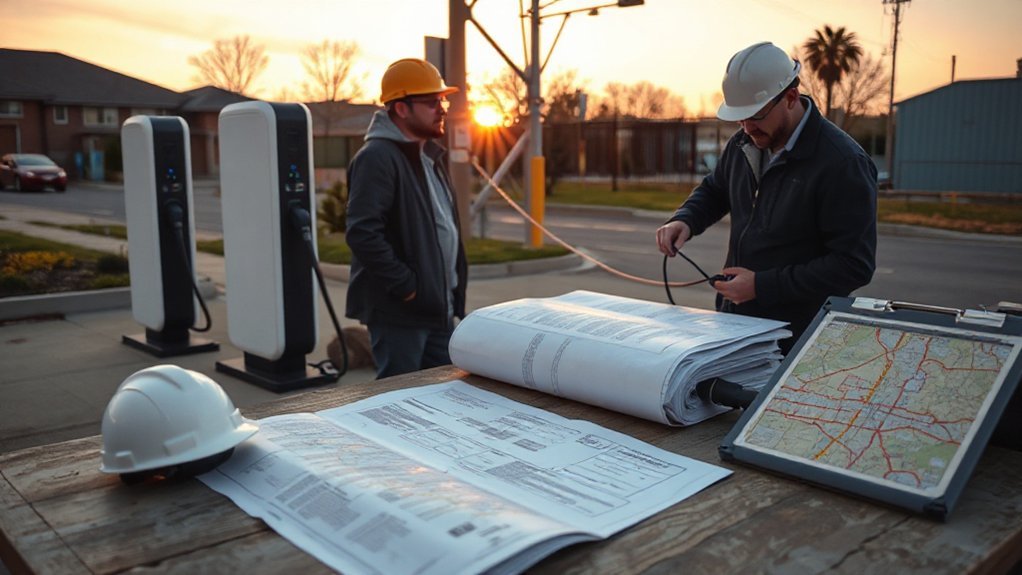
Kick off due diligence by mapping permit paths, zoning constraints, and utility interconnection lead times—these three drivers can swing CAPEX by 20–40% and push go‑live 3–12 months. Build a permit matrix by jurisdiction, fees, review steps, Municipal timelines, and submittal requirements. Verify allowed use, setbacks, screening, lighting, and ADA accessibility; if conditional, schedule hearings and buffer 60–120 days. Pre‑coordinate with the utility on capacity, transformer placement, make‑ready scope, and service upgrades; request preliminary design and firmed interconnection dates. Sequence civil, electrical, and trenching permits to compress the critical path. Lock Inspection coordination with AHJs and the utility to avoid rework. Track milestones, carry contingency (10–15%), and gate spend on approvals. Time saved reduces IDC, accelerates revenue, and protects franchise ROI while limiting change orders.
Choose Hardware, Software, and Network Providers

While options look similar on paper, you’ll lock in 7–10 years of ROI, uptime, and compliance with your hardware, software, and network choices. Audit certification status (UL, ENERGY STAR, ISO 15118), uptime SLAs, OCPP support, and total cost per kWh delivered. Prioritize open networks with transparent API Licensing to avoid vendor lock‑in and enable fleet, loyalty, and billing integrations. Evaluate Firmware Security practices, over‑the‑air update cadence, and vulnerability disclosure. Compare warranties and spare‑parts logistics. Demand metering accuracy (ANSI C12), payment compliance (PCI, ADA), and proven remote diagnostics.
- Benchmark uptime: target 98–99.5% with SLA penalties.
- Verify OCPP 1.6/2.0.1 certification, field-tested interoperability.
- Require ISO 15118 Plug&Charge and OCPI roaming readiness.
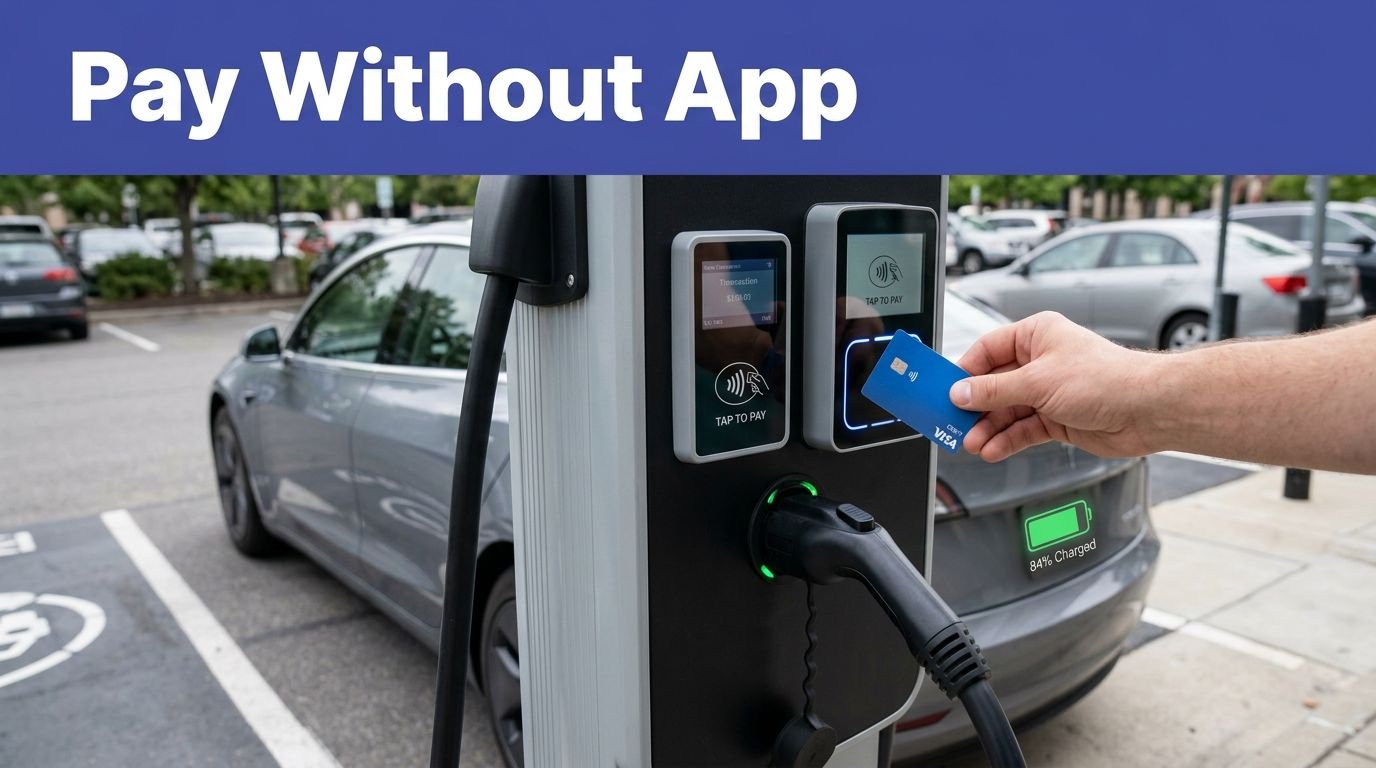
- Validate PCI P2PE, EMV, and ADA-compliant payment flows.
- Analyze dashboard KPIs: session success, kWh, gross margin.
Plan Financing, Procurement, and Installation

Sequence financing, procurement, and installation to minimize time-to-revenue and de-risk compliance. Lock capital first: combine franchisee equity (20–30%), green loans, and incentives; model payback under baseline, +20% utilization, and 10% capex overrun. Align lender covenants with permit milestones and utility make-ready windows. Set a Project Timeline with critical path: utility design, civil works, commissioning, inspections. Bid competitively; demand Equipment Warranties tied to uptime SLAs and parts availability. Use bonded contractors and require as-builts and AHJ sign-offs.
| Control | Target |
|---|---|
| Permit lead time | 30–90 days |
| Utility upgrades | 8–24 weeks |
| Procurement SLA | 4–8 weeks |
| Installation duration | 5–10 days |
| Uptime acceptance | ≥98% first 30 days |
Stage deliveries just-in-time to reduce carrying costs; schedule commissioning with network provider and utility to hit revenue day-one. Validate ADA, signage, and metering.
Launch Operations, Pricing, and Customer Support

With permits closed and commissioning complete, you move to go‑live—activate operations, set evidence‑based pricing, and stand up support that protects uptime and revenue. Configure charge management software, SLAs, and alerting for OCPP, metering, and payment integrity. Use cost-plus models: energy, demand charges, network fees, and site O&M, then A/B test dwell-based or dynamic rates within regulatory caps. Execute staff onboarding, helpdesk setup, and incident runbooks. Audit ADA access, signage, and PCI/EMV compliance; document everything.
- Set hours, escalation matrix, 24/7 coverage; ASA <30s, FCR >80%.
- Target uptime 97–99%, MTTR <4h; spare parts kits, swap policy.
- Harden payments: tokenization, fraud scoring, chargeback playbooks, refund SLAs targets.
- Schedule preventive maintenance 30/90/180‑day; torque checks, firmware, calibration logs tracking.
- Build data pipelines: meter‑utility reconciliation, per‑port margins, anomaly alerts reports.
Market Your Stations and Optimize Ongoing Performance

After go‑live, you monetize through targeted demand generation and continuous optimization, tying every tactic to measurable lift and compliant operations.
Define Brand positioning by segment: commuters, fleets, and retail hosts. Use location data, session heatmaps, and conversion funnels to allocate budget toward high-ROI sites and time windows. Launch Referral incentives, loyalty pricing, and app prompts to lift repeat sessions. Run A/B tests on signage, landing pages, and bundled parking offers; keep winners and retire waste. Track CAC, utilization, session revenue, uptime, and NPS; set weekly targets and alert thresholds. Coordinate with utilities on demand charges, and publish transparent pricing to meet state UDAP, ADA, and privacy rules. Automate firmware, payment, and receipt compliance checks. Report results to partners monthly and reinvest in what scales.
Conclusion
So you’ll chase kilowatts, not dreams: you’ll screen sites by traffic counts, dwell times, and transformer capacity, then sign 10–20‑year host leases because nothing says agility like long terms. You’ll model capex, incentives, and 20–40% utilization to hit a 12–18% IRR, provided uptime stays above 97% and SLAs bite. You’ll love permits, NEC compliance, and utility queues, because that’s how you de-risk cash flow. Launch, iterate pricing, and let data—not hope—compound returns. Over time, compliantly.