You want precise charge times, not guesses. This calculator computes required energy (kWh) from usable capacity and SOC change, then limits power by charger/vehicle kW, taper bands, efficiency (≈85–95%), and temperature. It compares Level 1/2 vs DC fast, models degradation, and plans TOU windows. You’ll see why 20–80% can charge 2–4× faster than 80–100%, and when a 7.2 kW EVSE beats a “50 kW” station—if you know what to input next.
Key Takeaways
- Enter usable battery kWh, current and target SoC, charger rating, vehicle limit, and losses; calculator computes energy needed.
- Time = required_energy ÷ effective_power, where effective_power = min(station, vehicle) × efficiency × taper duty factor.
- Taper is modeled: constant power until ~50–70% SoC, then linear decline; integration improves estimates versus simple averages.
- Supports Level 1, Level 2, and DC fast; typical results: 60 kWh 10–80% takes ~6–8 h (L2) or ~20–40 min (DCFC).
- Accounts for temperature and thermal derating; shows formulas, intermediate values, and handles invalid inputs and divide-by-zero errors.
How the EV Charging Time Calculator Works

While the interface looks simple, the calculator applies a clear energy-power relationship to estimate charge duration. It divides required energy (kWh) by effective charging power (kW) to produce time (h), then converts to minutes as needed. It models efficiency η (0–1), onboard and station power limits, and thermal derating. For taper, it integrates a piecewise power curve: constant-power to a threshold, then a linear decline to a minimum. You can enable Algorithm Transparency to view formulas, constants, and unit conversions. The engine validates units, bounds parameters, and propagates significant figures. Error Handling catches negative or non-numeric entries, infeasible power, and divide-by-zero, then returns actionable messages. It logs assumptions, exposes intermediate values, and supports deterministic reproducibility via versioned calculation profiles. Exports machine-readable results for automation.
Key Inputs: Battery, State of Charge, and Target

Building on the model mechanics, the calculator requires three primary inputs: battery parameters, starting state of charge (SoC), and target SoC. You specify usable capacity (kWh), Battery Chemistry (e.g., NMC, LFP), and thermal constraints that cap charge power. You set your current SoC (%) and a desired SoC target (%). The engine converts percent to energy with usable_kWh × (target−start)/100, then applies taper curves derived from Battery Management System data and Battery Chemistry limits.
You can refine accuracy with SOC Calibration: align dashboard SoC with true pack energy via recent full charge or deep discharge logs. You may also input reserve buffers and degradation (kWh lost) to adjust effective capacity. The model outputs required energy (kWh) and time under the active power profile assumptions.
Charger Types: Level 1, Level 2, and DC Fast
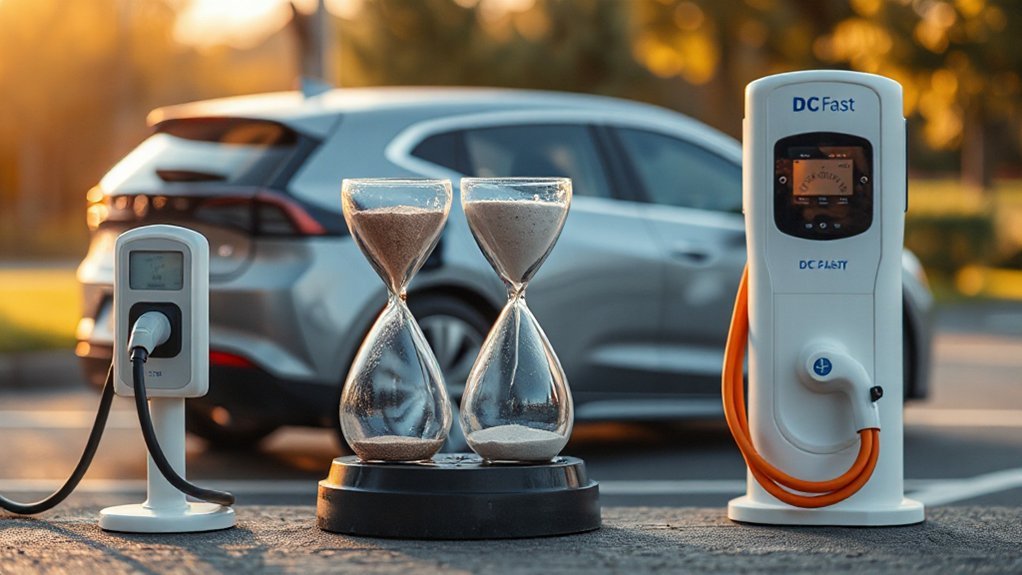
Because charger class bounds the power you can draw, the calculator maps your session to Level 1, Level 2, or DC fast parameters. Level 1 (120 V, 12–16 A) delivers ~1.4–1.9 kW; you’ll add roughly 3–5 miles of range per hour, suitable for overnight. Level 2 (208–240 V, 16–80 A) yields ~3.3–19.2 kW; expect 12–60 miles per hour, ideal for home or workplace. DC fast supplies 50–350 kW (often bus-limited by your car’s max kW); you can add hundreds of miles in ~20–45 minutes. You select the highest class available and the tool constrains power to the lesser of station rating and vehicle acceptance. Connector standards, reliability, and Design Aesthetics influence user preference and Market Adoption. Install capacity and tariffs also guide practical choice.
Accounting for Efficiency, Temperature, and Charging Curves

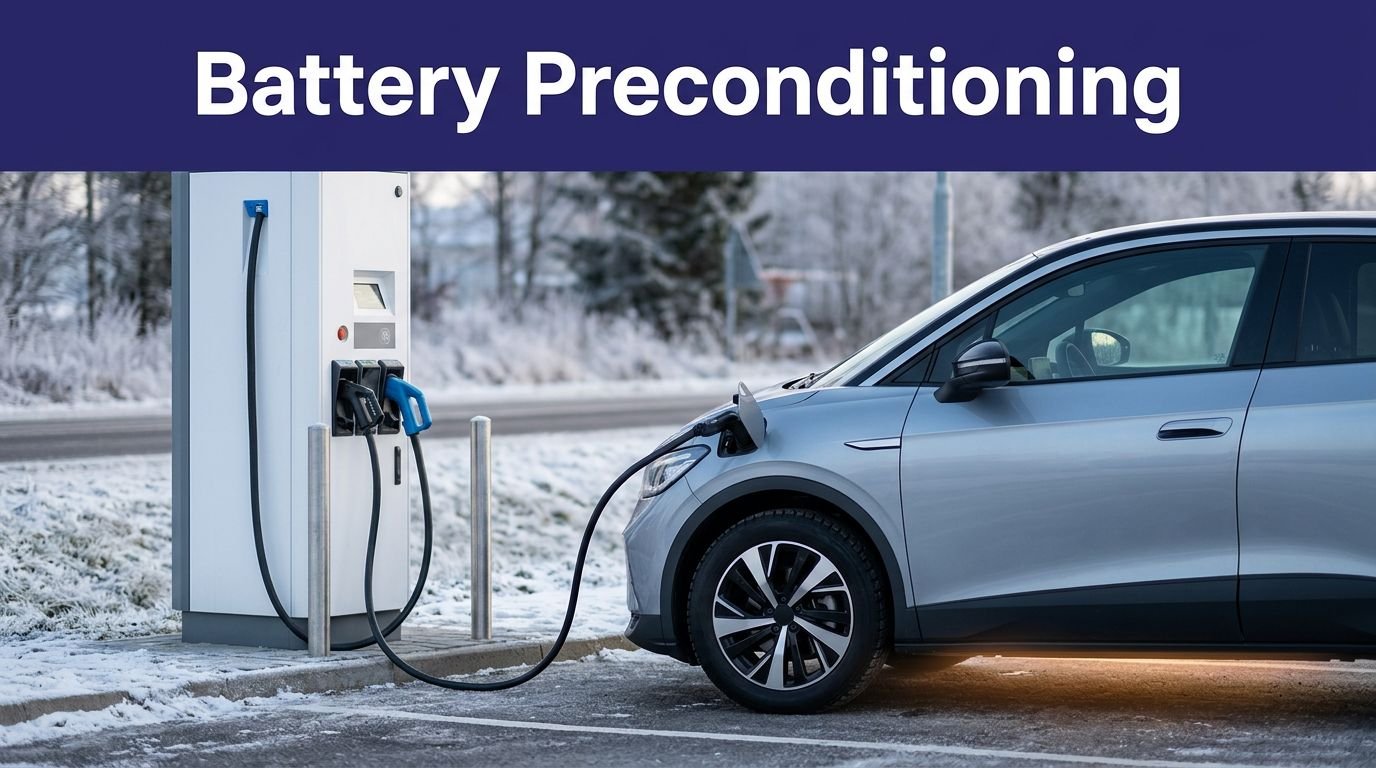
Power class sets the ceiling, but real charging time depends on losses, temperature, and the battery’s taper curve. You should model DC input vs usable kWh: time ≈ target_kWh / (charger_kW × η). η ranges 0.85–0.95, falling with high current or cold cells. Temperature increases internal resistance; at 0°C, expect 10–30% slower rates unless preconditioned. Above 35°C, thermal limits cut power. Taper begins near 50–70% SoC; current steps down to protect longevity, driven by Cell chemistry and pack voltage ceilings. Use Curve modeling (piecewise or logistic) to integrate power over SoC bands, not a flat rate.
| Factor | Typical impact | Mitigation |
|---|---|---|
| Efficiency η | −5–15% power | Warm pack, moderate C-rate |
| Temperature | −10–40% at extremes | Precondition, cooling |
| Taper/SoC | Power halves by 80% SoC | Stop early; partial charges |
Estimating Home Vs Public Charging Times

You’ll compare charger power levels: home Level 1 ≈1.2–1.9 kW, Level 2 ≈7–11 kW, public DC fast ≈50–350 kW. For a 60 kWh pack from 10–80%, you’d expect ≈6–8 h on Level 2 (7–11 kW, ~90% efficiency) versus ≈20–40 min on a 150 kW DC fast charger (average 70–120 kW). At public sites, you’ll factor vehicle max acceptance, SOC taper, temperature management, and power sharing, which reduce effective speed below the nameplate rating.
Charger Power Levels
A wall outlet delivers about 1.2–1.4 kW (Level 1), a typical home Level 2 unit delivers 7.2–11.5 kW, and public DC fast chargers supply 50–350 kW. Manufacturing trends push higher-power, bidirectional-ready hardware while tightening safety standards (thermal sensing, ground-fault, isolation) to manage rising currents.
You’ll estimate time as energy_needed (kWh) / net_power (kW), where net_power = charger_power × efficiency × duty factor (to account for taper). Net power is capped by the AC charger (often 6.6–11 kW) or the pack’s DC acceptance curve. Vehicle operating voltage (400 vs 800 V) and current limits set DC charging power = V×I; Stations cap at 200–500 A. Cold packs and high SOC reduce power. Circuit ratings matter: 120 V/15 A (~1.4 kW), 240 V/40–60 A (7.7–11.5 kW).
Typical Home Charge Duration

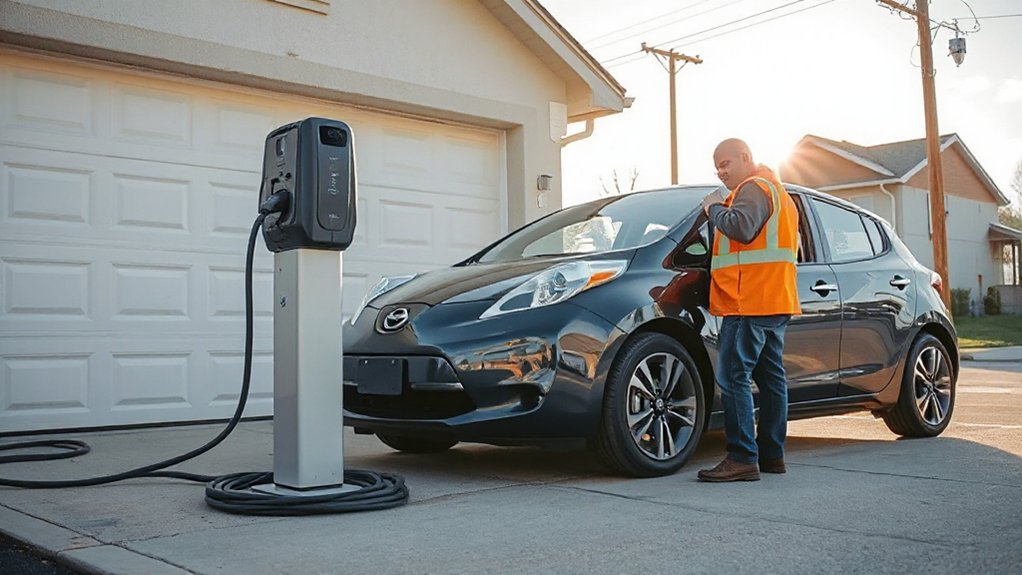


In practice, home charging spans overnight rather than minutes: a typical Level 2 setup (240 V, 40–60 A; 7.7–11.5 kW nameplate) delivers ~5–9 kW net after efficiency and taper, so a 60–80 kWh pack from 20–80% (36–48 kWh) takes ~4–9 hours; Level 1 (120 V/15 A; ~1.2–1.4 kW nameplate, ~0.9–1.1 kW net) stretches the same window to ~18–36 hours.
If you use 250–350 Wh/mi and drive 30–50 miles, that’s 7.5–17.5 kWh, or ~1–3 hours on Level 2, ~8–18 hours on Level 1. Add a buffer for cold (+10–30%) and taper at high SOC. Align habits to Family Preferences and Weekend Patterns: top up to 70–80% on weeknights, schedule 90–100% only before trips. A 200–300 mi EV at 70% SOC leaves 140–210 mi by morning.
Public Station Speed Factors
Home charging sets a baseline; public stations swing from 6–19 kW AC to 50–350 kW DC, but your car’s max charge rate, SOC window, and temperature govern what you actually get. To estimate time, divide usable battery kWh to add by effective power. Effective power = min(station rating, vehicle limit) × availability factor. Expect 0.9–0.98 on AC, 0.6–0.85 on DC due to taper from ~20–80% SOC. Cold packs can cut power 30–70% until warmed. Site congestion, shared cabinets, derating may halve output. Authentication delays, cable cooling cycles, and preconditioning time add minutes. Example: adding 40 kWh on a 150 kW charger at 0.7 efficiency yields ~40/(150×0.7)=0.38 h ≈ 23 min plus 3–8 min overhead. Compare home: 40 kWh at 9 kW ≈ 4.4 h.
Step-by-Step Guide to Using the Calculator

How do you run the EV Charging Time Calculator efficiently? Complete user onboarding: confirm data privacy notice, then proceed. Enter battery capacity (kWh), current state of charge (%), and target state of charge (%). Input max AC/DC charge rate (kW) for your vehicle and station. If applicable, set taper threshold (% SOC) and reduced power (kW). Choose charging losses (%, typically 8–15%). Select temperature adjustment if offered. Press Calculate.
Review outputs: energy required (kWh) = capacity × (target−current)/100; effective power (kW) after limits and losses; estimated time (h) = energy/power; time to taper and post‑taper time. Inspect assumptions: connector limit, onboard charger limit, and shared power. Save or export results. Reset to compare scenarios. Don’t enter personally identifiable information. Avoid sharing session identifiers publicly.
Tips to Reduce Charging Time and Costs

Charge during off‑peak TOU windows to cut energy price by 30–60% (e.g., $0.12/kWh vs $0.30/kWh), and set that rate in the calculator. Use higher‑power stations to shrink charge time: moving from 7 kW Level 2 to 150 kW DC fast can drop 20–80% SOC from ~6 hours to ~20–30 minutes, subject to taper limits. In the calculator, you’ll model both by setting station power (kW) and off‑peak $/kWh to minimize total $ and time per added mile.
Charge During Off-Peak
Because utilities discount electricity during off‑peak windows, you can cut charging costs 40–70% and often shorten sessions by avoiding power throttling. Schedule charging for your utility’s TOU low-rate blocks (e.g., 12–6 a.m. or midday solar peaks). Cooler ambient temps and lower feeder load reduce voltage sag, keeping your EV closer to its commanded kW. Enroll in Demand Response to receive bill credits and automated deferment signals. Target Renewable Alignment: charge when wind overnight or solar midday creates surplus; grid congestion falls, and rates drop. Use your EVSE’s scheduler or utility app to automate start times and verify rates nightly accurately.
| Window | Typical rate/impact |
|---|---|
| 12–6 a.m. | $0.08–$0.14/kWh; 5–15% faster vs peak |
| 10 a.m.–2 p.m. | $0.10–$0.16/kWh; solar surplus |
| Shoulder | $0.15–$0.22/kWh; moderate load |
| Peak | $0.28–$0.45/kWh; slowdowns likely |
Use High-Power Stations
When you choose DC fast chargers that meet or exceed your car’s peak acceptance, you minimize session time and often cost. Match station power to your vehicle: if your car peaks at 150 kW, a 350 kW unit won’t speed charging above ~150 kW but can sustain peak longer under load sharing. Prioritize sites with dedicated power modules and low utilization; fewer stalls per cabinet reduces throttling. Prefer stations near highways with robust grid capacity; you’ll see steadier voltage and fewer dips. Monitor taper curves: charge from 10–60% SOC to stay near peak, then depart. Use apps showing live kW, stall occupancy, and pricing. Advocate infrastructure planning that improves urban accessibility, reduces queuing, and increases high-power coverage. This cuts downtime and optimizes trip economics.
Common Vehicle and Charger Limitations

Most EVs charge at the lowest limit among four factors: EVSE max power, the car’s onboard AC charger rating, pack voltage–current limits (V×I), and thermal management. You can hit ceilings quickly: a 7.2 kW EVSE paired with a 6.6 kW onboard charger yields ~6.6 kW. DC fast charging caps at the vehicle’s maximum pack voltage and allowable current; e.g., 400 V × 200 A = 80 kW, regardless of a 150 kW station. Battery temperature gates power; cold or hot packs trigger derates of 20–70%. State of charge tapers power above ~60–80% to protect cells.
Cable and connector specs also constrain current (e.g., 32 A vs 48 A). Station load sharing reduces allocated kW. Warranty Restrictions, charge counters, or Firmware Bugs may limit rates.
Sample Scenarios and Real-World Estimates

Although charging math looks simple (time ≈ energy added ÷ average power), real estimates hinge on scenario-specific averages. For a 64‑kWh pack from 30–80% (32 kWh), on a 7.2‑kW Level 2 at home, you need ~4.5 h assuming 92% efficiency; cold weather (−10°C) can drop average to 5.5 kW, raising time to ~5.8 h. On a 150‑kW DC fast charger, same window averages ~80 kW due to taper, so ~0.4 h. Workplace 6.6‑kW units add ~20 kWh in a 3‑h stay.
Plan buffers for commute variability: ±20% energy swing changes time proportionally. For fleet scheduling at a depot with eight 19.2‑kW posts sharing a 100‑kW circuit, expect ~12 kW average per vehicle; a van needing 40 kWh takes ~3.3 h plus 5–10 min latency.
Conclusion
You’ve seen how the calculator converts usable kWh, SoC targets, charger limits, and taper into a precise time estimate. You can compare L1/L2/DCFC, plan TOU windows, and factor degradation and reserve buffers. Include efficiency, temperature, and vehicle charging curves to avoid optimistic results. One telling stat: above 80% SoC, many EVs cut charge power by 60–80%, doubling time per added kWh. Use scenarios to benchmark home vs public sessions and minimize cost per mile overall.