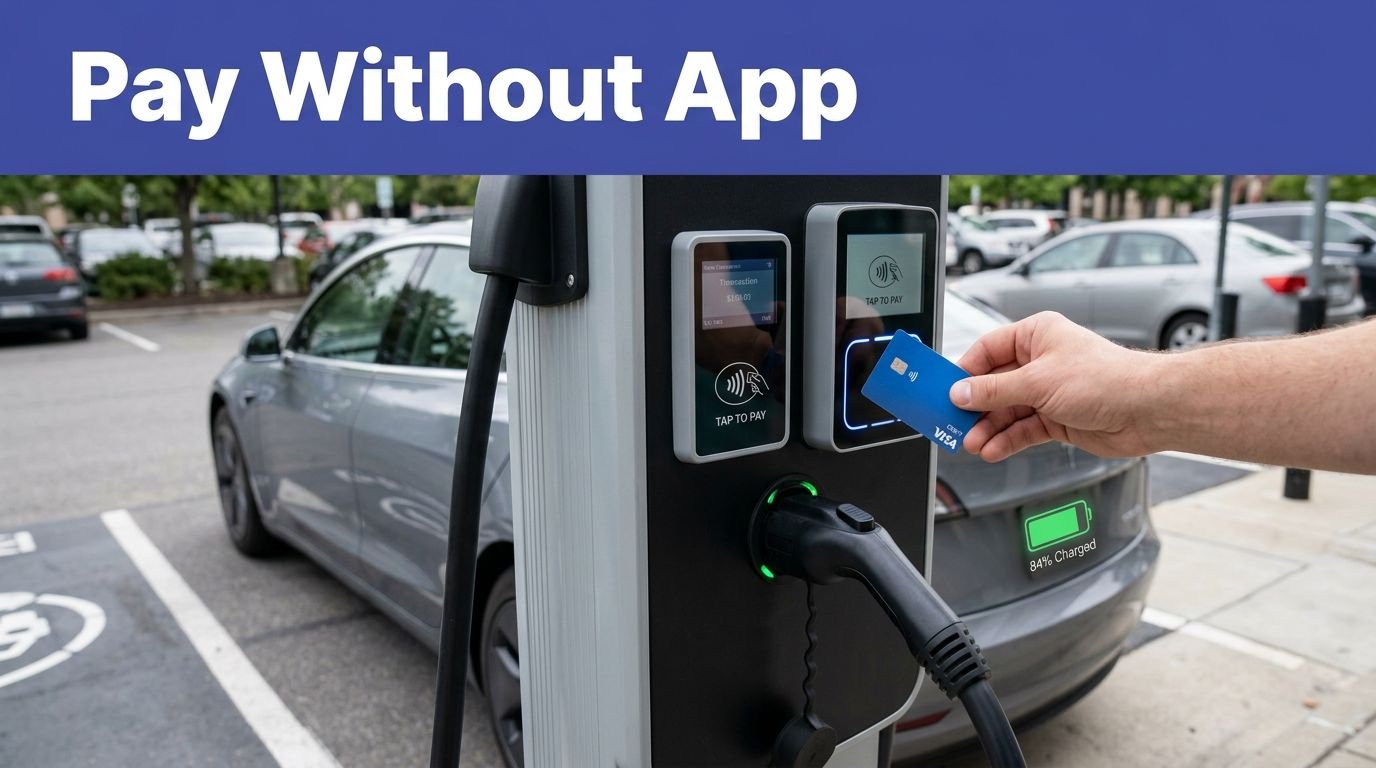
When range gets tight, you need a plan grounded in standards and safety. You carry a UL‑listed portable Level‑1 EVSE, a certified NACS–CCS adapter, and a weatherproof kit with fuses and desiccant. You route with redundant DC fast chargers, arrive near 10–30% SOC, cap at 80%, and avoid derated stalls. You monitor telemetry and keep HV‑trained towing on standby. Next comes the gear, apps, and protocols that keep you moving.
Key Takeaways
- Carry UL-listed portable Level 1 EVSE and NACS–CCS adapter; verify GFCI, grounding, IP ratings, and keep cables dry, capped, and organized.
- Plan routes with real-time station availability/uptime; set conservative arrival SOC (15–25%) and backup sites within 10–15 miles.
- For emergencies, use dedicated, properly grounded outlets; follow 80% rule for circuit current to avoid tripping and overheating.
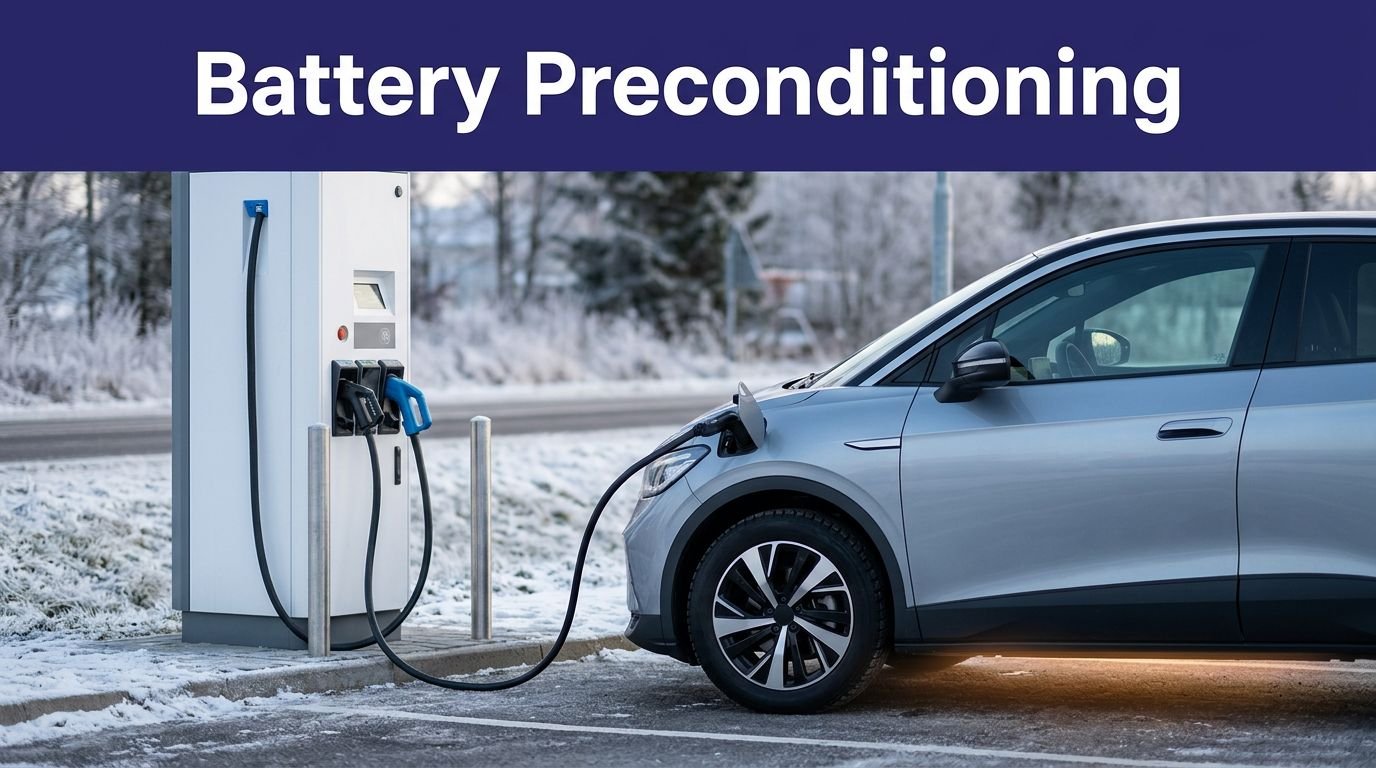
- Precondition battery and arrive 10–30% SOC at DC fast chargers; prefer unpaired high-kW stalls and vacate at ~80% to minimize dwell.
- Confirm roadside assistance covers flatbed towing and mobile charging; ensure responders follow OEM/SAE high-voltage safety protocols.
Portable Charging Options on the Road
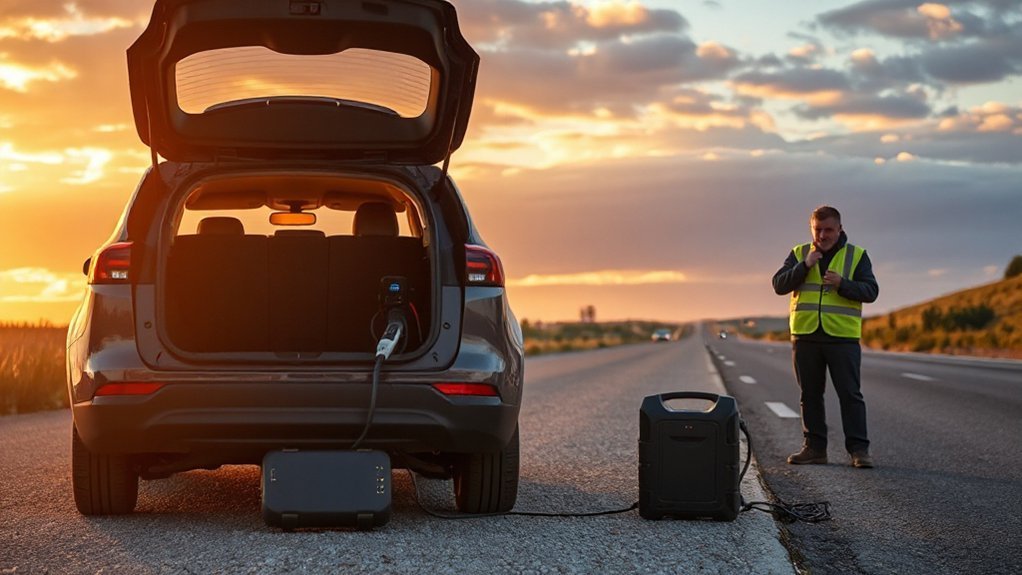
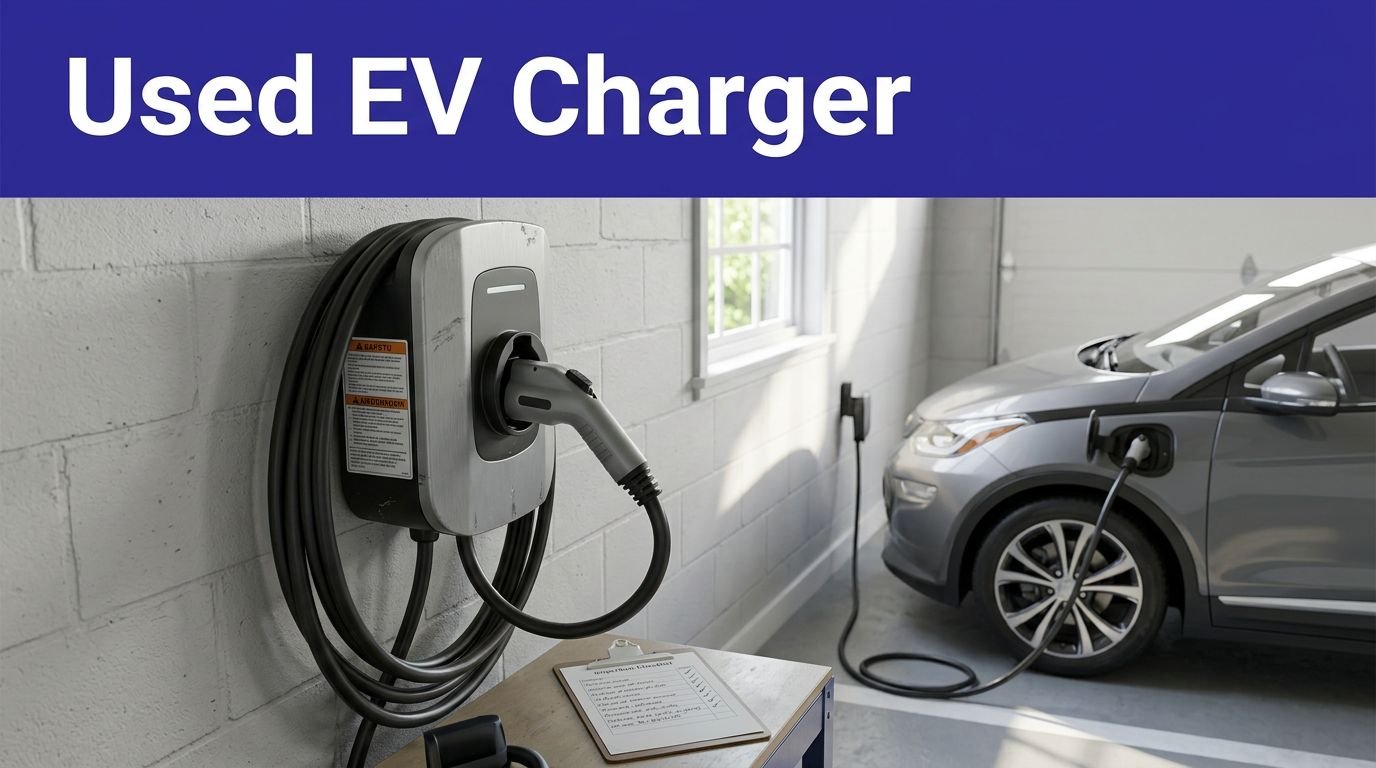
Pack a compliant portable EVSE and you’ll expand your charging options without compromising safety. Choose units certified to UL 2594/2231 and compatible with SAE J1772 or your adapter. Verify built‑in GFCI, ground monitoring, temperature sensing, and a test button. Use adjustable current and apply the 80% rule: 12 A on 15 A circuits, 24 A on 30 A, 32 A on 40 A. Prefer dedicated, properly grounded receptacles; inspect for heat, damage, and correct polarity. Weather matters—seek at least IP54 enclosures. Avoid extension cords; if unavoidable, use heavy‑gauge, rated, shortest‑length options. Campground TT‑30 and 14‑50 outlets are common; set amperage accordingly. Portable inverters and power stations rarely sustain EV charging loads; Solar backpacks are suitable only for accessories, not traction batteries in the field.
Finding and Using DC Fast-Charging When It Counts

You map reliable DC fast chargers with network and OEM navigation, verifying uptime, max kW, and connector types before departure. You confirm plug standards—CCS (SAE), NACS (SAE J3400), or CHAdeMO—and only use vehicle-approved adapters meeting UL/IEC ratings to prevent overheating and communication faults. You plan for peak periods by checking station occupancy, reserving when supported, arriving at 10–30% SOC with a preconditioned battery, and setting charge limits to minimize dwell, costs, and risk at high-current equipment.
Mapping Reliable Stations
How do you guarantee a fast charge when it matters? You map stations using verifiable data: real-time availability, historical uptime, and operator transparency. Prioritize networks that publish SAE-referenced power ratings, maintenance SLAs, and outage reporting. In your app, filter for sites with multiple dispensers, redundant power modules, 24/7 access, lighting, and clear wayfinding. Read recent session logs and user reports for derating, ICEing, or firmware faults. Cross-check utility outage maps and weather alerts to avoid systemic failures. Favor locations with safe ingress/egress, cameras, and emergency contact numbers posted. Before departure, pre-auth accounts and test the app’s start/stop functions. En route, monitor SOC, plan fallback sites within 10–15 miles, and arrive with a safe buffer to maintain thermal margins. Document issues and report failures promptly.
Plug Standards and Adapters
After verifying station reliability, match your vehicle’s DC interface to the site’s plug type and protocol. Confirm CCS1/CCS2, NACS, CHAdeMO, and check ISO 15118 or DIN 70121 support. Use only listed adapters whose voltage, current, temperature, and IP ratings meet regulatory compliance and your EV’s limits. Verify lock, strain relief, and firmware. Never use AC adapters for DC. Confirm international compatibility.
| Plug/Protocol | Notes |
|---|---|
| CCS (1/2), ISO 15118/DIN 70121 | Broad support; high power; Plug&Charge |
| NACS, ISO 15118 | Expanding in North America; certified adapters only |
| CHAdeMO, CAN | Legacy; declining sites; limited power |
Before energizing, inspect pins, seat fully, monitor heat, and abort if the latch loosens or the connector overheats. Observe station prompts, respect cable limits, and stop if insulation monitoring faults. Report issues to operator.
Peak-Time Charging Strategies
When grid demand peaks and sites congest, treat DC fast charging as a time‑critical, power‑managed operation. Precondition the pack en route, target arrival at 10–30% SOC, and choose unpaired stalls with the highest advertised kW. Verify power-sharing indicators and connector condition; don’t use damaged hardware. Use apps with OCPP data to check live availability, time based pricing, and derates. Prefer ISO 15118 Plug&Charge for faster handshakes. Set a charge cap (e.g., 80%) and vacate promptly; avoid back‑to‑back sessions to manage thermal limits. If queues form, join a FIFO list and stay within audible range. Shift non‑urgent energy to scheduled charging off‑peak. In emergencies, escalate to any reliable CCS/CHAdeMO site and accept reduced rates to preserve safety and grid stability. Document sessions for reimbursement audits.
Roadside Assistance and Mobile Charging Services

Though careful route planning reduces risk, roadside assistance and mobile charging services provide defined, standards-compliant responses for depleted or disabled EVs. You should verify Coverage options that include flatbed towing, mobile DC fast charging, and high-voltage-safe recovery. Providers follow Response protocols aligned with OEM service manuals, SAE J2990/J2990-2 for responder safety, and UNECE R100 battery integrity considerations. Expect operators to secure the scene, de-energize as required, inspect for damage, and confirm isolation resistance before moving or charging. For towing, they’ll use flatbeds, wheel lifts only when permitted, and transport to approved facilities or the nearest reliable charger. For mobile charging, they’ll meter energy, manage temperature limits, and log SOC and voltage. Confirm your VIN, location, connector standard, and any warnings displayed. Document service details.
Adapters and Cables You Should Carry
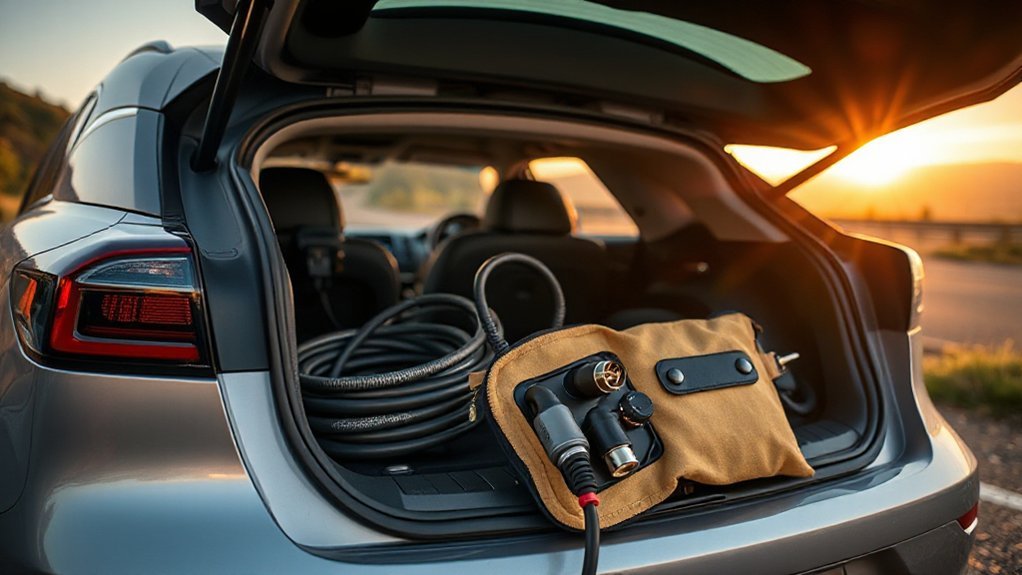
Carry a certified NACS–CCS adapter to guarantee interoperability across networks, and verify UL/CE listings and current limits match your vehicle’s specs. Pack a portable Level 1 EVSE with GFCI protection, a 12–15 A setting, and the correct plug type (NEMA 5-15/5-20), and use only grounded outlets. Store all leads in a weatherproof, flame-retardant cable organizer with strain relief and protective caps to keep connectors dry, clean, and undamaged.
Nacs–Ccs Adapters

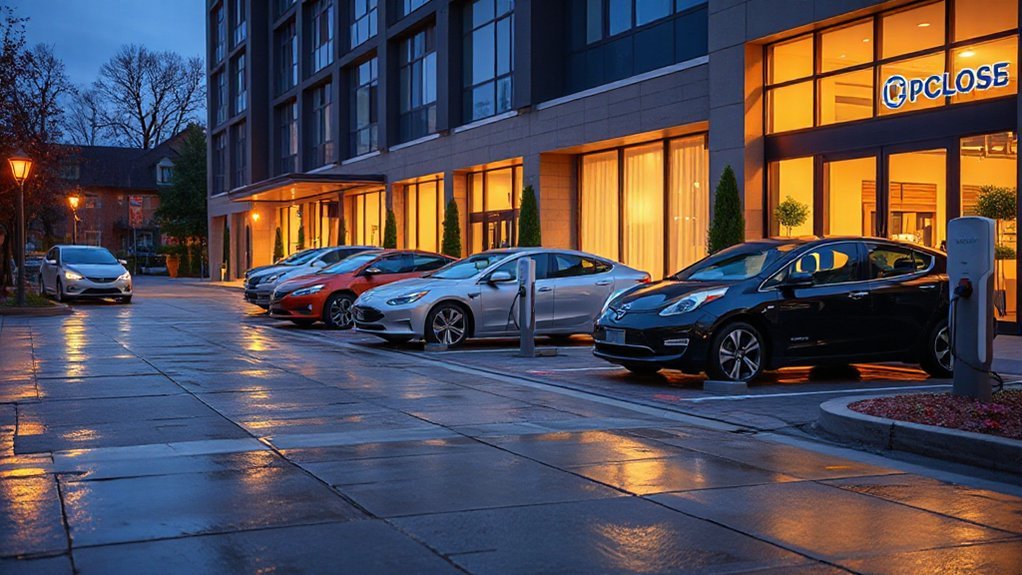


Why carry a NACS–CCS adapter? You extend site compatibility, yet you must verify ratings, Patent disputes, and Warranty implications. Choose adapters certified to UL 2251 and compliant with SAE J3400 (NACS) to SAE J1772 Combo/IEC 62196‑3 (CCS). Confirm DC current ≥300 A, voltage ≥500 V, IP54 minimum, and conductor gauge for heat rise.
| Checkpoint | Target |
|---|---|
| Protocols | ISO 15118, DIN 70121; PLC stability |
| Safety | UL/CE marks; temp derating; ingress seals |
| Mechanical | Locks; strain relief; UV‑stable shell |
| Ops | Updatable firmware; error codes; support |
At stations, inspect pins, clear debris, pre‑cool battery; avoid clones that cause faults or overheating. Test connectivity at home before long trips.
Portable Level 1 Charger
While public charging can be inconsistent, a portable Level 1 EVSE provides a safe 120 V fallback when only household outlets are available. Carry a UL-listed, GFCI-protected unit with interchangeable NEMA 5‑15 and 5‑20 plugs, plus a properly rated J1772 cable. Verify SAE J1772 compatibility and select adjustable current (6–12 A) to match circuit capacity. Avoid extension cords unless they’re heavy‑gauge (12 AWG or better) and uncoiled.
Inspect receptacles for heat damage; confirm tight blade tension. Use a plug‑in tester to check polarity and grounding before energizing. Prioritize Thermal Management: temperature sensors in the handle and plug should derate or stop charging if overheating. Keep firmware current; apply Firmware Updates for improved GFCI tripping, ground‑monitoring, and open‑neutral detection. Log charging amperage and outlet temperature.
Weatherproof Cable Organizer
Protecting adapters and EVSE cables from moisture, abrasion, and impact starts with a weatherproof organizer built to standards. Choose an enclosure rated at least IP65 with sealed seams, corrosion‑resistant zippers, and UV protection for rooftop or trunk heat. Specify materials meeting UL 94 V-0 and salt‑spray resistance. Internal layout should secure J1772/IEC 62196 couplers, keep pins capped, and maintain bend radius to prevent conductor fatigue. Look for drainage design, pressure‑equalization vents, and desiccant pockets to manage condensation. Separate energized gear from tools; add tie‑downs and foam to prevent chafing. Use lockable pulls, tamper indicators, and clear labels. Verify compatibility with NEC 625 cord lengths and NEMA plug guards. Clean gaskets, inspect strain reliefs, and dry contents before resealing after rainy deployments and road grime.
Smart Route Planning and Station Mapping
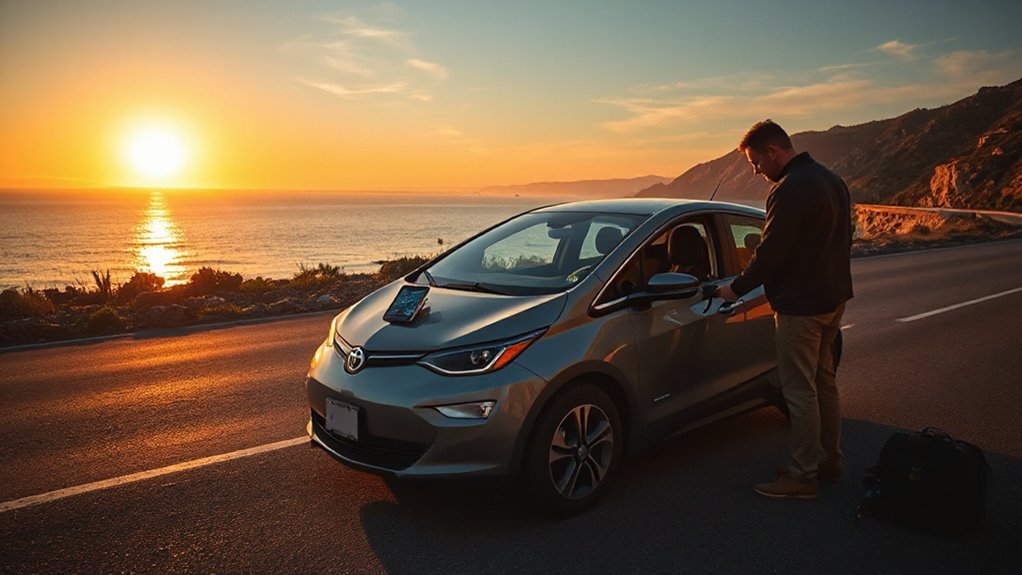
From trip inception, smart route planning aligns your EV’s range profile with verifiable charger data to reduce risk and downtime. You calculate consumption using Elevation profiles, ambient temperature, wind, and payload, then apply Traffic integration to model speed variance and dwell time. You map stations by standard and rating—NACS, CCS, CHAdeMO; 50–350 kW; OCPP status telemetry—and filter for 24/7 access, lighting, cameras, and clear egress. Set conservative arrival SOC thresholds (e.g., 15–25%) and define contingency waypoints within the vehicle’s remaining range. Validate connector counts versus parking layout to minimize blocking hazards, and check towing clearance. Document utility outages and site notes, and time your charging windows to local peak-demand tariffs. Finally, confirm payment methods and any RFID prerequisites. Note site-grade signage and maintenance schedules.
Apps to Avoid Broken or Busy Chargers
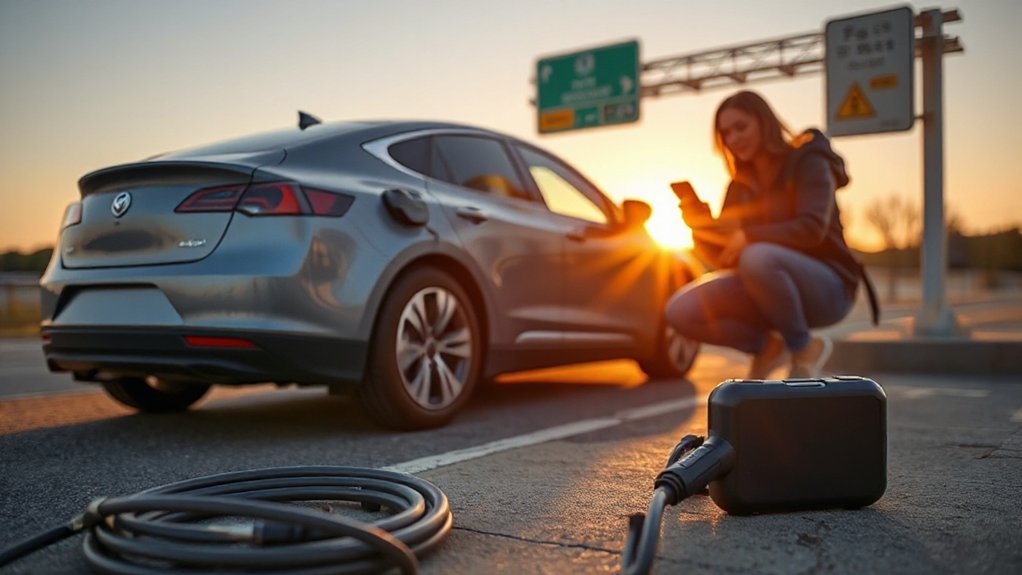
How do you avoid arriving to a broken or full charger? Use apps that aggregate live status via OCPP telemetry and crowdsourced check-ins. Prioritize platforms showing connector type, kW rating, uptime, and session faults in real time. Enable notifications for stalls going offline or queues forming. Filter by payment method, ADA access, and reliability score over the last 30 days. Verify recent photos and error codes before you navigate. Prefer networks that support reservations and dynamic pricing transparency.
Audit privacy concerns: review data collection, location sharing, and third-party analytics. Minimize identifiers and disable useless telemetry. Compare subscription costs versus per‑kWh fees; calculate breakeven based on your charging frequency. Cache offline maps, but refresh data before departure. Always have alternate, standards-compliant stations pinned and verified.
Techniques to Stretch Your Remaining Range Safely

When your SOC drops, apply disciplined, safety‑compliant techniques to extend range without risking occupants or components. Reduce speed to the posted limit, maintain steady cadence, and use Smooth Acceleration to minimize peak current draw. Select Eco mode, maximize regenerative braking, and anticipate stops to avoid friction braking. Keep tires at placard pressure; verify alerts and rolling resistance. Eliminate unnecessary loads: dim displays, unplug accessories, and set Climate Control to eco or fan‑only while using seat heaters for localized comfort. Keep windows closed above 35 mph to reduce drag.
Maintain safe following distance; don’t draft or coast in neutral. Avoid aggressive lane changes. Choose gentle grades when possible, but prioritize legal, driving. Monitor inverter and battery temps; if they climb, ease power to protect hardware.
Backup Plans for Rural Routes and Severe Weather
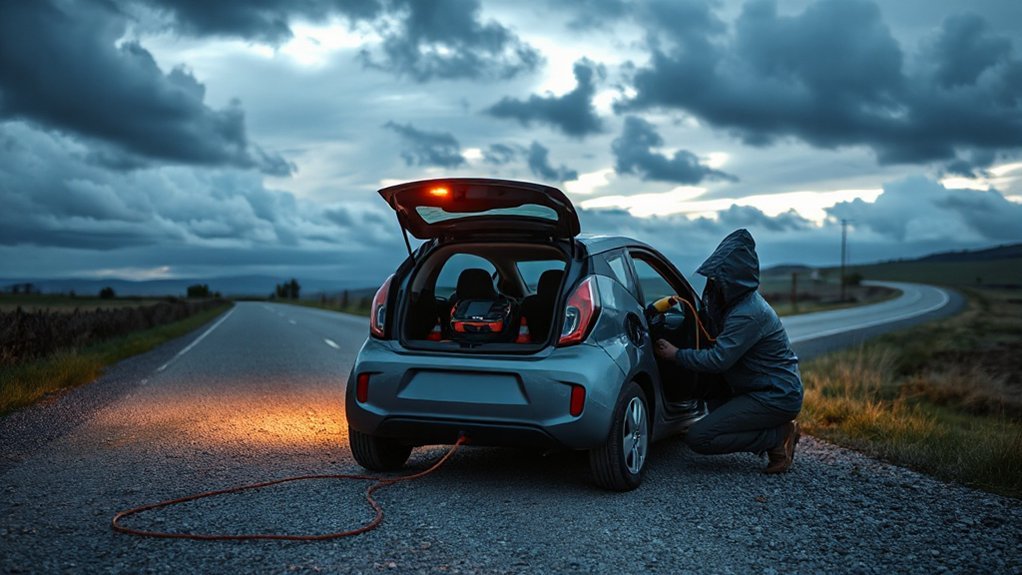
Although rural corridors and severe weather can simultaneously cut range and constrain charging access, you can reduce risk by planning redundant, standards‑compliant options and conservative energy margins. Pre-verify multiple DC fast sites across CCS/NACS/CHAdeMO using operator status APIs, and cache maps offline. Set go/no-go thresholds: depart with 90–100% SOC, target arrival >25% SOC, and maintain ≥15% buffer between sites. Identify Level 2 fallback at lodgings, Community hubs, and public works yards; confirm connector type, hours, and power. Carry rated adapters, a tested mobile EVSE, and extension cords compliant with NEC load limits. Monitor wind, temperature, and elevation; recalc consumption with headroom. If forecasts degrade, reroute to towns with Emergency shelter, cellular coverage, and redundant grid feeds. Notify contacts and log location timestamps at regular intervals.
Charging Etiquette and Safety Essentials
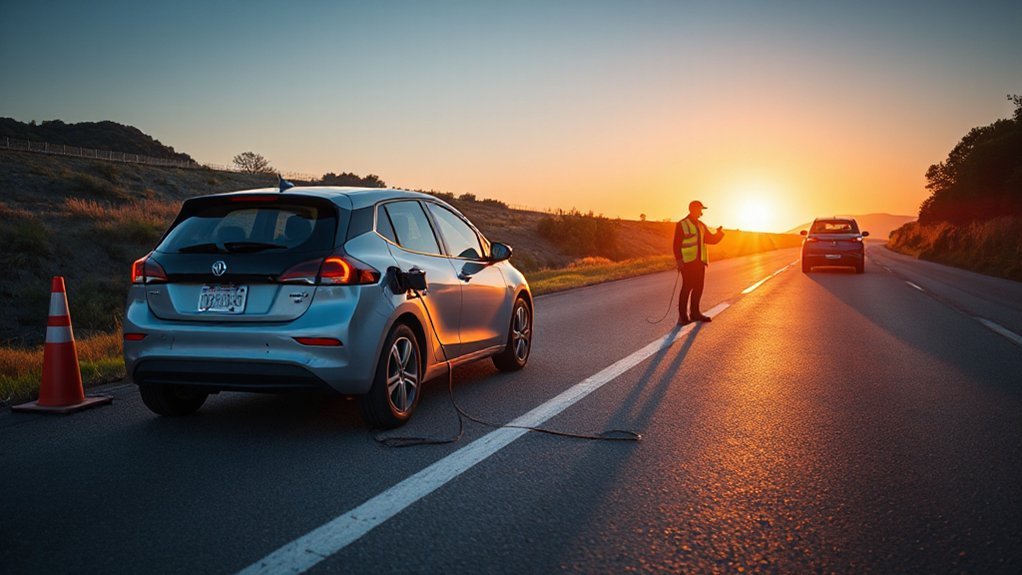
Because charging sites are shared electrical installations, you should apply standards-based practices that protect people, equipment, and grid capacity. Follow posted amperage limits, don’t daisy-chain adapters, and verify connector temperature. Perform Grounding checks per IEC 61851/SAE J1772 indicators, and stop if faults or RCD trips occur. Maintain Pedestrian awareness: coil cables, park within the bay, and yield to mobility access. Authenticate, charge, then move; avoid occupying stalls after taper. Inspect cables for cuts, broken latches, or moisture; don’t use damaged equipment.
- Pre-charge: check signage, bollards, and cord reach; turn off the vehicle before mating.
- During charge: monitor current, connector latch, and EVSE LEDs; keep kids and pets clear.
- Post-charge: stow cables, close covers, and report defects through the network app.
Know the E-stop location.
Conclusion
You’re your own pit crew: when a blizzard closed I‑80, a driver with a UL‑listed Level‑1 EVSE, a NACS‑to‑CCS adapter, and a 10–15‑mile fallback reached shelter with 12% SOC—proof preparation beats luck. You’ll plan redundant DCFC stops, precondition to arrive 10–30%, cap at 80%, and verify stalls aren’t derated. Carry weatherproof organizers, spare fuses, and desiccant; follow SAE, NEC, and UL guidance. Monitor telemetry, observe etiquette, and keep high‑voltage‑trained towing on speed dial for emergencies.