Your EV can add 200 miles in 20 minutes—or crawl for an hour—on the same trip, and the difference isn’t just kW on the sign. Charge speed hinges on AC vs. DC power, your onboard charger/DC limit, battery chemistry and pack voltage, state of charge, temperature and thermal management, and BMS caps. Grid sharing and cable resistance cut delivered kW. Preconditioning helps but accelerates wear. Here’s what actually controls your minutes.
Key Takeaways
- Charger type and site power determine delivered kW; power sharing, voltage sag, and cable losses can significantly reduce actual charging speed.
- Vehicle limits cap intake: onboard AC charger rating or DC max current/voltage, plus connector and cable ratings, set the maximum power.
- State of charge controls power: fastest at low–mid SOC; above ~60–80% the BMS tapers current, lengthening time to full.
- Battery temperature matters: cold or hot packs throttle; preconditioning to ~25–35°C enables peak rates and can shorten sessions 10–40%.
- Battery size and architecture affect time: larger packs need more energy; 800‑V designs reduce current and sustain higher power with less heat.
Charger Types and Power Levels (AC vs. DC Fast Charging)
Although both refill the same battery, AC and DC chargers deliver power differently and at different scales. You’ll see AC Level 1 at ~120 V, ~1.2–1.9 kW, and Level 2 at 208–240 V, typically 6–19 kW (single- or three-phase). DC fast chargers supply rectified DC at 50, 150, 250, or 350 kW, with liquid-cooled cables to manage >300 A. Higher power slashes dwell time but increases grid impact, demand charges, and installation costs, especially for multi-cabinet sites. Efficiency varies: modern AC EVSE and DCFC deliver ~94–97% at rated load. You should align site design with dwell patterns and business models: workplace or retail favors AC density; highway corridors favor DC throughput, redundancy, and power-sharing architecture for uptime and cost control and scalable power distribution.
Onboard Charger and Vehicle Limits
Understand that the vehicle, not the station, sets the ceiling for charge rate. Your onboard AC charger dictates the maximum AC power (e.g., 7.2, 11, or 19.2 kW), regardless of a higher-rated Level 2 pedestal. On DC, the power you see is capped by the car’s allowable current, pack voltage window, and thermal limits; a 350‑kW cabinet won’t help if your vehicle accepts 100–150 kW.
The car, not the station, sets charging speed—AC by OBC, DC by current, voltage, heat.
- Onboard charger (OBC) rating: single/three‑phase support, 32–80 A, dictates AC intake.
- DC acceptance: max kW, max current (e.g., 500–650 A), temperature thresholds define taper schedule.
- Interfaces: connector standard and cable limits, Port placement affects cable run, resistance, and parking alignment.
- Engineering and Cost constraints: OBC size, wiring gauge, cooling, and software guardrails cap power safely.
Battery Capacity, Chemistry, and Architecture
You estimate charge time from capacity and power: at a 150 kW DC charger, adding 60 kWh typically takes ~25–35 minutes because taper drops average power to ~100–140 kW. You’ll wait longer with larger packs at the same power unless the pack architecture (more parallel cells, low-resistance busbars, strong thermal management) raises peak and sustained kW. You also account for chemistry-driven C-rate limits and taper: NMC/NCA often sustain ~2–3C peaks, LFP ~1–2C with earlier taper, and LTO up to 5–10C, shifting minutes per 10 kWh.
Capacity Vs Charge Time
How do battery capacity, chemistry, and architecture set the ceiling on fast‑charge time? You feel it as longer sessions when capacity grows, because energy scales linearly while peak charge power doesn’t. To control Range anxiety and sharpen Trip planning, relate pack size to sustained C‑rate, thermal limits, and voltage.
- Capacity vs power: A 75 kWh pack at 150 kW averages 2C initially; tapering pushes session time to ~30–40 minutes from 10–80%.
- Architecture: Higher pack voltage (800 V) halves current for equal power, reducing losses and sustaining peak longer.
- Parallelism: More modules in parallel lower cell current, enabling higher system power without overheating.
- Thermal system: Aggressive cooling maintains internal resistance, delaying taper and keeping average charge power higher on road trips.
Cell Chemistry Impact
Because charge rate ultimately hinges on electrochemistry, cell chemistry sets the safe C‑rate, temperature window, and taper profile. Your Material selection governs lithium diffusivity, interfacial resistance, and plating risk. Fast Electrochemical kinetics in NMC or NMCA cathodes help, but graphite anodes bottleneck at low temperatures. LFP tolerates abuse and more cycles, yet its lower voltage elongates charging at equal C. LTO anodes enable 4–6C with wide thermal margins, trading energy density and cost. Electrolyte additives and particle morphology shift the knee where constant‑current hands off to constant‑voltage. Thicker electrodes increase ohmic drop and heat, forcing earlier taper; thin, high‑porosity designs accept higher currents. Validate with calorimetry.
| Chemistry | Typical fast‑charge spec |
|---|---|
| NMC/Graphite | 1–2C, ~10–45°C, early taper below 40% SOC |
| LFP/Graphite | 1–1.5C, ~15–55°C, flatter CV region |
State of Charge and the EV Charging Curve
While pack size grabs attention, state of charge (SoC) dictates instantaneous charging power through the EV’s charging curve. You’ll see peak kW at low-to-mid SoC, then a taper to protect cell voltage limits and maintain longevity.
- 0–20%: The charger ramps quickly; low internal resistance allows high current, maximizing kW and adding Perceived range fast.
- 20–60%: Power plateaus near the vehicle’s advertised peak; this window delivers the best minutes-per-mile efficiency.
- 60–80%: Taper begins as pack voltage nears limits; you hit practical Charging milestones, then decide whether to unplug.
- 80–100%: Current falls sharply; minutes per added kWh rise steeply, so staying connected yields diminishing returns.
Plan stops around the plateau to minimize dwell time and optimize cost per mile. Avoid deep top-ups when speed matters most.
Temperature, Preconditioning, and Thermal Management



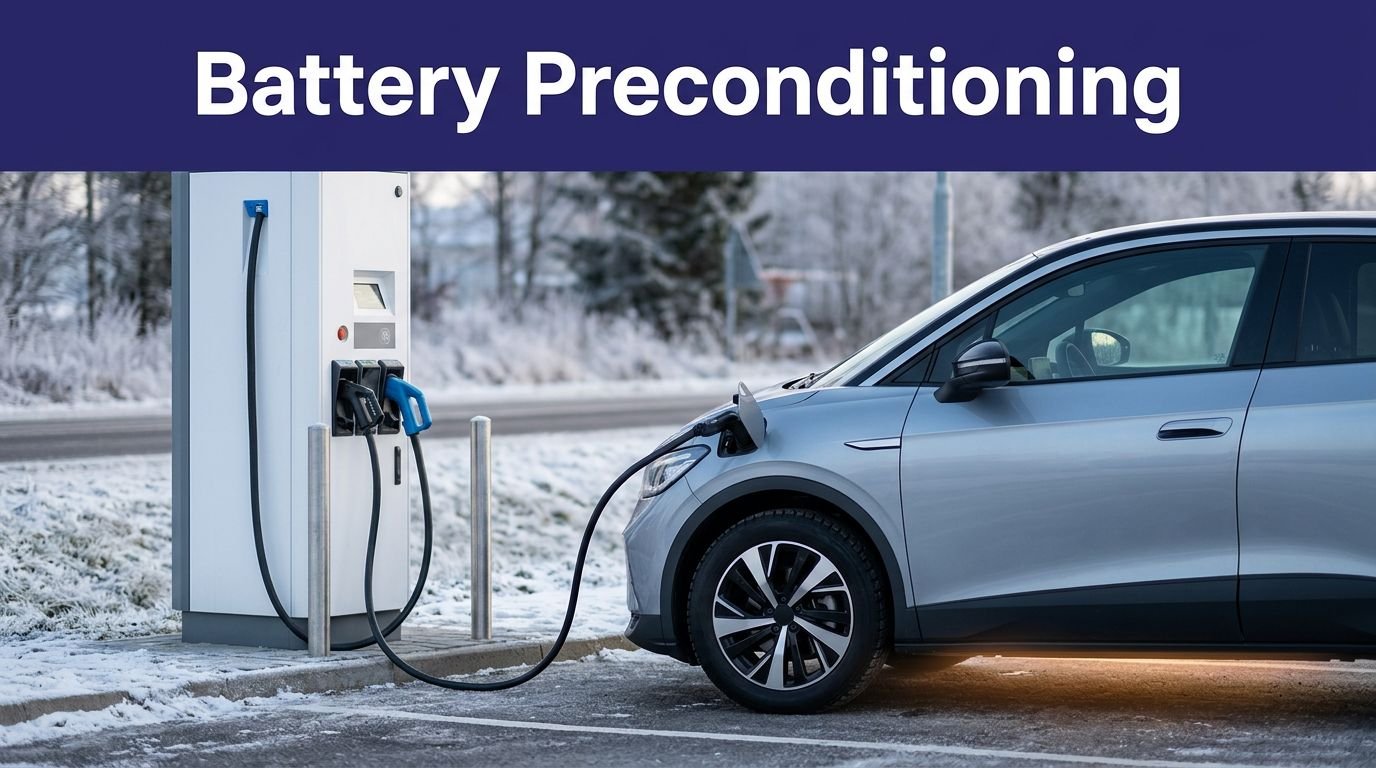
In cold weather, you face charging limits because the BMS reduces DC power to avoid lithium plating (often capping at ~20–50 kW below 0°C). When you precondition en route to a fast charger, you raise cell temperature into the ideal ~25–35°C band, enabling near-peak rates (e.g., 150–250 kW) and cutting session time by ~20–40%. Your EV’s active thermal management—liquid loops, heat pumps, and predictive controls—keeps cell temps uniform, protects longevity, and stabilizes charging across seasons.
Cold Weather Charging Limits
Although modern EVs can fast-charge at 1–3C when the pack sits near 20–35°C, cold-soaked batteries force dramatic limits to prevent lithium plating. Below 0°C, the BMS typically cuts DC power to 0.2–0.5C and may block fast charging entirely until cell temps rise.
- Chemistry constraints: Low diffusion coefficients and higher internal resistance elevate anode overpotential, increasing plating risk above ~0.1–0.3C at −10°C.
- Power routing: The car prioritizes pack heating, so a 150 kW charger may deliver <40–80 kW to cells, extending time and cost.
- Health and policy: Ignoring warnings can trigger Warranty exclusions; severe misuse may carry Insurance implications after failure investigations.
- Usability impacts: Expect stepwise charge curves, longer taper, and higher Wh/km overhead from thermal management loads during deep cold snaps.
Battery Preconditioning Benefits
Preconditioning sets cell temperatures into the pack’s ideal window (roughly 20–35°C for NMC/NCA, ≥15–25°C for LFP) before you arrive at a charger, cutting internal resistance and raising permissible C‑rates without plating risk. You hit peak kW sooner, hold it longer, and shorten taper. Expect 10–40% faster DC sessions versus cold-soaked packs, with lower I²R losses and tighter cell imbalance. Trigger it via navigation to a fast charger for Pre trip Convenience and better Departure Reliability. It also protects graphite from lithium plating and reduces SEI growth, preserving cycle life.
| Condition | Effect on charge power |
|---|---|
| NMC/NCA at 25–30°C | ~90–100% of advertised peak; taper delayed |
| LFP at ≥20°C | Stable acceptance; avoids BMS cold limits |
You arrive ready for maximal throughput.
Active Thermal Management Systems
Because charge power is thermally limited, active thermal management keeps the pack within a tight window to maximize C‑rate without accelerating degradation. You’ll see ideal fast‑charge speeds when cell cores sit near 25–35°C; below ~15°C, lithium plating risk rises, above ~45°C, impedance and aging accelerate. Controllers blend coolant loops, heat pumps, and chiller valves, using pack, inlet, and cell‑core sensors at 10–100 Hz.
- Precondition en route: navigation cues the BMS to target ~30°C before arrival, cutting taper and session time.
- Manage thermal spread: balance module‑level temperatures to within ±2°C to maintain uniform SOC and resistance.
- Respect maintenance intervals: inspect pumps, valves, coolant, and desiccants for flow and conductivity.
- Demand serviceability design: quick‑swap pumps, accessible filters, and bleed ports reduce downtime and cost during servicing.
Battery Health, Degradation, and Longevity Trade-offs
While faster charging slashes dwell time, it raises cell stress and accelerates degradation via lithium plating, SEI growth, and electrode/mechanical strain. You shorten cycle life most when charging at high C-rates, low temperatures, and high state-of-charge. Empirical fleets show 10–30% faster capacity fade when DC fast charging dominates use. High-SOC parking compounds calendar aging; each 10°C rise roughly doubles parasitic reactions. Deeper discharge swings amplify mechanical strain. Manufacturing variability means the weakest cell limits pack longevity and is stressed first during aggressive sessions. To trade time for life intelligently, charge moderately when practical, precondition temperature, avoid prolonged 100% dwell.
| Feeling | Technical reality |
|---|---|
| Hurry | Elevated plating risk |
| Relief | Irreversible SEI growth |
Track pack health metrics.
Software, BMS Controls, and Charge Rate Caps
Though fast-charging hardware sets the headline kW, BMS software actually meters current in real time to protect cells and maximize throughput.
Hardware sets the kW, but the BMS meters current to protect cells and sustain speed.
You’ll find caps vary by SOC, cell temp, impedance growth, and pack balancing state.
Your BMS enforces taper curves and preconditions the pack to hold higher C-rates without breaching voltage or thermal limits.
Firmware updates can enable faster profiles and refine diagnostics.
- SOC window: Peak from 10–50% SOC; above ~60%, taper limits voltage rise and lithium plating risk.
- Temperature: Ideal ~20–40°C; cold packs draw less; hot packs throttle to protect SEI.
- Health metrics: Internal resistance triggers stricter caps; modules with drift prompt balancing pauses.
- Security/comms: Authentication and timing plus mitigations for cybersecurity risks prevent spoofed currents, maintain stable sessions.
Grid, Site Sharing, and Cable/Connector Quality
Beyond BMS control, upstream power—utility feed, site distribution, and cable/connector quality—often dictates real charging power. Utility transformers set the kVA ceiling; voltage sag under peak demand reduces charger DC output proportional to Vin. If the site uses power-sharing, simultaneous sessions divide rectifier capacity, throttling you to a dynamic cap. Conductor gauge, run length, and temperature drive I²R losses; high resistance in connectors, worn pins, or oxidized contacts triggers thermal derates. Poor parking layouts elongate cable reach, increasing drop and bending stress. Local permit requirements can force smaller services or phased deployments, constraining throughput. You’ll see faster sessions at sites with headroom, short, cooled cables, and balanced load management.
| Factor | Impact on kW |
|---|---|
| Grid voltage sag | −5–20% versus nameplate |
| Shared power modules | Cap 72–150 kW |
Conclusion
You’ve seen how charger power, vehicle limits, chemistry, temperature, SOC, and site constraints set your real charging time. Prioritize DC fast chargers that match your car’s max and precondition to hit the ideal window (typically 10–60% SOC). One striking data point: at 350 kW, many modern EVs sustain 200+ kW, adding roughly 180–220 miles in 15 minutes. Monitor BMS caps, avoid repeated 100% fast charges, and plan around shared stations to maintain speed and longevity.