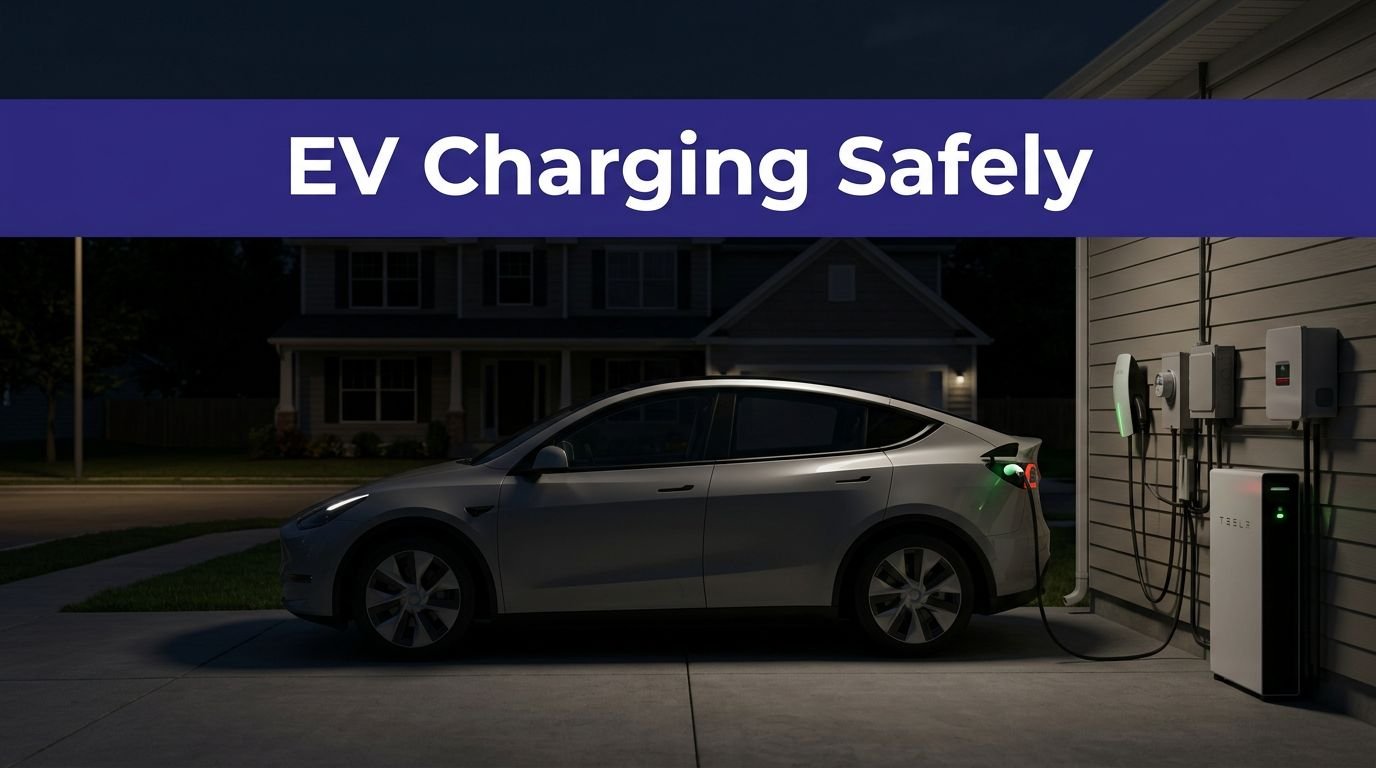
You probably don’t know that the same EV charger and labor can cost over $1,500 more in one state than another. You’ll want to factor in permits, panel upgrades, cable runs, and local labor rates, plus incentives that cut your out‑of‑pocket price—keep going to see how those factors change your estimate by state.
Key Takeaways
- Typical U.S. Level 2 home charger installations cost about $800–$2,500 nationwide (charger hardware $400–$1,200; labor $400–$1,500).
- State variation: California and New York often exceed $1,200–$2,500, while Texas and Florida commonly stay under $1,500.
- Major cost drivers: panel upgrades, long cable runs, hard-to-reach mounting, and higher metro labor rates.
- Local permits, electrical code compliance, and licensed electricians add fees and affect timeline across states.
- Federal, state, and utility incentives (IRA credit, rebates, make-ready funding) can cut homeowner costs through 2026.
National Average and Typical Price Ranges for Residential Installs
Although exact prices vary by region and job complexity, most U.S. homeowners in 2025 will pay about $800 to $2,500 to install a Level 2 home charger; you should budget for charger hardware ($400–$1,200), installation labor ($400–$1,500), permitting ($50–$300), and possible panel upgrades ($500–$2,500+). Many homeowners can reduce their out‑of‑pocket costs through a federal tax credit.
If your panel’s capacity is limited, you’ll want a professional to evaluate upgrade needs to avoid overloads. Distance from the panel, outdoor or hardwired installs, and added materials like conduit or breakers raise costs.
Typical simple installs near the panel run about $850–$1,700; moderate wiring (20–40 ft) often reaches $1,050–$2,200. Prioritize licensed electricians and required permits so your charger operates safely and complies with code.
Check eligible federal or local incentives first to reduce your out‑of‑pocket cost and confirm installer credentials before work begins.
State-by-State Cost Snapshot: High, Low, and Median Prices
You’ll notice big swings between states when comparing the highest and lowest installation prices. In California and New York you’ll often pay toward the upper ranges—roughly $1,200–$2,500 or more—because of higher labor, permitting, and upgrade needs.
In Texas and Florida you’ll typically see lower costs, often under $1,500, thanks to cheaper labor and fewer panel upgrades. Overall, nationwide average installation totals around $1,200–$4,000 .
Highest State Prices
The states with the highest EV charger installation costs tend to cluster where labor, permit fees, and home-age issues push prices well above the national average—think California, New York, Hawaii, Massachusetts, and Alaska. You’ll face higher electrician rates, stricter permitting, and more frequent panel upgrades in these places, so plan for $3,000+ jobs when homes need significant work.
Prioritize safety: hire licensed electricians, insist on up-to-code permits and inspections, and get written estimates that list panel, wiring, conduit, and labor costs. Remote or hard-to-access sites add wiring and material expenses; older homes can require costly asbestos checks or wall repairs. Confirm available incentives locally, but don’t rely on rebates to cover safety-driven upgrades. Ask contractors for proof of insurance and safety certifications before hiring. Note that the national average EV charger installation cost is $2,442 as of 2025.
Lowest State Prices
When states keep permitting simple and labor costs low, you can find EV charger installs for as little as $300–$800 for basic plug‑in or near‑panel 240V hookups. In those states, grounding and basic labor often run under $400, and streamlined permits push total installs toward $500 or less. You should prioritize licensed electricians who follow local codes, since safe wiring and proper grounding prevent hazards.
Expect median state prices to cluster $1,200–$2,000 when new wiring, permits, and minor panel work are needed. Permit fees usually add $50–$300, and taxes or utility fees can tack on another $50–$200. If your site needs a panel upgrade or long wiring runs, budget substantially more to maintain safety and compliance. Check state incentives to reduce net installation costs. The underlying analysis focuses on the 100 largest U.S. metropolitan areas.
How Home Setup Complexity Changes Your Final Bill
Many homes end up paying more than the charger sticker price because outdated panels, long cable runs, hard-to-reach mounting locations, and missing EV-ready outlets all add labor, materials, and permit fees; you should expect upgrades, longer wiring, and safer mounting to change the final bill. Also, when choosing a charger, remember to match charge speed to your typical dwell time to avoid overspending on unnecessary power. Consider these primary drivers so you can plan responsibly:
Expect higher overall costs—panel upgrades, long wiring runs, and tricky mounting often add fees.
- Panel upgrades — replacing or upgrading panels and adding a dedicated breaker raises cost and requires temporary power interruptions for safe work.
- Distance and wiring — long runs need heavier gauge cable, conduit, possible trenching, and more labor.
- Physical constraints — detached garages, concrete walls, or poor access increase specialized labor and safety measures.

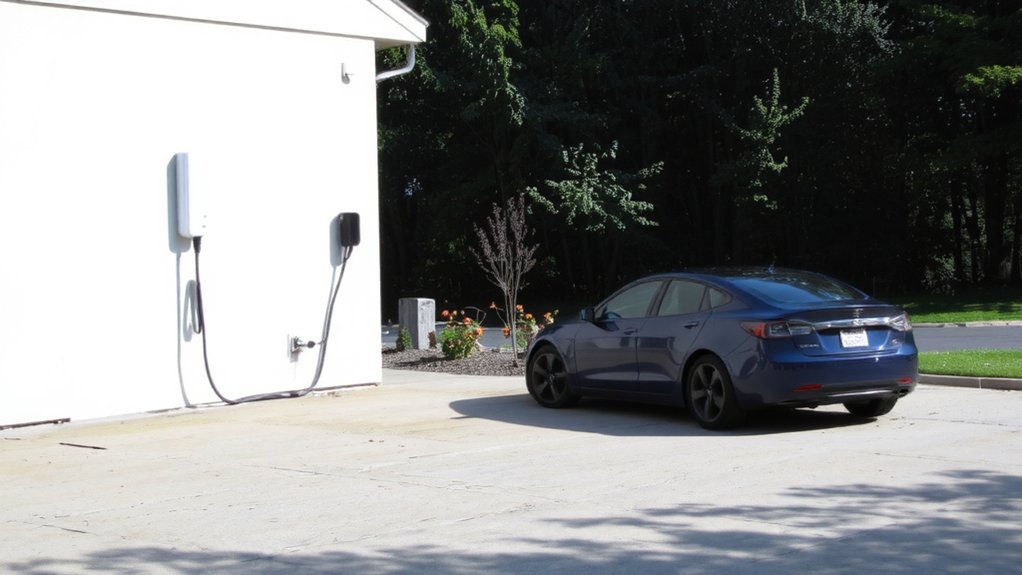
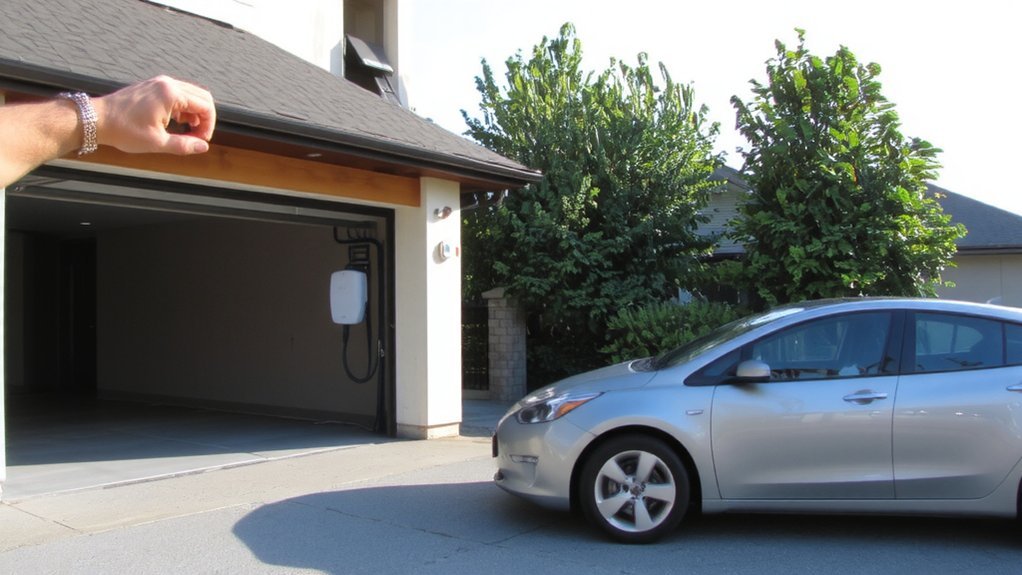
Get a qualified electrician to assess your site and provide written estimates before any work starts.
Local Permits, Codes, and Regional Labor Rate Impacts
Because local permits, code versions, and labor markets vary so much, they can materially change both your EV charger price and installation timeline. Permits matter because they ensure installations meet code compliance, reducing fire risk and liability. You’ll need permits for any new 240V outlet, hardwiring, panel upgrade, trenching, or structural work; municipalities often reference the NEC and local amendments.
Expect varied fee structures—flat fees, percentage-based charges, and separate inspection costs—and longer reviews in urban or commercial projects. Licensed electricians are typically required; metropolitan areas and stricter NEC adoptions raise hourly rates and labor intensity.
In high-demand regions labor shortages can push costs and wait times up. To stay safe and compliant, confirm local code versions, get written permit estimates, and hire a licensed professional who handles inspections and documentation. Plan for permit delays when scheduling installation early.
Federal, State, and Utility Incentives That Lower Out-of-Pocket Costs
Federal, state, and utility incentives can cut your out-of-pocket EV charger costs through refundable tax credits, cash rebates, make-ready programs, and federal grants—often in combination so you can stack savings and target different parts of a project (hardware, installation, infrastructure, or public charging). You’ll likely qualify for the IRA residential credit—up to $1,000 (30%) through June 30, 2026—and businesses can claim 30% up to $100,000 per project. These credits include the Home Charging Station tax credit for residential installations.
Federal, state, and utility incentives—tax credits, rebates, and grants—can significantly cut EV charger costs and be stacked
State rebates commonly add $250–$700 for Level 2 chargers and may cover infrastructure in targeted programs. Utilities offer rebates, make-ready funding, special rates, and geographic programs that pair with federal and state support.
- Evaluate eligibility and stack options safely.
- Prioritize programs with labor or location requirements.
- Document claims and follow compliance for safer installations.
Cost Components: Hardware, Labor, Upgrades, and Hidden Fees
While costs vary by site and equipment, you’ll pay for four core components: the charger hardware, electrician labor, any panel or service upgrades, and permits/inspection fees. Hardware typically runs $400–$1,200 for Level 2 units, with entry models near $300 and premium chargers above $1,200; add $50–$300 for NEMA or hardwire kits and $30–$200 for GFCI/grounding. Additionally, typical overall installation falls in a moderate range with an Avg Level 2 cost often cited. Labor spans $400–$1,500+: basic installs $400–$800, typical $800–$1,300, complex over $1,500. Panel or subpanel work costs $500–$2,500+, and utility service upgrades add $250–$1,000+. Permits and inspections are $50–$500; load calculations $50–$150. Expect hidden fees—trenching $500–$2,000, weatherproofing $100–$500, testing $50–$150—and budget 10–15% contingency. Follow licensed electricians’ recommendations, verify local code requirements, and get written estimates so you won’t face unsafe shortcuts or surprise costs during installation and allow for inspections.
Commercial, Multi‑Family, and DC Fast Charger Cost Considerations
You’ll see commercial Level 2 chargers typically cost $3,000–$15,000 per unit, while DC fast chargers and required site work can push total installation north of $50,000 to over $100,000. Standard AC chargers commonly cost between £1,000–£3,000 per unit, while ultra-rapid DC chargers can exceed £35,000.
State-by-state differences in labor, utility fees, permitting, and urban versus rural site complexity can change that range considerably.
For multi‑family projects expect added expenses for panel and transformer upgrades, separate metering, and longer permitting and coordination timelines.
Commercial and Multi‑Family
Because site infrastructure and electrical capacity vary widely, costs for commercial and multi‑family EV charging can swing dramatically, and you should expect trenching, panel or transformer upgrades, conduit sizing, concrete work, and permitting to drive the bulk of the price. Also consider targeting Workplaces, which help attract and retain EV-driving employees. You’ll typically see Level 2 installs at $3,000–$10,000 per charger; panel upgrades $500–$2,500; trenching $500–$2,000+; labor $400–$1,500.
Plan early utility coordination, oversize conduit for growth, and verify permits, ADA signage, and inspections for safe operation. Factor incentives and maintenance into payback estimates and hire experienced contractors.
- Site scope — distance to power, trenching, concrete, and parking modifications.
- Electrical capacity — panels, transformers, conduit sizing, and future expansion.
- Compliance & operations — permits, ADA requirements, signage, inspections, and maintenance for safe operation.
DC Fast Charger Costs
Often you’ll find DC fast charging projects cost an order of magnitude more than Level 2 installs because both hardware and site work are intensive. DC fast charging equipment can cost from $10,000 to over $200,000 per dispenser, showing wide price variability. You should budget $10,000–$200,000+ per dispenser: typical ranges are 50 kW ($20,000–50,000), 150 kW ($50,000–100,000), and 350 kW ($100,000+).
Expect installation from $18,000 to $350,000+ per port depending on distance to service, trenching, transformer or panel upgrades, and permits. Plan $5,000–$15,000 more for labor and permitting.
Guarantee three‑phase power and code compliance; upgrades can add $2,000–$5,000+ and require inspections. Operationally, prepare for higher energy costs (~$0.40–$0.60/kWh), demand charges, and increased maintenance.
Prioritize safety, certified installers, and clear documentation to reduce risk and delays. Seek incentives and utility coordination early to control costs and guarantee safe, reliable service and planned maintenance schedules.
Conclusion
You’ve seen how EV charger installation costs vary by state, and you can use this guide to estimate your own expenses. You’ll factor hardware, labor, permits, and potential panel upgrades, and you’ll hunt incentives to cut your out-of-pocket price. If your driveway feels like a horse-drawn carriage scenario with long cable runs, expect higher fees, but planning, local quotes, and incentives will help you avoid surprises and make a smart, future-ready choice for the future.