Pick the right capacity, choose efficient standards, and manage heat safely. You’ll cut weight, charge faster, and extend battery life—if you size Wh to your device draw, verify USB‑C PD/PPS profiles, and use e‑marked cables. Match port power budgets to simultaneous loads, consider magnetic packs for on‑the‑go, and use MPPT when solar. Follow airline Wh limits and store at mid‑SoC. The payoff is measurable, but only when you align specs with use…
Key Takeaways
- Estimate power bank size: total device mAh × recharges ÷ 0.75, and verify Wh (≤100 Wh for flights).
- Match output: phones need 5,000–10,000 mAh at 18–30 W; tablets/cameras 10,000–20,000 mAh with 20–45 W.
- Prefer USB‑C PD with PPS for cooler fast charging; use e‑marked 5 A cables above 3 A and low‑resistance leads.
- For magnetic snap‑on packs, choose Qi2/MagSafe‑certified, strong magnets, sub‑150 g, <12 mm, and case thickness under 2 mm.
- Protect batteries: charge between 10–30°C, keep SoC 20–80%, ensure airflow, and avoid damaged cables or stacked devices.
Picking the Right Power Bank Capacity
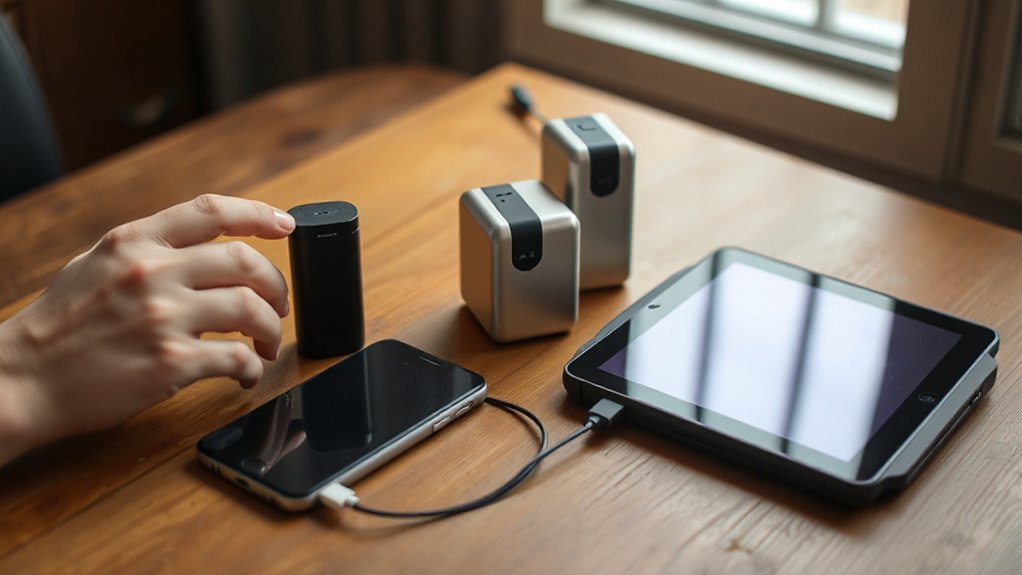
How much capacity do you actually need? Start with Usage Estimation. Sum your devices’ battery capacities, then multiply by expected recharge cycles and a conversion factor of 0.7–0.8 to account for DC‑DC losses and cable resistance. For example, a 3,000 mAh phone recharged twice requires roughly 7,500–8,600 mAh available energy.
Match output to workload. If you’ll power tablets or cameras, prefer banks supporting 20W–45W with 10,000–20,000 mAh. For phones only, 5,000–10,000 mAh at 18–30W suffices for a day.
Weigh Weight Tradeoffs. Capacity scales mass: ~180 g for 10,000 mAh, ~350 g for 20,000 mAh. Larger packs charge slower on 18W inputs; plan recharge time budgets. Verify rated capacity versus Wh (e.g., 37 Wh ≈ 10,000 mAh at 3.7V) and airline limits under 100 Wh.
Snap-On Batteries and Magnetic Mount Options
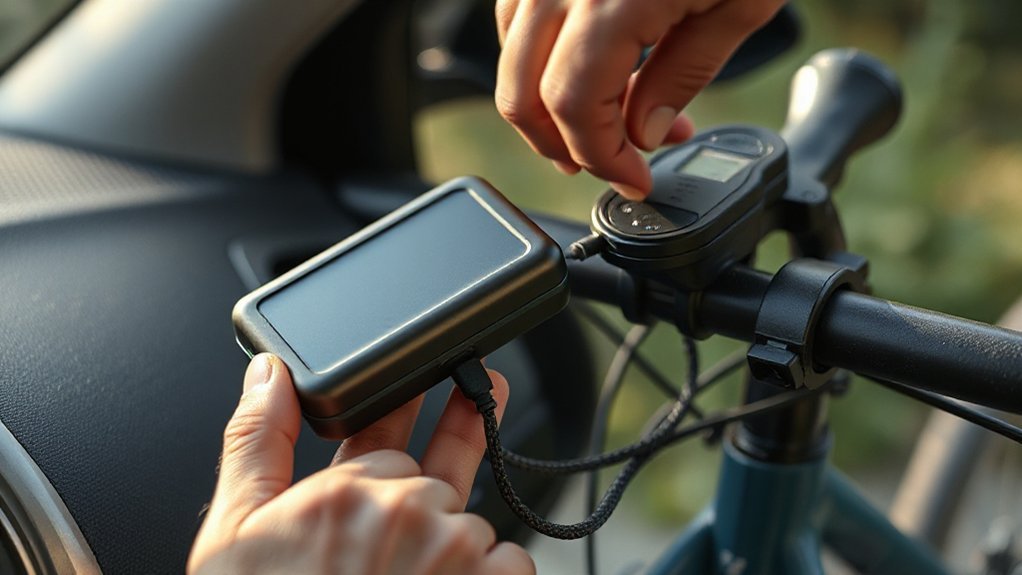
With capacity sorted, attachment matters: snap-on magnetic packs prioritize on-the-go efficiency by eliminating cables and maintaining pocketability. Evaluate magnet strength (typically 0.4–0.8 N normal force or 1,000–1,800 gauss at the ring) to prevent shear slips during jogging or typing. Verify case compatibility: magnetic rings align best through <2 mm non-metal cases; thicker or textured shells reduce coupling and heat dissipation. Prefer Qi2/MagSafe-certified units for 15 W negotiated power, tighter alignment, and faster wake-to-charge. Target sub-150 g mass and <12 mm thickness to maintain ergonomics. Look for >80% DC-DC efficiency at 5–15 W, NTC-based thermal throttling, and passthrough readiness. Check status LEDs, auto-start, and kickstand angles (30–60°) for usability. Confirm NFC/credit-card clearance to avoid demagnetization and interference. Test grip on glass, polymer, and matte finishes.
Solar Panels and Off-Grid Charging

Sizing solar for off-grid charging starts with your daily Wh demand and local peak sun hours (PSH). Divide Wh by PSH, then derate by 0.7–0.8 for temperature, wiring, dust, and angle losses to size array wattage. Optimize panel orientation: tilt near latitude, adjust seasonally, and aim perpendicular to sun; keep modules cool and unshaded. Use MPPT charge controllers for higher harvest with variable irradiance and higher-voltage strings; use PWM only for budget, matched-voltage setups. Match controller current rating to array Isc with 1.25× safety margin. Right-size battery capacity (Wh = V × Ah) for autonomy days and depth-of-discharge limits. Minimize voltage drop with thicker, shorter cables and locking connectors. Add inline fusing, surge protection, and accurate shunt-based metering. Log performance data to validate assumptions.
Multi-Port Hubs and Shared Power Management
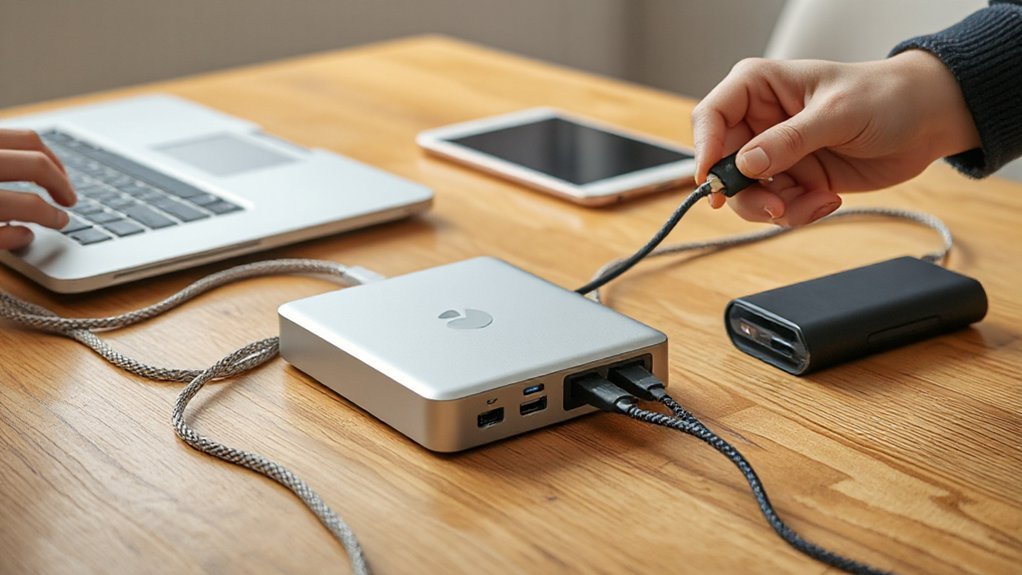
Although you can plug everything into a single brick, multi-port hubs demand tight control of the total power budget and per‑port allocation. You quantify input wattage, subtract conversion losses (typically 6–12%), then enforce caps per port. Real-time telemetry—voltage, current, temperature—lets you predict brownouts and throttle proactively. Implement Load Balancing so idle ports surrender headroom to active ones, while Port Prioritization guarantees mission-critical devices stay powered.
- Measure source capacity continuously; log 1 s averages and 100 ms peaks.
- Allocate per-port limits; enforce via current-limited switches and MOSFETs.
- Detect cable/connector resistance; compensate using dynamic voltage offsets.
- Mitigate heat; derate power above 60°C and stagger ramp-up to cut inrush.
Audit efficiency regularly and track cumulative watt-hours to validate real-world margins under dynamic loads.
Fast-Charging Standards: USB-C PD, PPS, and QC

You need the USB-C PD basics: negotiated PDOs from 5V, 9V, 15V, 20V (EPR adds 28/36/48V up to 240W) with up to 5A via an e‑marked cable. With PPS, you get programmable 3.3–21V in ~20 mV and 50–100 mA steps, yielding higher efficiency and lower heat than fixed-step QC during CC/CV phases. In practice, pick PD/PPS for cross-device compatibility and stable high power, and use QC (3/4/5; QC5 can exceed 100W) only when a Qualcomm handset specifically benefits.
USB-C PD Basics
Standards define how fast power moves: USB Power Delivery (USB‑PD), Programmable Power Supply (PPS), and Qualcomm Quick Charge (QC) govern negotiation of voltage and current. You focus on USB‑PD basics: a handshake protocol over the CC pins lets source and sink exchange Power Data Objects (PDOs), advertise capabilities, and lock a safe contract. Controller firmware enforces policy, current limits, and fault responses while monitoring cable e‑markers.
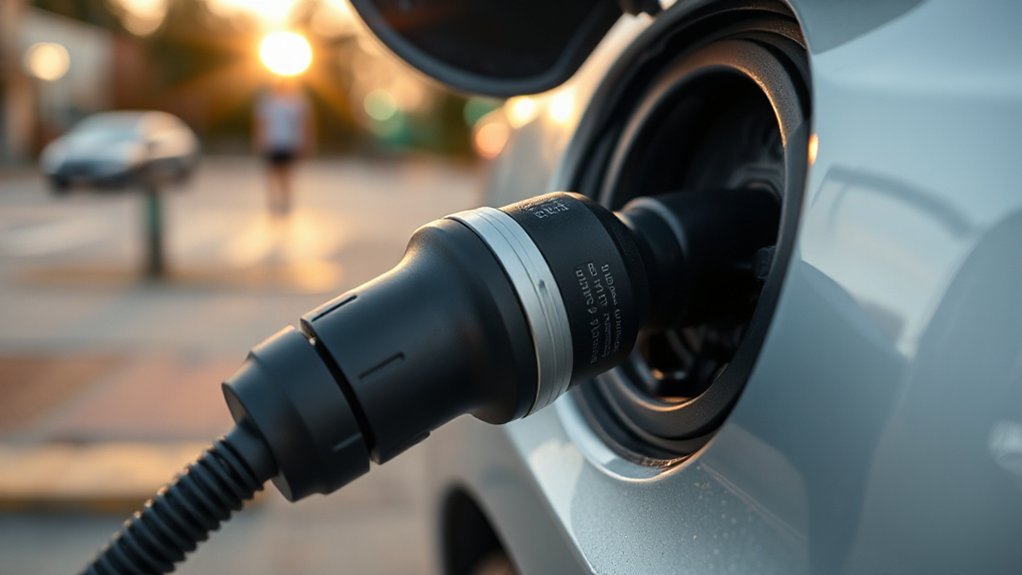
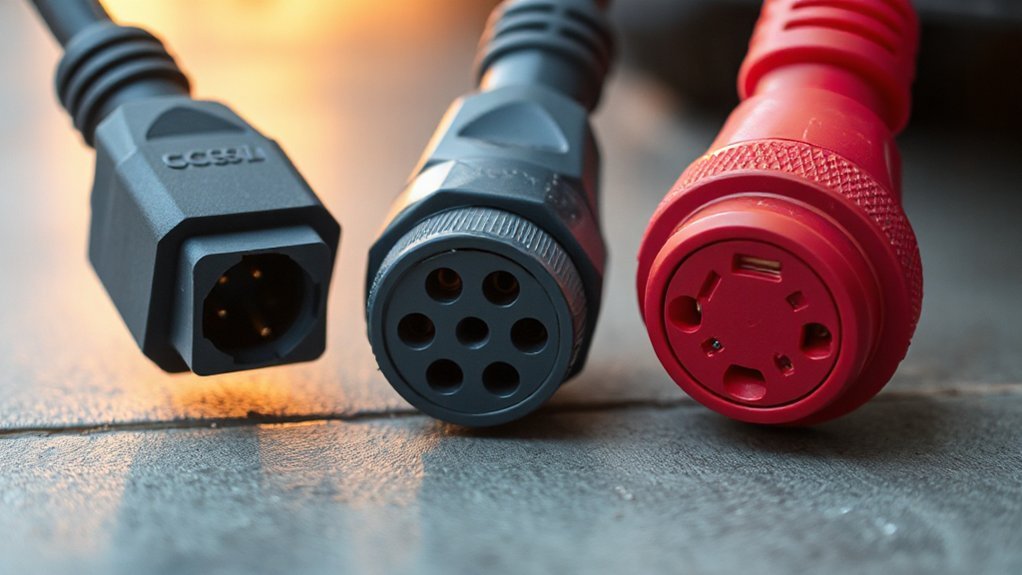
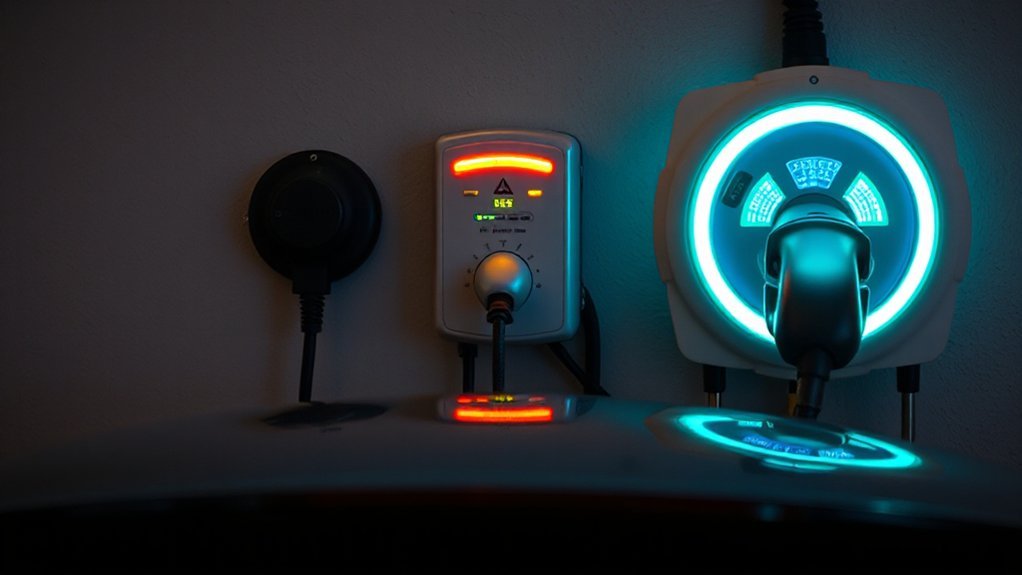

Key mechanics you should verify:
- Roles: source, sink, or dual‑role; Fast Role Swap minimizes brownouts.
- Power ranges: SPR to 100 W; EPR to 240 W with 28/36/48 V rails.
- Cables: e‑marked 5 A cables required above 3 A; authentication prevents spoofing.
- Efficiency: choose higher voltage/lower current to cut I²R loss and connector heating.
Validate logs and thermal margins.
PPS Vs QC Performance
Building on USB‑PD’s handshake, performance diverges when PPS and Qualcomm Quick Charge control how fast voltage and current move. With PPS, you request granular 20 mV/50 mA steps, letting the charger track the battery’s impedance curve and trim conversion losses. QC favors discrete voltage rails and faster ramp rates, useful under burst loads but riskier for thermal headroom. In mixed ecosystems, you’ll see Interoperability quirks and Firmware incompatibilities: phones may fall back to 9 V QC, or cap PPS at 3.3–11 V. Measure delivered watt-hours, not peak watts, and watch temperature rise per minute; those reveal real efficiency.
| Metric | PPS vs QC |
|---|---|
| Voltage control granularity | PPS: 20 mV; QC: discrete rails |
| Current modulation | PPS: 50 mA steps; QC: device-managed |
| Thermal behavior | PPS: smoother, cooler; QC: faster, hotter overall |
Cables and Connectors That Matter
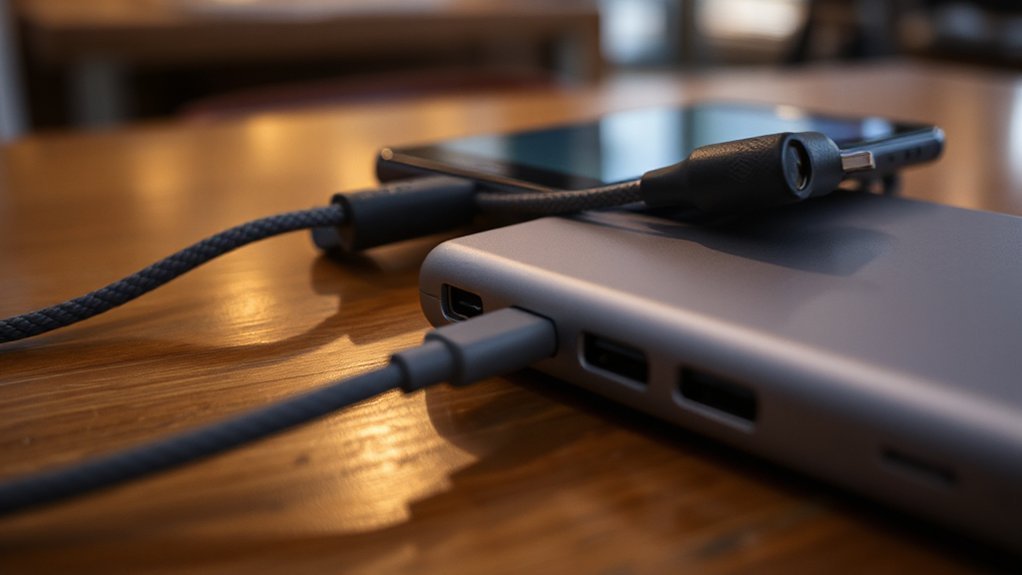
Cable gauge and connector design determine charge speed, heat, and safety in mobile setups. You’ll maximize throughput by matching cable specs to the charger’s negotiated profile. For >60 W USB-C PD, choose 5 A e-marked cables; for 20–45 W, high-quality 3 A works. Verify AWG: lower numbers reduce resistive loss across longer runs.
- Conductor size: 5 A cables often use 20–21 AWG power pairs; aim for <100 mΩ loop resistance per meter.
- Connector plating: Prefer 30–50 µin gold on contacts to cut fretting corrosion and maintain low contact resistance.
- Strain relief: Look for molded, extended boots and 10,000+ bend-cycle ratings to prevent intermittent drops.
- Data capability: USB 2.0 vs 3.x lanes affect cable diameter; confirm e-marker advertises current and Supported EPR.
Safety, Heat, and Battery Health Best Practices
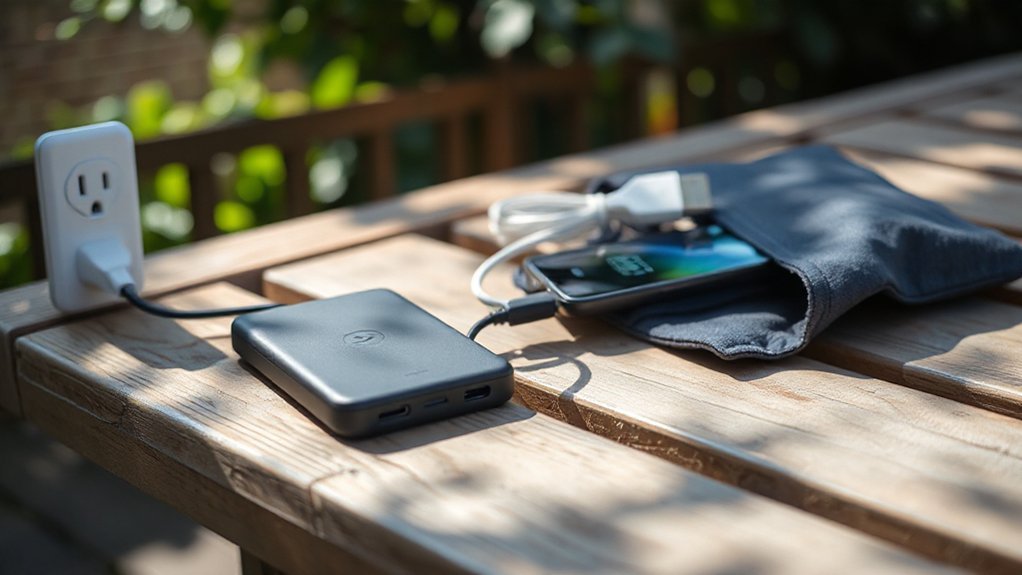
You can tighten safe charging by using certified adapters/cables, enabling 80–90% charge limits, avoiding overnight trickle, and unplugging at full to reduce cycle and calendar aging. Heat is the prime stressor: above ~40°C, lithium‑ion aging accelerates (roughly 2× per +10°C), so don’t charge under pillows, in hot cars, or with heat‑trapping cases during fast charge. Keep charging within ~10–35°C, pause if the device feels hot or throttles, and prefer moderate rates (≤0.8C) when thermal headroom is limited.
Safe Charging Habits
Prioritizing thermal management and state-of-charge control preserves safety and extends lithium‑ion cycle life. You charge deliberately: use certified adapters, match voltage/current ratings, and monitor charge curves to avoid sustained 100% dwell.
- Outlet inspection, Surge protection: verify polarity and grounding; use UL 1449 Type 3 protectors; record surge events and replace after clamping.
- Cable integrity: select low-resistance leads (22–24 AWG power conductors) to limit voltage drop; retire frayed or hot cables promptly.
- Charging windows: keep SoC in the 20–80% band; enable charge limiters; disable trickle once the taper phase ends.
- Process discipline: detach at target SoC, schedule charging during low-load periods, avoid stacking devices, and maintain unobstructed airflow around packs and chargers.
Audit logs quarterly to verify charger performance and safety.
Avoid Extreme Temperatures
Beyond adapter choice and SoC control, thermal exposure dictates safety and cycle life. Keep cells between 10–30°C during charge; above 40°C accelerates SEI growth, gas generation, and swelling, while below 0°C risks lithium plating. Don’t fast‑charge in a hot car; cabins can exceed 60°C, driving pack temps beyond limits. Use airflow, remove thick cases, avoid sun, and place devices on hard, thermally conductive surfaces. Monitor battery temperature; pause charging above 45°C or below 5°C. Prefer lower current when warm.
Store at 40–60% SoC at 15–25°C. Heat causes cosmetic changes and warping, increases internal resistance, and wastes energy. Many warranties exclude thermal abuse; expect warranty implications if logs show over‑temperature events. Choose gear with NTCs, thermal throttling, and don’t cover power banks during charging sessions.
Travel Rules, Airline Limits, and Packing Tips
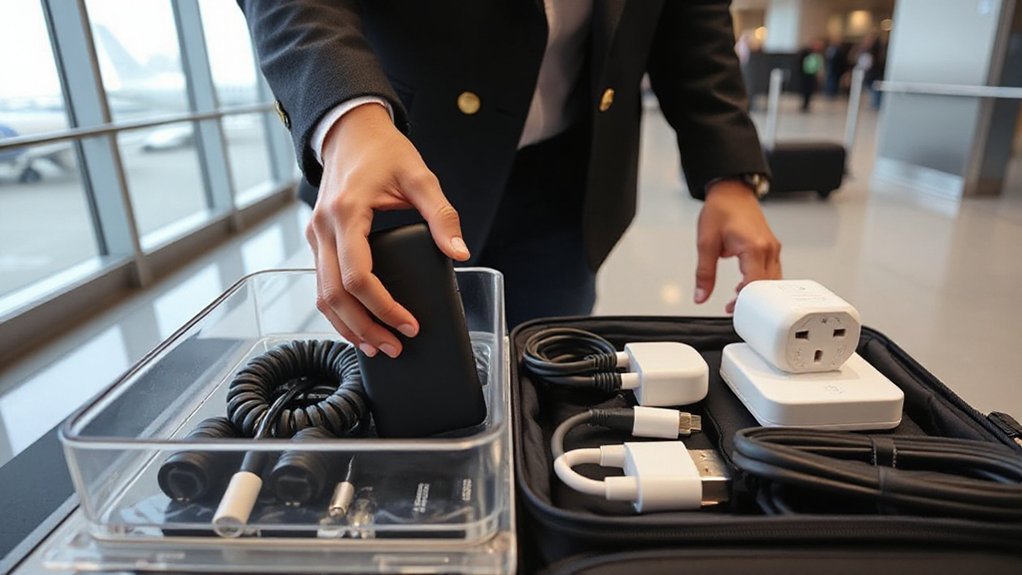
While regulations vary by country and carrier, most airlines align with FAA/IATA limits for lithium batteries in power banks and device packs: ≤100 Wh allowed in carry-on (spares only), 100–160 Wh allowed in carry-on with airline approval (typically up to two spares), and >160 Wh prohibited for passengers.
Most airlines follow FAA/IATA: ≤100Wh carry-on, 100–160Wh with approval, >160Wh banned.
Check TSA allowances and Airline policies before packing; calculate watt-hours (Wh=V×Ah) from labels.
- Keep all spares in carry-on; tape terminals; use original cases to prevent short circuits.
- Distribute capacity: carry multiple ≤100 Wh banks instead of one large unit to stay within limits.
- Declare 100–160 Wh units at check-in; obtain approval; expect quantity caps and extra screening.
- Pack smart: leave prohibited >160 Wh packs; remove e-bike batteries; secure cables; label Wh clearly.
Keep documentation handy, digital.
Conclusion
You optimize portable power by matching Wh to needs, minimizing weight, and keeping temps in check. Verify ratings, pick certified MagSafe or USB‑C PD/PPS, and use e‑marked cables. Set charge limits, store around 40–60% SoC, and inspect gear. Off‑grid, pair MPPT solar with multi‑port hubs. Pack within airline Wh rules. Then coincidence strikes: a delayed flight, a critical call, a sunset upload. Because you engineered efficiency, every device stays ready—and the moment doesn’t slip away.