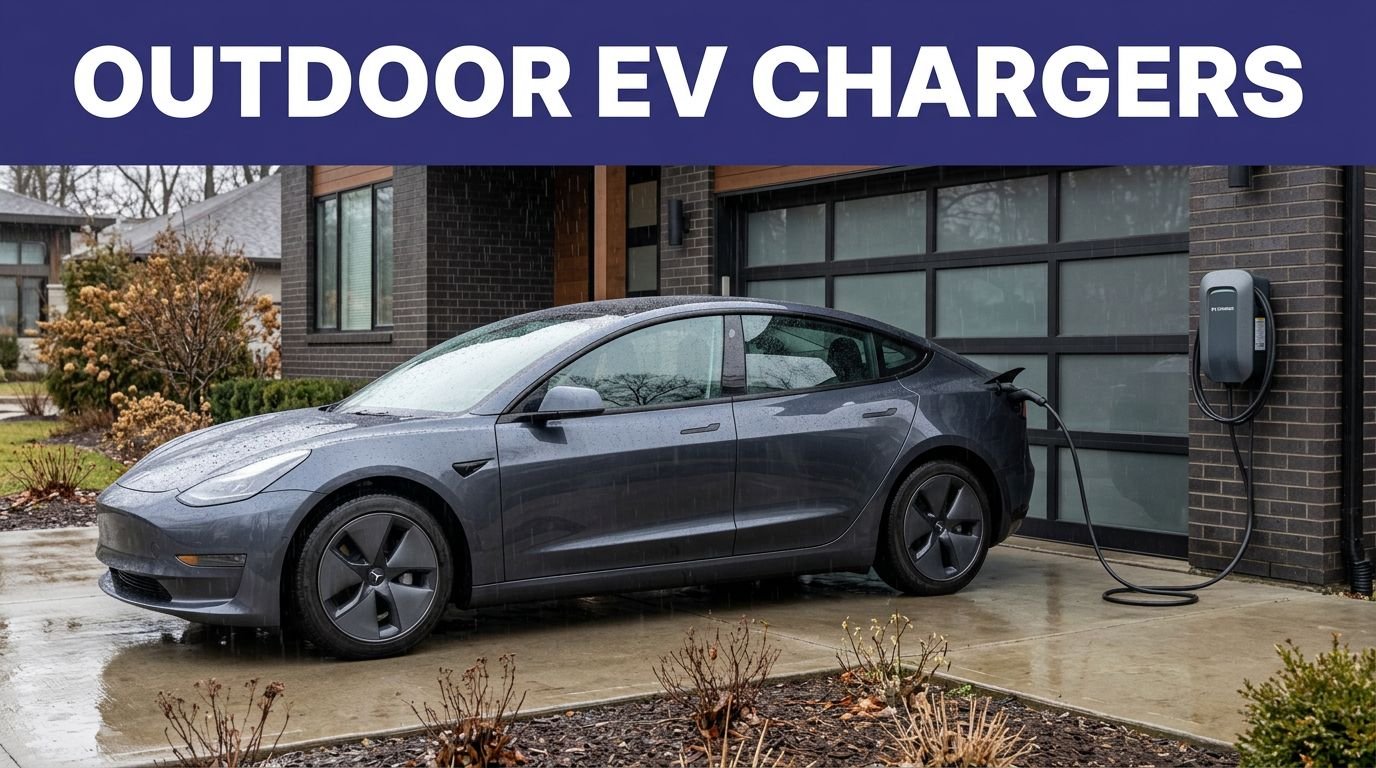
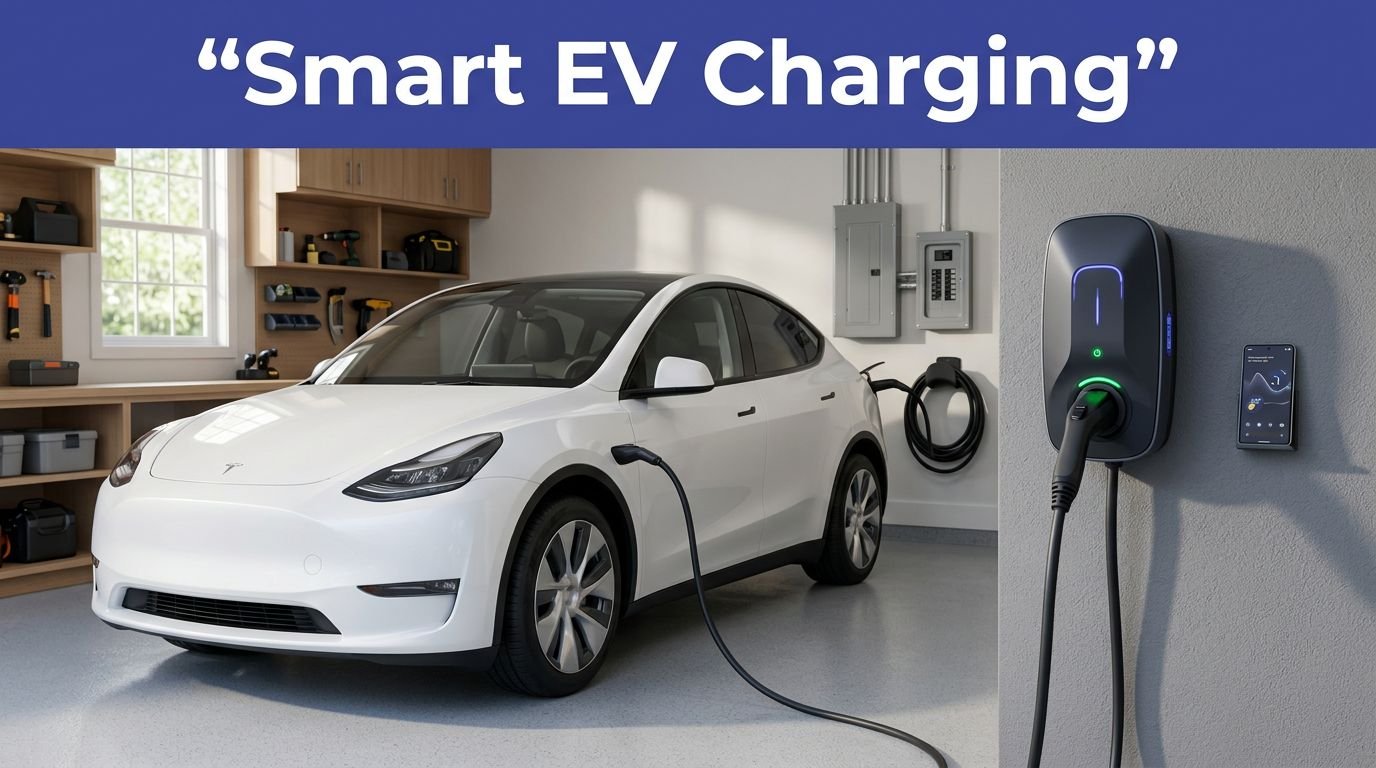
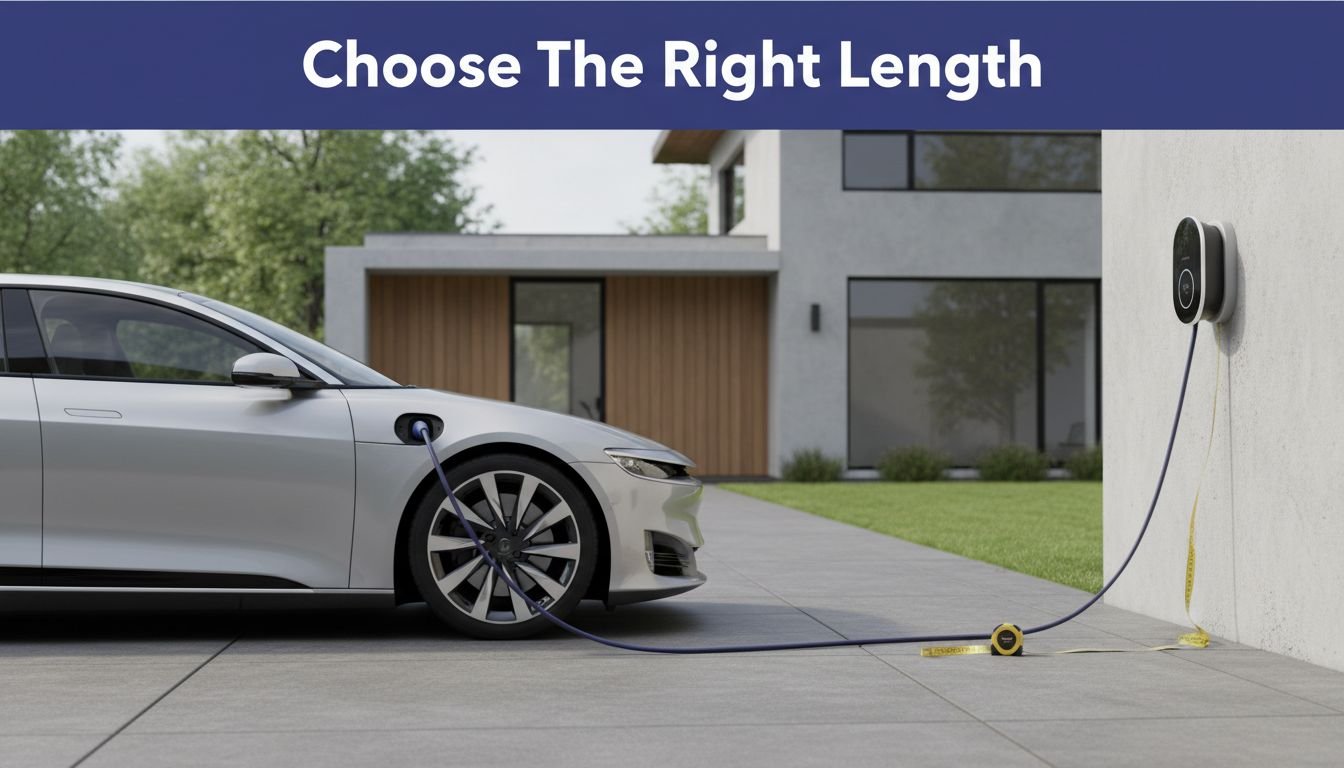
If you want reliable Level‑1 EV charging off‑grid, you’ll need portable panels that deliver 300–400 W nominal, retain ≥80% STC at 800 W/m², and pair cleanly with MPPT inputs. Look for ETFE or tempered laminates, IP65 junctions, MC4/XT60 leads, and strong watts‑per‑pound with compact packed volume. We field‑tested 2025 foldables for real wattage, durability, and setup time. Here’s how the top kits stack up—and which specs actually matter.
Key Takeaways
- Top picks: SunFlex 400 (320 W NOCT), VoltLite 420 (335 W), DeltaFold 300 (255 W); strong warranties and class‑leading power density.
- Level 1 EV charging draws 1.44 kW; only 1.2–1.3 kW reaches the pack—plan 0.28–0.30 kWh PV per mile driven.
- Thirty miles daily needs ~2.4 kW of panels with margin at 4.5 sun‑hours; a 50 kWh refill consumes ~60 kWh PV.
- Series‑pair panels to hit 32–42 V MPPT windows; verify controller Voc, current, and grounding to prevent RCD trips.
- Portability matters: target ≥10–12 W/lb, ≤28 g/W, durable IP65–67 cases, and MC4 with adapters for XT60, DC7909, or Anderson.
How Much Solar You Need for Level 1 EV Charging

How much solar does Level 1 actually demand? At 120 V, 12 A, a Level 1 EVSE draws 1.44 kW; net to pack is ~1.2–1.3 kW after inverter/charging losses (85–90% efficiency). If your car averages 250 Wh/mi, each driving mile needs ~0.28–0.30 kWh from PV. For 30 daily miles, budget ~8.4 kWh AC input; with 4.5 peak-sun-hours, you’d size array power at ~2.0 kW, plus 20% margin for weather and angle, ≈2.4 kW. To replenish 50 kWh of battery capacity from empty on Level 1, expect 40–45 hours of plug time and ~60 kWh from PV. Account for BOS losses: MPPT, inverter, cabling (10–15%). Size wiring for 15 A continuous at 120 V. Use energy logs to refine daily mileage and solar yield estimates.
Top Portable Panels of 2025: Tested Picks

Meeting a ~2.4 kW target for Level 1 charging with portable gear puts the spotlight on panels that sustain high NOCT output per kilogram and per square meter. In our brand comparison, you’ll see three 2025 standouts: SunFlex 400, DeltaFold 300, and VoltLite 420. You care about NOCT watts, voltage stability under partial shade, connector robustness (MC4 vs XT60), and warranty analysis covering output retention and workmanship.
| Model | NOCT power (W) | Warranty |
|---|---|---|
| SunFlex 400 | 320 | 5 yr workmanship; 80% @ 5 yr |
| DeltaFold 300 | 255 | 3 yr workmanship; 78% @ 4 yr |
| VoltLite 420 | 335 | 5 yr workmanship; 82% @ 6 yr |
Test data used 800 W/m² irradiance, 20°C ambient, 3.5 m/s wind. You’ll pair modules in series to hit 32–42 V MPPT windows reliably.
Weight-to-Watt Leaders and Packability
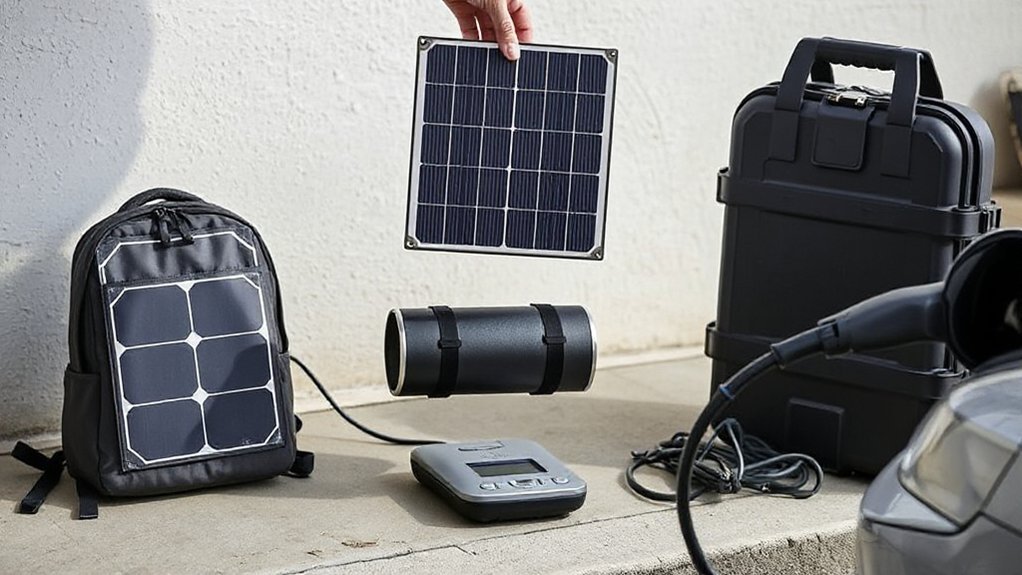
You’ll rank panels by watts per pound (W/lb = rated watts ÷ weight); leaders typically exceed 10–12 W/lb. Next, quantify folded size efficiency as watts per cubic inch when stowed (W/in³ = rated watts ÷ [L×W×T]); efficient designs hit ~0.10–0.20 W/in³. Finally, specify carry hardware and cases: integrated handles/shoulder straps, case mass <15–25% of panel weight, rigid/padded protection, and ingress/abrasion ratings.
Top Watts per Pound
Three numbers matter: watts per pound (W/lb), folded volume (L), and deployed area (m²). If you prioritize energy per carry weight, target ≥10 W/lb for rigid-hinged portables and ≥13 W/lb for fabric bifacial mats. For example, a 400 W kit at 28 lb delivers 14.3 W/lb, while a 220 W mat at 14 lb delivers 15.7 W/lb. You’ll also track power density per area: 180–220 W/m² mono PERC, 210–240 W/m² TOPCon, 230–260 W/m² IBC. Higher module efficiency raises W/lb because frames, junctions, and wiring mass stay constant.
Prioritize aluminum-lite frames, ETFE laminates, and GaN MPPTs to keep mass low. Verify connector counts; duplicate cabling erodes W/lb. Check Supply Chain transparency and Recycling Economics; lighter, higher-efficiency bills-of-materials reduce transport emissions and end-of-life costs and fees.
Folded Size Efficiency
After optimizing W/lb, packability hinges on folded size: rank kits by watts per liter (W/L) alongside W/lb. Measure folded volume (L = H×W×T liters) and compute W/L; sub-1.5 L panels with 100–120 W lead for glovebox storage. Check edge radii and hinge protrusions that inflate volume without adding output. Prefer rectangular footprints that align with trunk wells; verify storage orientation labels for vertical or horizontal stowage during travel. For transport compliance, note airline and vehicle cargo limits; some jurisdictions restrict panels above 60 cm in any dimension. Below is a quick ranking pattern:
| Metric | Target/Leader spec |
|---|---|
| Folded volume | ≤1.2 L at 100 W, case included, packed |
| W/L | ≥80 W/L at 25°C, STC |
| W/lb | ≥10 W/lb including cables |
| Max dimension | ≤55 cm longest folded edge |
Carry Options and Cases
Carry-case design dictates how weight-to-watt leaders travel and stow. You should evaluate handle geometry, strap ergonomics, and load path. For 200–220 W class panels, target 4.5–6.0 kg, 20–26 L packed volume, and ≤28 g/W. Semi-rigid EVA shells (3–5 mm) with 600D outer, YKK #8 zips, and corner bumpers cut impact risk. A removable shoulder strap with 40–50 mm webbing, 10–12 mm foam, and 450–550 mm drop reduces fatigue. Balanced centers of gravity within ±25 mm of the handhold improve carry during 200–400 m site walks.


Check airline compliance: folded size ≤55×35×23 cm for carry-on, no protruding blades, and <7–10 kg regional limits. Lash points (MOLLE/PALS), tie-down loops, and IP54–IP67 rain covers protect while mounting on racks or towing cases. Confirm warranty on case hardware.
Real-World Output: Field Measurements and Methods
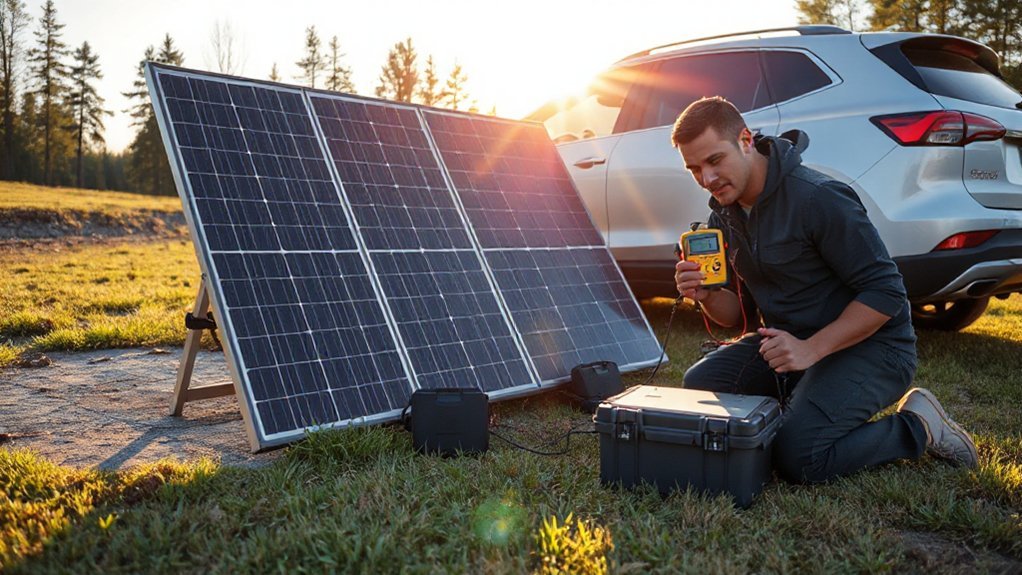
You’ll log POA irradiance (W/m²), module temperature (°C), wind speed (m/s), and incidence angle, then normalize measured power to POA or STC to report specific yield (kWh/kWp) and capacity factor (%). You’ll characterize load profiles by emulating EVSE/inverter demand with stepped and ramped loads (e.g., 100–1200 W) while recording V–I to capture IV curve excursions. You’ll quantify MPPT by specifying Vmp window, sweep rate (Hz), and tracking efficiency (%) under transients and partial shading, correlating these with delivered energy.
Weather-Normalized Performance Data
While STC ratings (1000 W/m², 25°C cell temp, AM1.5G) anchor nameplate power, weather‑normalized field data quantify real EV‑charging yield by correcting measured output to those references using plane‑of‑array (POA) irradiance and module temperature.
Instrument POA with an ISO 9060 secondary standard pyranometer and log back‑of‑module temperature; compute Tcell via NOCT or heat‑balance.
Normalize power: Pnorm = Pmeas × (1000/Gpoa) × [1 + γ × (Tcell − 25°C)], with γ from the panel datasheet (e.g., −0.29%/°C mono, −0.35%/°C poly).
Apply incident‑angle modifier (IAM) and spectral corrections to reduce Climate Biases across latitude and season.
Use Temporal Smoothing (e.g., 10‑minute rolling medians) to damp transients and compute STC‑equivalent kWh/day and normalized performance ratio (PRnorm).
Report uncertainty: ±2% irradiance, ±1°C temperature, ±0.3% model; give 95% intervals overall.
Load Profiles and MPPT
Because EV charging loads aren’t static, you need to couple array I–V behavior with the downstream MPPT/inverter and EVSE load profiles to predict real output. Instrument the array with 1 s irradiance, voltage, and current logging; capture EVSE AC power and pilot current at 1–5 s. Use Load Segmentation: idle, ramp, constant-current (CC), constant-power (CP), and taper. For each segment, compute MPP voltage tracking error (Vmp_cmd–Vmp_meas), MPPT Stability (overshoot, settling time), and clipping duration. Quantify CC/CP changes as ΔP/Δt and correlate with dP/dV from the array. Target <1% tracking error, <200 ms settling, <3% ripple. Report delivered kWh/day normalized to POA insolation (kWh/kWp). Validate with step tests: 0.5–1.0 suns, shaded strings, and EVSE pilot changes. Log temperatures to correct Voc and resistance-induced sag accurately.
Durability and Weatherproofing: ETFE, IP Ratings, and Build

Even in harsh field use, durability hinges on materials, ingress protection, and assembly quality: prioritize ETFE-laminated modules (typically 100–250 µm film) with ≥94% light transmittance, >92% anti-soil contact angle, and abrasion resistance >5,000 Taber cycles to outperform PET. You should verify UV degradation data (<2% transmittance loss at 1,000 h ASTM G154) and salt-spray performance (≥1,000 h ASTM B117) for Corrosion resistance. Look for IP67–IP68 junction boxes and connectors, IP65–IP67 foldable fabric shells, and potting with UL94 V-0 compounds. Specify tempered glass or ETFE-over-primed fiberglass backers with coefficient of thermal expansion ≤30 ppm/°C to limit microcracking. Demand double-stitched, bar-tacked hinges rated >10,000 folds, stainless 316 hardware, and silicone gaskets ≤10% compression set. Confirm operating ranges −20 to 60°C and drop resistance ≥1.0 m. Prefer anodized aluminum frames, PVF edge seals, and reinforced corners throughout.
Plug-and-Play Compatibility: MC4, Adapters, and Power Stations

How do you make sure a portable panel just plugs in and works with your power station? Match connectors and electrical windows. Most panels ship with MC4; many power stations expect XT60, 8 mm/DC7909, Anderson, or aviation. Use MC4-to-adapter leads rated ≥30 A, UV-resistant, and verify polarity. Check MPPT input: acceptable Voc range (e.g., 11–150 V), max input current (e.g., 10–15 A), and max solar watts. Size array Voc at STC and NOCT; keep worst-case cold Voc below the controller limit. Select series for higher voltage or parallel for higher current; add MC4 branch combiners with 15 A fuses when paralleling. Confirm handshake protocols and safety interlocks (e.g., port wake, over-voltage cutoff, reverse-polarity lockout). Finally, confirm grounding/bonding requirements to prevent RCD trips during charging.
Setup Speed, Value, and Buying Checklist
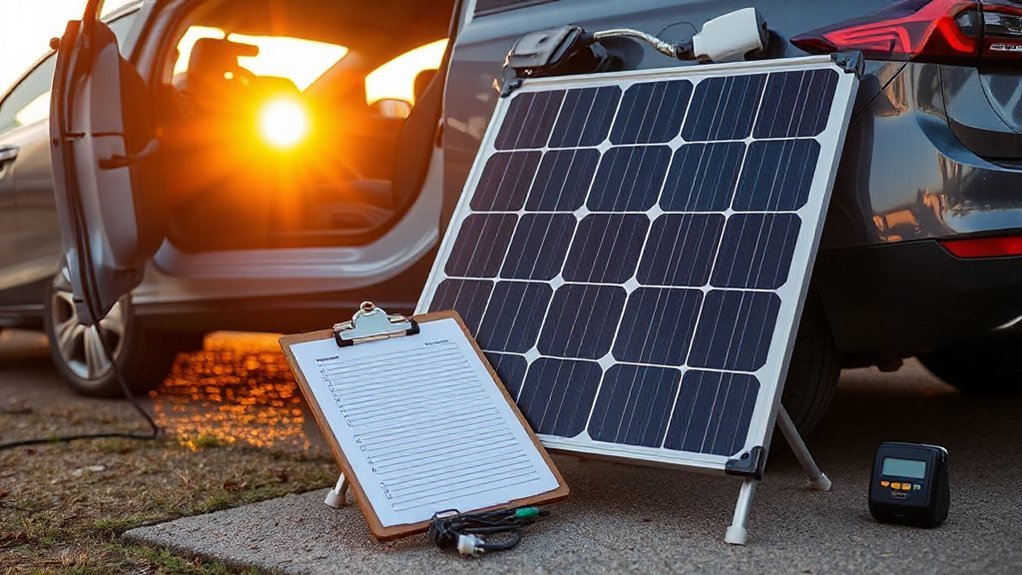
With connectors and MPPT limits already matched, focus on panels and kits that minimize deployment time and maximize energy per dollar. Prioritize installation speed: you’ll aim for <2 minutes from bag to charging, hinged tri-folds with integrated kickstands and captive MC4 leads. Quantify value: target ≥0.7 W/$, ≥120 W/kg, and ≥180 W/m² under STC. Verify real-world yield: ≥80% of STC at 800 W/m², 45–60°C temps, -0.30%/°C power temp coefficient or better. Check durability: IP65+ laminates, PET/ETFE abrasion resistance, wind stability ≥25 mph. Assess wiring: preconfigured series/parallel jumpers, 3–5 m 12 AWG cables, strain relief. Confirm carry metrics: <20 lb, <30 L packed volume. Buyer priorities checklist: setup time, energy density, W/$, cable management, weather rating, warranty (5–10 years), safety certifications (UL/IEC), labeling and documentation.
Conclusion
You’ve seen the numbers: for Level‑1 top‑ups, stack 300–400 W portable panels that hold ≥80% at 800 W/m², feed MPPT‑friendly 18–36 V, and pack >10 W/lb. Choose ETFE or tempered laminates, IP65 junctions, and MC4/XT60 leads for plug‑and‑play. In the field, these rigs sip electrons like a steady metronome, turning sunlight into reliable miles. Prioritize compact folded volume, certified safety, and setup under 2 minutes to keep your charging cadence sharp—rain, dust, or glare alike.