You don’t need DC fast charging for daily use—Level 2 at 240 V supplies 3–19 kW via SAE J1772/IEC Type 2 to your onboard charger, with IEC 61851 pilot signaling and GFCI protection. Expect roughly 12–60 miles/hour, limited by vehicle OBC amperage. Proper installs need dedicated 40–100 A circuits and NEC 625 compliance. Smart scheduling, load sharing, and revenue-grade metering change the math—so which specs actually matter for you?
Key Takeaways
- Level 2 uses 240 V AC with SAE J1772/Type 2; the EVSE advertises current via pilot PWM, and the onboard charger rectifies to DC.
- Typical power is 3.3–19.2 kW; common 7.7–11.5 kW yields about 20–40 MPHc; 7.7 kW adds ~26 miles/hour at 0.30 kWh/mi.
- Install on a dedicated 240 V circuit sized at 125% continuous; a 40 A EVSE needs a 50 A breaker per NEC 625.
- Safety features include 20–30 mA GFCI, ground continuity, and isolation tests; look for UL 2594 units with NEMA 4/IP66 outdoor enclosures.
- Hardware costs $400–$2,000; installation $800–$3,000; incentives include 30C tax credit and utility rebates; smart units support Wi‑Fi, OCPP scheduling, and load balancing.
How Level 2 Charging Works
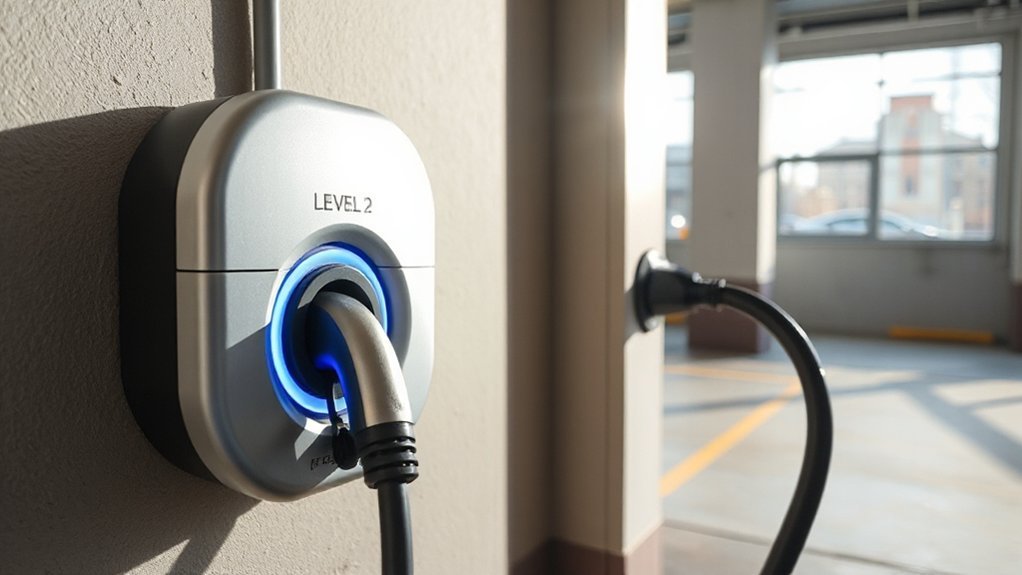
How does a Level 2 EVSE deliver energy to your EV? The EVSE supplies 240 V, 60 Hz AC through a contactor only after control-pilot handshaking per SAE J1772/IEC 61851. You connect via connector standards such as SAE J1772 (Type 1) or IEC 62196-2 (Type 2) with proximity detection and temperature sensing. The pilot’s PWM duty cycle advertises the EVSE’s continuous current limit (e.g., 16–80 A); your onboard charger enforces it and performs AC rectification to regulated DC for the battery. Ground-fault monitoring (typically 20–30 mA trip), equipment grounding, and isolation tests precede energization. The EVSE measures leakage and opens the contactor on faults. Installation follows NEC Article 625; units are evaluated to UL 2231/2594. Optional OCPP metering reports kWh and status and telemetry.
Charging Speeds and Real-World Range Added

You quantify charging speed as miles per hour charged using mph ≈ (AC power in kW × vehicle efficiency in mi/kWh), within SAE J1772 Level 2 limits (typically 3.3–19.2 kW). With 240 V at 32–48 A (7.7–11.5 kW), you’ll typically add about 25–45 mi/h assuming 3–4 mi/kWh and ~8–12% charging losses. Range added varies with supply voltage (208 vs 240 V), onboard charger rating, SOC taper and battery temperature (per SAE/IEC guidance), and accessory/thermal loads.
Miles Per Hour Charged
Why does a Level 2 EVSE add roughly 10–40 miles of range per hour? Because SAE J1772 AC charging supplies 240 V at 16–48 A (3.8–11.5 kW), and your vehicle’s onboard charger converts that power into stored energy, typically 250–300 Wh/mi. Divide power by consumption to estimate miles per hour (MPHc). You can use MPHc for trip planning and charging etiquette decisions.
- Example: 32 A at 240 V = 7.7 kW → 7.7/0.30 ≈ 26 mi/h (EPA mixed).
- Onboard charger max kW caps MPHc; a higher-rated EVSE can’t exceed it.
- Circuit sizing: a 40 A breaker supports 32 A continuous per NEC 625, ~7.7 kW.
- For precision, use vehicle-reported Wh/mi instead of generic EPA values for daily energy budgeting plans.
Range Added Factors
Accounting for both charging power and vehicle energy use, real-world miles per hour charged (MPHc) varies with electrical supply, vehicle limits, and conditions. On Level 2, MPHc ≈ (V×A×η_chg)/Wh_per_mile. With 240 V at 32 A, η_chg≈0.90, you add ~6.9 kW; at 300 Wh/mi, that’s ~23 MPHc. Onboard-charger limits (e.g., 7.2 or 11.5 kW) and J1772/NEC rules (continuous load ≤80% of breaker) bound current. Battery temperature and state-of-charge taper reduce effective power. Real-world Wh/mi depends on speed, driving style, HVAC, tire pressure, and terrain elevation; headwinds or climbs can push 300→380 Wh/mi, dropping 23→18 MPHc at constant kW. Cold-soaked packs raise losses and cabin loads. Measure kWh added and miles driven to calibrate your vehicle-specific MPHc. Use logged data across seasons for robust planning accuracy.
Installation and Electrical Requirements
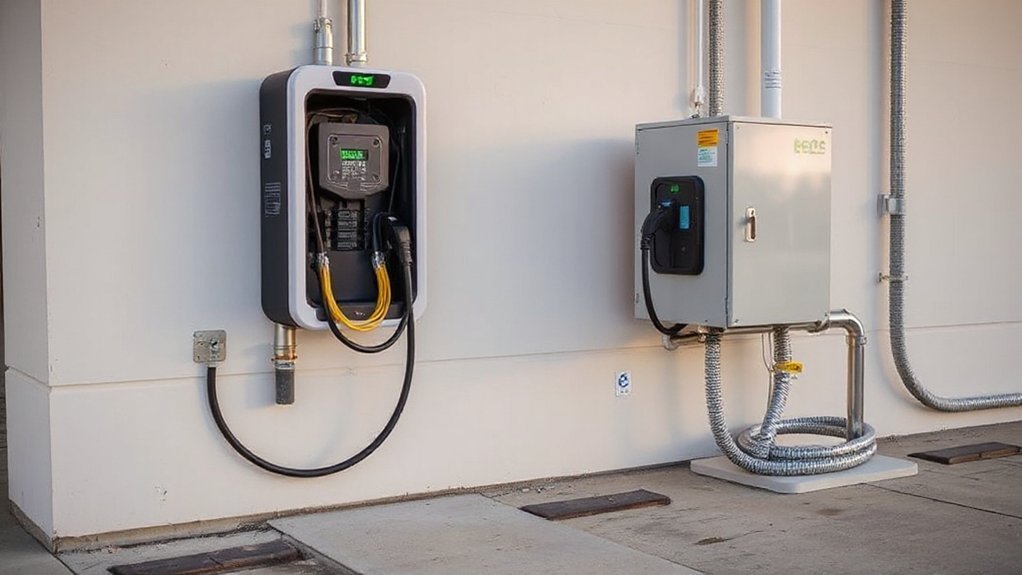
Before selecting hardware, confirm compliance with NEC Article 625 and local amendments, then size and install the branch circuit accordingly. Use a dedicated 240 V circuit sized at 125% of continuous load per NEC 210.19(A)(1); a 40 A EVSE requires a 50 A breaker, 8 AWG Cu THHN in 3/4 in. EMT. Provide GFCI where required; label disconnecting means. Verify service capacity; maintain ≤80% panel loading on continuous duty. Coordinate permit process with the AHJ; plan conduit routing to keep voltage drop <3%.
Size EV circuits per NEC; 40A EVSE on 50A breaker; verify capacity; plan for <3% drop.
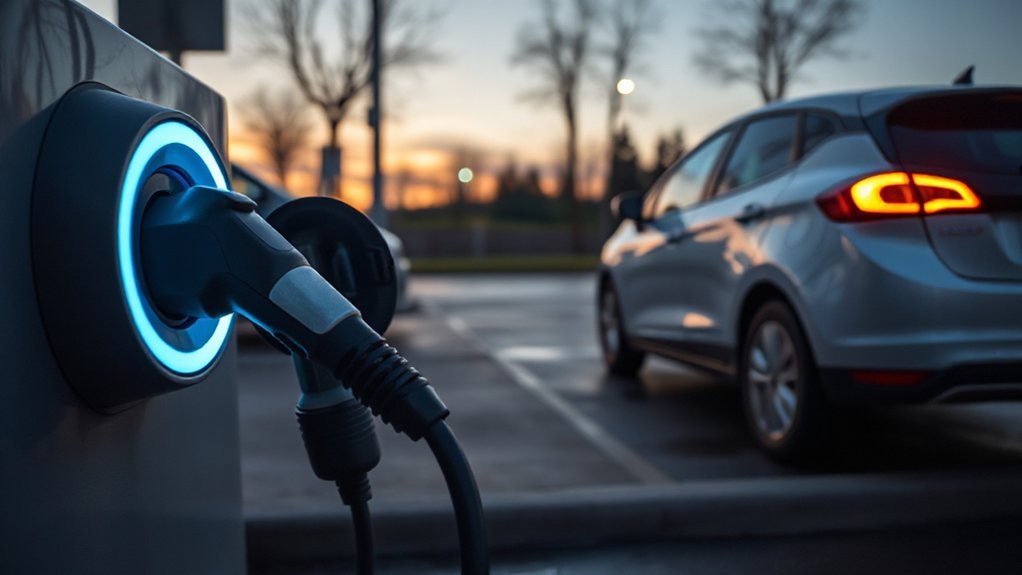


- Select UL 2594 EVSE, NEMA 3R/4X, -30–50 °C ambient.
- Limit impedance for ≤2% drop at 32–48 A; torque lugs to spec.
- Provide NEC 110.26 clearances; mount 18–48 in. AFF.
- Bond equipment grounding conductor, test fault current path; properly record commissioning measurements.
Costs, Incentives, and Utility Programs
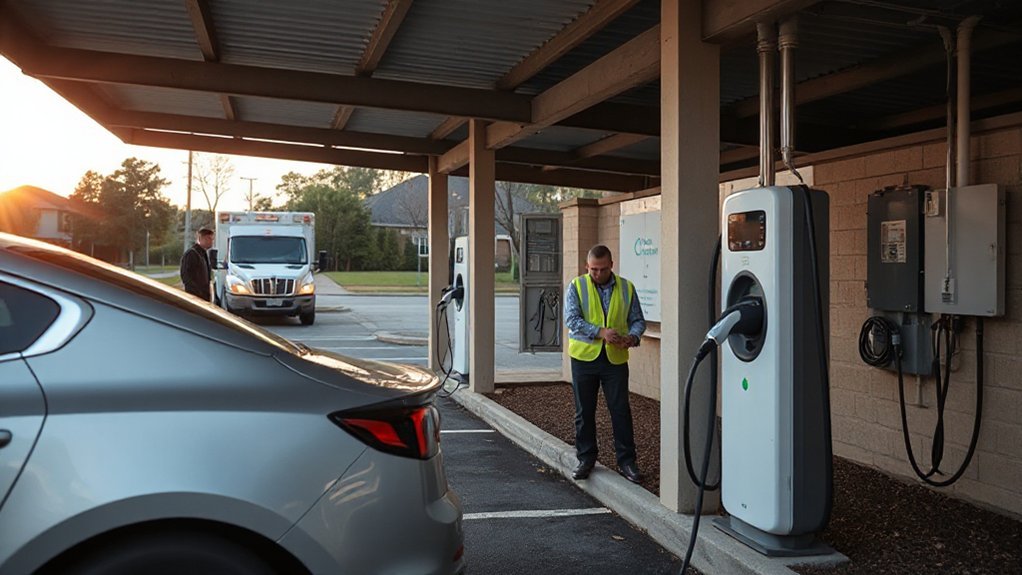
How much a Level 2 installation costs hinges on EVSE rating, run length, and any service upgrades: expect $400–$1,200 for basic UL 2594/CSA C22.2 No. 280 compliant units ($700–$2,000 for networked/OCPP models), plus $800–$3,000 for typical installation to NEC 625 (trenching/conduit can add $20–$60/ft; service upgrades run $1,500–$5,000). Add permit and inspection fees ($100–$500), utility meter work ($0–$800), and GFCI/Siemens-class breaker costs. You can reduce net cost via tax credits and utility programs. The federal 30C credit typically covers 30% of residential hardware and install, up to $1,000; commercial caps vary and may require eligible census tracts. Rebate eligibility often requires UL listing, licensed installation, closed permit, photos, and pre-approval. Utilities offer make-ready rebates, panel upgrade incentives, and EV time-of-use rates, plus bill credits.
Smart Features and Energy Management
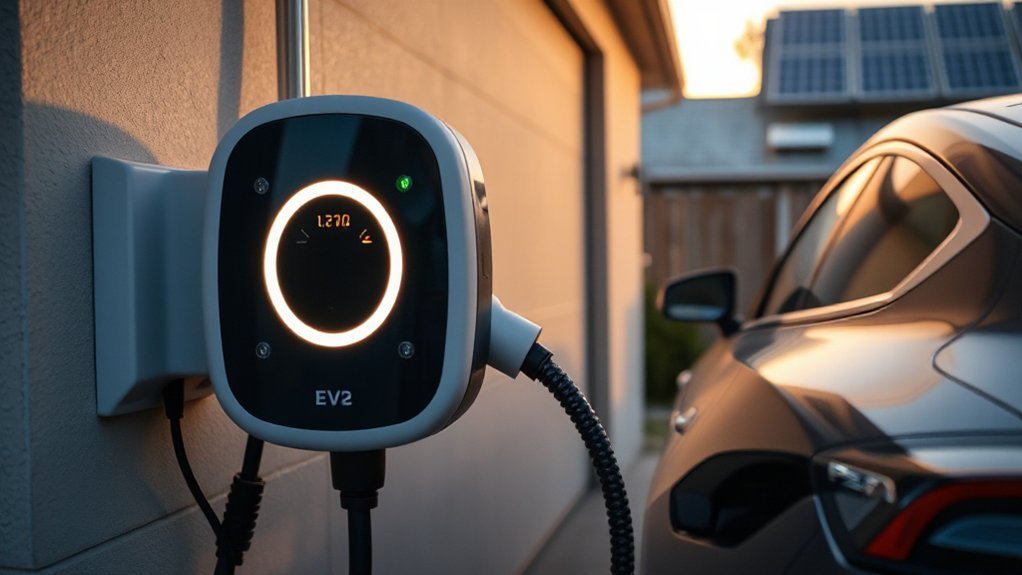
You use Wi‑Fi (802.11ac with WPA2/WPA3) and an OCPP 1.6/2.0.1 app to monitor kW/kWh, set current limits, and apply firmware updates over TLS 1.2+. With dynamic load balancing, you allocate amperage across multiple EVSEs to respect a site cap (e.g., 80 A branch, 19.2 kW max) via IEC 61851 control pilot and CT‑based feedback, preventing service overloads. You schedule sessions to TOU windows (e.g., off‑peak after 23:00) to minimize $/kWh and demand charges while meeting SAE J1772 signaling and NEC 625 load calculation requirements.
Wi‑Fi and App Control
Why do smart Level 2 EVSEs integrate Wi‑Fi, Ethernet, and OCPP-compliant app control? You gain standards-based telemetry (OCPP 1.6/2.0.1), secure provisioning, and remote management without lock-in. Over HTTPS/TLS 1.2+, the charger reports metrology (kWh, A, V), schedules charging by tariff windows, and executes Firmware Updates with signed images. You authenticate with OAuth2 and enforce MFA. Address Privacy Concerns by disabling unnecessary data fields and rotating tokens. With Ethernet, you get deterministic connectivity; with Wi‑Fi 802.11ac, you retain flexibility.
- SAE J1772 pilot/PP states in app; cap current 16–48 A per NEC 625 80% rule.
- Utility integration: OpenADR 2.0b maps to OCPP profiles for TOU compliance.
- PQ monitoring: log RMS voltage, frequency, THD; alert on ANSI C84.1 limits.
- Security hardening: WPA2-Enterprise, cert pinning, encrypted logs; RBAC.
Dynamic Load Balancing
Balancing feeder capacity in real time, dynamic load balancing allocates per‑EVSE current setpoints so aggregate demand never exceeds the service limit, OCPD, or NEC 625 continuous‑load 80% derate.
You meter feeder current, subtract building load, and compute per‑port limits: Iset = floor((Ifdr_available)/N), capped by each EVSE and cable rating (e.g., 32 A). Controllers publish setpoints via OCPP 1.6J/2.0.1 and verify with UL 2594/2231 limits. You can prioritize ADA spaces or low‑SOC vehicles to meet Equity considerations while satisfying Regulatory frameworks and utility interconnection rules.
| Parameter | Example |
|---|---|
| 100 A feeder, 80% rule | 80 A shared across 4 ports → 20 A/port |
| One 6.6 kW EV requests 32 A | Others throttled; port receives 32 A |
It minimizes nuisance trips, voltage sag, and transformer thermal stress under contingencies.
Time-of-Use Scheduling
Although driver convenience matters, Time-of-Use (TOU) scheduling shifts Level 2 charging to utility-defined off‑peak windows to minimize $/kWh and demand charges, while honoring NEC 625 continuous‑load limits and IEC 61851-1 control constraints. You map tariff periods, then set charge windows that cap pilot current so branch circuits stay ≤80% of rating. Smart EVSE reads EVSE/EV handshakes, modulates PWM duty cycle, and defers starts until price or demand thresholds trigger. With Tariff Optimization, you compute marginal $/kWh, include demand ratchets, and schedule to meet departure SOC with least-cost energy. Behavioral Incentives—price signals, gamified badges, and opt-in overrides—nudge adherence without compromising readiness.
- Aligns with SEP 2.0 price messages.
- Uses OCPP 1.6/2.0.1 smart charging profiles.
- Forecasts PV/backfeed limits via IEEE 1547.
- Verifies departure SOC using energy models.
Safety, Weatherproofing, and Certifications
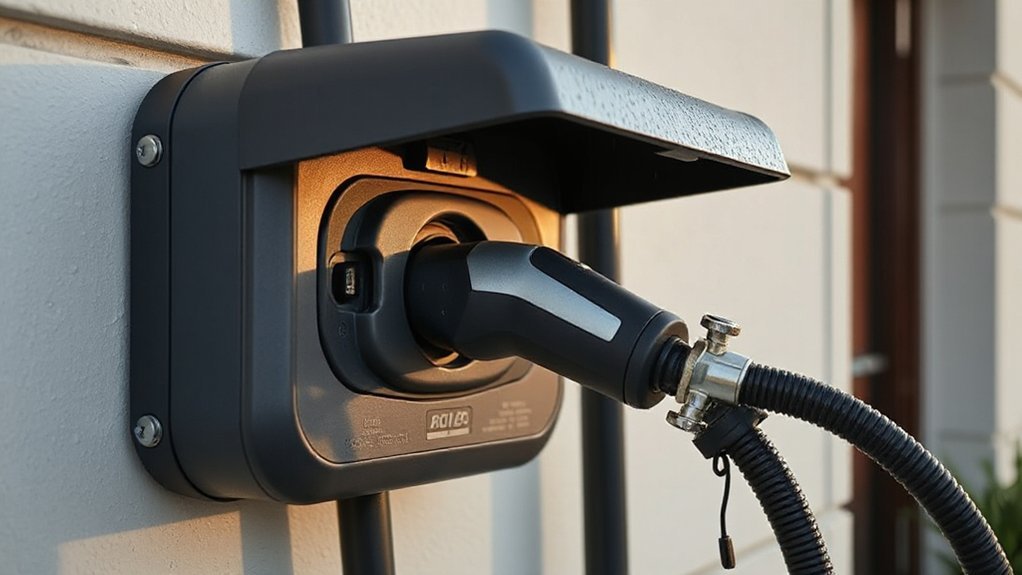
When you evaluate a Level 2 EVSE, anchor safety and weatherproofing to recognized standards and measurable ratings. Look for UL 2594 with UL 2231-1/-2, NEC 625 compliance, and SAE J1772. Specify NEMA 4 or 4X enclosures (IP66) for outdoor use and Corrosion resistance verified per ASTM B117 ≥1,000 h. Require integrated GFCI (20–30 mA), ground-continuity monitoring, auto self-test, and thermal derating. Confirm Tamper protection via locking holster and fasteners, plus firmware integrity checks. Check operating range −30 to 50 °C and impact IK08 or higher. Verify labeling: FCC Part 15, Energy Star (optional), and ETL/CSA marks.
| Parameter | Standard/Rating | Target |
|---|---|---|
| Ingress protection | NEMA 4/4X, IP66 | Outdoor, washdown |
| Electrical safety | UL 2594, UL 2231 | Trip 20–30 mA |
| Durability | IK08, UV, ASTM B117 | ≥1,000 h salt fog |
Conclusion
You leave with a full “tank” like a reservoir refilled overnight: at 9.6 kW (240 V, 40 A), you add ~30–35 miles/hour. Level 2 works to SAE J1772/IEC 61851 signaling, with GFCI, pilot duty-cycle control, and UL-listed hardware on a dedicated NEC 625 circuit. You’ll manage load, tariffs, and billing via OCPP demand response. Install for thermal clearance and weatherproofing (NEMA 3R/4). Do it right, and you’ll charge safely, efficiently, and standards-compliantly—at home or work.