Here’s a twist: a “40A charger” typically runs on a 50A circuit to satisfy the NEC 80% continuous-load rule. You’ll weigh your EV’s onboard charger limit, panel capacity, conductor size, and whether a NEMA 14‑50 plug or hardwired unit fits your site and local code. Factor GFCI requirements, load calculations, and future needs. Choose wrong, and you’ll overpay or undercharge—let’s sort what actually delivers safe, compliant speed.
Key Takeaways
- Charging speed: 40A ≈9.6 kW; true 50A ≈12 kW, ~25% faster if your car’s onboard AC charger accepts ≥50A.
- Onboard charger dictates draw; if your car is limited to 32–40A, a 50A EVSE won’t charge faster.
- NEC sizing: 40A EVSE needs 50A breaker; 50A EVSE often needs ~70A breaker and larger conductors.
- Installation: Plug‑in NEMA 14‑50 is usually limited to 40A; hardwired on a larger circuit can deliver ~48–50A continuous.
- Future‑proofing and costs: Upsize wiring/conduit now if panel capacity allows; voltage sag, heat, and software may reduce real‑world kW.
How Charging Speed Differs Between 40A and 50A
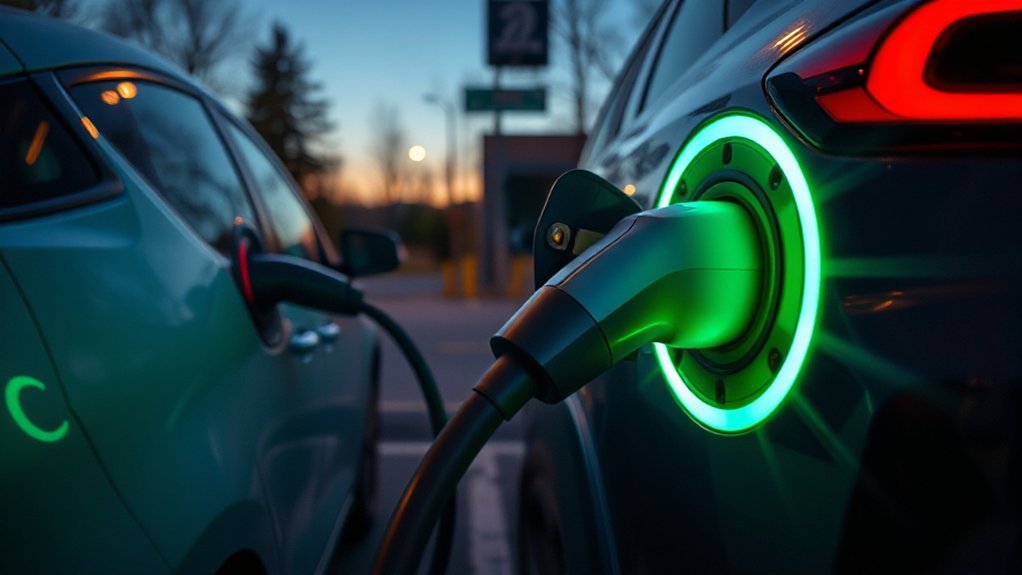
Because charging power scales with current at roughly 240 V, a 40 A EVSE delivers about 9.6 kW while a true 50 A output delivers about 12 kW—roughly 25% faster if your car’s onboard charger can accept it. That’s the theoretical delta; in Real world throughput, line voltage often sags under load, so power may be 8.9–11.5 kW. Temperature impact matters, too: hotter conductors and connectors raise resistance, triggering thermal throttling in the EVSE or vehicle inlet. For safety and code compliance, treat EV charging as a continuous load. A 40 A EVSE needs a 50 A breaker with #6 AWG copper; a 50 A EVSE needs a 70 A breaker with #4 copper. Verify lugs, terminations, and enclosure ratings before sustaining 50 A.
Matching Charger Output to Your EV’s Onboard Charger
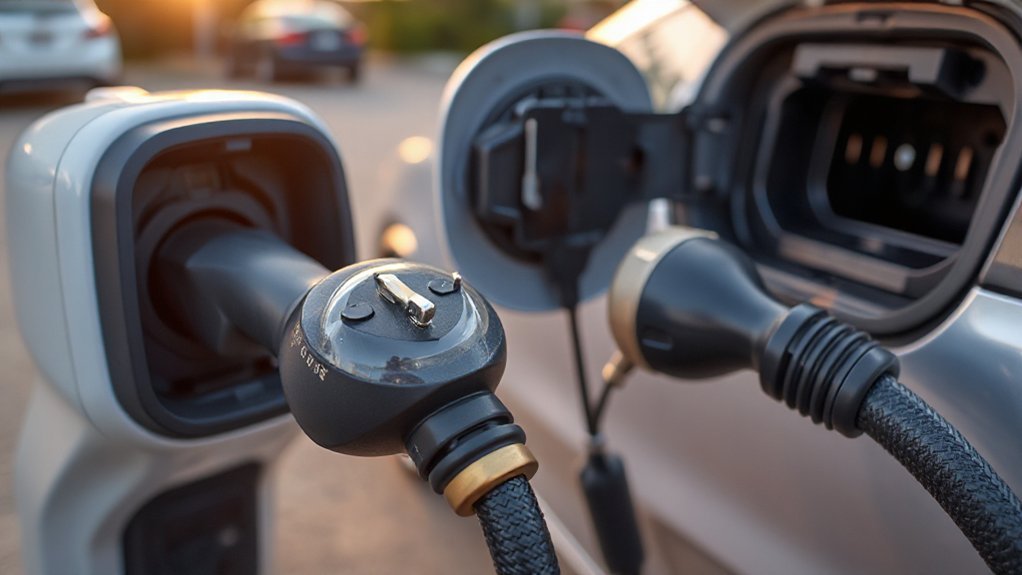
You need to match the EVSE’s output to your EV’s onboard charger limit (kW or amps), since the car caps AC charging current. For ideal pairing and code compliance, apply the NEC 125% continuous-load rule—use a 40A EVSE on a 50A circuit or a 50A EVSE on a 60A circuit—and set the EVSE so it never exceeds the car’s AC max. For future-proofing, you can install wiring and a breaker sized for a 50A EVSE now (subject to panel capacity), with permits and inspection to guarantee safety.
Onboard Charger Limits
While a 50‑amp circuit can supply more current than a 40‑amp one, your EV’s onboard AC charger ultimately sets the charging speed. The EVSE advertises available current via the pilot signal, and your car draws up to the onboard charger’s maximum—no more. If your vehicle’s AC charger is limited to 32 A, a 40 A or 50 A circuit won’t increase kW. Internal safeguards also cap draw: thermal throttling reduces amperage when inlet, cable, or battery temperatures rise; software limits may lower current due to battery state, grid conditions, or charger health. For code compliance, size conductors and breakers to the EVSE’s continuous load rating (typically 125% of sustained current) and use a dedicated circuit. Verify firmware settings and monitor charging logs for safety.
Optimal Amperage Pairing
Given the onboard charger sets the AC charging ceiling, ideal amperage pairing means sizing the EVSE and circuit to match your car’s max AC draw without exceeding code limits. If your EV draws 32A, use a 40A circuit and set the EVSE to 32A. NEC 625/210 requires 125% for continuous loads; a 40A onboard charger needs a 50A circuit, EVSE limited to 40A. Verify conductor gauge, GFCI protection, and enclosure rating. Align charging with User routines and Energy tariffs through scheduled charging, always within the EVSE’s configured limit. Hire a licensed electrician to perform load calculations, permitting, and commissioning.
- Feel confident: right-sized amperage prevents nuisance trips.
- Gain relief: compliant wiring reduces heat and fire risk.
- Enjoy certainty: matched output guarantees safety.
Future-Proofing Considerations
Although your current car may cap AC charging at 32–40A, future-proofing means matching today’s EVSE setting to the onboard charger yet installing infrastructure that can safely support higher draw later under NEC 625/210 continuous-load rules. Size the branch circuit, conductors, and breaker for 125% of continuous load: a 50A EVSE draws 40A; a 60A EVSE draws 48A. If you only need 32–40A now, set the EVSE accordingly, but run wire and conduit rated for a 60A or 70A circuit, space permitting. Perform a dwelling load calculation, verify panel capacity, and use GFCI protection per 210.8 and 625.54. This approach minimizes technological obsolescence, aligns with market incentives favoring faster onboard chargers, and avoids rework, overheating risks, and permit revisions later. Consult a licensed electrician early.
Breakers, Wiring, and the 80% Continuous-Load Rule

Because EV charging counts as a continuous load under the NEC, you must size the breaker and conductors at 125% of the EVSE’s maximum output current. That 80% rule means the circuit rating must exceed the charger’s nameplate. For a 40A EVSE, use a 50A breaker and conductors with at least 50A ampacity (often 8 AWG Cu, 75°C terminals). For a 50A EVSE, use a 70A breaker and conductors with at least 62.5A ampacity (often 4 AWG Cu).
Apply Conductor Sizing and Breaker Derating together: account for ambient temperature, insulation type, conduit fill, and termination ratings. Tighten lugs to spec and confirm GFCI where required.
1) Protect your home from overheated wiring.
2) Avoid nuisance trips and hazards.
3) Sleep easy knowing you’re code-compliant.
Plug-In (Nema 14-50) Vs Hardwired Setups
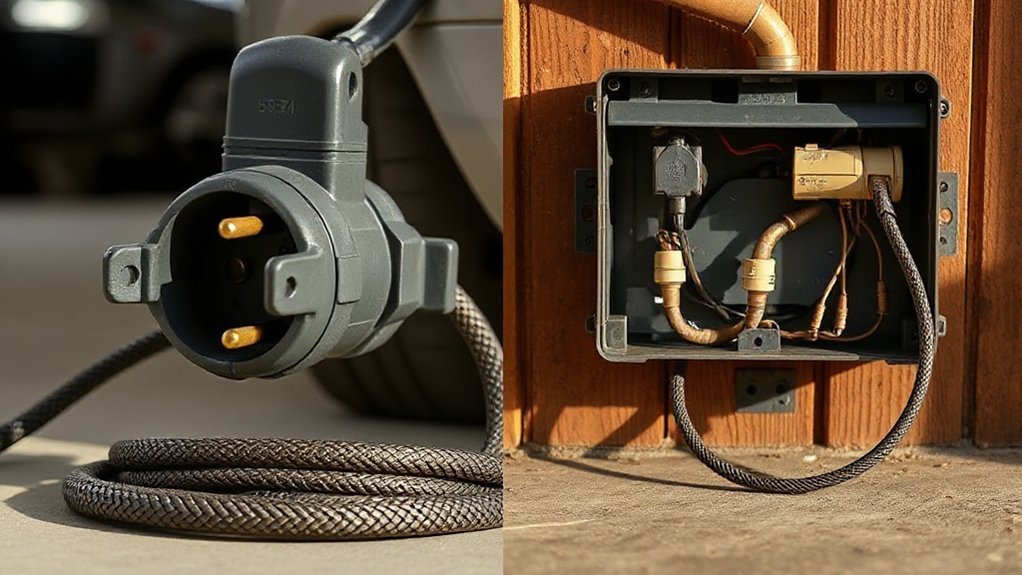
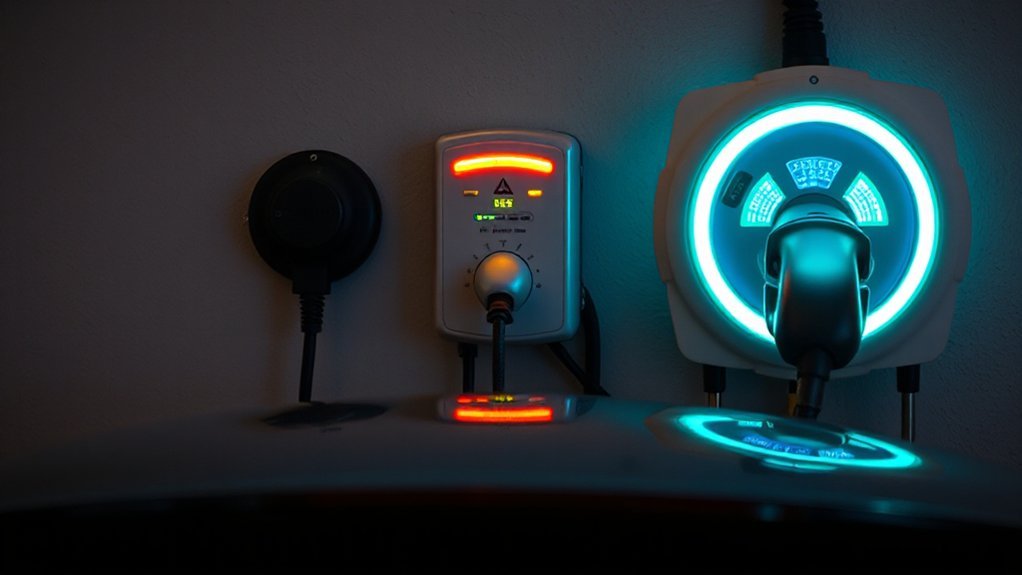


You’ll balance installation complexity and mobility: a NEMA 14-50 plug-in EVSE installs faster and moves easily, but you must use a properly rated 50A receptacle, required GFCI protection, and maintain clear working space per code. A hardwired unit needs a dedicated circuit and disconnect, reduces receptacle wear, and can run 48A continuous on a 60A breaker, while plug-in 14-50 setups are typically limited to 40A continuous on a 50A breaker. Match the setup to your load needs and future plans, and pull a permit with a licensed electrician.
Installation Complexity
While a plug-in EVSE on a NEMA 14-50 can look simpler, installation complexity hinges on code, load capacity, and protection requirements. You’ll run a load calculation (NEC 220) to confirm service capacity; a 40A EVSE uses a 50A breaker, a 50A EVSE uses 60A. A 14-50 in a garage needs a GFCI breaker, copper conductors sized for voltage drop, proper box fill. Hardwired units need a dedicated circuit, conduit, a disconnect if not within sight or over 60A, and routing that respects Site accessibility, Mounting options, working clearances, and wet-location rules. Pull permits, follow instructions, and pass inspection verifying torque, bonding, and GFCI/AFCI coordination.
- Reduce risk; protect your family and home.
- Avoid rework; pass inspection the first time.
- Charge confidently; code compliance delivers peace.
Flexibility and Portability
Even though a plug‑in EVSE on a NEMA 14‑50 gives you true portability—unplug it, move it to another location, or take it on the road—it’s constrained by receptacle rules and continuous‑load limits. You gain flexibility for rentals, relocations, or backup use at cabins and friends’ homes. Choose a unit with a locking plug, proper strain relief, and a holster; store cables in Travel Cases to protect terminals. Verify the receptacle is listed, GFCI‑protected where required, mounted in‑use, and inspected for heat discoloration.
A hardwired EVSE isn’t portable, yet it’s mechanically secure, weather‑sealed, and tamper‑resistant. You’ll appreciate fixed routing, drip loops, and fewer plug blades to wear. Weight Comparison matters: lighter plug‑in models are easier to pack; heavier hardwired enclosures suit permanent, code‑compliant mounting best.
Power Capacity Limits
Because EV charging is a continuous load under NEC 625, a 50‑amp NEMA 14‑50 branch circuit can only deliver 40 amps continuous to a plug‑in EVSE (about 9.6 kW at 240 V). A hardwired EVSE on a 60‑amp circuit may deliver 48 amps (≈11.5 kW), provided conductors, breaker, and labeling match listing. You avoid receptacle heat, cord cap wear, and plug derating.
Hardwired or plug‑in, size conductors for 75°C terminals, use GFCI protection where required, and verify panel capacity. In multifamily or commercial sites, coordinate transformer capacity and demand charges; unnecessary peaks cost money and stress infrastructure.
1) Enjoy faster, safer charging without stressing your panel.
2) Avoid nuisance trips and overheated plugs.
3) Protect your budget from surprise demand charges.
Plan for growth.
Installation Costs, Panel Capacity, and Code Considerations

How do installation costs, panel capacity, and code rules tip the balance between a 40A and 50A EV charger? Start with your budget: permit costs, inspection fees, and rebate availability can narrow the gap, but labor, run length, and penetrations drive most expense. A 50A circuit needs larger conductors and a bigger breaker than 40A, raising material and conduit costs. Per NEC continuous-load sizing, a 50A branch circuit supports a 40A EVSE; a 40A circuit supports 32A.
Verify panel capacity. Do an NEC 220 load calculation; if the service or bus is near its rating, you may need a derate or service upgrade. Plan GFCI protection for NEMA 14‑50 garage receptacles; hardwired EVSEs include GFCI. Check voltage drop and upsize conductors for long runs.
Future-Proofing: When a 50A Setup Makes Sense

While your current charging needs may be modest, a 50A setup makes sense if you want faster Level 2 charging without committing to a service upgrade. A 50A breaker with a 40A EVSE follows the NEC 80% rule, giving you headroom for dwell charging and future models. You’ll run larger conductors once, use a dedicated circuit, and keep voltage drop in check. Permit the work, use copper THHN/THWN-2 in conduit or NM-B where allowed, and require inspection.
- Feel ready for road-trip recovery with 40A continuous charging.
- Boost resale appeal; buyers recognize upgrade-ready, code-compliant wiring.
- Prepare for vehicle to grid or higher onboard chargers without re-wiring.
If panel space allows, install NEMA 14-50 or hardwire, GFCI as required, and label the disconnect.
Conclusion
You should pick the amperage that matches your EV’s onboard charger, budget, and panel. A 40A EVSE on a 50A breaker is simple and economical. A hardwired 50A unit on a properly sized circuit can feel lightning-fast, yet demands heavier conductors and capacity. Follow the 125% continuous-load rule, use listed equipment, and pull permits. Choose NEMA 14‑50 only if code-allowed and load-calcs pass; otherwise hardwire. Future-proof if you’ll upgrade vehicles—safely, not heroically and thoroughly inspected.