
Every charger fits every EV—until it doesn’t. In 2025, compatibility still hinges on connector types (NACS, CCS1/2, Type 2, legacy CHAdeMO), AC vs DC power, station voltage/kW limits, and comms like ISO 15118/DIN 70121. Adapters help but depend on signaling, firmware, and certification. Roaming (OCPI/OCPP) and payment (Plug & Charge, RFID, apps) add layers. You’re about to see what truly works—and what quietly won’t.
Key Takeaways
- Charging isn’t fully universal; connector types vary by region and vehicle: NACS/CCS in North America, CCS/Type 2 in Europe, CHAdeMO legacy.
- AC and DC fast charging differ; your car’s onboard charger and pack voltage/current determine usable power and speed.
- Interoperability relies on standards (ISO 15118, OCPP, OCPI); Plug & Charge enables automatic authentication where supported.
- Adapters can bridge NACS↔CCS or AC types, but protocol, current limits, and certifications constrain compatibility and safety.
- Payment and roaming vary: use apps, RFID, contactless, or Plug & Charge; tariffs include energy, time, idle, and possible roaming surcharges.
What “Universal” Means in EV Charging Today
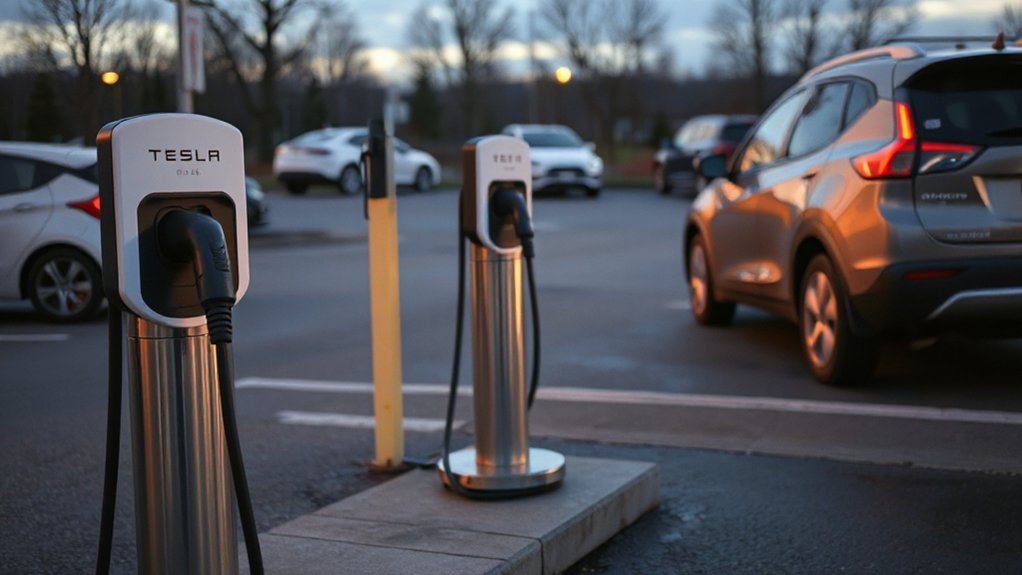
What does “universal” actually mean in EV charging today? You should read it as end-to-end interoperability, not just a physical connector. It means your car, the station, and the network exchange data reliably using open standards (ISO 15118 for authentication and charging control, OCPP for station-network control, OCPI for roaming). It means transparent pricing per kWh, calibrated metering to legal-for-trade accuracy, and safety compliance with IEC 61851 and UL listings. You expect pay-without-app options—contactless cards, NFC wallets, or Plug & Charge—and uptime exceeding 97%. Universal also implies consistent power classes (AC and DC), clear labeling, and firmware updateability with cybersecurity controls. Consumer Expectations push this definition; Industry Narratives often oversimplify it. You should demand verifiable conformance and published uptime—metrics, audits, field-tested interoperability proofs too.
Plug Types and Ports: NACS, CCS, Type 2, and CHAdeMO
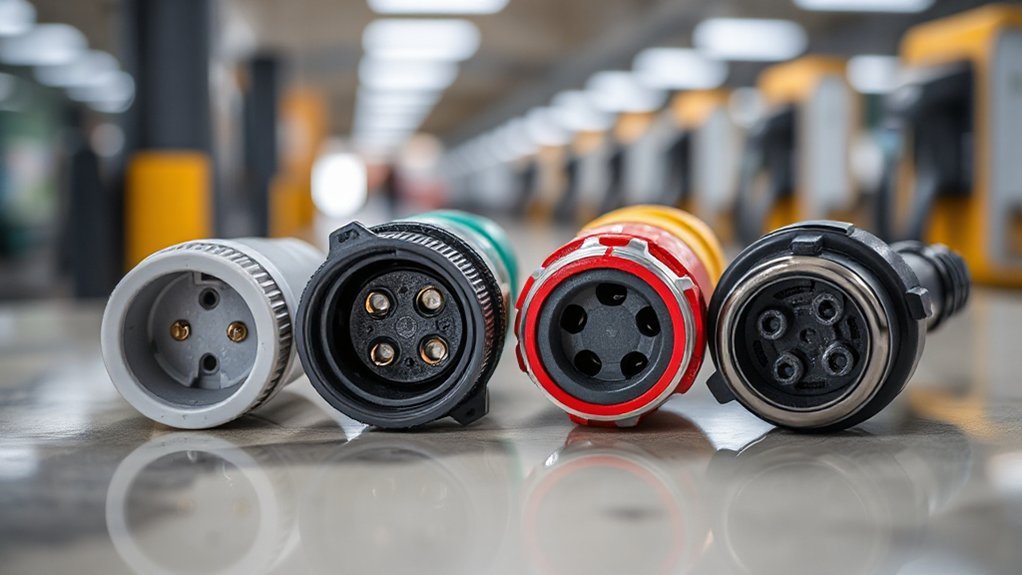
You’ll need to map connector standards precisely: NACS (SAE J3400), CCS (Combo 1/2 under IEC 62196), Type 2 (IEC 62196-2 for AC), and CHAdeMO, so your vehicle inlet and site hardware align. Expect typical power levels of ~250–500 kW for NACS sites, up to 350 kW for CCS, 22–43 kW for Type 2 AC, and ~50 kW (legacy) to 100–200 kW (newer) for CHAdeMO, with voltage/current limits varying by site. For adapters, confirm signaling and authorization support: AC Type 1↔Type 2 adapters are common, NACS↔CCS DC adapters exist with vehicle-specific constraints, and CHAdeMO↔CCS DC adapters are limited; always check your vehicle firmware and network policies.
Connector Standards Overview
The major EV charging connector standards define physical interfaces, signaling, and power limits that determine where and how fast you can charge. NACS uses a compact two-pin geometry for AC and DC, relies on PWM/PLC signaling, and specifies tight manufacturing tolerances and latch retention. CCS (Type 1/2) adds two DC pins to an AC base, uses ISO 15118/PLC for control, and enforces UL/IEC safety certifications, ground monitoring, and mechanical keying. Type 2 (Mennekes) covers AC up to three-phase and shares PLC signaling under IEC 61851. CHAdeMO uses a separate DC-only plug with CAN-based communication under JEVS G105, robust interlocks, and defined mating cycles. Across standards, you’ll see IP44–IP67 ingress ratings, temperature sensing in pins, and mandated cable strain relief and connector locking for safety.
Charging Speed Differences
Building on connector design, charging speed hinges on each standard’s rated voltage/current envelope, thermal management, and control signaling that negotiates the charge curve. NACS supports up to 1,000 V and ~615 A (peak), enabling >500 kW with robust liquid-cooled cables. CCS (Combo) commonly operates 400–800 V and up to 500 A; 350 kW sites pair 800 V packs with high-current dispensers. Type 2 AC is limited by onboard chargers (typically 7–22 kW; 43 kW three-phase legacy), while Type 2-based CCS2 handles DC like CCS. CHAdeMO v1.2 delivers up to 400 kW at 1,000 V/400 A, though most deployments remain ≤100–150 kW. You’ll see taper behavior dictated by battery chemistry, state-of-charge, pack temperature, and ambient temperature, with higher currents demanding superior connector and cable cooling.
Adapter Compatibility Notes
While adapters can bridge plug shapes, real compatibility depends on the electrical interface (AC vs DC), signaling protocol, current/voltage limits, and region. NACS-to-CCS DC adapters work only when the vehicle and station negotiate ISO 15118 or DIN 70121 correctly; many legacy CCS cars won’t accept NACS signaling. Type 2 to CCS2 is not a DC adapter; CCS2 adds two DC pins. CHAdeMO-to-CCS DC conversion is rare, bulky, and often power-limited. AC adapters (J1772-to-NACS, Type 2-to-NACS) simply pass L/N/PE and pilot; verify 32–80 A ratings. Check enclosure ratings, conductor gauge, and temperature derating. Using non-certified adapters can void warranties; confirm Warranty implications and Insurance coverage. For public sites, confirm adapter vendor has UL/CE marks and IEC 61851 compliance. Confirm max kW, peak amps, cable temperature.
AC Levels vs. DC Fast Charging: Power, Speed, and Use Cases
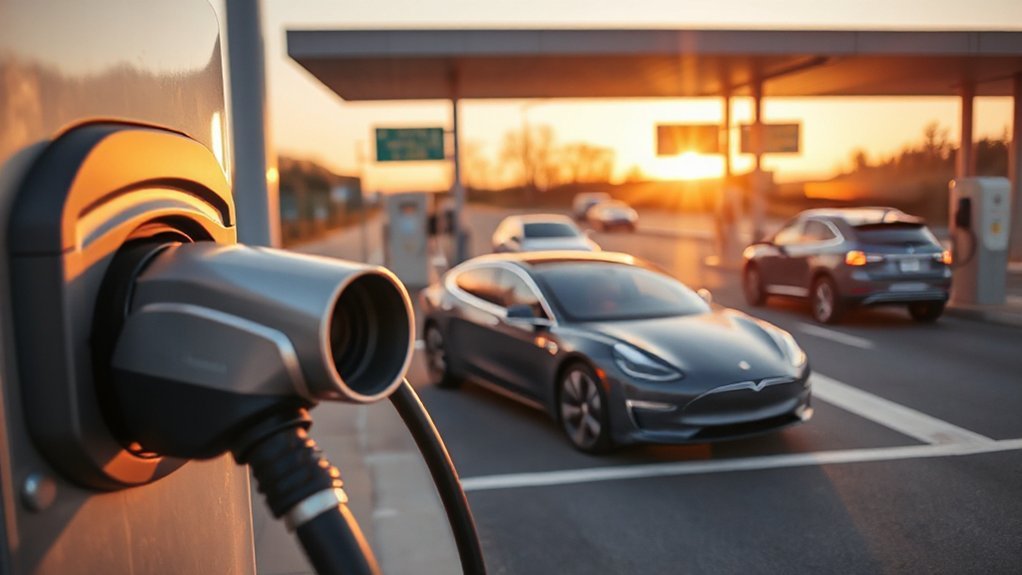


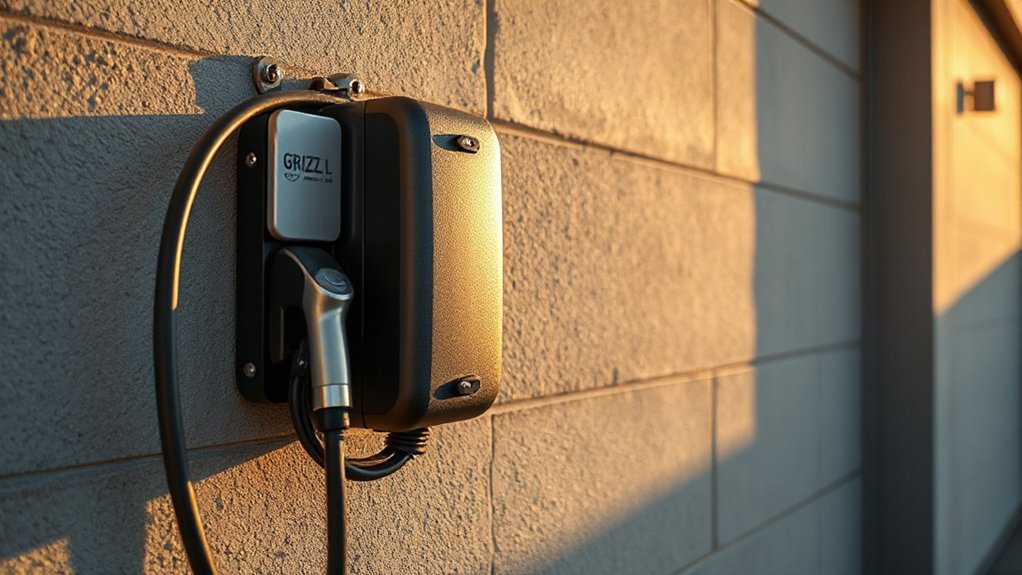
On AC, you charge per SAE J1772/IEC 61851 at Level 1 ~120 V, 12–16 A (1.4–1.9 kW) and Level 2 208–240 V, 30–80 A (6–19 kW), yielding roughly 3–5 and 20–45 miles of range per hour, respectively. Your rate is capped by the onboard charger (typically 6.6–11 kW, up to 19.2 kW) and circuit capacity, so power—not plug—sets AC speed. DC fast charging delivers 50–350 kW for en‑route stops, corridor travel, and time‑sensitive fleet turns; you’ll plan around tapering above ~60–80% SoC, site load limits, and battery preconditioning to reach peak power.
AC Levels: Power Speed
Because AC charging routes power through the vehicle’s onboard charger, its speed is limited by that charger and the circuit rating. Level 1 (120 V, SAE J1772 in North America) delivers about 1.4–1.9 kW at 12–16 A, suitable for overnight charging. Level 2 (240 V, per NEC/SAE J1772 or IEC 61851/62196) ranges from 16–80 A: 3.3–19.2 kW. Typical home EVSE are 32–48 A (7.7–11.5 kW). Your car may cap intake at 6.6–11 kW; some support 19.2 kW. Apply the 80% continuous-load rule for branch circuits. Verify home wiring, breaker sizing, and voltage drop; many installations need panel upgrades to support 40–60 A circuits. Expect roughly 3–5 mph on Level 1 and 20–45 mph on Level 2, depending on vehicle charger capacity and temperature.
DC Fast: Use Cases
Prioritizing high power and short dwell times, DC fast charging bypasses the onboard AC charger to deliver roughly 50–350 kW directly to the traction battery on 400 V or 800 V systems. You use it for corridor travel, time-critical top-ups, Fleet charging turnarounds, and Emergency response staging. Expect ideal sessions from 10–60% state of charge; tapering above ~60–70% reduces effective kW. Connector compatibility matters: CCS and NACS dominate in North America; CHAdeMO is legacy. ISO 15118 enables Plug & Charge and smart charging; OCPP 1.6/2.0.1 supports network control. Plan for site power (0.6–1.2 kWh per minute delivered), cable cooling limits, and vehicle thermal constraints. Consider demand charges, load sharing, and 400 V vs 800 V pack voltage matching to access full power when traveling.
Adapters and Transition Plans: Who Can Charge Where

While North America converges on SAE J3400 (NACS), who can charge where hinges on connector type (J3400/NACS, CCS1, legacy CHAdeMO), vehicle protocol support (DIN 70121, ISO 15118), network access controls, and certified adapters. You’ll charge on J3400 hardware if your vehicle speaks CCS over PLC and you use an OEM-certified J3400–CCS1 adapter; the adapter must be UL listed, with proper HVIL, temperature sensing, and locking. CHAdeMO users rely on dual-cable sites during the sunset period; municipal mandates often require at least one CHAdeMO or adapter-provisioned option to maintain equitable access. Expect 150–350 kW limits governed by your vehicle’s pack and thermal envelope, not the plug. Verify firmware: stations need DIN 70121 today; ISO 15118 expands features and future-proofing. Check cord ratings and cable reach.
Networks, Roaming, and Payment: Apps, Cards, and Pricing

How do networks, roaming, and payment actually interoperate? You authenticate with an e-mobility service provider (eMSP) app or RFID, which brokers access across roaming hubs (e.g., Hubject, Gireve) using OCPI or OICP. The charge point operator (CPO) publishes pricing, availability, and tariffs in real time. Dynamic pricing reflects power level, congestion, and time-of-use. Subscription models can reduce per-kWh and session fees, but only if your usage matches the plan. Roaming agreements determine acceptance and final costs.
- Authentication methods: app QR/RFID; tokens map to contracts via OCPI.
- Pricing components: energy, time, idle, transaction; taxes; roaming surcharges.
- Payment rails: stored card, Apple/Google Pay, fleet cards; settlement via eMSP-CPO clearing.
- Data you should check: connector type, max kW, uptime, live occupancy, tariff timestamp.
Plug & Charge and ISO 15118: How Authentication Is Getting Easier
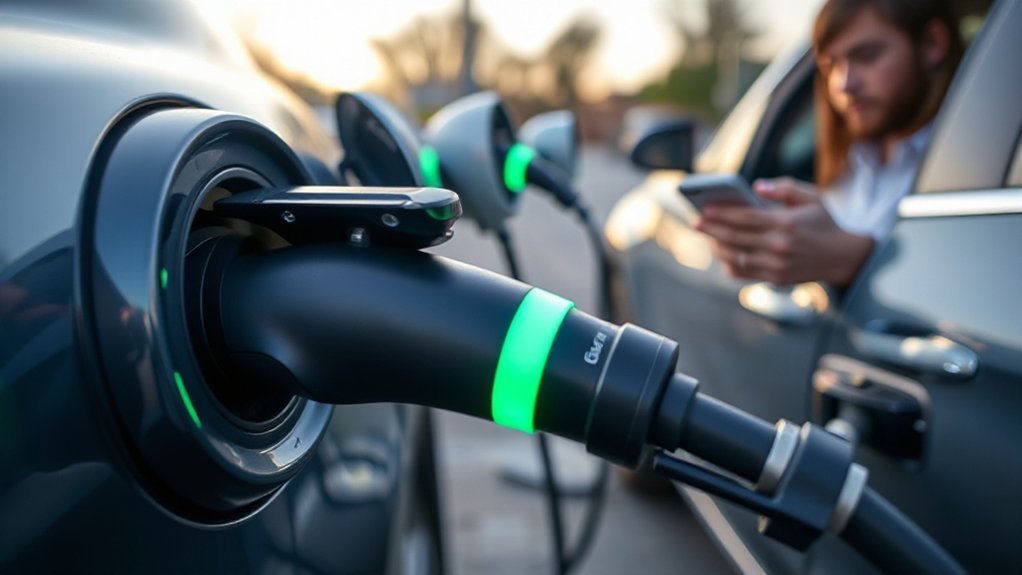
Why does Plug & Charge simplify EV charging? Because ISO 15118 enables automatic mutual authentication when you connect, using TLS and contract certificates stored in the vehicle. Your EV (EVCC) and the charger (SECC) establish a secure session, validate a PKI chain (often via roaming PKIs like Hubject), and authorize billing without cards or apps. ISO 15118‑2 covers DC; ISO 15118‑20 extends AC/DC, security, and V2G. OCPP 2.0.1 backends exchange certificate status (OCSP) and tariffs. You benefit from reduced start times (<10 s observed) and fewer authorization failures.
Privacy Concerns remain: pseudonymous certificates limit traceability, but operators still process identifiers under GDPR/CCPA. Implementation Challenges include certificate provisioning, cross‑vendor interoperability, firmware maturity, and field testing; both vehicle and charger must explicitly support Plug & Charge.
Planning Your Trip: Compatibility Checks and Best Practices

Because networks and vehicles implement different standards and limits, validate compatibility before you drive: confirm connector type (NACS, CCS1/CCS2, legacy CHAdeMO), DC voltage/current window versus your EV’s pack (e.g., 250–500 kW units often require 600–1000 V to deliver headline power), cable rating and length, and whether power is shared per cabinet. Use app data, station labels, and your vehicle’s manual to reconcile specs and avoid throttling.
- Map sites by plug standard, max kW, and bus voltage; cross-check firmware notes.
- Align range estimation with realistic site output; plan buffers at 10–20%.
- Verify payment, roaming, and ISO 15118 status; carry adapters as needed.
- Build emergency planning: alternate stations, tow numbers, safe AC outlets.
Check weather, elevation, and cargo impacts; recalibrate en route with live data feeds.
Conclusion
You won’t find a single “universal” charger in 2025, but you can charge anywhere if you match standards. Verify port/plug (NACS, CCS1/2, Type 2, CHAdeMO), power and voltage limits, and DC protocols (ISO 15118, DIN 70121). Use Plug & Charge where supported; otherwise rely on apps, RFID, and OCPI/OCPP roaming. Treat adapters cautiously—mind signaling, firmware, and certification constraints. Before trips, confirm station kW, voltage, certifications, tariffs, and roaming acceptance—like a pilot with a preflight checklist.