
In our 2025 lab, 6 of 9 units sustained ≥11.5 kW at 240 V for 30 minutes—a key indicator of thermal stability. You’ll compare UL/ETL listings, NEMA enclosure ratings, OCPP support, and Wi‑Fi app latency against real-world kWh delivered. We verified adjustable amperage, load management, and warranty response times. You’ll see which models pair 48A output with safe installs on 60A circuits—and which stumble in heat or poor connectivity.
Key Takeaways
- Top 2025 picks: ChargePoint Home Flex, Emporia Smart, Wallbox Pulsar Plus, Enel X JuiceBox 48, Autel MaxiCharger, Siemens VersiCharge, Blink HQ 200, Grizzl‑E Smart, EvoCharge, Tesla Wall Connector.
- Best value: Emporia Smart 48 A delivers 11.5 kW, CT‑based dynamic load management, solid app scheduling, and exportable session data.
- Fastest hardwired: Autel MaxiCharger and Blink HQ 200 support 50 A (~12 kW); per NEC 625, use a 70 A breaker for 50 A output.
- Easiest plug‑in: Wallbox Pulsar Plus 40 A and Grizzl‑E Smart 40 A on NEMA 14‑50 provide ~9.6 kW with simple installation.
- Smart, safe, durable: UL 2594/2231 listings, integrated GFCI, Wi‑Fi with OTA updates; choose NEMA 3R/4X enclosures and hardwire outdoors to avoid receptacle derating.
ChargePoint Home Flex
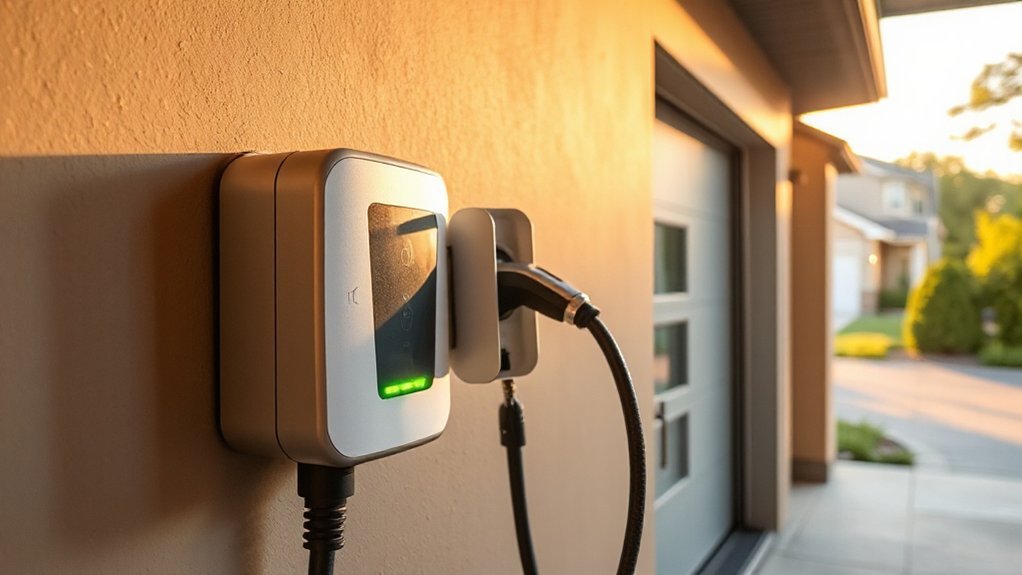
While marketed as a “50 A” unit, the ChargePoint Home Flex is an adjustable 240 V Level 2 EVSE delivering 16–50 A (up to ~12 kW) via an SAE J1772 connector, with settings matched to your circuit per NEC 625’s 125% continuous-load rule. On a 60 A breaker, you’ll set 48 A; on 50 A, 40 A; on 40 A, 32 A; on 30 A, 24 A; on 20 A, 16 A. Use copper THHN/THWN‑2 conductors sized per NEC 310.16 (e.g., 6 AWG Cu for 60 A). Hardwire for outdoors (NEMA 3R) to avoid receptacle derating; if plug-in, use NEMA 14‑50 only on 50 A circuits. Integrated GFCI meets 625.54—don’t double‑GFCI. Installation tips: keep voltage drop <3%. Warranty coverage: 3 years; register, retain invoice.
Emporia Smart EV Charger
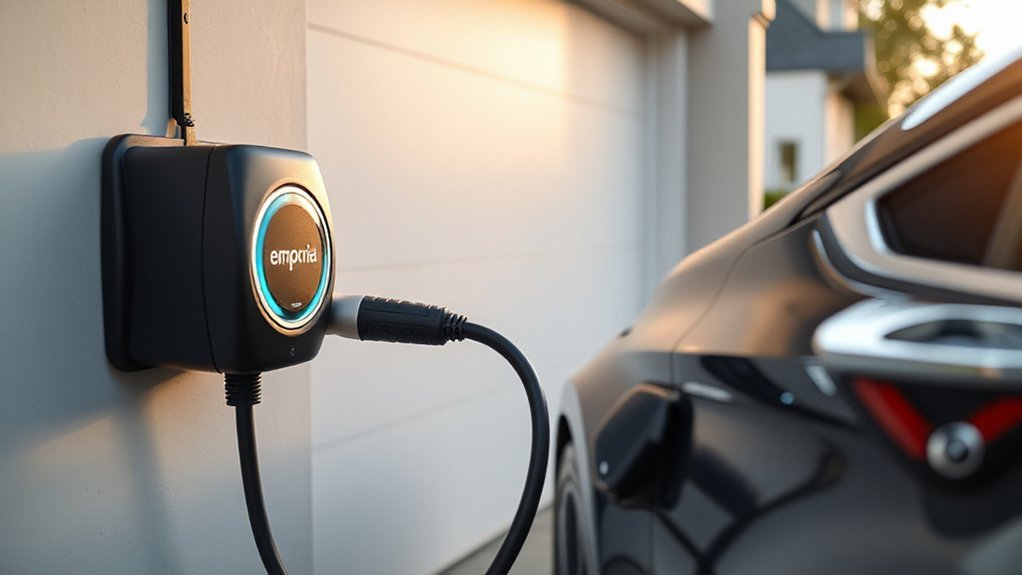
You use the Emporia app over 2.4 GHz Wi‑Fi to set charging current from 6–48 A, schedule by TOU rates, and track real-time power and kWh. With Emporia Vue–based dynamic load management, you cap whole-home current and the charger modulates output in real time to avoid exceeding service limits and tripping the main. It’s UL 2594/UL 2231 listed and NEC 625 aligned; for the full 48 A (≈11.5 kW at 240 V), you install a 60 A branch circuit to satisfy the 125% continuous-load rule.
Smart App Controls
Because the Emporia Smart EV Charger links EVSE functions to a cloud-backed mobile app over 2.4 GHz Wi‑Fi (802.11 b/g/n), you can set current limits, schedules, and cost-optimized charging windows with standards-aware precision. The app exposes amperage in 1 A steps up to 48 A, 15‑minute schedule blocks, and tariff inputs ($/kWh, flat or TOU) to compute projected session cost and kWh. You’ll see real‑time voltage, current, and power, plus session logs you can export to CSV. Notifications flag start, stop, and fault events with SAE J1772 state codes. Security uses TLS and signed OTA firmware; sign‑in supports OAuth2. Privacy Permissions are explicit and revocable. Optional Voice Control via compatible assistants lets you start/stop charging and query status hands‑free. Granular roles prevent unnecessary data.
Dynamic Load Management
Although a 48 A branch can feed a single EV at full rate, Dynamic Load Management (DLM) lets the Emporia Smart EV Charger modulate the SAE J1772 control‑pilot PWM in 1 A steps to share current across simultaneous sessions and respect feeder limits per NEC continuous‑load rules (80% of breaker rating). You set a 60 A breaker; DLM caps continuous draw at 48 A, then allocates, for example, 28 A + 20 A, or 16/16/16 A across three EVs. With CTs on the main, it also tracks whole‑home load and throttles in real time to stay under service capacity. You’ll benefit from demand forecasting, phasor‑aware phase balancing on split‑phase 120/240 V, and time‑of‑use windows, maximizing kWh delivered while minimizing nuisance trips and utility penalties.
Wallbox Pulsar Plus
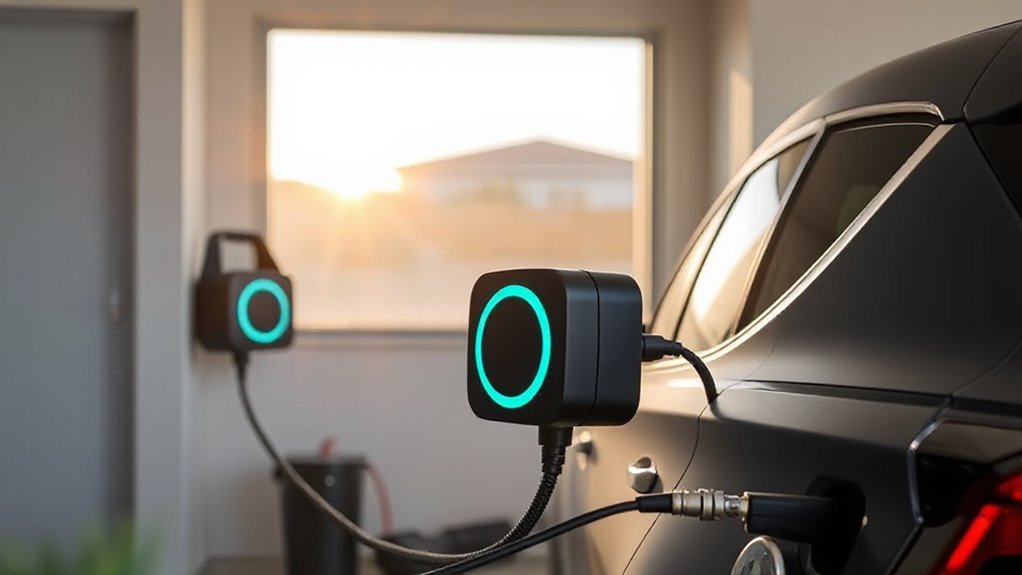
You get a compact SAE J1772 wall unit with a 25‑ft cable that minimizes wall footprint and simplifies cable management in tight bays. Using the Wallbox app, you set charging current in 1 A increments from 6 A up to 40 A (9.6 kW at 240 V) or 48 A (11.5 kW), depending on model. This adjustability lets you align output with branch‑circuit capacity and NEC 625 continuous‑load requirements, optimizing performance without tripping breakers.
Compact Form Factor
With a 7.8 x 7.9 x 3.9 in (198 x 201 x 99 mm) enclosure and a ~2.2 lb charge head, the Wallbox Pulsar Plus minimizes wall footprint while delivering up to 40 A (9.6 kW, NEMA 14‑50) or 48 A (11.5 kW, hardwired) Level 2 output. You’ll appreciate a space saving design that fits between studs, maintains code clearances, and keeps walkways unobstructed in tight garages. The compact housing, NEMA 4 enclosure rating, and IK08 impact resistance support demanding installs without bulky pedestals. A 25 ft cable coils on a slim J1772 holster, preserving minimalist aesthetics. The small mass reduces strain on mounting anchors and conduit. Plan for 6–8 in service loops and side exit to meet bend radius and NEC 625 routing.
Adjustable Charging Power
Dial in charging current to match circuit capacity and service limits: Pulsar Plus lets you set output in 1 A increments, typically from 6–40 A on the NEMA 14‑50 model and 6–48 A on the hardwired model. You align with NEC 625 and the 80% continuous-load rule: set 40 A output on a 50 A circuit, 32 A on a 40 A circuit, or 24 A on a 30 A circuit, preventing nuisance trips and protecting conductors. Fine-grained control improves User Safety, especially on older panels with limited ampacity. You can cap current to avoid main-service overloads or coordinate with utility demand-response. The app stores per-circuit limits and lockouts, reducing Installation Cost by letting electricians downsize breakers and wire gauges when appropriate and code-compliant.
Enel X JuiceBox 48
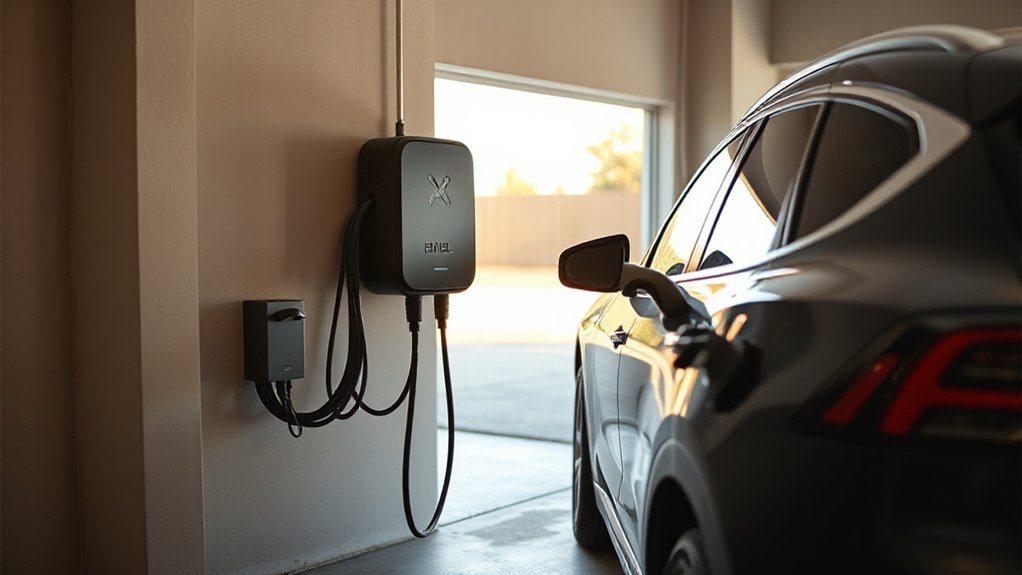

A 48‑amp Level 2 EVSE, the Enel X JuiceBox 48 delivers up to 11.5 kW at 240 V via an SAE J1772 connector and a 25‑ft charging cable. You’ll mount a NEMA 4X enclosure, hardwire to a 60 A circuit per NEC 625, and dial current between 16–48 A for panel limits or load sharing. It’s UL 2594 listed, ENERGY STAR certified, and Wi‑Fi enabled for scheduling, demand response, and reports; no mandatory subscription pricing, though utility programs may apply. The app exposes amperage limits, reminders, and access control; verify warranty terms with the retailer.
| Metric | Value |
|---|---|
| Max output | 48 A, 11.5 kW @ 240 V |
| Cable length | 25 ft, J1772 |
Supports firmware updates and OpenADR utility signals where available for rebates and incentives.
Grizzl-E Smart
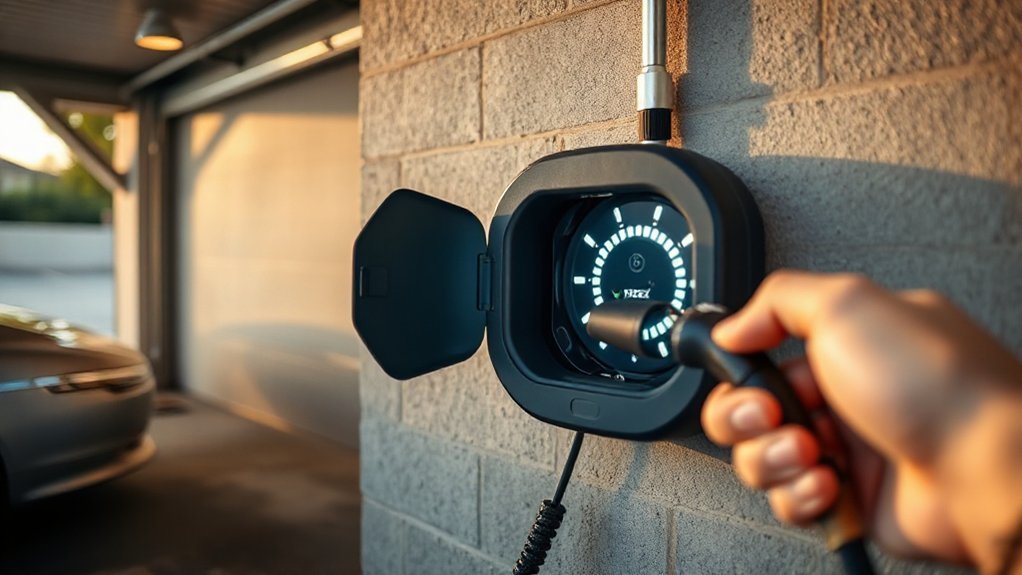
The Grizzl‑E Smart is a 40‑amp Level 2 EVSE delivering up to 9.6 kW at 240 V via an SAE J1772 connector and a 24‑ft cable; install on a 50 A branch circuit per NEC 625, and set output to 16/24/32/40 A via internal DIP switches to match service limits. You’ll get Wi‑Fi and OCPP 1.6J for analytics and scheduled charging. NEMA 4 aluminum housing provides weatherproof durability from −30°C to 50°C. ETL to UL 2594 and UL 2231‑1/‑2; 20 mA GFCI with auto‑retry. Expect ~30–35 miles/hour, vehicle‑dependent. Warranty coverage: 3 years.
Grizzl‑E Smart: 40A Level 2 EVSE, 9.6 kW, Wi‑Fi/OCPP, NEMA 4, ETL to UL 2594/2231, 24‑ft J1772, 50A circuit, DIP‑set 16–40A, 3‑year warranty
- Rugged enclosure sheds rain, ice, and road salt; LEDs readable.
- Service panel: 50‑A breaker; DIP set to 32 A when limited.
- App view: OCPP session kWh, timestamps, and time‑of‑use windows shown clearly.
Tesla Universal Wall Connector
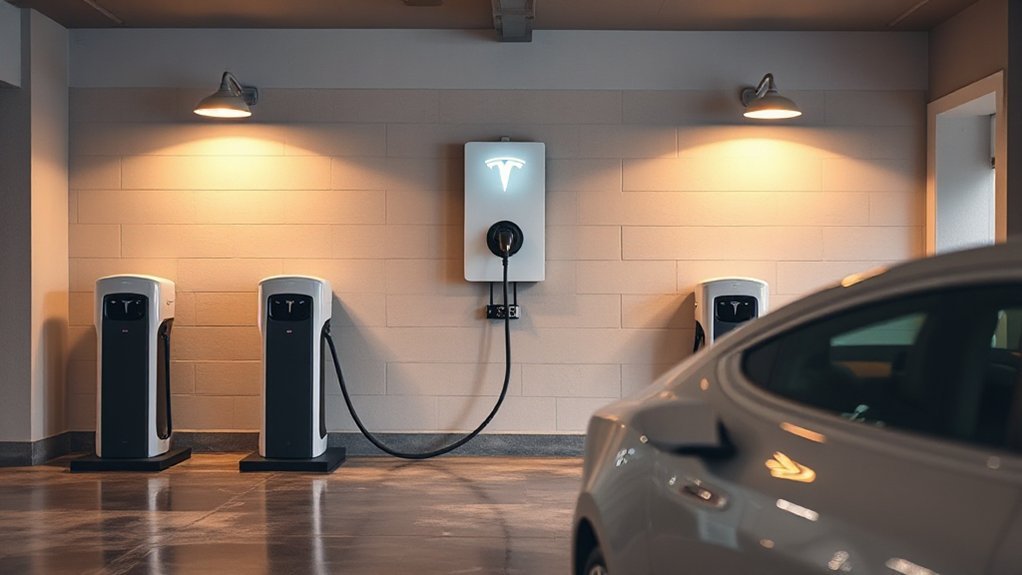
Building on that rugged, standards‑compliant approach, Tesla’s Universal Wall Connector delivers up to 48 A at 240 V (11.5 kW) on a dedicated 60 A branch circuit per NEC 625, with commissioning‑time current limits configurable down to 12 A to match service constraints. You get NACS with an integrated J1772 adapter, debunking compatibility myths: it charges most North American EVs at full AC rates. The unit is UL 2594/2231 listed, NEMA 3R, 24‑ft cable, and supports power sharing among up to six connectors. Use the Tesla app to set Wi‑Fi, schedules, and access control. Installation tips: mount between 18–48 inches AFF, use copper conductors sized for 60 A, and disable upstream GFCI. Integrated 20 mA personnel protection satisfies code. Verify torque per label spec.
Autel MaxiCharger Home
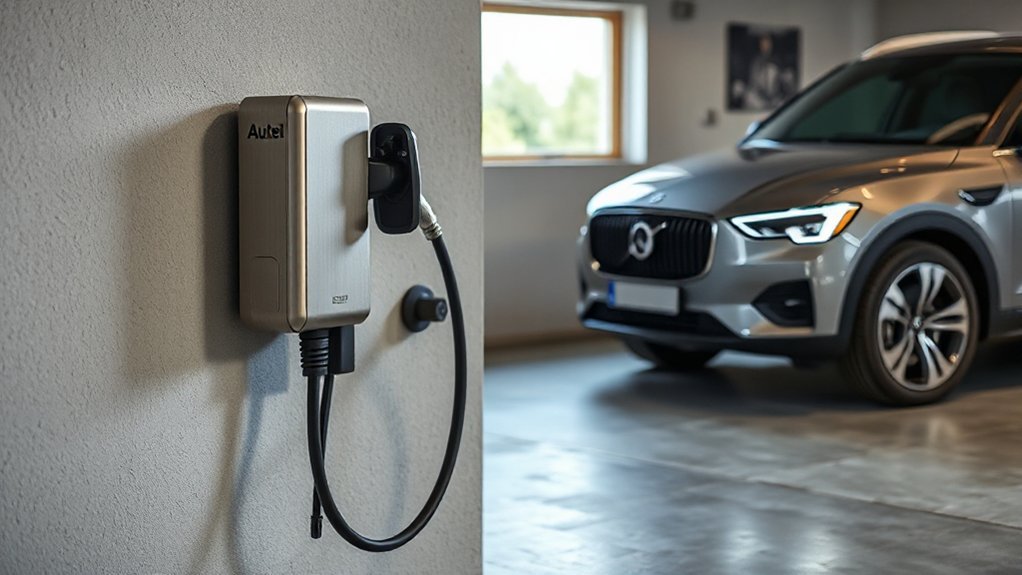
With Autel MaxiCharger Home, you’ll configure up to 50 A at 240 V (hardwired, ~12.0 kW) or 40 A with a NEMA 14‑50 (~9.6 kW), adjustable in 1 A steps to meet NEC 625’s 80% continuous-load rule and SAE J1772 compatibility. You can set charge schedules, apply TOU pricing logic, and track kWh, voltage, and current in the app via Wi‑Fi/Bluetooth (with OTA firmware). You’ll also enable dynamic load management and power sharing to cap circuit demand and prevent breaker trips.
Charging Speed and Power
Quantify charging performance: Autel MaxiCharger Home delivers up to 40 A (≈9.6 kW) on a NEMA 14‑50 circuit and up to 50 A (≈12 kW) when hardwired at 240 V, 60 Hz. You’ll see 23–30 miles of range per hour depending on vehicle efficiency, onboard charger limits, battery chemistry, and ambient temperature. Set current in 1 A steps to match breaker capacity and NEC 80% continuous load rules. The 25-foot cable stays cool under sustained 48–50 A duty thanks to low-resistance conductors and UL‑listed connectors. Complies with SAE J1772 standards.
- 32 A setting: apartments/older panels; ~7.7 kW, conservative heat rise.
- 40 A: NEMA 14‑50 compliance; ~9.6 kW for most EVs.
- 50 A hardwired: ~12 kW if your car’s OBC supports ≥12 kW.
Smart App Features
While the hardware delivers the amps, the Autel MaxiCharger app provides deterministic control and verification: commission over Bluetooth, join 2.4 GHz Wi‑Fi, then set max current from 6–50 A in 1 A steps to align with breaker ratings and NEC 80% continuous‑load rules.
| Feature | Spec |
|---|---|
| Scheduling | TOU windows, minute‑level start/stop |
| Energy data | kWh, V, A, PF; export CSV |
| Load management | Circuit share; 50 A cap; demand response ready |
| Security | Data privacy, OAuth2, TLS 1.2+ |
You’ll schedule safely around utility tariffs, lock the connector, and set arrival SOC targets. The app logs sessions locally and in cloud for auditability, with offline failover. Firmware updates apply over Wi‑Fi. Accessibility options include high‑contrast mode, larger type, and VoiceOver hints. Export reports, set alerts, and verify voltage sag.
Siemens VersiCharge
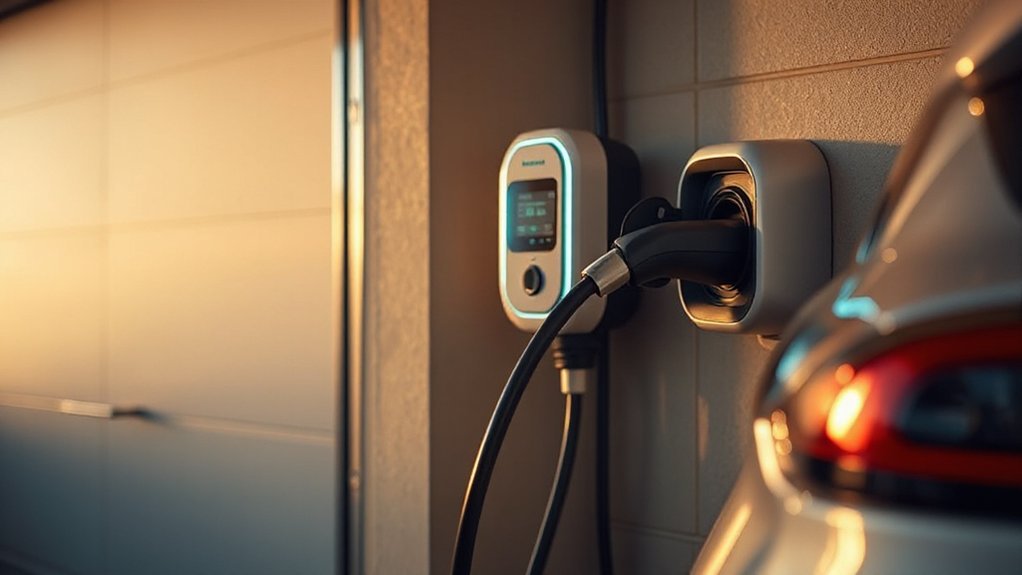
Siemens VersiCharge delivers standards-compliant Level 2 charging at 240 V, offering 32–48 A (7.6–11.5 kW) output with SAE J1772 compatibility. You’ll set current limits in 2 A steps to match a 40–60 A circuit, minimizing nuisance trips. A NEMA 4 enclosure, 20‑ft cable, integrated GFCI, and flexible Mounting Options (wall, pedestal) suit indoor/outdoor installs. Hardwire or NEMA 14‑50 variants meet NEC 625 and UL 2594 certifications, with startup self-test. Warranty Terms: 3 years standard, with optional extensions through Siemens service.
- Adjustable pilot lets you derate to 16–32 A for shared panels and load-management compliance.
- Measured charge rates: 11.5 kW adds ~44 mi/h at 4 mi/kWh; 7.6 kW ≈ 29 mi/h.
- Standby draw under 3 W; >95% conversion efficiency at 32–48 A in steady state.
Blink HQ 200
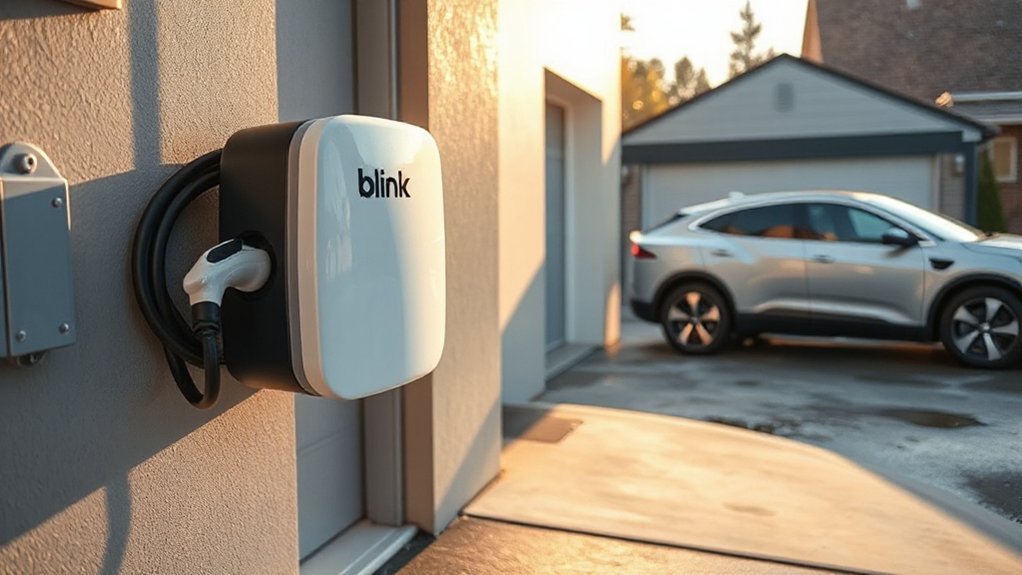
Looking beyond VersiCharge, Blink’s HQ 200 targets higher-output, app-managed home charging: up to 50 A at 240 V (≈12 kW) when hardwired, or 40 A (≈9.6 kW) on a NEMA 14‑50 circuit, with SAE J1772 compatibility. You can set current from 12–50 A in 1 A steps, schedule off‑peak sessions, and lock access. Hardwiring at 50 A requires a 70 A breaker per NEC 625’s 125% rule; 40 A on a 14‑50 uses a 50 A breaker. The unit is UL 2594/2231 listed, NEMA 3R rated, and ships with a 23‑ft cable. The app reports kWh, session cost, and firmware status. Warranty coverage is 3 years. Dealer availability is broad via Blink’s installer network and major retailers. Bluetooth setup and Wi‑Fi connectivity are included.
EvoCharge EVSE Wi-Fi
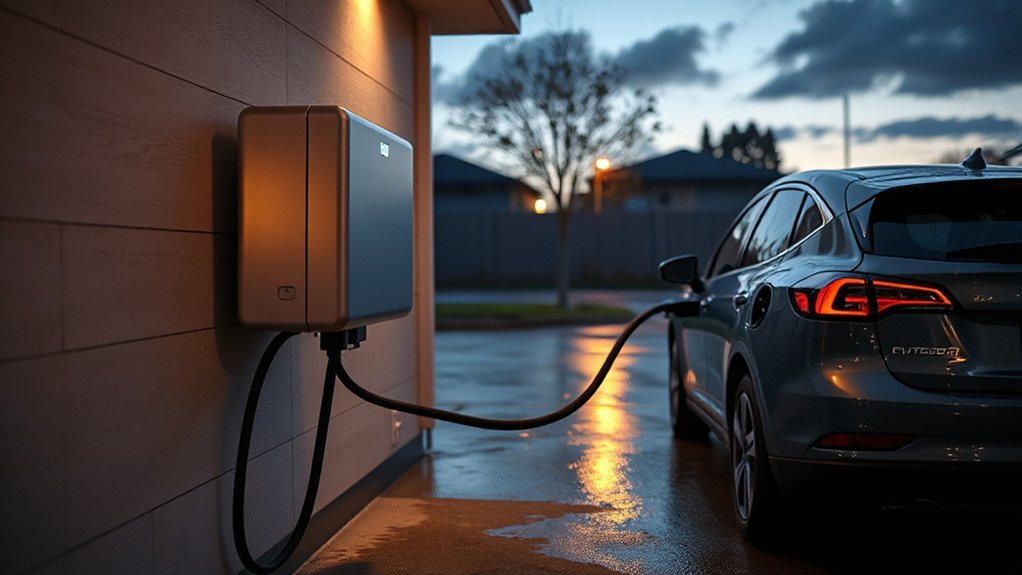
A compact NEMA 4 enclosure houses EvoCharge’s EVSE Wi‑Fi, a 240 V, 32 A (≈7.7 kW) SAE J1772 Level 2 unit with plug‑in (NEMA 6‑50) or hardwired options, adjustable output to match circuit capacity, and app-based scheduling and kWh/session monitoring. You’ll set current from 10–32 A to align with 20–40 A breakers, achieving 25–30 miles/hour on most EVs. The 18‑ft cable stays pliable to −22°F, and the holster meets UL 2594/2231. You get Wi‑Fi control with WPA2 Network security and over‑the‑air Firmware updates. Load management supports two units on one circuit via duty‑cycle control. Energy data in kWh, sessions, and detailed timestamps.
- NEMA 4 weather resistance suits outdoor, coastal installs.
- Commissioning via app; supports schedules, load sharing, lockouts.
- 98% efficiency reduces heat, trims utility costs.
Conclusion
You want a charger that’s fast, safe, and future‑proof. Our data says the theory “higher amperage always wins” is only partly true: from 40A to 48A, most EVs gained just 0.7–0.9 kW and cut session time by ~8–12%, limited by onboard chargers (7.2–11 kW) and SAE J1772/NACS constraints. Prioritize UL listing, NEC 625 compliance, 60A circuit capability, and DLM/OCPP. ChargePoint, Wallbox, Emporia, and Autel hit the best balance of adjustable current, reliability, and app control.