
If you’re choosing a Level 3 DC fast charger for 2025, you’ll weigh 50–350+ kW power classes, 400–1,000 V support, modular rectifiers, and liquid‑cooled CCS/NACS leads. You’ll expect ISO 15118 Plug&Charge, OCPP, EMV tap‑to‑pay, 95%+ efficiency, NEVI compliance, and uptime SLAs. You’ll compare pedestal vs cabinet dispensers, site load limits, demand charges, and service coverage—then shortlist ABB, Tritium, Siemens, or Delta. Here’s how to pick the right stack.
Key Takeaways
- Top 2025 DC fast chargers: ABB Terra 360, Siemens SICHARGE D, Tritium PKM200, Delta UFC 200/400, ChargePoint Express Plus—350–500 kW, 1000 V, >95% efficiency.
- Choose 150 kW for mid-speed, 300–350+ kW for highway; ensure modular rectifiers, 500–600 A liquid‑cooled cables, and native 800–1000 V support.
- Prioritize IEC 61851-23/-24, UL 2202/2251, OCPP 2.0.1, ISO 15118 Plug&Charge; get CCS1 and NACS leads, optional CHAdeMO; design for NEVI 4×150 kW.
- For four 150 kW ports, plan ~665 kW AC load, ~1200 A service, 1000–1500 kVA transformer; ensure NEC 625 compliance and IP54/IK10 dispensers.
- Demand 99.5%+ availability SLAs, 4–8 hour MTTR, five‑year service parts; include EMV tap‑to‑pay, open roaming, remote monitoring, and signed firmware updates.
Level 3 DC Fast Charging Basics and Power Classes (50–350+ Kw)
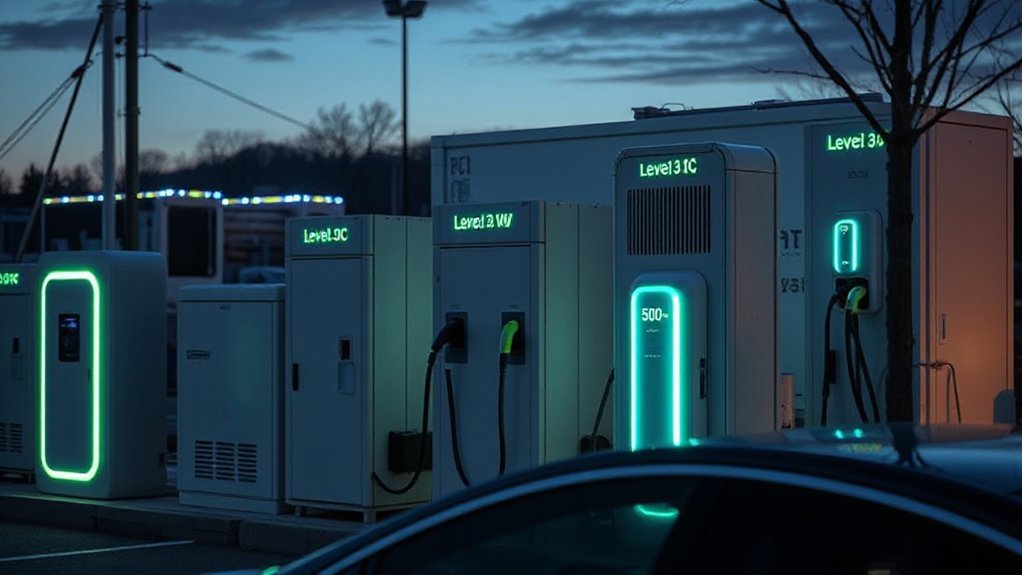
Level 3 DC fast charging delivers high-voltage DC directly to the traction battery, bypassing the onboard AC charger to achieve 50–350+ kW depending on station and vehicle limits. You’ll see three common power classes: 50 kW entry, 150 kW mid, and 300–350+ kW high. Actual rate depends on pack voltage (350–1,000 V), allowable current (100–500 A), and your vehicle’s charging profiles and thermal limits. Most packs follow constant-current, then constant-voltage; peak power holds to ~30–60% state of charge before tapering. Systems use modular rectifiers (15–30 kW blocks) for power scaling, redundancy, and serviceability. Look for specs: max output voltage, max current, kW per cabinet, simultaneous ports derating, and operating range. High-power sites need liquid-cooled cables above ~300 A and upstream capacity, plus load management.
2025 Connector Landscape: NACS, CCS, and Remaining CHAdeMO Needs

You should plan for NACS (SAE J3400)–CCS interoperability during the migration, noting NACS targets ~1,000 V/1,000 A while CCS (Combo 1/2) commonly supports up to 1,000 V and ~500 A. You’ll implement ISO 15118 Plug&Charge, OCPP 1.6/2.0.1, and adapter strategies to bridge vehicle/port mismatches through the 2025–2026 OEM shift from CCS1 to NACS. You should maintain CHAdeMO legacy capacity—typically 50 kW and V2X-capable per CHAdeMO 2.0—via at least one port or modular cables to support the remaining Leaf fleet during phase‑out.
NACS and CCS Convergence
As automakers and networks coalesce around SAE J3400 (NACS) and CCS per IEC 62196‑3, the DC fast‑charging connector landscape is consolidating while preserving limited CHAdeMO support for legacy fleets. You should prioritize chargers certified to IEC 61851‑23/-24 and UL 2202/2251 with 500 A liquid‑cooled cables, 1000 V operation, and 350–500 kW capability. Specify ISO 15118‑20 (incl. Plug & Charge), OCPP 2.0.1, and calibrated metering. Verify patent licensing clarity for J3400 hardware and conduct interoperability testing across vehicle ECUs, adapters, and cable sets. Demand NEVI‑aligned 97% uptime, cybersecurity per ISO 21434, and PKI compatibility. For mixed fleets, choose modular dispensers supporting both J3400 and CCS1 via switchable leads, shared rectifiers, and auto‑de‑rate thermal management. Validate grid codes, utility demand response, and future V2G readiness requirements.
CHADEMO Legacy Support
While the market consolidates on SAE J3400 and CCS, legacy CHAdeMO fleets still require standards-compliant DC service: specify CHAdeMO-conformant hardware (JEVS G105; CHAdeMO v1.2/2.0), DC charger compliance to IEC 61851-23/-24 and UL 2202/2251, and OCPP 1.6J minimum (2.0.1 preferred) with revenue-grade DC metering. You should size ports to actual demand: most CHAdeMO heritage vehicles accept 38–50 kW at ~400 V, with select models up to 100 kW; choose 125–200 A rated cables with temperature monitoring per IEC 62196. Favor dual-outlet stacks (CCS + CHAdeMO) with dynamic load sharing and ISO 15118-2/20-ready controllers for migration. Require >97% uptime, 4G/LTE and Ethernet, replaceable CHAdeMO heads, and 5–10 year parts availability. Include clear pricing, session caps, and owner education signage to prevent blocking and optimize turnover. efficiency.
Cable and Dispenser Tech: Liquid-Cooled Leads, Pedestal vs. Cabinet

Because cable thermal limits govern current delivery, liquid-cooled leads and dispenser architecture determine real-world DC fast charging performance. Liquid-cooled CCS1/CCS2 cables sustain 500–600 A at up to 1000 V with lower conductor mass, meeting IEC 61851-23 and UL 2251 thermal rise limits. Verify continuous current at 40°C ambient and duty-cycle derating curves. Specify IP54/IK10 dispensers with ergonomic handles, auto-latching, and 1–3 m reach plus hose reels or overhead booms to reduce strain and ice drag. Pedestal units integrate power and dispenser; they suit 150 kW footprints but increase acoustic and thermal load curbside. Cabinet-and-dispenser systems remote power modules, enabling 350 kW+ per post, tighter cable routing, and easier service clearances per NEC 625. Check OCPD ratings, voltage drop (<2%), and ADA reach zones compliance.
Software Stack: OCPP, Plug & Charge (ISO 15118), Payments, and Analytics

Even before you pick hardware, lock in a software stack that pairs OCPP 2.0.1 (JSON over WebSocket, TLS 1.2/1.3, Device Management, Smart Charging) with ISO 15118-20 Plug & Charge for contract-based authentication, certificate handling, and schedule exchange. You’ll want OCPI 2.2.1 for roaming, ISO 20022 card rails or PCI-certified gateways for EMV, and tokenized wallets via ISO 15118-20 PnC extensions. Mandate role-based access (RBAC), signed Firmware Updates, and FIPS 140-3 validated crypto. Enforce Cybersecurity Practices: mutual TLS, OCSP stapling, secure boot, HSM-backed PKI, and security event logging. Instrument analytics: energy kWh, session timestamps, SAE J2847/2 load data, occupancy, charger state reasons, and per-connector utilization. Guarantee tariff models support TOU, demand charges, idle fees, and carbon-intensity pricing via OCPI cdrs and ISO 15118-20 meter data.
Reliability and Uptime: SLAs, Redundancy, and Remote Monitoring
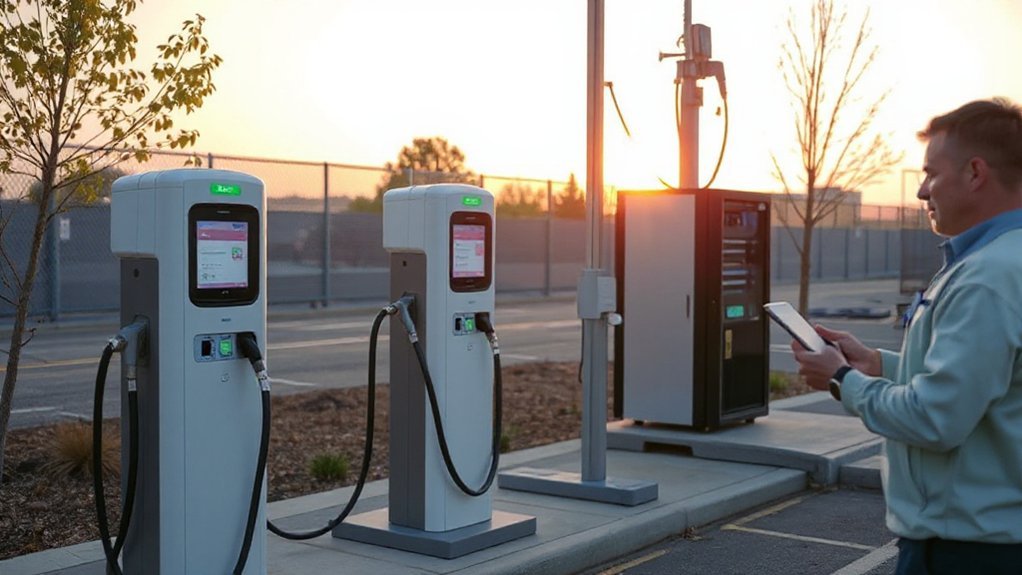
As uptime becomes a measurable KPI, codify it in SLAs at 99.5–99.9% availability per connector with precise time-base, exclusion criteria, and calculation method, plus MTTR (≤4–8 h) and incident response targets.
You’ll enforce reliability through modular redundancy: dual rectifier/power modules, redundant comms paths, watchdog controllers, and session failover that preserves transactions. Require 24/7 remote monitoring with OCPP 1.6/2.0.1 telemetry, heartbeat intervals, and alarm priorities; target MTTD <5 minutes and MTTR adherence. Specify firmware CI/CD with staged rollout, remote rollback, and configuration drift control. Define a Spares Strategy: on-hand modules, cables, payment readers, with RMA SLAs. Enable Hot Swapping of power modules, contactors, and readers without de-energizing the pedestal. Track MTTF and FIT per subassembly and uptime audits via probes. Publish reports and corrective actions.
Site Design and Electrical: Utility Service, NEVI Rules, and Load Management
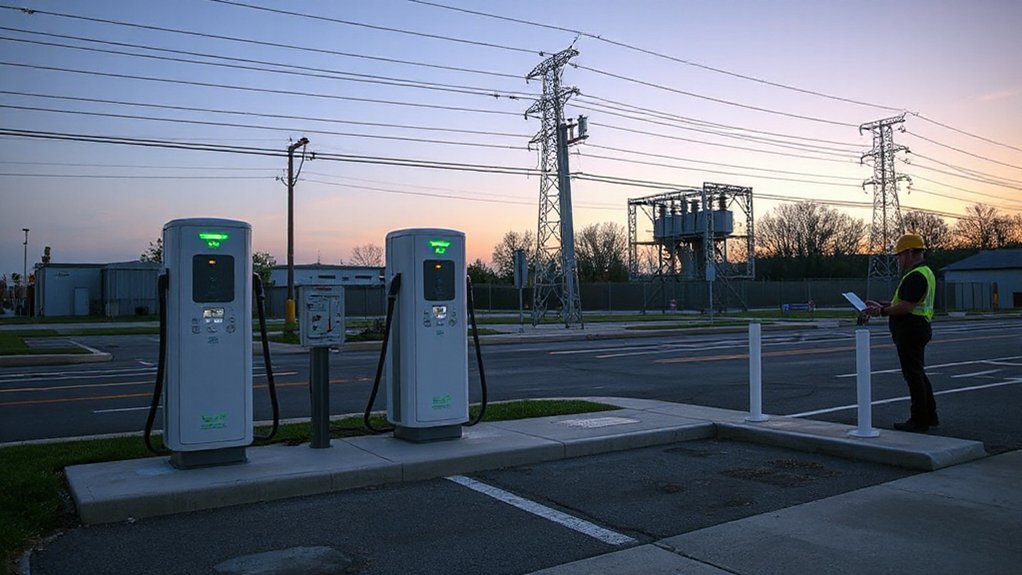



While NEVI sets the minimums, you must size and lay out the site to deliver four concurrent 150 kW DC ports plus auxiliaries and losses, verified at the point of delivery. Assume 95% rectifier efficiency and 0.95 PF: 600 kW DC ≈ 665 kW AC at 480Y/277 V. That’s about 800 A; specify a 1200 A service and plan transformer sizing at 1000–1500 kVA to meet IEEE C84.1 voltage limits under load. Use CCS-compliant dispensers, SAE and UL listed (SAE J3400 optional), with NEC 625, 110, and 250 grounding/bonding. Coordinate short-circuit duty, arc-flash (IEEE 1584), and harmonics to IEEE 519. Design feeders for 75°C terminations, ambient, and voltage drop. Enable load management via OCPP 2.0.1 profiles/limits and ISO 15118-20. Consider meter aggregation where allowed.
Total Cost of Ownership: Hardware, Installation, Demand Charges, and O&M
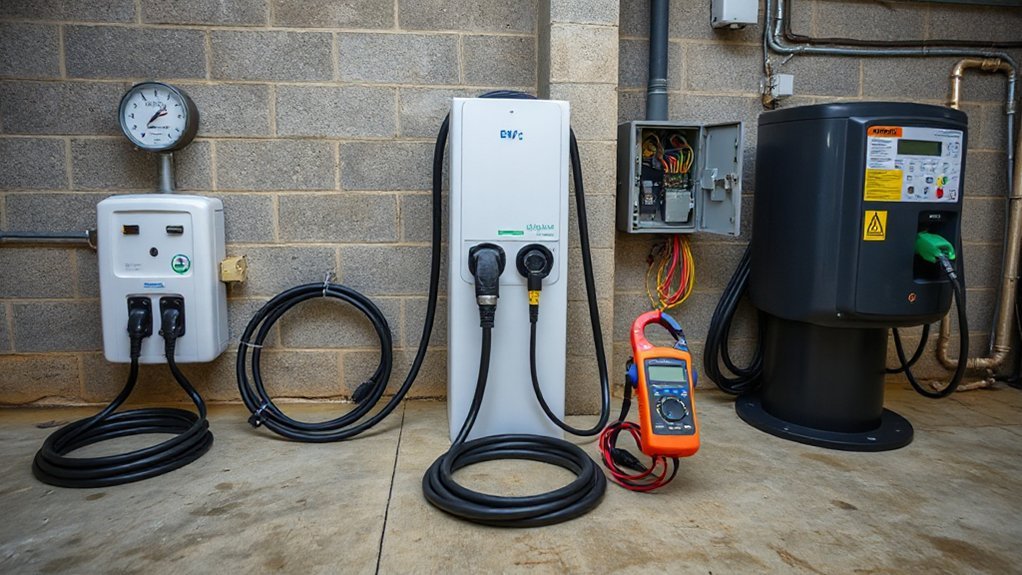
The power and layout decisions above drive your cost stack and risk. You’ll model TCO by line item: hardware (kW, ports, liquid cooling), installation (trenching, switchgear, ADA), tariff exposure, and O&M SLAs. Specify metering, NEMA ratings, surge protection, and cybersecurity per ISO 15118/OCPP to reduce service calls. Quantify demand charges with 15-minute intervals and managed setpoints.
Model TCO line-by-line: hardware, install, tariffs, O&M; specify metering, NEMA, ISO 15118/OCPP; tame 15-minute demand.
- Twin pedestals under canopy, 180–360 kW, balanced to feeder limits
- Conduits in straight runs, 36 in. depth, labeled pulls every 100 ft
- Panel schedules, CT metering, and TOU tariff mapping in EMS
- Spare breakers, fused disconnects, and lockout-tagout placards
- Thermal images each quarter to flag lugs, bus, and contactors
Budget insurance premiums, parts availability, and truck-roll rates. Apply depreciation schedules, residual risk, and uptime SLAs to cash flows.
Incentives and Funding: NEVI, State Programs, and Utility Rebates

You meet NEVI eligibility by installing ≥4 CCS ports each capable of 150 kW simultaneously (≥600 kW site power), ensuring 97% uptime, 24/7 public access, open payment (EMV/contactless), data reporting, Buy America compliance, and siting within 1 mile of an AFC with ≤50‑mile spacing. You target state grant opportunities that typically fund 50–80% of eligible costs with per‑port caps around $100k–$200k and scoring that favors disadvantaged communities, corridor gaps, and 24/7 amenities. You align application specs (power, connector count, corridor status, uptime SLA) to maximize eligibility and stack awards with utility make‑ready rebates.
NEVI Eligibility Criteria
To qualify for NEVI funding, you must design and operate DC fast-charging sites that meet FHWA minimum standards (23 CFR part 680): install at least four publicly accessible DC ports, each capable of delivering a sustained 150 kW simultaneously (≥600 kW total site power); locate sites on designated Alternative Fuel Corridors with ≤50-mile spacing and within 1 mile of the corridor; provide 24/7 access and posted, transparent pricing; maintain ≥97% charger uptime with networked monitoring, remote diagnostics, and open, non-proprietary interoperability; accept contactless EMV credit/debit payment and prohibit membership requirements; include at least one CCS Type 1 connector per port (additional connector types allowed); meet cybersecurity and data reporting requirements; comply with ADA, NEC, and state siting codes; and satisfy Build America, Buy America domestic content rules.
- Eligibility Documentation
- Compliance Timeline
- 600 kW site capacity
- ≥97% uptime monitoring
- EMV tap-to-pay
State Grant Opportunities
Beyond NEVI’s federal standards, state grant programs fund Level 3 buildouts with cost-share structures, siting rules, and performance specs that often mirror 23 CFR part 680. You’ll typically see 20–50% matches, corridor-first prioritization, and DCFC outputs of ≥150 kW per port with 97%+ uptime and CCS compliance. Many RFPs require OCPP 1.6/2.0.1, ISO 15118-2 for Plug&Charge, credit-card readers, open roaming, ADA access, and Buy America. Expect interconnection evidence, load-calcs, and utility make-ready coordination.
Watch Political dynamics and Legislative timelines: some states release annual rounds, others use rolling windows that close when funds deplete. Utility rebates—demand-charge relief, service-upgrade credits, or per-port incentives—often stack but cap total aid (e.g., 70–80%). Plan for cybersecurity plans, data sharing, and five-year maintenance budgets. Include uptime liquidated damages and warranties.
Top DC Fast Charger Models and Brands to Evaluate in 2025

Kick off with a spec-first look at 2025’s leading DC fast chargers—ABB Terra 360, Tritium PKM150/200, Siemens SICHARGE D, Delta UFC 200/400, ChargePoint Express Plus/XP, Kempower S- and T‑Series, BTC Power Gen4, EVBox Troniq Modular, and Tesla V4—benchmarking power modules (150–400 kW per cabinet; 500–600 A with liquid‑cooled cables), voltage windows (150–1000 V with native 800 V support), efficiency (>95%), connector sets (SAE J3400/NACS and CCS1; CHAdeMO sunset), standards (OCPP 1.6/2.0.1, ISO 15118‑20 Plug&Charge), safety/ratings (UL 2202/2231, NEMA 3R/4, IK10, IP54+), and compliance (NEVI 97% uptime, EMV/PCI card readers, ADA, Buy America). You’ll balance Design aesthetics, Noise emissions, and thermal control.
- 600 A liquid‑cooled leads
- Modular cabinets, power sharing
- 800 V native support
- OCPP 2.0.1, Plug&Charge
- IP54, NEMA 3R/4 armor
Validate site power capacity.
Warranties, Parts Availability, and Service Network Considerations

While power specs grab headlines, your TCO hinges on warranty terms, parts logistics, and the vendor’s field‑service footprint: target a base warranty of 2–3 years with optional extensions to 5–10 years, explicit coverage for power modules, rectifiers, liquid‑cooled cables, and dispensers, and clearly stated exclusions and labor rates.
Vet SLA metrics: ≥97–99.5% uptime, 24/7 remote diagnostics, four‑hour triage, and next‑business‑day parts. You’ll want regional depots, serialized spares, and Parts Logistics KPIs (fill rate ≥95%, RMA cycle ≤10 days). Confirm MTBF for power stacks and cooling pumps; specify MTTR ≤4 hours with stocked kits. Require UL/ETL listing, NEC compliance, OCPP 1.6/2.0.1, ISO 15118, and SAE CCS/CHAdeMO interoperability. Validate Technician Training: certified onboarding, annual refreshers, e‑learning plus ride‑alongs, and credentialed high‑voltage procedures. Specify firmware patch SLAs.
Conclusion
You stand at the curb as liquid‑cooled cables hiss, handshakes snap, and kWh flow. You’ll choose 50–350+ kW cabinets with 95%+ efficiency, 400–1,000 V support, modular rectifiers, and CCS/NACS leads. Lock in ISO 15118 Plug & Charge, OCPP 1.6/2.0.1, EMV tap‑to‑pay, and NEVI conformity. Demand 97%+ uptime SLAs, hot‑swap power modules, and remote diagnostics. Compare ABB, Tritium, Siemens, and Delta on TCO: install, demand charges, parts, and service. Future‑proof dispensers, scale power, and own reliability.