You plug into a 45–140 W USB‑C brick and expect PD 3.1/PPS to negotiate safely, yet brand‑specific chargers add proprietary PDOs, cryptographic authentication, and tighter thermal limits. They poll faults, cap ripple, and fall back when handshakes fail. You must match cable E‑markers, PD revisions, and certifications (UL, USB‑IF) to avoid throttling or risk. Want to know where compatibility breaks, which labels to trust, and how to pick third‑party gear?
Key Takeaways
- Brand-specific chargers optimize performance and thermal limits, using tighter voltage control, ripple, and device-managed thermals for faster, safer charging.
- They use authentication and handshakes to enable proprietary fast-charge modes, falling back to baseline USB-C or USB PD if signaling fails.
- Compatibility depends on protocols (PD/PPS, Apple 2.4A, QC, AFC, VOOC) and cable limits; non‑e‑marked cables block 5 A and higher power.
- Branded chargers integrate OCP/OVP, fast thermal protection, and transient suppression, with telemetry for reliability, certifications like USB‑IF and IEC 62368‑1.
- When choosing third‑party chargers, verify certifications, required PD/PPS levels and wattage, multi‑port derating, and regional input voltage and plug compatibility.
Why Brands Build Their Own Charging Ecosystems

Although USB-C PD 3.1 (EPR up to 28 V/5 A, 140 W) and Qi2 define common baselines, brands build proprietary charging ecosystems to optimize performance, safety, and control beyond generic profiles. You target tighter voltage error (<1%), lower ripple (<50 mVpp), and thermal ceilings (skin temp ≤43°C) to sustain peak device performance without aging cells. You enforce certification alignment (USB-IF, Qi2, IEC 62368-1), plus cryptographic accessory authentication, to block substandard hardware. You tune EMI, coil alignment, and RF coexistence to meet FCC/CE limits while minimizing audio or 5G desense. You standardize firmware, telemetry, and failure analytics to reduce RMA, extend MTBF, and plan recalls. You monetize accessories, drive ecosystem cohesion, and create measured customer lock in while ensuring backward compatibility and predictable user experience.
How Proprietary Fast-Charge Protocols Work

How do proprietary fast‑charge protocols actually work? You initiate a discovery phase where the charger and device exchange identification frames over control pins or D+/D− lines. The device measures advertised voltage/current capabilities, then requests a profile using defined Signal Encoding (e.g., static voltage dividers, pulse-width modulation, or differential levels). Handshake Timing is tight: typical detection completes in 20–200 ms, with retries at 50–100 ms intervals and timeouts near 1 s. After authentication, the charger steps output in quantized increments (say 200 mV or 0.5 V) while the device monitors slew rate (<30 mV/µs) and input current to stay within SOA. You enforce OCP, OVP, and thermal derating, and continuously poll for fault flags. If signaling drops, you gracefully fall back to baseline charging mode.
USB-C, USB PD, and Where Compatibility Still Breaks
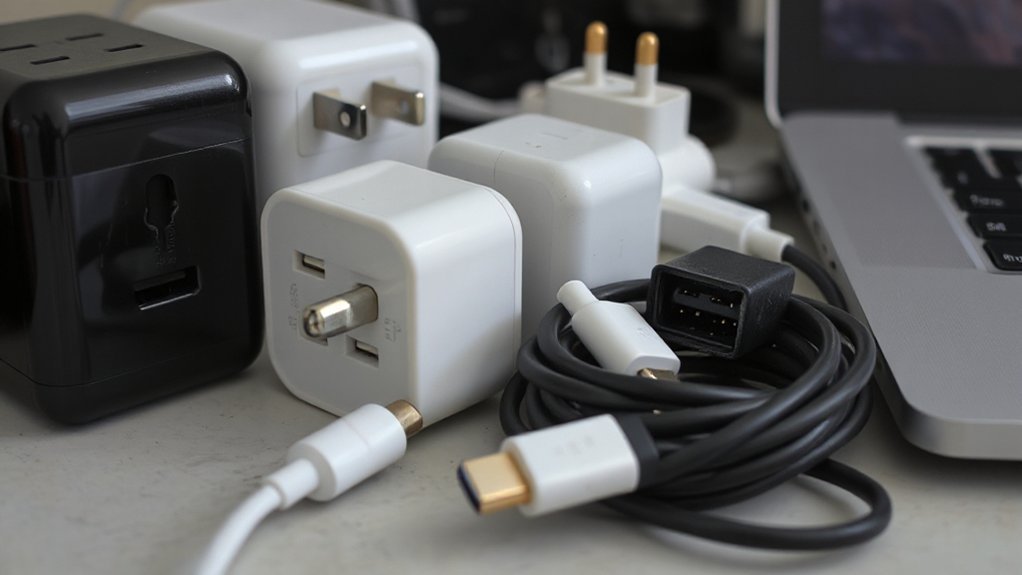
USB‑C and USB Power Delivery aim to unify what those vendor protocols fragmented: a single connector (USB Type‑C Spec Rev 2.2) and a negotiated power/role model (USB PD Rev 3.1 v1.9) using BMC signaling on the CC pins. Edges remain: mismatched PDOs (5/9/15/20 V SPR; 28/36/48 V EPR), non‑e‑marked cables blocking 5 A, and AltMode Conflicts on CC. Laptops request 20 V/5 A; you supply 20 V/3 A, throttling. Hardware Revisions matter: some sinks support Rev 2.0 only, reject EPR. USB logos don’t guarantee role swap success everywhere.
| Scenario | Symptom | Your move |
|---|---|---|
| Legacy cable | 100 W dream → 60 W reality | Use e‑marked 5 A |
| DP Alt Mode | Screen ok, battery drops | Prefer fixed PDOs |
| PPS absent | Warm, slow charge | Pick PD PPS supply |
Safety, Smart Chips, and Certification Labels to Trust

Confirm the charger implements overcurrent protection at 110–150% of rated current with <10 ms cutoff (or hiccup) and overvoltage protection tripping 5–10% above negotiated voltage with <5 ms response, plus short‑circuit and thermal shutdown. Verify the smart IC manages power via USB PD 3.0/PPS negotiation (20 mV/50 mA steps), cable E‑Marker reading, thermal derating to <100°C, and >10 kHz V/I monitoring with current foldback. Trust only units with verifiable marks—USB‑IF TID, UL/ETL or CSA to UL/IEC 62368‑1, TÜV/GS, CE (EN 62368‑1), FCC Part 15B, DOE Level VI/ErP CoC Tier 2—matched to test report IDs.
Overcurrent and Overvoltage Protection
From a safety standpoint, a well‑designed brand‑specific charger implements fast overcurrent protection (OCP) and overvoltage protection (OVP) in hardware and the PD/PPS controller: expect OCP to trip at roughly 110–130% of rated output current within <50 ms and short‑circuit protection to latch off in ≤2–10 ms; OVP should keep the output within ±5% of the negotiated PD voltage and clamp hard faults via TVS/crowbar around 120–140% of nominal. You should also verify Transient suppression using TVS diodes rated for IEC 61000‑4‑5 surge and IEC 61000‑4‑2 ESD. Prefer Crowbar circuits or secondary OVP on the output to guarantee fail‑safe disconnection. Check compliance: IEC 62368‑1, UL 62368‑1, USB‑IF PD/PPS CTS, and DOE/ErP no‑load limits. Validate load steps: ≤5% deviation and ≤2 ms recovery time under worst‑case.
Smart IC Power Management

Prioritize chargers that integrate a PD/PPS controller and PMIC with hardware comparators and firmware supervision: require analog OVP/OCP plus short‑circuit latchoff, ADC telemetry ≥1 kS/s, voltage accuracy ±3% (PD) and PPS step granularity 20 mV/50 mA, load regulation ≤5%, and OTP with foldback starting ~90–100°C and hard trip at 120–150°C (response ≤10 ms).
Demand PPS constant-voltage/current loops with 10–20 kHz bandwidth and ripple <50 mVpp. You need dynamic load step response <1 ms with overshoot <5%. Insist on per-port current sense, thermal throttling tied to a NTC, and MOSFET ORing for load balancing across ports. Verify cable drop compensation up to 300 mV at 5 A and negotiated EPR up to 28 V/5 A when supported. Confirm MCU enforces watchdogs, brownout reset, and firmware updates.
Trusted Certification Marks
How do you separate trustworthy chargers from marketing? Start by verifying third‑party marks with issuer transparency and label provenance. Look for UL/ETL/TÜV listings to UL/IEC 62368‑1, with traceable file numbers. Confirm CB Scheme certificates and NRTL status. Safety data should cite creepage/clearance ≥4 mm, touch current ≤0.25 mA, and enclosure temperature rise ≤65°C at full load. For RF/chemistry, require FCC Part 15B and RoHS/REACH. For efficiency, target DOE Level VI or EU CoC Tier 2; no‑load power ≤0.1 W. For smart chips, demand USB‑IF USB PD 3.1 certification (PPS), E‑marker compliance, and Qi 1.3 authentication; check MFi for Lightning. Validate OVP/OCP/OTP trip points, surge ≥2 kV, and EMC per CISPR 32. Always cross‑check databases. Use QR verifications, tamperproof labels, and serial-numbered reports from issuers.
Picking Third-Party Bricks and Cables Without Risk

You verify bona fide safety marks and certifications—UL/ETL/TÜV, CE/UKCA, FCC, USB‑IF, MFi, Qi2—using model numbers you can confirm in public databases. You match specs precisely: connector type, protocol (USB PD 3.0/3.1, PPS), output profiles (5/9/15/20 V at up to 3–5 A; EPR 28/36/48 V), and total wattage that meets or exceeds the OEM rating. For cables, you pick USB‑IF–certified, e‑marked 5 A leads for >60 W or PD EPR, verify the required data rate, and confirm the pair negotiates the device’s profiles so you don’t get throttling or faults.
Certification and Safety Marks
Before trusting a third‑party brick or cable, anchor your choice in verifiable certifications and standards compliance. Look for safety listings: UL or ETL (North America), CSA, TUV/GS (EU), CE + EN 62368‑1 conformity, UKCA, PSE (JP), KC (KR), CCC (CN), SAA (AU/NZ). Prefer CB Scheme test reports against IEC 62368‑1; avoid obsolete IEC 60950‑1 unless dual-certified. Verify marks via the issuer’s database: UL Product iQ, Intertek iCTL, TUV certificates, USB‑IF TID, Apple MFi, and Qi ID. Perform Counterfeit Detection: validate file numbers, model match, manufacturer name, and scope; scan QR/UID where available. Inspect Mark Evolution details (new UL hologram, UKCA migration dates, CE self‑declaration limits). Check creepage/clearance claims, fire enclosure ratings (HB/V‑0), and surge/LEAKAGE limits on reports. Retain evidence screenshots for warranty and recalls.
Match Specs and Compatibility
With certifications verified, match the charger’s negotiated protocols and power budget to the device’s requirements. Confirm USB PD revision (2.0/3.0/3.1) and PPS support; align PDO voltages (5/9/15/20/28 V) and current limits to the device’s peak draw in watts. For phones using PPS, provide adjustable 3.3–21 V in 20 mV steps and adequate amperage (up to 5 A with E‑marked cable). Validate brand protocols (Apple 2.4 A, Samsung AFC, Qualcomm QC, VOOC/SuperVOOC, SCP/FCP) when PD isn’t implemented. Match cable rating: 60 W vs 100 W, conductor gauge, E‑marker, and connector durability cycles per IEC 62680. Consider battery chemistry and charge profile; lithium-ion devices benefit from PPS to reduce heat. Check port count sharing, derating curves, and ambient-temperature limits. Verify cable length and DC resistance specs.
Travel Tips: Voltage, Region Plugs, and Airline Rules

How do brand-specific chargers handle foreign power grids? Verify the input range on the label: most OEM USB-C/PPS bricks accept 100–240 V, 50/60 Hz per IEC 60950-1/62368-1. If it reads 100–120 V only, you’ll need a step-down transformer, not just a plug adapter. Match plug type per IEC 60083; do outlet mapping before travel (e.g., Type C/E/F in EU, G in UK, I in AU/NZ). Practice adapter etiquette: bring a fused, certified adapter (BS 8546), and avoid daisy-chaining.
On aircraft, follow airline and IATA rules. Power at seats is often 110 V AC or 15 V DC EmPower; limit draw to ≤75 W. Pack lithium batteries in carry-on, ≤100 Wh each without approval. Coil cables, protect prongs, and avoid loose metal in your bag.
Cost, Longevity, and the E‑Waste Tradeoffs

Although OEM bricks cost more upfront ($20–40 vs $5–10 for no‑name EPS), you often recover the delta through higher efficiency, longer service life, and lower failure risk. OEM units typically hit ≥90% efficiency at 50% load with <75 mW no‑load draw; many generics hover near 80% and ~300 mW. MTBF is often ≥100,000 hours with <0.2% field returns, versus 20,000–30,000 hours and 2–5% for bargain models. You also get compliance: UL/IEC 62368‑1, DOE Level VI/CoC Tier 2, USB‑IF PD 3.1 (including EPR), and conducted ripple <30 mV. That translates to fewer replacements and less e‑waste. When you upgrade, resale markets preserve utility value; failing that, use OEM takeback programs. Prefer modular USB‑C cables and GaN designs to minimize material throughput over device lifecycles substantially.
Conclusion
You weigh speed, safety, and cost. Brand ecosystems use PD/PPS profiles, crypto handshakes, and thermal limits to hit rated watts with <50 mV ripple while logging telemetry. When signaling fails, they fall back to baseline USB PD. Check USB-IF, MFi, or UL marks, cable AWG, and PD revision to avoid faults. For travel, match voltage and plug types; follow airline Wh caps. Measure twice, cut once—you’ll charge faster, safer, and create less e‑waste over time.