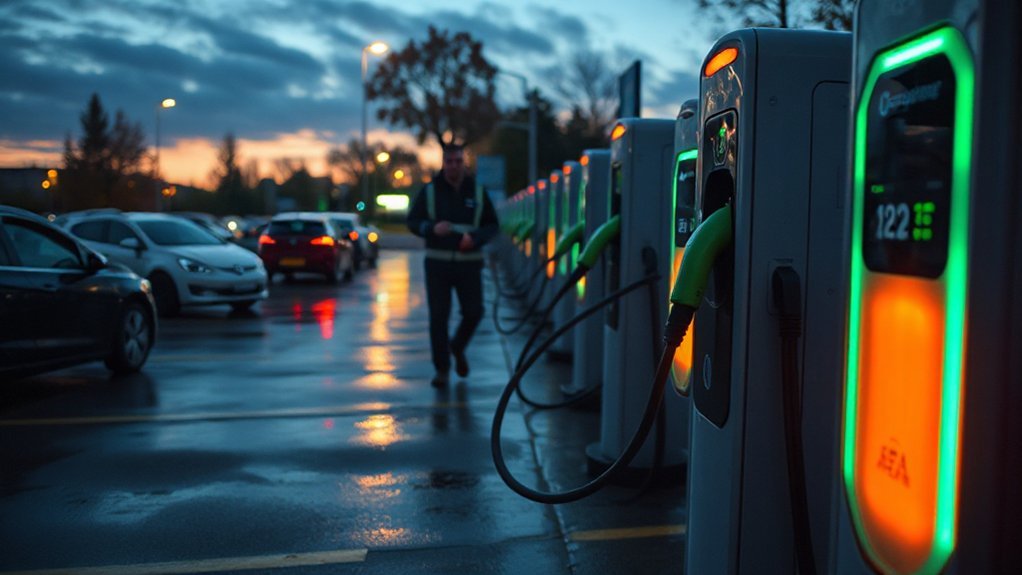
It feels like overnight every non-Tesla EV will be able to slam into a Supercharger. You’re seeing NACS adoption and adapters pop up, but access isn’t automatic. Different cars, station types, and apps all matter. I’ll cover who can plug in, how CCS-to-NACS adapters work, and the steps to start a charge — plus what could still trip you up at a V4 stall.
Key Takeaways
- Many non‑Tesla EVs can use Tesla Superchargers via manufacturer‑supplied or aftermarket NACS adapters where supported.
- Adapter availability and vehicle support depend on automaker, model year, region, and software enabling plug‑and‑charge.
- Charging speed varies by car architecture and Supercharger version — V4 can deliver up to 500 kW for compatible 800V+ vehicles.
- Adapters must support proper authentication and safety; some require Tesla or automaker app integration for billing.
- Always verify compatibility, adapter certification, and Supercharger access rules before relying on Tesla chargers for trips.
How Tesla Superchargers Work and What’s Changing in 2025-2026
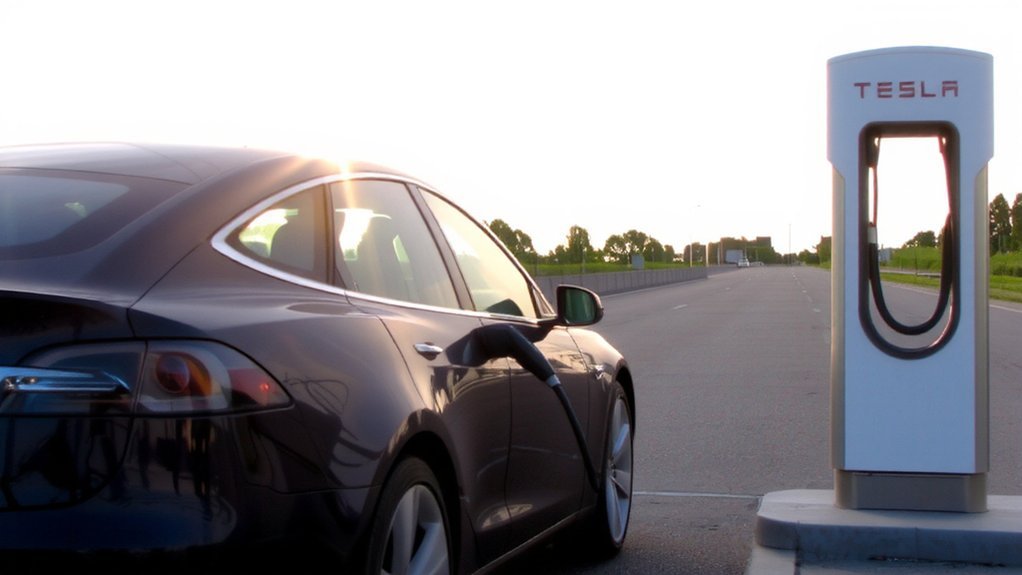
As Tesla’s Supercharger network moves from V2/V3 to V4 in 2025–2026, you’ll see faster, higher‑voltage charging and broader compatibility across brands. Superchargers evolved from 150 kW air‑cooled V2 to 250 kW liquid‑cooled V3 and now immersion‑cooled V4 offering 250–325+ kW today and planned 500 kW, with cabinet capability up to 1.2 MW for heavy vehicles.
V4 supports 250–1000 V architectures, so 800V+ cars charge more efficiently. Cables are thinner, immersion‑cooled, and stalls now deliver dedicated power to avoid sharing slowdowns. V4 cabinets power more stalls, boost power density, extend cabinet‑to‑post distance, and improve reliability.
When you charge, expect quicker fills, robust cooling, and consistent uptime; follow on‑site safety instructions and let vehicles manage charge curves to protect batteries. Stay alert and report any issues. Tesla’s network also includes over 25,000 stalls across North America as of 2025, expanding access for long‑distance travel.
NACS Vs CCS: What Every Non-Tesla Owner Needs to Know

You’ll first notice the connectors look and pin out differently—NACS is a slimmer, single-piece plug while CCS pairs an AC-style top with two large DC power pins below. They also use different communication protocols for handshaking and power negotiation, so the charger and vehicle must speak the same language to manage current and safety. However, many manufacturers have agreed to adopt NACS and give owners access to 15,000 stations in 2024, which will speed up interoperability rollout. That’s why a physical adapter alone doesn’t guarantee full-speed charging or seamless authentication until automakers finish software and hardware integration.
Connector Shape and Pins
The NACS connector is a smaller, sleeker plug with five shared pins that combine Level 2 AC and high-power DC functions, while CCS uses a bulkier two-part design with seven distinct pins for J1772 AC and separate DC fast charging. You’ll notice NACS is lighter and easier to grip, letting you handle plug-in/out one-handed and improving safety in wet or cold conditions.
CCS’s larger, heavier body houses separate AC and DC contacts, which can feel cumbersome with stiff cables. NACS’s shared-pin layout reduces connector size but requires careful engineering and proper adapters to maintain safe isolation and contact integrity. If you’ll use adapters, inspect them and follow manufacturer guidance to guarantee secure connections and safe charging, and stop use if you detect damage immediately. Additionally, many NACS Superchargers can deliver up to 250 kW, enabling very fast top-off charging for compatible vehicles.
Charging Communication Protocols
Because Tesla uses a proprietary communication stack on NACS, non‑Tesla drivers face more than a physical plug mismatch — they also need compatible authentication and data translation for payment, plug‑and‑charge, and session management. You should know Tesla’s system is closed: Superchargers authenticate via Tesla accounts and use proprietary messaging for reliable plug‑and‑charge and session control.
CCS uses ISO 15118, an open global standard supporting plug‑and‑charge, smart charging and V2G. That means CCS EVs talk directly to CCS chargers without vendor lock‑in. Adapters can bridge physical pins and sometimes translate protocols, but software integration or Tesla permission is often required. For safety, verify adapter certification, confirm authentication flow, and prefer networks supporting standardized protocols to guarantee secure, predictable, charging sessions. Carry backup payment options too. It’s important to remember that NACS was developed by Tesla for the North American market.
Which Non-Tesla EVs Can Access Tesla Superchargers Today
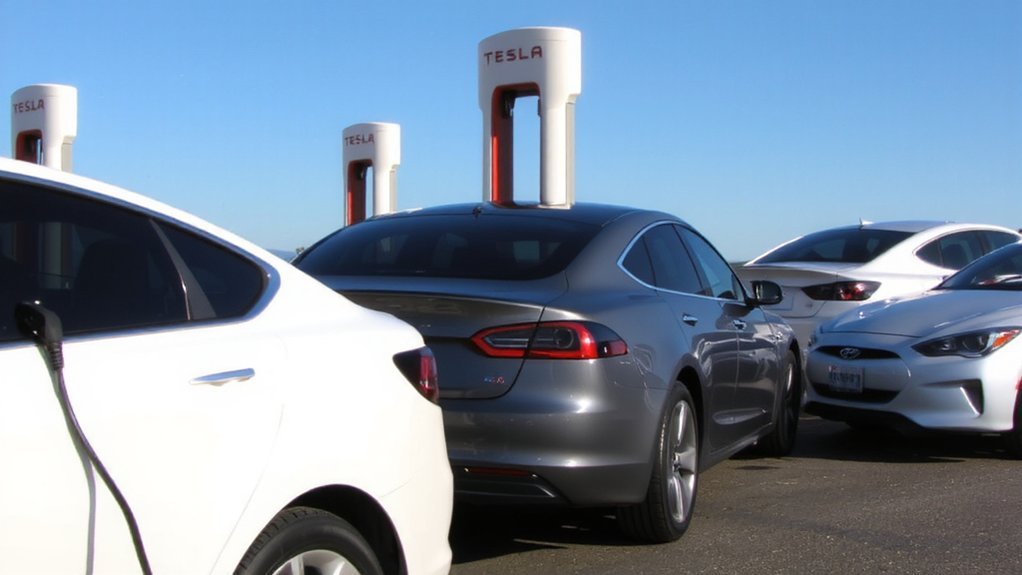
You’ll see three categories: vehicles with native NACS ports, models that use CCS-to-NACS adapters, and manufacturer access programs that coordinate adapter rollout and Supercharger permissions.
For example, Rivian and some Mercedes models already offer built-in NACS, while Mustang Mach‑E, F‑150 Lightning, R1S/R1T, GM, Volvo, and Polestar models charge via approved adapters.
You’ll typically start and pay with the Tesla app and may rely on manufacturer-provided adapters or Magic Dock–equipped stalls to connect.
BMW will offer an adapter that allows BMW EVs to charge at Tesla Superchargers BMW adapter.
Vehicles With NACS
Which non‑Tesla EVs can already use Tesla Superchargers? You can charge many recent non‑Tesla EVs: Ford’s Mustang Mach‑E and F‑150 Lightning have NACS adapters since early 2025, Rivian R1S/R1T are gaining or shipping with NACS, and GM (Chevrolet, GMC, Cadillac) supports adapter access. Most modern non‑Tesla EVs use CCS adapters.
Volvo, Polestar, Mercedes‑Benz, Lucid, Nissan, Hyundai and Kia are rolling out NACS compatibility; Hyundai and Kia now offer factory NACS ports on some models (e.g., Kia EV6, later IONIQ 5 batches).
Porsche, Audi, Honda, Acura, Genesis and Toyota are moving to NACS in 2025–2026. For safe use, confirm your vehicle has a compatible NACS port or adapter, check the Supercharger supports non‑Tesla vehicles via the Tesla app, and follow charging instructions. Also verify maximum charge rates and station accessibility before arrival.
Models Using Adapters
Many non‑Tesla EVs can already plug into Tesla Superchargers using manufacturer‑supplied NACS adapters. You can use adapters from Ford (Mustang Mach‑E, F‑150 Lightning), Rivian (R1S, R1T), GM (Chevrolet, Cadillac, GMC), Mercedes‑Benz, Volvo, and Polestar today.
Hyundai, Kia, and Genesis EVs still require adapters until model changes add NACS ports. BMW, MINI, and Rolls‑Royce will get BMW‑provided adapters in 2025; Audi’s Q6 e‑tron, A6 Sportback e‑tron, and E‑Tron GT (2025+) will use an Audi‑approved adapter.
Adapters are supplied by automakers and availability varies by region, model year, and software support. In addition, some automakers participate in the Ionna network, which has built over 200 Rechageries and plans major expansion. You’ll need the Tesla app to start charging, confirm stall compatibility, and expect variable speeds; follow manufacturer instructions and safety guidelines when attaching and using any adapter. Check for region-specific releases and required software updates promptly.
Manufacturer Access Programs
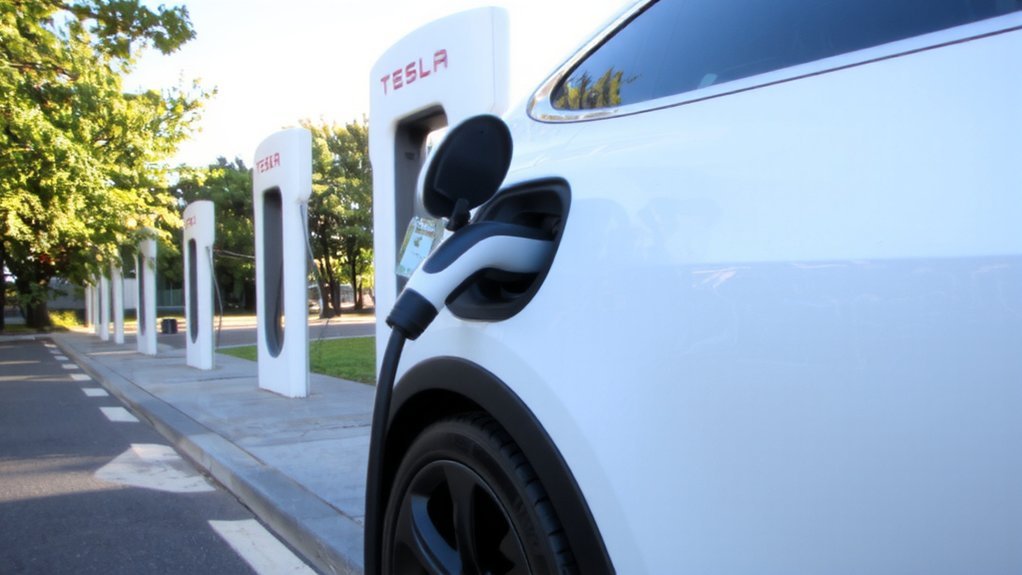
Several non‑Tesla EVs are already tapping into Tesla’s Supercharger network via automaker‑supplied NACS adapters or native NACS ports. Porsche customers also have soft launch access to Tesla Superchargers via a Porsche‑supplied NACS DC adapter. You can access Superchargers today if you own eligible models from Ford, Rivian, GM, Polestar, Volvo, Nissan, Lucid, or Mercedes‑Benz; Porsche (MY2025 Taycan, Macan Electric) and select Audi and VW Group models are joining in fall 2025.
Manufacturers supply adapters for CCS vehicles, or ship NACS‑native ports later, and you’ll typically start sessions through the Tesla app until plug‑and‑charge is enabled in OEM apps. Expect location and stall restrictions, possible reduced charge rates for 400V cars, and occasional adapter or firmware delays.
Use only manufacturer adapters, follow charging site safety instructions, and update vehicle firmware before visiting. Contact your dealer for adapter timing and safety guidance.
Adapter Types: How CCS-to-NACS Adapters Function
Think of a CCS-to-NACS adapter as a compact translator that lets a CCS-equipped EV talk to Tesla’s NACS Superchargers: it converts the physical connector, maps the electrical pinouts, and translates communication protocols so the charger and car can safely negotiate high-power DC charging. This is especially relevant since CCS2 supports AC/DC.
A compact translator converting connector, pinout, and protocol so CCS EVs safely charge at NACS Superchargers
You’ll rely on the adapter to bridge the bulky dual-pin CCS and Tesla’s slim single-piece NACS, so ergonomics and port fit matter.
Inside, the adapter preserves DC-only operation, maintains correct pin mappings, and mediates PLC-to-CAN signaling so the station and vehicle exchange valid safety and charging parameters.
Performance depends on adapter design, Supercharger generation, and your vehicle’s software and BMS. Always use manufacturer-approved adapters and updated vehicle software to guarantee safe, high-power charging.
Check connectors for damage and follow station instructions.
Step-by-Step: Starting a Charging Session as a Non-Tesla Driver
One quick pre-check will make starting a Supercharger session straightforward: confirm you have a NACS adapter (or a NACS-equipped vehicle), the Tesla app with a payment method, and that the station or stall supports non‑Tesla charging. By 2025, nearly every automaker will offer either a CCS port or a NACS adapter on new models. When you arrive, park only at a stall marked for non‑Tesla use or shown in the app. Open the Tesla app; be ready. Unplug the station cable before touching your vehicle’s port. Scan the stall QR or select it in the app, follow prompts and let the app verify.
If required, plug the adapter into your CCS port, then connect the Supercharger cable. Monitor charging and notifications in the app. To finish, stop charging in the app, return the cable, remove your adapter, and review the receipt promptly.
Compatibility Limits: Supercharger Versions, Power Levels and Station Availability
How much charging you’ll actually get at a Supercharger depends on three things: the station’s hardware version (V2, V3, V4), the stall’s available power and sharing behavior, and whether that specific site is equipped and configured for non‑Tesla cars. Keep in mind that Higher voltage allows more energy transfer to the battery, enabling faster charging. V2 tops around 150 kW (400V), V3 about 250 kW (up to 1,000V) and emerging V4 up to 350 kW; older V1 was ~120 kW. Your car’s voltage architecture, CCS support and battery management determine how much of that power you’ll accept.
Stations may split power between stalls, so two cars can reduce peak rates. Use the Tesla app to confirm site compatibility and displayed kW limits before plugging in, and monitor battery temperature and state of charge to charge safely and responsibly.
Automaker Plans and Adapter Programs (Bmw, Mercedes, Lucid, Mazda, Etc.)
After covering how station hardware and power sharing affect charging, it helps to look at who’s actually getting access and how they’ll connect. You’ll see varied timelines: Mercedes already supports plug‑and‑charge via Mercedes me Charge (since Feb 2025) so you can use Superchargers without Tesla’s app.
BMW and Lucid plan adapter rollouts in 2025 for CCS cars, with Lucid moving to factory NACS ports later that year; BMW likely needs the Tesla app until native plug‑and‑charge appears. Ford, GM and Rivian have distributed adapters and are expanding access through 2025.
Hyundai and Kia ship new models with NACS built‑in. Mazda, Volvo and Polestar expect adapter or port shifts but specific authentication paths remain pending. Always follow manufacturer guidance for safe charging and safety updates regularly.
Pricing, Payment Methods and App Authentication for Non‑Tesla Users
Curious how much you’ll pay to use a Supercharger in a non‑Tesla EV? You’ll generally pay more than Tesla owners—often around $0.55/kWh—though rates vary by site, time, and region.
Expect per‑kWh fees, possible congestion charges, and the one‑time adapter cost (~$200) if your car lacks an NACS port. You must install the Tesla app to find stations, start sessions, and handle billing; link a credit or debit card for pay‑as‑you‑go charging.
Tesla shows site‑specific prices and estimated fees before you plug in, so you can confirm costs and avoid surprises. A $13/month Supercharging membership may lower rates in some places, but free Supercharging promotions generally don’t apply to non‑Tesla drivers.
Check app updates and stall availability to plan safe, efficient charging stops every trip. Tesla now allows NACS‑equipped vehicles to use Superchargers, giving access to nearly 2,000 stations across the U.S.
Practical Tips for Using Tesla Superchargers With a Non‑Tesla EV
If you own a non‑Tesla EV and plan to use a Supercharger, plan ahead: confirm your car has CCS fast‑charging or a manufacturer‑supported NACS adapter, update your EV’s firmware, and check the Tesla app to make sure the specific station is V3 and open to non‑Tesla users.
Bring the correct NACS‑to‑CCS adapter or use a built‑in NACS port, inspect the plug and cable for damage, and park to avoid obstructing other stalls. Start charging via the Tesla app, monitor charge rates and temperatures, and stop if the vehicle or connector feels hot or behaves unusually.
Know manufacturer limits—some adapters may cap speed initially—and carry charging and roadside contacts for safety. Update apps and adapters when available to improve interoperability and reduce risks and downtime.
Conclusion
You’ll find Tesla’s Supercharger shift to NACS truly widens options, but don’t assume universal access. Investigate the theory that adapters and automaker rollouts instantly equal seamless charging: it’s partly true — hardware and apps enable plug-in compatibility — yet station power, software authentication and local deployment pace create real limits. So plan routes, confirm vehicle-specific support and expect progress over 2025–26 rather than instant, flawless interoperability. Stay flexible, carry an adapter if possible, and check updates.