
In California, a 6 kW rooftop PV array routinely offsets 25–30 EV miles per day when paired with a Level 2 EVSE. You’ll convert PV DC to AC through a 97–99% inverter or use DC coupling, then account for 85–94% onboard charger efficiency and NEC 690 rapid shutdown. Roof azimuth, TOU tariffs, and battery storage shift energy economically. But what system size, interconnection, and hardware actually match your driving profile?
Key Takeaways
- Yes—grid‑tied PV can charge EVs: PV DC to inverter AC to Level 2 EVSE to onboard charger; expect ~10–20% losses; meet UL 1741/IEEE 1547.
- Size from driving: convert miles to kWh, add 10–15% losses, use PVWatts yield and 0.75–0.85 performance ratio to size kW/modules.
- Charging choices: Level 2 delivers ~7.7–11.5 kW; DC‑coupled fast chargers bypass onboard charger for higher efficiency but greater cost/complexity.
- Add 10–20 kWh stationary battery (UL 9540) to time‑shift solar, cap charger power, and provide backup; round‑trip efficiency ~88–94%.
- Economics: typical 4–9 year payback; 30% federal ITC, possible §30C EVSE credit, state/utility rebates; follow NEC 625/690 and rapid shutdown.
How Solar EV Charging Works
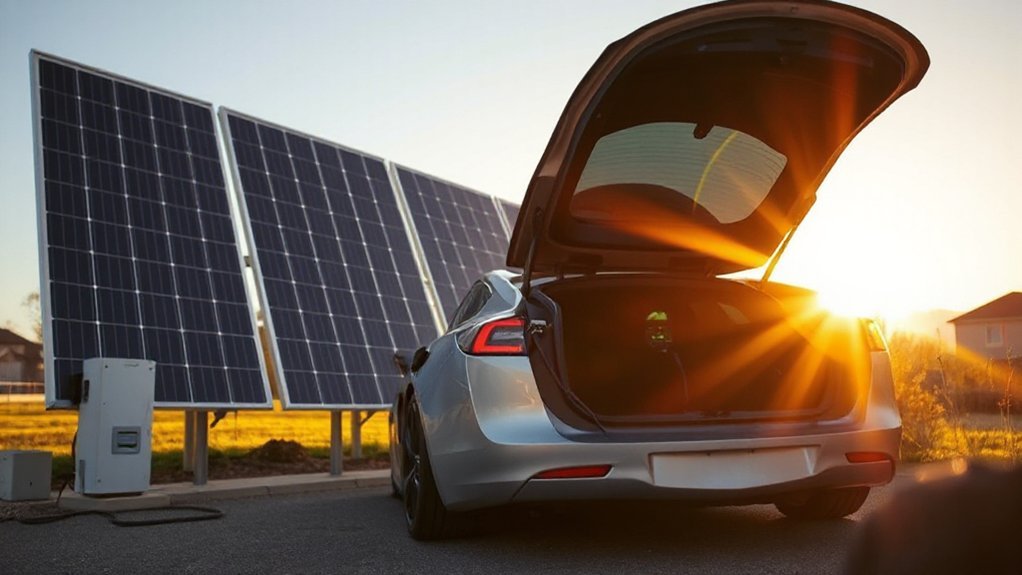
How does solar energy move from your roof to your EV battery? Your PV modules produce DC, tracked via MPPT, then route through combiner, rapid-shutdown per NEC 690, and inverter for DC‑to‑AC energy conversion (96–98% efficiency; UL 1741, IEEE 1547). Your Level 2 EVSE supplies 240 V AC (typically 32–48 A, 7.7–11.5 kW) using SAE J1772 control signaling and GFCI. The EV’s onboard charger rectifies AC to DC at ~92–96% efficiency, manages charging to ISO 15118/IEC 61851 limits, and protects the battery. If you use DC fast PV-coupled chargers, a bidirectional DC/DC stage bypasses the onboard charger, cutting system losses. Expect cumulative round‑trip efficiency of ~80–88%. Smart controls align charge windows with PV output; metering and data logging verify performance and code compliance standards.
Sizing Your System: Panels, Miles, and Roof Space
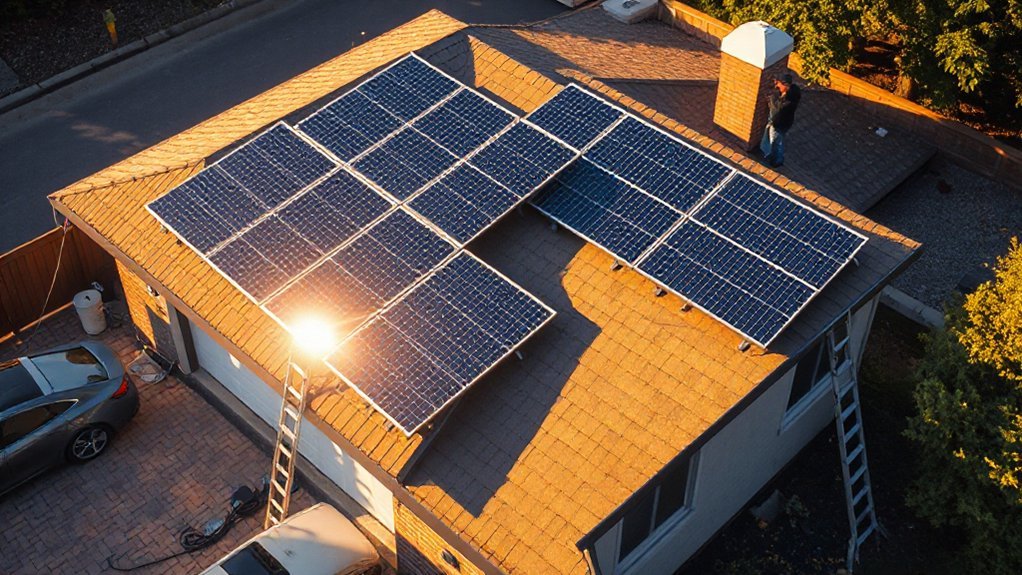
Start by translating miles to kilowatt-hours, then kWh to modules and roof area. Multiply your weekly EV miles by your vehicle’s efficiency (kWh/100 mi ÷ 100) to get energy needed, then gross up by 10–15% for charging and inverter losses. Convert required kWh to PV capacity using local specific yield (kWh/kW-year) from NREL PVWatts and adjust for Roof Orientation, tilt, shading, and Soiling/Seasonal Output. Divide target kW by module STC rating (e.g., 410–450 W) to estimate module count; multiply by module area plus interrow spacing to confirm roof fit. Apply a performance ratio of 0.75–0.85 per IEC 61724. Validate azimuth within ±15° of south (north in southern hemisphere). Verify structural loads, setbacks (IFC/NEC), and conduit runs. Cross-check modeled yields against utility bills and datalogs.
Charging Speeds and Home Hardware Options
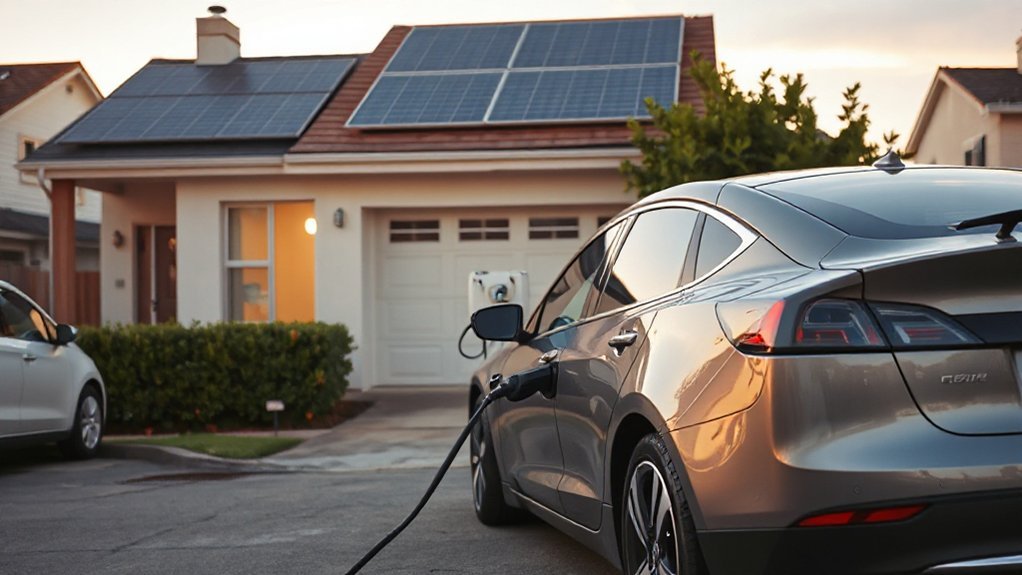
While charging speed ultimately comes down to delivered power (kW) and your car’s efficiency (kWh/mi), home hardware choices are bounded by standards and your electrical service. Level 1 (120 V, 12 A) supplies ~1.4 kW, adding roughly 3–5 miles/hour. Level 2 (240 V) scales with breaker size and the NEC 625 80% rule: a 40 A circuit delivers 32 A (~7.7 kW), while 60 A delivers 48 A (~11.5 kW). Your onboard charger caps usable kW. Select UL 2594/2231 listed EVSEs; hardwired units support 48 A, while NEMA 14‑50 receptacles typically limit to 32–40 A. Verify service and feeder capacity via NEC 220 load calcs. Prioritize connector compatibility (J1772, NACS), outdoor enclosure ratings (NEMA 3R/4), and cable management—holsters, retractors, and 18–25 ft cables available.
Grid-Tied Vs Off-Grid Setups
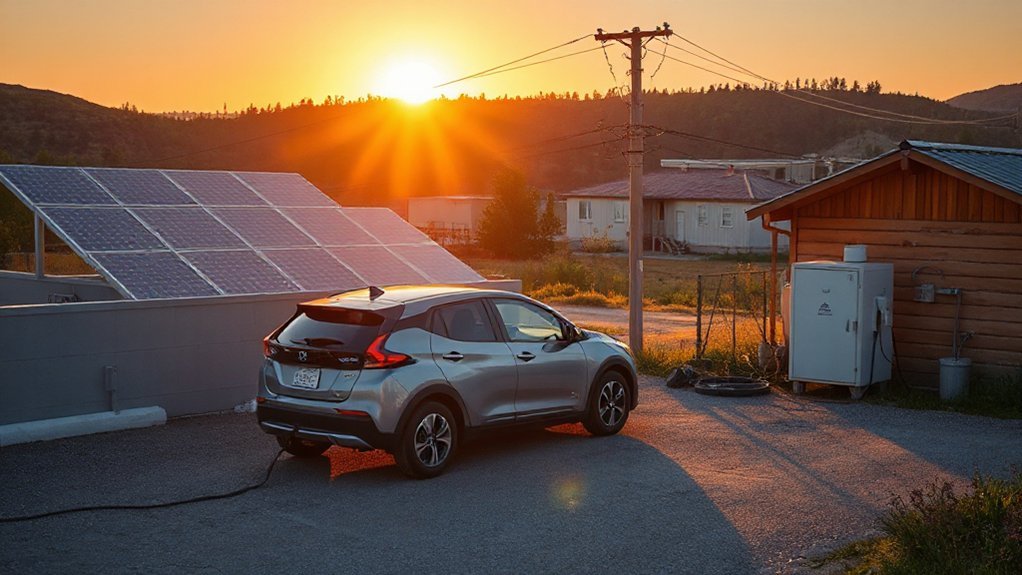
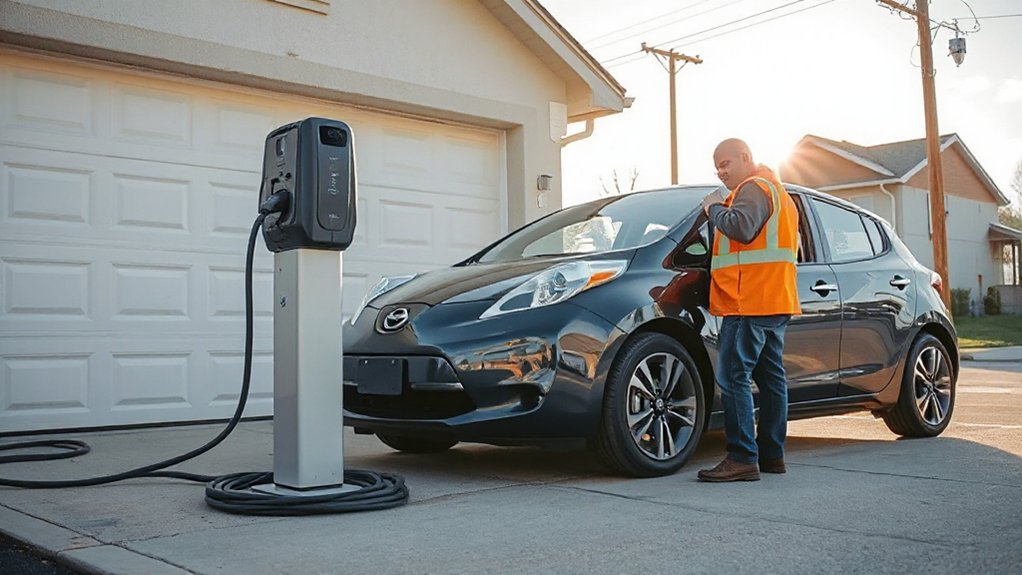
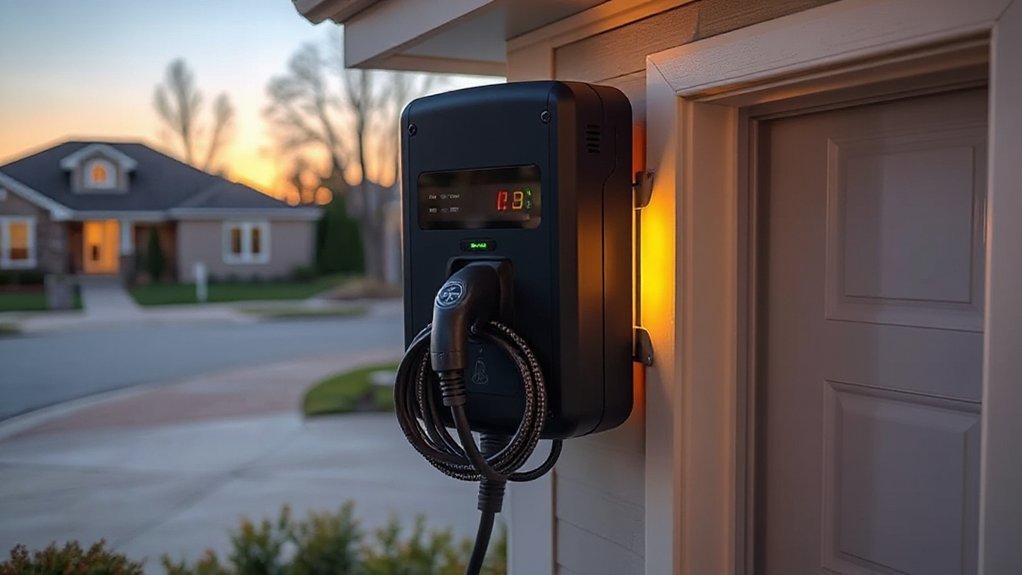


Selecting EVSE amperage and connectors is only half the story; your solar system topology—grid-tied or off-grid—governs how reliably you can deliver those kilowatts. Grid-tied systems use UL 1741 SA/IEEE 1547 certified inverters, meet Interconnection Standards with anti-islanding, and let the EVSE draw steady power while exporting surplus. Off-grid designs pair PV with batteries and hybrid inverters; you’ll manage state of charge and inverter continuous rating to meet your EV’s kW demand. Plan for NEC 625/690 compliance, rapid shutdown (690.12), and appropriate fault protection. Maintenance Differences matter: grid-tied emphasizes firmware and relay testing; off-grid adds battery health, ventilation, and periodic capacity checks.
- String combiner shadows, conductors, labeled disconnects.
- Meter seal, utility lockout, placards.
- Battery racks, clear aisles, hydrogen-safe ventilation.
- Weather-rated enclosures, drip loops, strain relief.
Costs, Savings, and Incentives
You can estimate payback by modeling CAPEX, O&M, and load profiles with tools like NREL SAM, yielding 4–9 years at $0.12–$0.30/kWh utility rates for typical 5–10 kW PV plus Level 2 charging. You can reduce net cost with a 30% federal ITC (IRC §25D/§48), state/utility PV rebates ($0.20–$1.00/W), EVSE rebates ($200–$1,500), and (for businesses) MACRS/bonus depreciation. You should align assumptions with IEEE 1547 interconnection and NEC 690/625 compliance and confirm ROI via LCOE benchmarks of ~$0.06–$0.12/kWh.
Payback Period Estimates
Estimating payback for solar EV charging requires a transparent cost-and-savings model tied to local tariffs and incentives. You’ll compute simple and discounted payback using installed cost, O&M, solar yield (kWh/kW-yr), EV profile, and tariff structures (TOU, demand). Model self-consumption, export compensation, degradation, and inverter efficiency. Run Sensitivity analysis on fuel prices, tariff escalation, and irradiance variance. Include Resale impact by estimating property value and system transferability. Benchmark against 25-year life and battery warranty terms. Use net present value and internal rate of return to validate outcomes; stress-test scenarios for curtailment or policy shifts.
- A meter spinning backward on a sunny afternoon.
- A dashboard showing payback crossing year eight.
- A roof array powering an EV at off-peak rates.
- A cashflow curve flattening under worst-case tariffs.
Available Rebates and Credits
How incentives stack across federal, state, and utility programs determines your net installed cost and annual cashflows. You can claim the 30% federal Investment Tax Credit (IRC §25D) on residential solar and paired storage; EV chargers may qualify under §30C if your property sits in an eligible census tract, capped at $1,000. States layer rebates, SRECs, and sales‑tax exemptions; utilities add per‑watt solar rebates and $200–$1,500 Level 2 EVSE incentives. Check Eligibility Criteria: equipment must be UL 1741/IEEE 1547 compliant, chargers ENERGY STAR, and installations permitted and inspected. Track Application Deadlines and funding caps; many programs are first‑come, first‑served. Keep invoices, interconnection approvals, and commissioning reports. Model cashflows with realistic step‑downs and expiration dates to avoid overstating savings. Include income limits where applicable too.
Smart Strategies: Time-of-Use, Batteries, and Energy Management
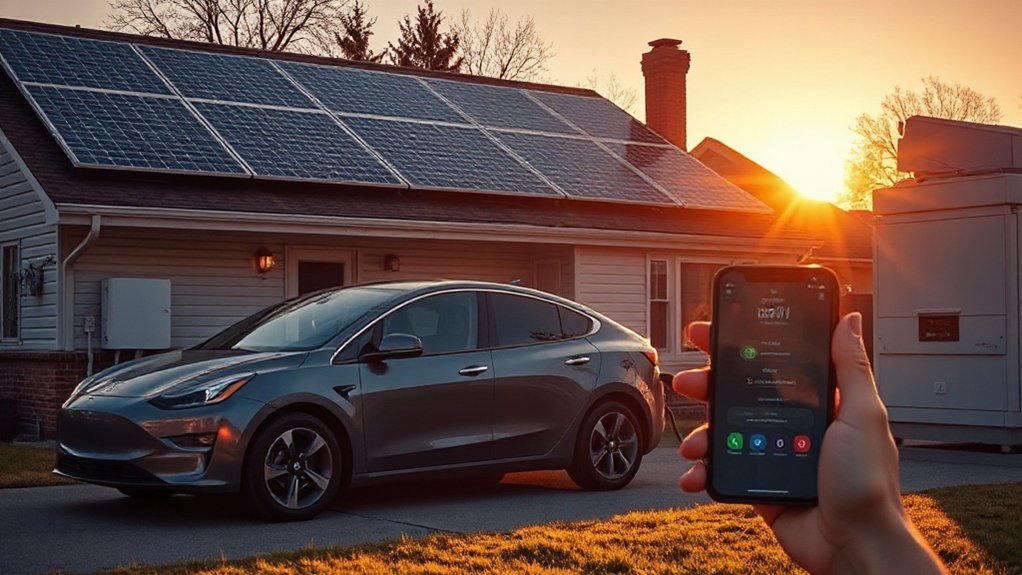
You align EV charging with off-peak TOU windows and high PV output to cut $/kWh by 30–60% and mitigate demand charges, using utility schedules and OpenADR 2.0b signals. You pair a stationary battery (UL 9540/9540A, 85–92% round-trip efficiency) to time-shift solar, cap charger power, and maintain critical-load backup. You implement standards-based controls (ISO 15118/OCPP, IEEE 1547-2018/2030.5, NEC 625) to automate setpoints, enforce export limits, and verify performance.
Optimize Time-of-Use Rates
When utilities price electricity by time-of-use (TOU), aligning EV charging with midday PV output and off-peak windows minimizes cost and demand on the grid. Begin with billing analysis: extract interval data, identify peak/partial-peak/off-peak prices, and compute $/kWh weighted by your charging profile. Use plan negotiation to switch to a TOU tariff with lower midday or super-off-peak rates. Configure your EVSE or vehicle scheduler (SAE J1772/ISO 15118) to charge during solar surplus and utility off-peak. Enable utility signals via OpenADR or IEEE 2030.5 where available, and cap current to avoid tier triggers and demand charges. Verify seasonal differentials.
- Sunlit driveway cables humming at 11 kW
- Tariff charts with troughs circled in blue
- A scheduler timeline snapping to off-peak blocks
- Meter pulses slowing as clouds pass
Battery-Backed EV Charging
Coordinating a home battery with EV charging turns intermittent PV into firm, low-cost kWh while cutting peak demand and enabling outage ride-through. Use the battery to soak midday PV, cap charger power to stay within service limits, and discharge during peak TOU windows. Target 88–94% round-trip efficiency and 5–10 kW inverter power to sustain Level 2 charging without grid spikes. Comply with UL 9540/9540A, IEEE 1547 interconnection, NEC 705 backfeed rules, and ISO 15118-20 for smart charging. Set SOC floors for outages and participate in demand response where supported. Budget throughput-based degradation (roughly $0.05–$0.15/kWh) and plan battery recycling at end of life. Note insurance considerations: disclose storage, maintain clearances, and document commissioning, permits, and as-builts.
| Metric | Typical |
|---|---|
| Round-trip efficiency | 88–94% |
| Usable capacity | 10–20 kWh |
Conclusion
You close the circuit between sun and street: a PV array sized to ~4–6 kW per 10,000 annual EV miles (0.27–0.35 kWh/mi), routed through UL 1741 inverters and NEC 690/705 compliant gear. You match Level 2 loads, manage TOU with batteries, and document rapid shutdown per 690.12. Treat panels as your odometer: each kWh a mile. Build to code, verify with commissioning data, and you’ll drive on photons safely, cheaply, and predictably, year after year.