Sunlight pools on your driveway and the panels hum quietly; you can use that energy to fill an EV’s battery. It’s practical but not one-size-fits-all. You’ll weigh grid‑tied versus off‑grid or hybrid setups, panel count and charging habits, and incentives versus upfront cost—I’ll walk you through the choices that make it work for your home.
Key Takeaways
- Yes — solar panels can directly or indirectly charge EVs using grid‑tied, off‑grid, or hybrid systems with appropriate inverters and EVSE.
- Size your array based on daily miles, vehicle efficiency, and local solar irradiance; typical homes need 5–12 panels for routine charging.
- Batteries enable nighttime or cloudy‑day charging; plan 10–30 kWh usable storage for most daily EV needs.
- Hybrid or grid‑tied setups with smart charging optimize solar use, reduce costs, and avoid oversized battery systems.
- Upfront costs vary widely ($10k–$30k+); federal/state incentives and net metering significantly improve payback (often 8–15 years).
How Solar EV Charging Works
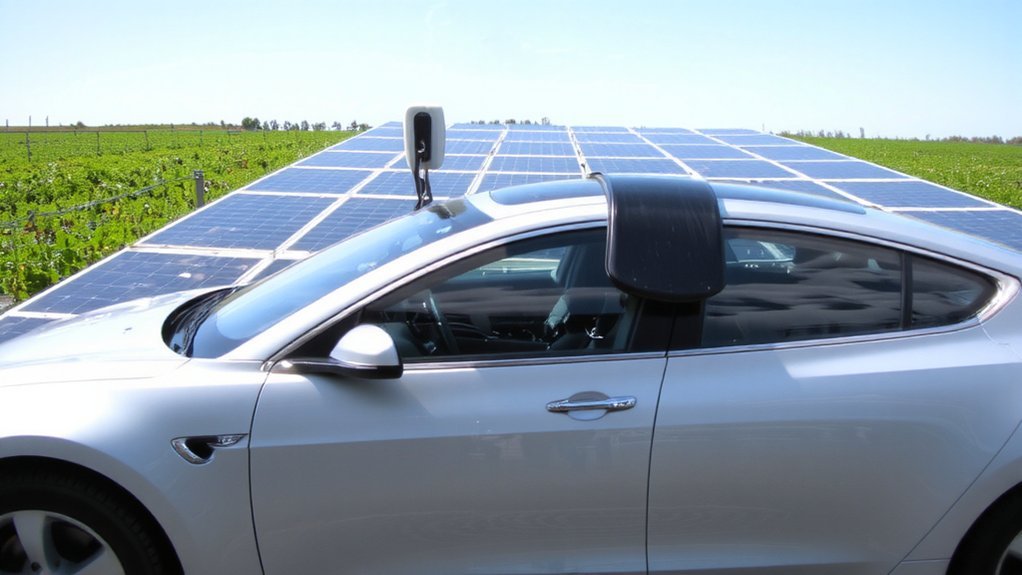
While sunlight falls on photovoltaic (PV) panels, they convert it into direct current (DC) electricity that flows into your home system, where an inverter usually turns it into alternating current (AC) for the EVSE to charge your car.
Solar PV panels convert sunlight into DC, which an inverter changes to AC so your EVSE can charge.
Choosing between grid-tied and off-grid setups depends on location, energy security needs, and budget.
You’ll typically need eight to twelve panels for regular residential charging, though output varies with location, panel efficiency, and sun exposure. Panels mount on roofs or ground frames at safe, ideal angles.
Inverters must match system voltage and have high efficiency to reduce conversion losses; without one most EVSE can’t use DC. Charge controllers protect batteries from overcharge and may include MPPT to maximize harvest.
If you include battery storage, size it to daily charging needs and follow installation safety guidelines and consult certified installers regularly.
Types of Solar EV Charging Systems (Grid-tied, Off-grid, Hybrid)
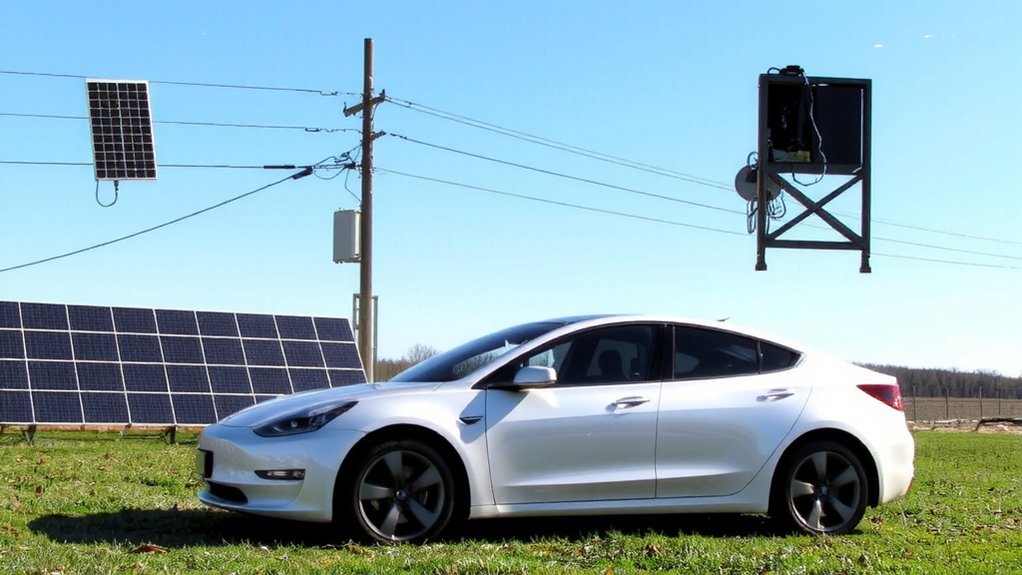
Because your energy needs and site constraints differ, you’ll choose among three main solar EV charging approaches: grid‑tied, off‑grid, and hybrid.
- Grid‑tied: panels feed the grid, enable net metering, avoid large batteries, integrate with Level‑2 chargers and smart load management for cost‑effective urban/suburban use.
- Off‑grid: independent systems use battery banks to power charging and home loads at remote sites; require sufficient storage, safe battery installation, ventilation, and accept slower charging.
- Hybrid: combines batteries plus grid connection for resilience; batteries supply backups during outages while the grid supplements as needed and energy management optimizes safety and cost. Many hybrid systems now incorporate second‑life batteries to lower cost and improve compactness and efficiency.
Choose the approach that matches access, reliability, and safe installation practices. Consult licensed electricians and follow local codes and manufacturer guidance to guarantee safe, compliant installations.
Sizing Your Solar Array for Real-World EV Charging Needs
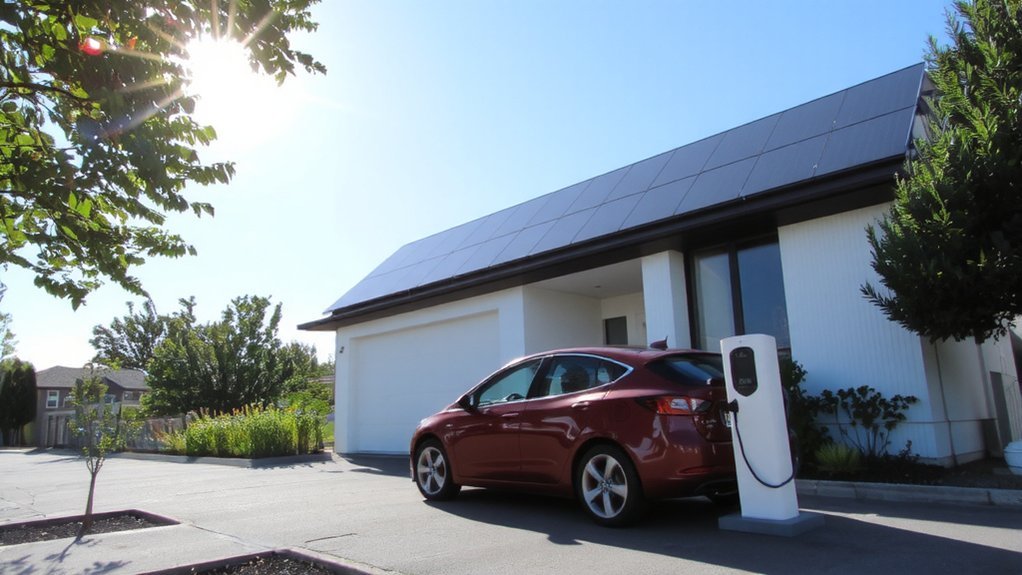
Start by calculating your EV’s real-world energy use—you can use your car’s display or the U.S. average (~11.8 kWh/day, ~4,310 kWh/year) as a baseline. Keep in mind that greater daily energy consumption will require a larger solar system. Translate that into panel needs using local peak sun hours and panel wattage—most homes require roughly 5–12 additional panels (350–400W each) for typical EV charging, with heavier use needing more.
Then evaluate how much battery storage you’ll need to shift daytime surplus to nighttime charging and remember to add about 20% for system losses when sizing panels and storage.
Calculate Your EV Usage
Figure out how much electricity your EV really uses before sizing a solar array — the typical U.S. driver logs about 13,500 miles/year, which works out to roughly 4,000 kWh of charging annually (about 30 kWh per 100 miles). Start by tracking your daily miles and vehicle efficiency; most drivers need 30–50 kWh/day, more for trucks/SUVs. Remember charging losses: plan for 85–90% charging efficiency and inverter/battery losses.
Consider seasonal solar variation and safety: avoid overloading circuits and follow installer guidance.
Keep in mind that new EVs made up 9.6% market share of light-duty vehicle sales in Q1 2025.
- Record average daily miles and convert to kWh.
- Add 10–20% for charging/inverter losses and larger vehicle needs.
- Match usable solar hours and storage strategy to evening charging safely.
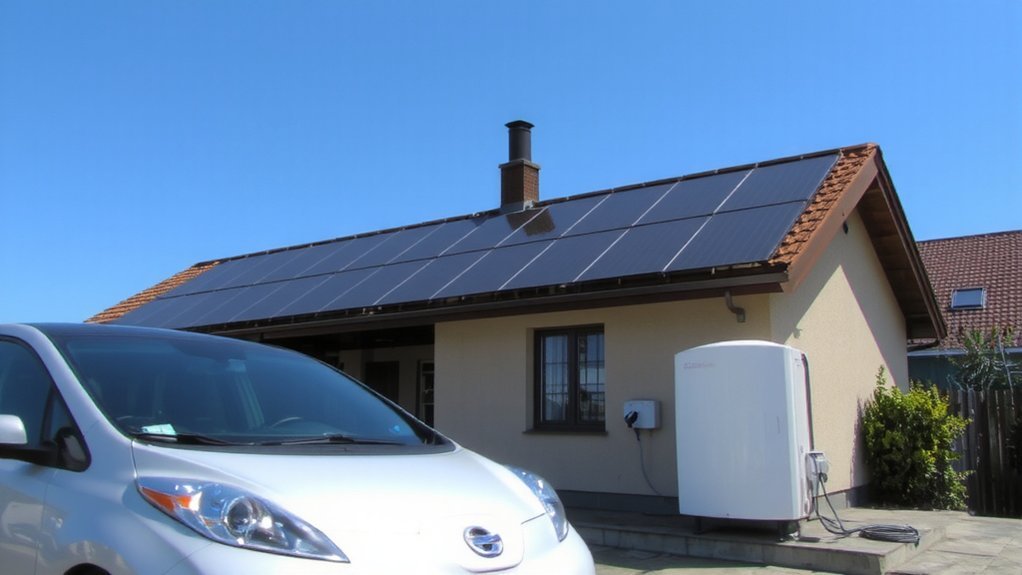
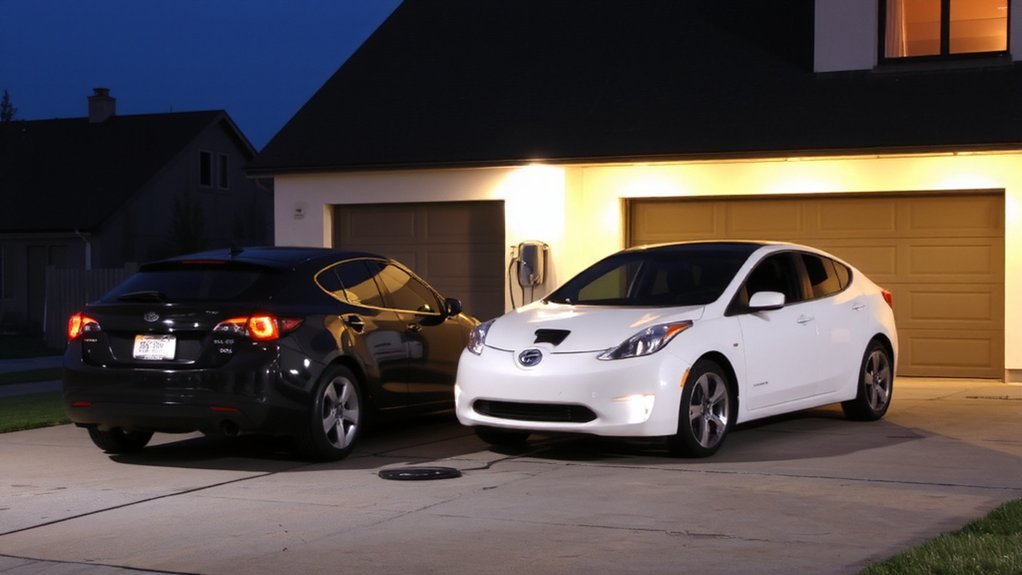
Since 80% of charging happens at home, coordinate installers and utilities for safe interconnection.
Panel Count Estimates
After you’ve calculated your EV’s daily kWh needs, estimate panel count by dividing that number by the expected daily output per panel. A standard 300 W panel yields roughly 1.5 kWh per day assuming 5 peak sun hours, so typical home EV charging needs fall between 5 and 12 panels depending on battery size and driving.
A Tesla Model 3 (75 kWh) needs about 10–12 panels for a one-day full charge; smaller plug-ins like a RAV4 Prime (18 kWh) need 3–5. Account for geographic irradiance, roof orientation and shading, and seasonality; oversize arrays 10–20% to guarantee reliability.
Portable options use 1–3 panels for slow topping-up only. Work with a certified installer to guarantee safe, code-compliant sizing and installation. Confirm permits and interconnection requirements locally. Also remember a solar system needs an inverter required to supply AC power to an EV charger.
Battery Storage Considerations
Think about battery storage as your bridge between sunlit generation and real-world charging needs: it stores daytime solar so you can charge overnight or on cloudy days, and you should size it around your EV’s daily kWh plus household consumption (typical usable needs are roughly 10–30 kWh for most EVs), with extra capacity to cover multi-day stretches of low sun and unexpected loads. Remember that an EV’s battery capacity is measured in kWh.
You’ll size storage to match daily EV demand plus essential home loads, factor in seasonal variability, prefer some oversizing. Pair storage with smart charging and load balancing to prevent circuit overloads and maintain speed. Maintain batteries to preserve lifespan.
- 1. Calculate daily kWh (EV + home).
- 2. Add buffer for low-sun days (20–50%).
- 3. Integrate smart charging.
Economics, Incentives, and Cost Savings
You’ll face upfront costs for panels, inverters, and installation, but you can estimate payback by comparing those expenses to avoided fuel and grid bills. Government incentives, tax credits, and rebates can substantially shorten that payback period. Check local programs and run a simple ROI calculation to see when solar charging becomes net savings for you. Also, integrating smart charging and real-time controls can increase solar utilization and reduce grid demand during peak times.
Upfront Costs and Payback
When you add solar to charge an EV, expect a substantial upfront hit—typical residential systems run $10,000–$30,000 before incentives, with small 4–6 kW installs around $10–16K, larger 8–12 kW systems $18–30K, batteries another $7–12K, and charger and panel work adding roughly $1–4K—yet federal tax credits (about 30%) and low solar kWh costs (as little as ~5.3¢ vs. ~13.2¢ grid rates) can cut payback to roughly 8–15 years depending on your local rates, system size, and whether you include storage. Prioritize certified installers and permits for safety.
- Size vs demand — 4–6 kW meets ~20 kWh/day.
- Batteries and upgrades — add $7–12K; panel work $3K+.
- Savings vs grid — ~$700+/yr; payback ~8–15 years.
Review local rates and roof condition before proceeding safely.
Also note that the federal tax credit currently covers around 30% credit of eligible solar costs.
Government Incentives and Rebates
A range of federal, state, and utility incentives can cut the upfront cost of charging an EV with solar, but eligibility rules matter—so check them before you buy. You may also qualify for a federal EV tax credit of up to $7,500. You can claim a federal Alternative Fuel Vehicle Refueling Property Credit with IRS Form 8911: residential installs get 30% up to $1,000 per unit if your home is in an eligible census tract; businesses can get 30% up to $100,000 per item if wage/apprenticeship rules are met. Use Argonne’s mapping tool to verify eligibility.
Illinois offers EPA rebates up to $4,000 for EVs and utilities rebate $1,000–$3,750 for Level 2 chargers; applications and income prioritization vary. The 30% solar tax credit can apply to PV systems; document components separately and keep records to stay compliant today.
Installation Process, Permits, and Maintenance Schedule
If you plan to charge your EV with solar, start with a full site assessment—checking panel capacity, charger location, and wiring routes—then install a dedicated 240V (typically 50‑amp) circuit and mount the Level 2 charger per manufacturer specs. Keep in mind that Level 2 is the sweet spot for home installations.
After assessment, secure permits and confirm electrical compatibility. You’ll need electrical permits, load calculations, and final inspection; some areas add 1–2 weeks. Hire a licensed electrician to perform wiring, inverter integration, and safety verification.
Maintain the system with a clear schedule:
- Quarterly visual checks of panels, charger, and conduits.
- Clean panels every 6–12 months; test connections and breakers annually.
- Update inverter firmware and address any defects immediately.
Document all work and retain permits and inspection records. Follow codes and inspections to keep charging safe and reliable.
Emerging Trends, Smart Charging, and Practical Tips
Because solar, storage, and smart controls are converging, you’ll see faster, more flexible EV charging that aligns with on‑site renewable generation. Expect to see more ultra-fast chargers paired with on-site batteries at major charging hubs. You can expect ultra‑fast chargers paired with panels and batteries to cut dwell times, while wireless pads add convenient, low‑risk charging in urban settings. Public solar charging networks are expanding along highways and in cities, improving access to green energy.
Use smart chargers and apps to schedule charging when solar output is high or rates are low, and enable safety features like automatic load management and fault detection. Add battery storage to cover nights and cloudy days. Choose chargers certified for solar feed‑in, work with qualified installers, and monitor energy flows to guarantee efficient, code‑compliant, and safe operation, and keep documentation for inspections.
Conclusion
You can absolutely charge your EV with solar panels, so stop pretending gas pumps are the only plugs in town. You’ll need panels, an inverter, and maybe patience while the sun negotiates with your schedule. It’ll cost upfront, but incentives and lower bills will make your wallet stop crying. Embrace smart chargers, plan your array, and enjoy driving on sunlight — because nothing says modernity like cruising silently to the grocery store powered by sunshine.