You want faster home or travel charging without a wallbox, but you need to match speed, cost, and safety. We’ll map kW = volts × amps, typical 6–...
Your Complete Guide to Electric Vehicle Charging
You want faster home or travel charging without a wallbox, but you need to match speed, cost, and safety. We’ll map kW = volts × amps, typical 6–...
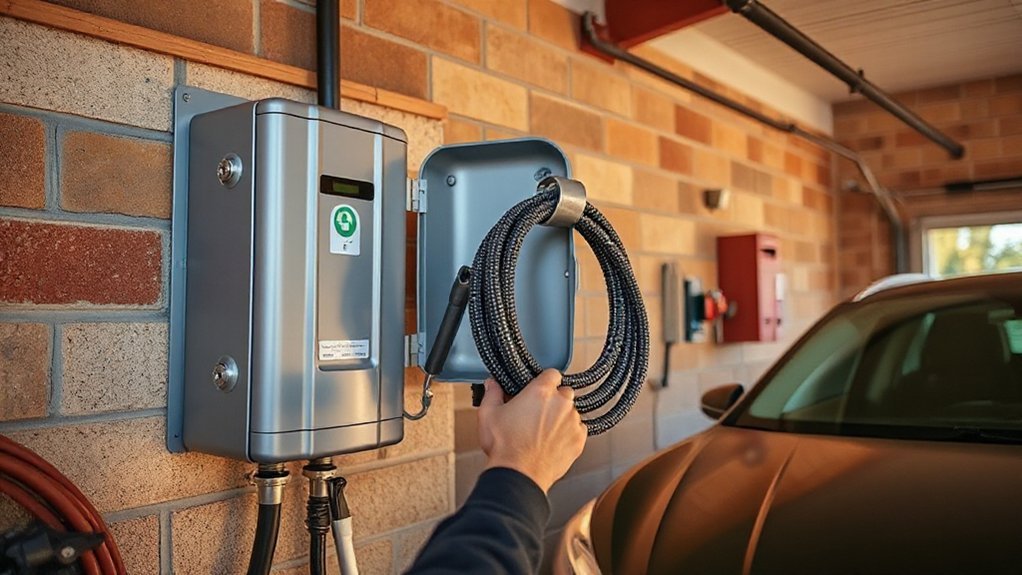
Plugging a UL-listed 32A portable EVSE into a NEMA 14-50 on a 40A circuit gives you true Level 2 charging, but only if the circuit, plug, and veh...
When you’re stranded, portable EV charging isn’t one-size-fits-all: Level 1 (120 V, ~1–2 kW) adds miles slowly; portable Level 2 (240 V, ~3.8–9.6...
Over 80% of EV charging happens at home, so your portable Level 2 choice matters. The Blink unit delivers up to 32 A with a 25‑ft cable, integrat...
Choosing a portable EV charger in 2025 means matching Level 1 or 2 (120/240V) to your circuit, verifying NEC 625 continuous‑load sizing, and conf...
By coincidence, your daily range anxiety and the Blink portable EV charger meet at the same constraints: amps, volts, and protocol limits. You’ll...
Pick the right capacity, choose efficient standards, and manage heat safely. You’ll cut weight, charge faster, and extend battery life—if you siz...
A 50 kW DC fast charger like the ABB Terra 54 can draw hundreds of amps and often needs three‑phase service. You’ll coordinate with your utility,...
Thinking about Level 3 at home in 2025? You’ll face equipment and install costs often in the tens of thousands, possible 400 A or three‑phase ser...
You can install a Level 3 (DC fast) charger at home, but it’s rarely practical. These 50–350 kW systems demand three‑phase service, major switchg...