
North America’s CCS1 meets Europe’s CCS2 while Japan’s CHAdeMO stands apart. You face different plugs, protocols, and limits. CCS1/2 use IEC 62196 forms, PLC with ISO 15118, and 400–1000 V up to ~350 kW. CHAdeMO uses CAN, mature V2X, and typical caps near 100–150 kW. Adapters, Plug&Charge, and network density shift real‑world speed and cost. Which standard best secures fast, interoperable trips in 2026 and beyond?
Key Takeaways
- CCS1/CCS2 use combo AC/DC with top-latch; CHAdeMO is separate round plug with side-lever; all support liquid-cooled cables up to ~500 A.
- Regions: North America favors CCS1, Europe mandates CCS2, Japan prioritizes CHAdeMO; verify adapters and homologation for cross-region travel or imports.
- Power: CCS1/CCS2 deliver 150–350 kW typical (up to 500–600 A, 1,000 V); CHAdeMO usually 50–100 kW, with 2.0 sites up to ~200 kW.
- Protocols: CCS uses PLC with DIN 70121/ISO 15118 enabling Plug-and-Charge; CHAdeMO uses CAN, offering mature V2H/V2G deployments today.
- Road-trip practicality: CCS networks dominate outside Japan; CHAdeMO sites dwindling; use rated adapters, check ISO 15118 support, and plan on 150–350 kW corridors.
Connector Designs and Physical Differences
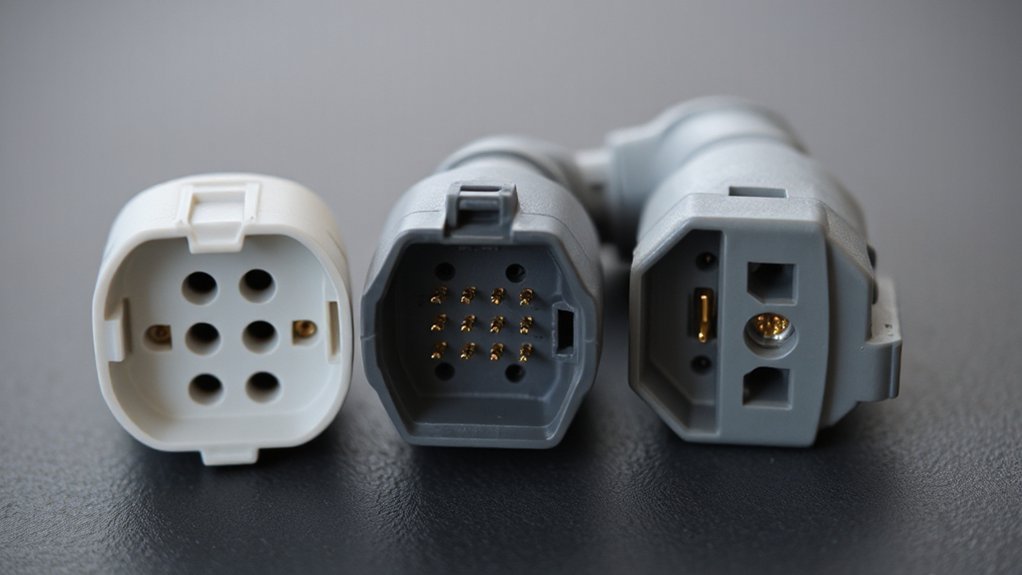
While communication protocols coordinate charging, the connectors themselves differ in geometry, pinout, and thermal design defined by their standards. You’ll see CCS1 (SAE J1772 Combo) retain the Type 1 AC profile with two DC pins, whereas CCS2 (IEC 62196-3, Combo 2) integrates a Type 2 envelope with larger protective shrouds; both support liquid-cooled cables up to ~500 A, 1000 V. CHAdeMO (JEVS G105) uses a separate round housing with symmetrical DC pin configurations and robust signal pins. Latching differs: CCS employs top-latch actuator mechanisms; CHAdeMO uses a side lever with lock. Contact diameters, keying, and ingress seals target IP54–IP55 mated. Thermal probes monitor contact rise; some assemblies embed PT100/NTC sensors. You’ll notice handle ergonomics, strain reliefs, and cable bend radii optimized for one-handed operation.
Regional Availability and Vehicle Compatibility
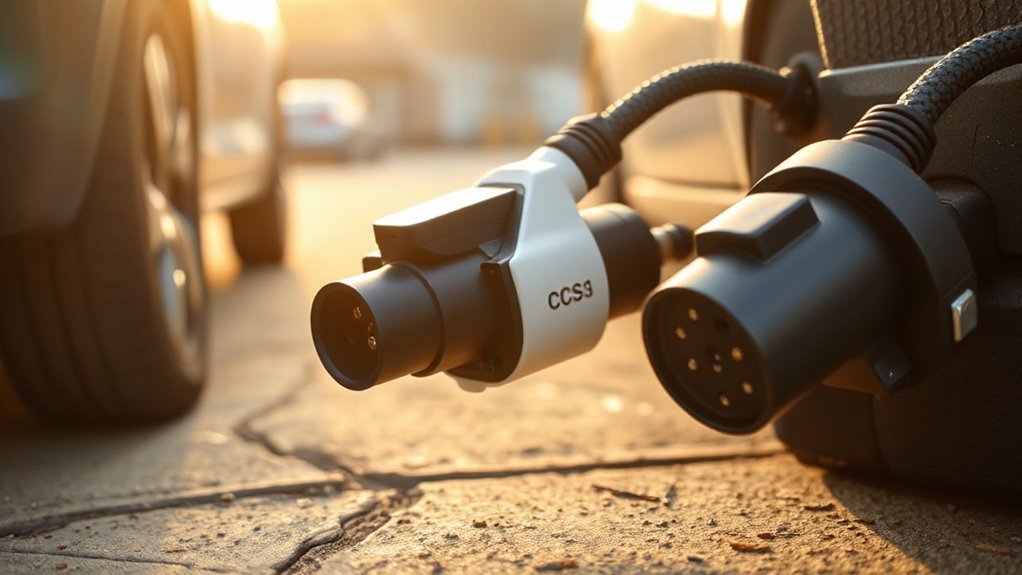
Although connector families share electrical goals, regional standards and policy drive which plugs you’ll actually find and what vehicles can use them. In North America, CCS1 (SAE J1772 Combo per SAE J3068) dominates DC sites due to government regulations like NEVI funding rules and UL listing practices; most 2019–2024 models ship CCS1. In Europe, CCS2 (EN 62196‑3, IEC 61851) is mandated by AFIR, so virtually all EU‑type‑approved BEVs support CCS2. Japan prioritizes CHAdeMO (JEVS G105), and many domestic models retain it; outside Japan, CHAdeMO persists mainly for legacy Nissan LEAF fleets. Manufacturer partnerships shape maps: EU OEM alliances standardized CCS2, while U.S. automakers’ 2023–2025 deals add NACS in parallel, CCS1 ports remain for compliance. Confirm adapter support and homologation before cross‑region travel or imports.
Charging Power, Voltage Limits, and Real-World Speeds



Because charging power equals pack voltage times delivered current, connector standards and vehicle architectures cap speed. CCS1/CCS2 support up to 500–1,000 V per IEC 62196-3, with 500–600 A liquid-cooled; CHAdeMO v1.2 tops ~500 V, 200–400 A. In practice, you’ll see 150–350 kW on CCS, 50–100 kW on legacy CHAdeMO, and up to ~200 kW on CHAdeMO 2.0 where available. Your car’s battery curve, SOC, temperature, and cable cooling govern peak performance and thermal throttling. Expect taper above ~60–70% SOC. Below is a concise comparison.
| Standard | Max V/A (spec) | Typical 10–80% kW DC |
|---|---|---|
| CCS1 (400 V pack) | 500 V, 500 A | 120–180 |
| CCS2 (800 V pack) | 1,000 V, 500–600 A | 200–300 |
| CHAdeMO 1.2 | 500 V, 200–400 A | 40–90 |
| CHAdeMO 2.0 | 500 V, 400 A | 80–200 |
Communication Protocols, Plug-and-Charge, and V2X Capabilities

Most EV charging features hinge on the protocol stack: IEC 61851/62196 define power and signaling layers, DIN 70121 and ISO 15118 handle high-level EV–SE communication, and OCPP 1.6/2.0.1 connects stations to backends. With CCS1/CCS2, you communicate over HomePlug GreenPHY PLC on the control pilot; DIN 70121 covers legacy DC, while ISO 15118-2/-20 adds TLS security, Contract Certificates, and Plug-and-Charge via OEM PKI Certificate Management. You get automated Billing Integration through OCPP tokens and ISO 15118 payment details. CHAdeMO uses CAN bus; it supports mature V2H/V2G today, with certified 3.3–10 kW systems. CCS under ISO 15118-20 enables bidirectional AC/DC and scheduled V2X, but deployments remain pilot-scale. Across ecosystems, backends orchestrate load, pricing, and metering using OCPI/OCHP gateways. Cybersecurity relies on TLS, TPMs, and revocation checks.
Adapters, Network Coverage, and Futureproofing for Road Trips

While connector types in North America are converging on SAE J3400 (NACS), your road‑trip readiness still hinges on carrying the right DC‑capable adapters, validating corridor coverage and uptime, and matching protocol support end‑to‑end. Prioritize CCS1↔NACS adapters with 250–500 kW ratings; note CHAdeMO adapters are rare and often limited to ~50 kW. Confirm ISO 15118/DIN 70121 negotiation and your car’s firmware.
1) Map coverage using AFDC and PlugShare, filter by kW, reliability, and NEVI 97% uptime compliance, and cross‑check site redundancy.
2) Audit networks and apps for ISO 15118-2 PnC, OCPP 1.6/2.0.1, and card readers to reduce roaming fees and fallback friction.
3) In trip planning, stage energy on backbone corridors, precondition, and carry AC backups; revisit quarterly as deployments shift and charger availability forecasts.
Conclusion
You wanted a universal plug; instead, you audition three standards like USB’s awkward cousins. You’ll pick CCS1 in North America (SAE J1772/Combo, ISO 15118/DIN 70121), CCS2 in Europe (IEC 62196-3, 800–1000 V), or CHAdeMO in Japan (CAN, mature V2X). Real networks deliver 50–350 kW—if cables are cooled and cars allow. Adapters exist, miracles pending. For road trips, follow coverage maps, firmware notes, and plug-and-charge support. It’s not elegant, but it’s defensible, repeatable, standards-compliant science today.