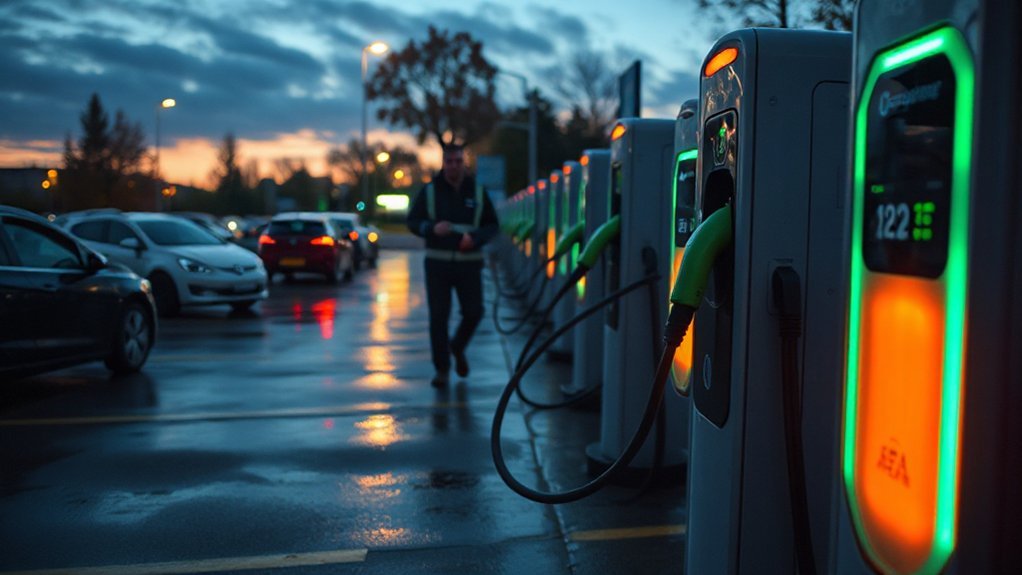
If you’re thinking about installing a home EV charger, expect total costs from about $1,200 to $4,000 for most jobs, but your situation can swing that number a lot. You’ll want to know how panel capacity, wiring distance, and permits change the bill—keep going to see which factors will matter most for your home and budget.
Key Takeaways
- Typical home EV charger installation in 2025–2026 costs about $1,200–$4,000, depending on complexity.
- Easy installs using an existing 240V outlet run roughly $300–$800.
- Typical Level 2 installs adding a new 240V circuit and basic wiring cost $1,200–$2,000.
- Complex jobs—panel upgrades, trenching, or weatherproofing—start around $2,500 and can exceed $4,000.
- Expect equipment $400–$1,200, permits $50–$500, and labor $400–$1,500+; get written estimates from licensed electricians.
Typical Cost Ranges for Home EV Charger Installation
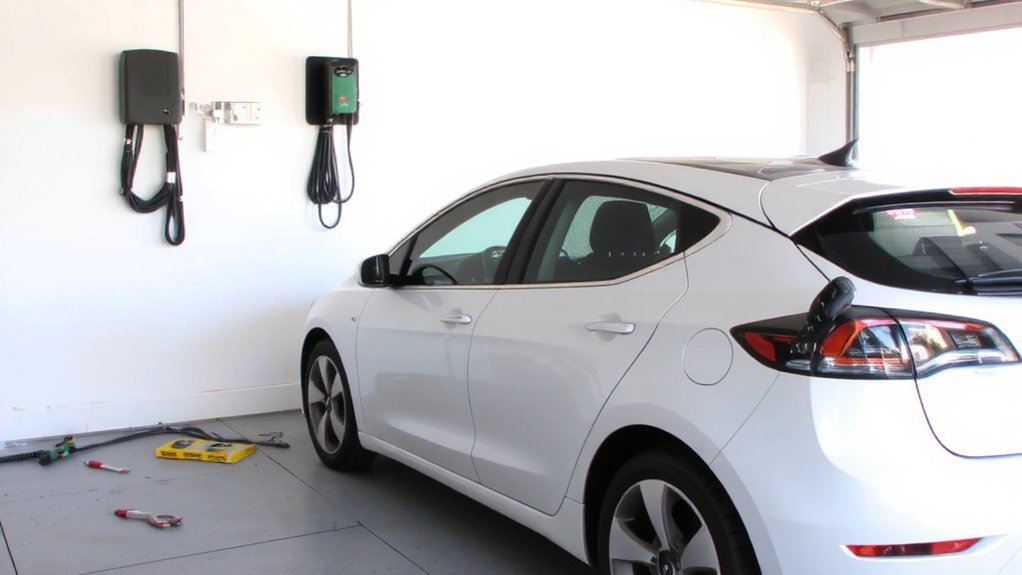
Home EV charger installations typically fall into three cost tiers depending on what work you need: Easy installations run about $300–$800 when you can plug into an existing 240V outlet (like a NEMA 14-50). You’ll mainly buy the charger and plug in; an electrician may perform a quick safety check.
Typical installations cost $1,200–$2,000, with a new 240V outlet, basic wiring, conduit, permits, and a same‑day visit.
Complex installations start around $2,500 and can exceed $4,000 when panel upgrades, trenching, long conduit runs, or weatherproofing are required; panel replacement alone can add $1,500–$3,500. Expect equipment costs from $400 to $2,000 depending on features, and always follow safe installation and inspection practices. On average, homeowners can expect total costs to fall in the $1,200–$4,000 range. If you’re unsure, get a licensed electrician to assess and confirm safe options.
Factors That Influence Installation Price
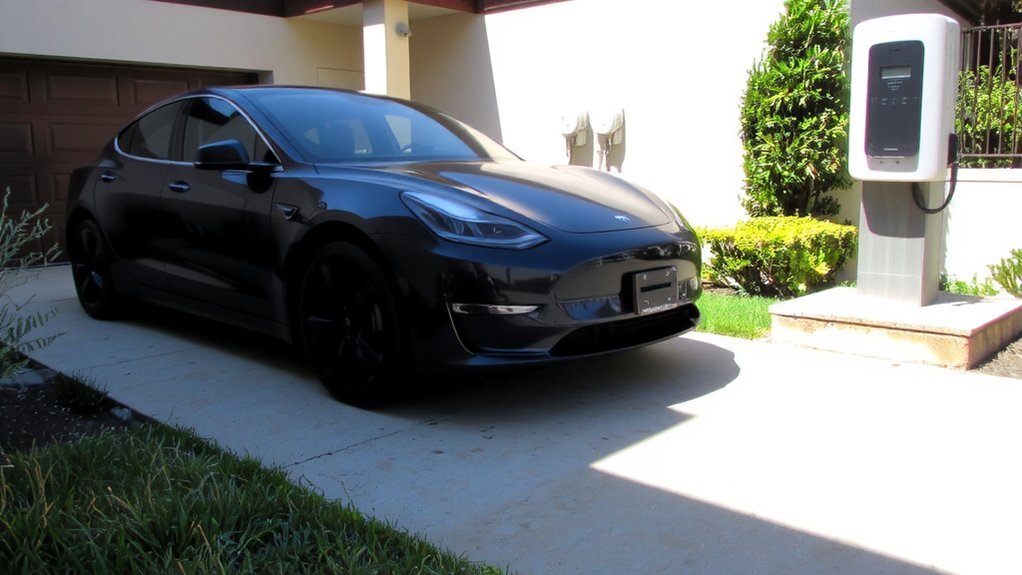
If you thought price was just about the charger unit, think again — several site-specific factors drive the final bill. You’ll need a licensed electrician to verify panel capacity; many homes under 150 amps require upgrades, which commonly add $1,300–$3,500 (sometimes up to $4,000) for panel replacement, subpanels, or dedicated circuits.
Distance from panel to charger affects wiring, conduit and trenching costs; runs over 25 feet or underground work can add $500–$2,000. Permits and inspections usually cost $50–$500 and local codes can require stricter, costlier compliance. Labor varies by complexity and region, typically $400–$1,500+, so choose experienced pros to guarantee safe, code-compliant installation.
Always ask for written estimates, verify licenses and insurance, and prioritize safety over lowest bids to avoid costly rework or hazards. You should always hire a professional electrician to ensure safe, code-compliant work.
Common Installation Scenarios and Example Costs
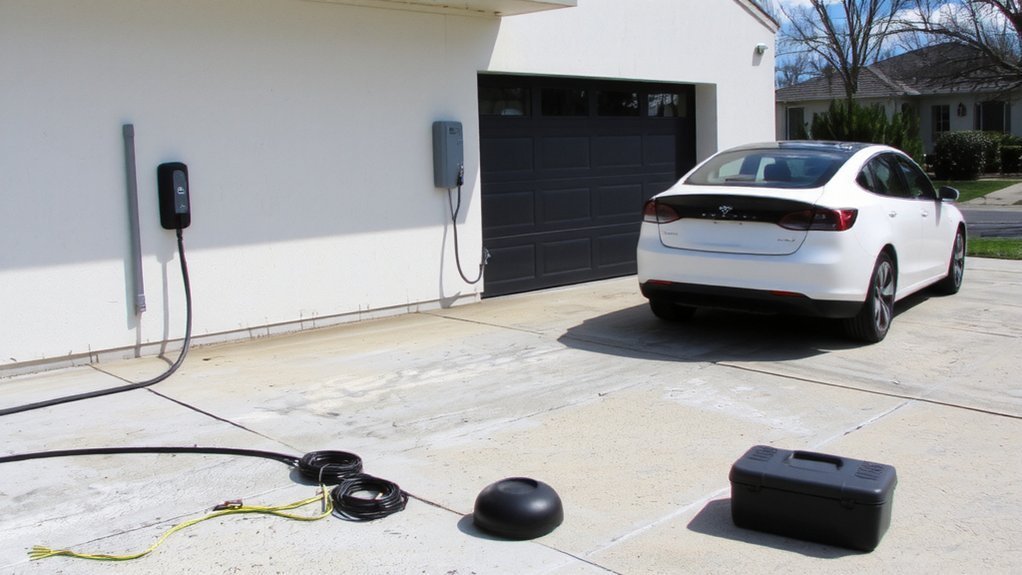
Because installation needs hinge on your existing wiring, panel capacity, and how far the charger will sit from the panel, you’ll typically fall into one of three cost tiers: simple (using a pre-installed 240V outlet, $300–$800), typical Level 2 (new 240V outlet and wiring, $800–$2,500), or complex (panel upgrades, long runs or trenching, $2,500–$4,000+).
If you already have a NEMA 14-50 or similar outlet, expect minimal work—maybe a breaker addition or safety check—and the quickest installation.
Typical Level 2 jobs add wiring, conduit, and permits; they’re common when the panel sits near the garage.
Complex jobs require panel upgrades, trenching, or weatherproofing for outdoor chargers and raise costs substantially.
Prioritize licensed electricians and inspections to keep installation safe and code-compliant and avoid DIY shortcuts.
For most homeowners, Level 2 chargers provide the best mix of speed and practicality.
Detailed Cost Breakdown: Equipment, Labor, and Permits
You’ll pay $300–$1,200 for a typical Level 2 charger, with premium models and optional subscription services adding ongoing costs. For most homeowners, Level 2 Chargers are the best choice, providing faster charging without the high cost of DC fast chargers.
You’ll find installation labor usually runs $400–$1,300+ depending on panel upgrades, distance, and weatherproofing, and can take a few hours to multiple days.

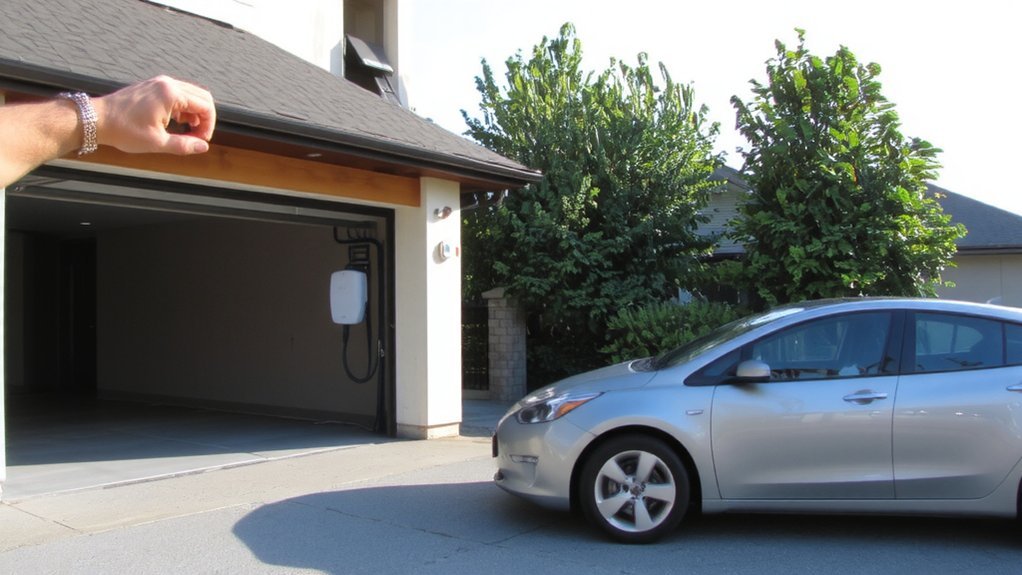
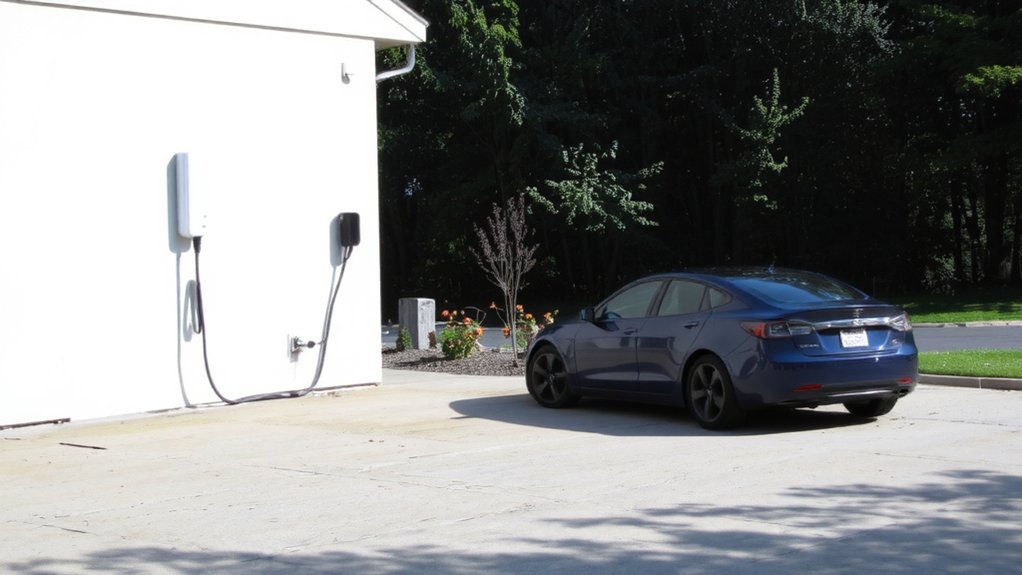
You’ll also need permits and inspections—typically $50–$300—and delays or required upgrades can push the total higher.
Charger Equipment Costs
Equipment costs usually run $400–$1,200 for Level 2 home chargers, with most reliable models priced around $400–$700 and premium smart units exceeding $1,000. Level 2 chargers require a 240V connection for faster charging. You’ll choose based on durability, smart features, and charging speed: rugged Grizzl‑E models cost about $450–$600; ChargePoint Home Flex and JuiceBox sit higher ($650–$900) for app control and energy monitoring; Tesla Wall Connector is midrange and now supports all EVs.
Factor in taxes, shipping, and optional extended warranties ($50–$200+). Pick weatherproof hardware if you park outdoors to maintain safety and reliability.
- Choose a smart charger for scheduling and energy insights.
- Prioritize weatherproofing for outdoor installations.
- Keep receipts for warranty, permits, and safety inspections.
Buy from certified retailers and check UL listing and manufacturer safety documentation before use regularly.
Installation Labor Rates
Most electricians charge $50–$100 per hour for EV charger installs. You can expect a typical install to take 4 to 8 hours, so labor often runs $400–$1,500 depending on complexity and location.
Simple jobs with an existing 240V outlet usually cost about $300–$800 in labor and finish in under four hours. Typical installs adding a 240V circuit and basic wiring are about $500–$1,000+ and take roughly 4–6 hours.
Complex work—panel upgrades, trenching, or weatherproofing—can push labor to $1,000–$1,500+ or add $500–$2,000 when extensive wiring or drywall repairs are needed. Urban areas and stricter codes raise rates, while experienced contractors charge premiums.
You should hire a licensed electrician and prioritize thorough testing to keep systems safe. Verify credentials, get written estimates, and confirm warranties promptly.
Across the U.S., the average total installed cost is about $2,442.
Permits and Fees
How much will permits and fees add to your EV charger project? Expect permitting and inspection costs typically between $50 and $720 depending on where you live, with most projects landing in the $50–$300 range. Inspections may be bundled or billed separately ($50–$150).
Don’t forget HOA, historic-district, environmental or fire approvals that can add $50–$500. Some utility or service-upgrade charges may apply. Keep documentation: rebates and federal tax credits (up to 30%, $1,000 cap) often require permits and passed inspections.
Typical permit/inspection: $50–$720
Additional regulatory/HOA fees: $50–$500
Rebates often require permit/inspection proof
Plan for possible re-inspection fees if work fails initial review, and confirm local permit timelines so you don’t delay installation or forfeit incentives tied to timely inspection and documented compliance. Stay safe now. You should hire a certified electrician to handle installations and ensure code compliance.
Operating Costs, Charging Savings, and Utility Considerations
When you charge at home, electricity will usually be your biggest ongoing EV expense, averaging about 17.6¢/kWh in the U.S. (roughly $60/month for typical driving), with overnight or off-peak rates often cutting that cost further. You can lower operating costs by scheduling charging during off-peak hours with a smart charger and avoiding public fast chargers that charge a premium.
Expect optional subscription fees for advanced charger features ($5–$15/month). Your utility’s rate structure and available time-of-use plans will determine savings; confirm your home service and panel capacity can support desired charging power. Monitor charger efficiency and usage to track costs, and consult utility advisors or qualified electricians to guarantee safe, code-compliant installation and operation. Regularly review bills and adjust habits to maximize safe savings monthly. Also, many installations require a dedicated 40- or 50-amp circuit—have an electrician verify your panel and run a proper 240-volt circuit.
Incentives, Rebates, and Federal Tax Credits for Home Chargers
After you’ve reviewed operating costs and billing options, look at incentives that can sharply reduce your upfront charger expense. You can claim the federal 30C tax credit for home EV charger equipment and labor — 30% up to $1,000 — if your installation meets eligibility (notably programs target low‑income or non‑urban households) and is completed before June 30, 2026. Installer quotes and on-site factors will determine your final price, with typical professional installation falling in the $799–$1,999 range.
Many states and utilities add rebates, bill credits, time‑of‑use rates or discounted hardware when you enroll in demand‑response programs. To stay safe and compliant, use certified electricians, keep receipts and permits, and confirm charger certifications. Check local rules to combine incentives and lower your net cost.
- Federal 30C: 30% up to $1,000, expires 6/30/2026
- State/local: varying rebates, Level 2 required
- Utility: TOU rates, equipment discounts, enrollment rules
Conclusion
You’ll find that installing a home EV charger typically costs a few hundred to several thousand dollars, and you’ll want to weigh equipment, labor, permits, and potential panel upgrades. Consider savings from lower fuel and smart off‑peak charging, and hunt down available rebates or tax credits to lower your outlay. Plan using a checklist like a Victorian ledger: compare quotes, verify electrician credentials, and prioritize safety so your investment pays off reliably over decades too.