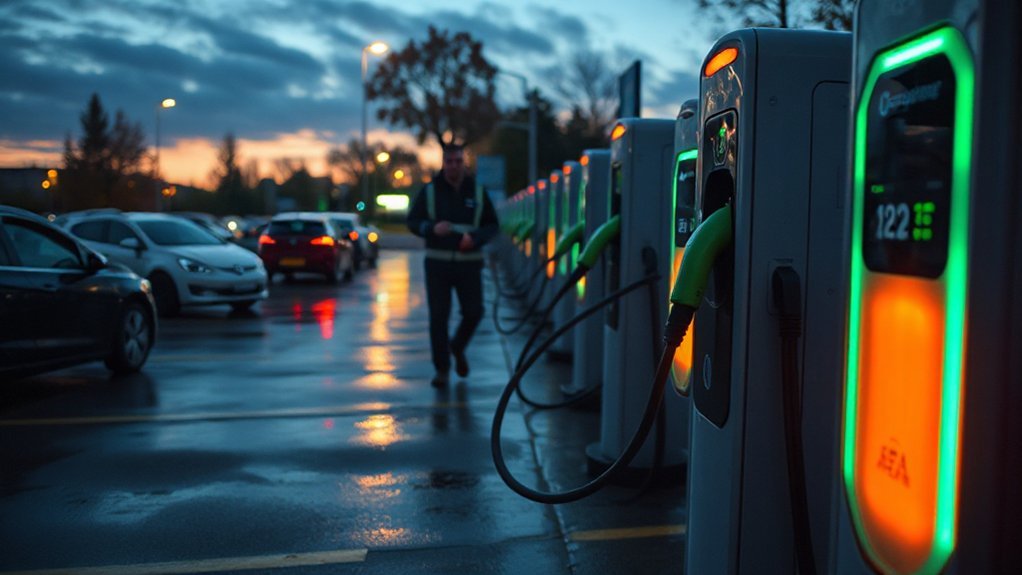
About 80% of EV charging happens at home. If you drive long daily miles or own a large battery, you’ll likely need a 240V Level 2 outlet for practical overnight charging. Before you call an electrician, there are panel, code, and cost factors that will change the answer — here’s how to decide and what to expect next.
Key Takeaways
- Whether you need 240V depends on battery size and daily driving; large batteries or high-mileage use usually require Level 2.
- A 240V Level 2 charger dramatically reduces overnight charging time, typically adding about 10–32 miles of range per hour.
- A 120V Level 1 outlet can suffice for low-mileage drivers, PHEVs, or occasional charging but is very slow for large batteries.
- Level 2 installation needs a dedicated dual-pole breaker sized at 125% of continuous load and will likely require a permit (2025–26).
- Hire a licensed electrician for load calculations, NEC-compliant GFCI protection, and equipment listed by a recognized testing lab (UL/ETL).
Understanding EV Charging Levels

Typically, charging an EV falls into three levels—Level 1, Level 2, and Level 3—each defined by voltage, amperage, and power output and offering progressively faster speeds as infrastructure gets more robust. Note that AC charging (Levels 1 and 2) is converted to DC inside the vehicle, while DC fast charging converts power at the station.
EV charging splits into Levels 1–3—defined by voltage, amperage and power—offering progressively faster speeds.
You’ll use Level 1 with a standard 120V AC outlet for slow, safe overnight top-ups; it delivers about 1–2.4 kW and adds roughly 2–4 miles per hour, so a full BEV recharge to 80% can take 40–50+ hours.
Level 2 runs on higher-voltage AC, provides 3–under 20 kW, and typically adds 12–32 miles per hour, charging BEVs to 80% in 4–10 hours with a dedicated circuit.
Level 3 uses DC at 50–350 kW for rapid public charging, bringing many BEVs to 80% in 20–60 minutes. You should follow manufacturer guidance and certified installers.
When 240V Is Necessary for Your Vehicle
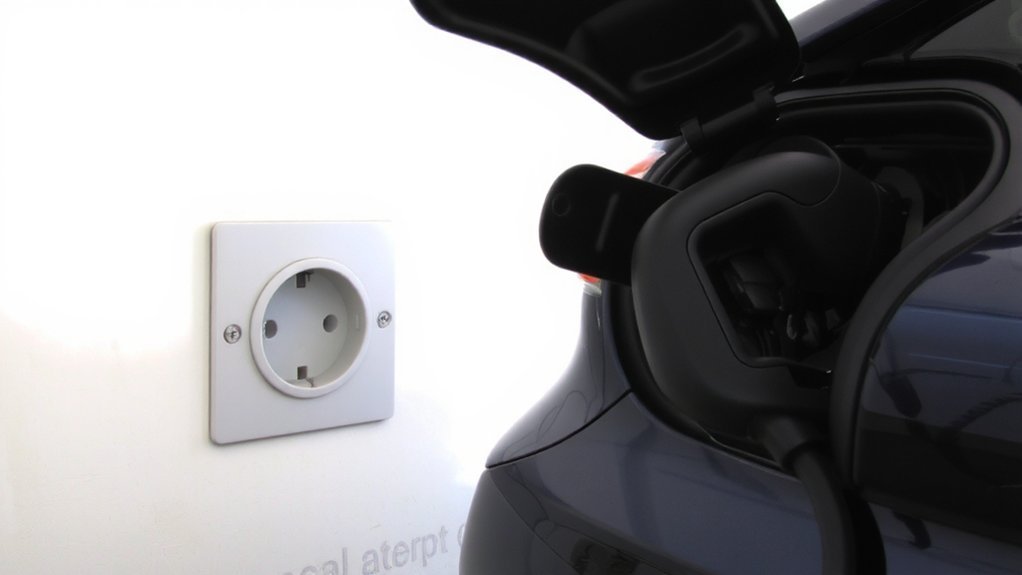
If you drive a large‑battery EV or put on a lot of miles daily, you’ll usually need 240V charging to recharge overnight.
Your daily driving needs determine how quickly you must top up, and Level 2 on 240V typically adds about 10–20 miles of range per hour. Also check your vehicle’s onboard charger — its kW limit sets the fastest charge you’ll actually get, regardless of circuit capacity. The 2026 National Electrical Code will likely make it illegal for homeowners to install their own EV chargers in many areas.
Battery Size Matters
Many drivers with battery packs above 40–60 kWh find 120V charging impractical, because Level 1 can take 40+ hours to fill a large pack while a 240V Level 2 charger cuts that to roughly 4–10 hours, making overnight replenishment reliable for high-mileage or long-range use. If you charge at home, consider installing a Level 2 240V charger for faster replenishment.
If your EV exceeds 60 kWh, you’ll likely need a 240V outlet to restore range safely overnight and avoid downtime. Consider these factors:
- Battery capacity — larger packs need higher power to charge reasonably.
- Onboard charger rate — vehicle limits determine usable amperage.
- Panel capacity — you may need electrical upgrades for higher amps.
- Safety and convenience — preserves battery health.
Plan installation with a licensed electrician to meet codes and guarantee safe operation.
Daily Driving Needs
Because most commutes run 15–30 miles, you can often get by without fast charging, but a 240V Level 2 charger becomes necessary when your routine approaches 60–80 miles a day or when seasonal range loss cuts capacity. The average UK driver covers just 20 miles per day. Track your weekly mileage and add a 20–30% buffer for detours, traffic and extra errands to gauge realistic needs.
In mild climates a 120V outlet might suffice, but cold weather can drop range 10–20%, making Level 2 charging safer and more reliable. Level 2 delivers enough overnight miles to cover typical daily cycles, avoiding morning shortfalls. If you can’t charge nightly, a 240V outlet prevents cumulative range deficits.
Plan for occasional holiday spikes or winter heating use so you maintain safe, dependable daily operation and minimize risk.
Onboard Charger Limits
Your vehicle’s onboard charger sets the cap on how fast it can take AC power, so knowing its rating tells you whether a 240V circuit is needed. The onboard charger converts AC to DC, so almost all charged energy flows through its power electronics. Check your owner’s specs: onboard chargers usually range from 7 to 22 kW, matching 400 to 800 V battery systems; lower-voltage cars may accept slow 120 V Level 1 charging but at about 1.4 to 1.9 kW.
If your onboard charger is 3.3 kW or higher, plan for 240 V Level 2 use. For safety, match circuit amperage to charger limits and use a dedicated circuit installed by an electrician.
- Confirm onboard kW rating.
- Compare battery voltage and charger design.
- Choose 240 V if charger ≥7 kW.
- Install appropriate 40–80 A circuit.
Assessing Your Home Electrical Panel and Capacity
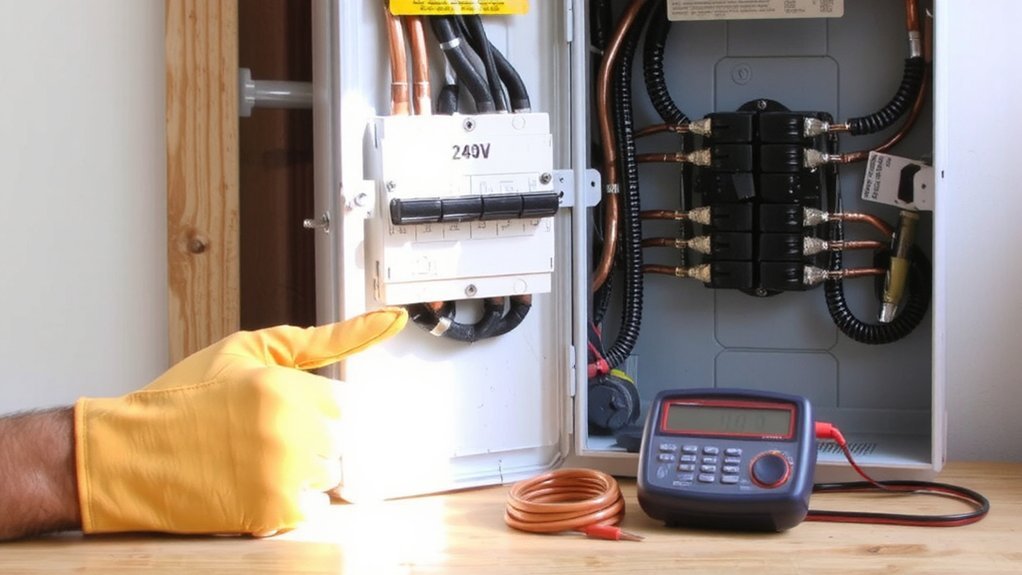
When planning an EV charger, check whether your service panel can handle a dedicated 240‑volt Level 2 circuit—most U.S. homes have 100‑ or 200‑amp service, older homes may still be on 60‑amp, and available capacity determines whether you can install a 30–50A (or higher) charger. Many Level 2 chargers draw 30–50A, with higher‑amp models up to 80A providing faster charging. Inspect panel amperage, existing loads, and breaker space. Level 2 chargers draw 30–50A (some up to 80A); NEC requires breakers sized at 125% of continuous load, so a 32A charger needs a 40A breaker. Don’t share circuits; use a dedicated dual‑pole breaker.
Have a licensed electrician perform a load calculation to avoid overloads, trips, or safety risks. If capacity is limited, consider a service upgrade or a load‑management smart system to allow safe, compliant charging and reduce charging interruptions safely.
Permits, Codes, and Safety Standards for 2025–2026
You’ll need a permit in most jurisdictions for any new EV charging circuit in 2025, and inspectors will expect documentation and load calculations. For most homes, a Level 2 charging circuit is recommended to achieve faster daily charging.
The 2025–2026 NEC updates require a licensed electrician for permanent installs and mandate 5 mA GFCI protection on EV circuits, though state adoption may vary.
Make sure your EVSE is listed by a recognized testing lab (UL/ETL) and that installers provide equipment listings and paperwork to pass inspection.
Permit Requirements 2025
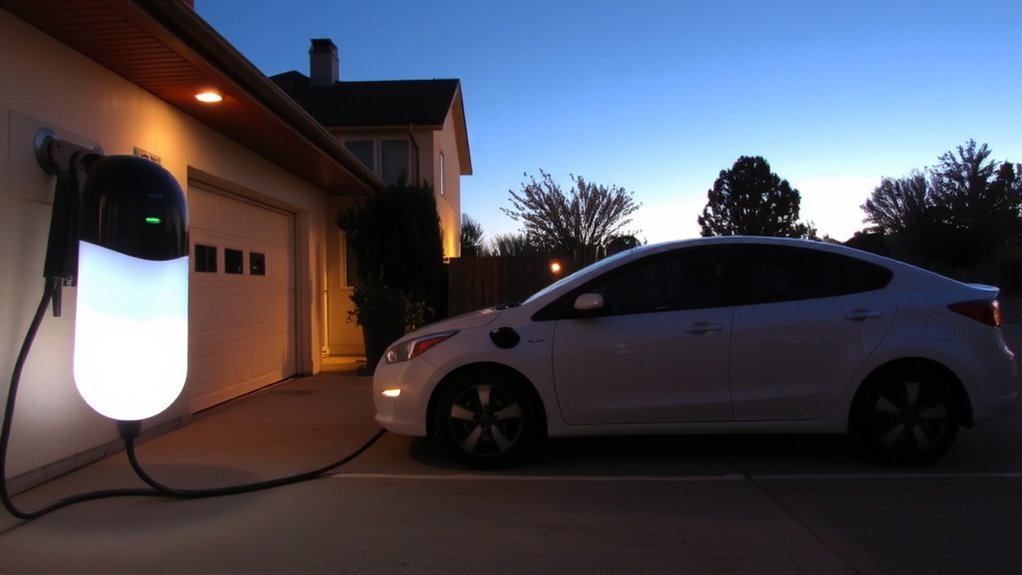


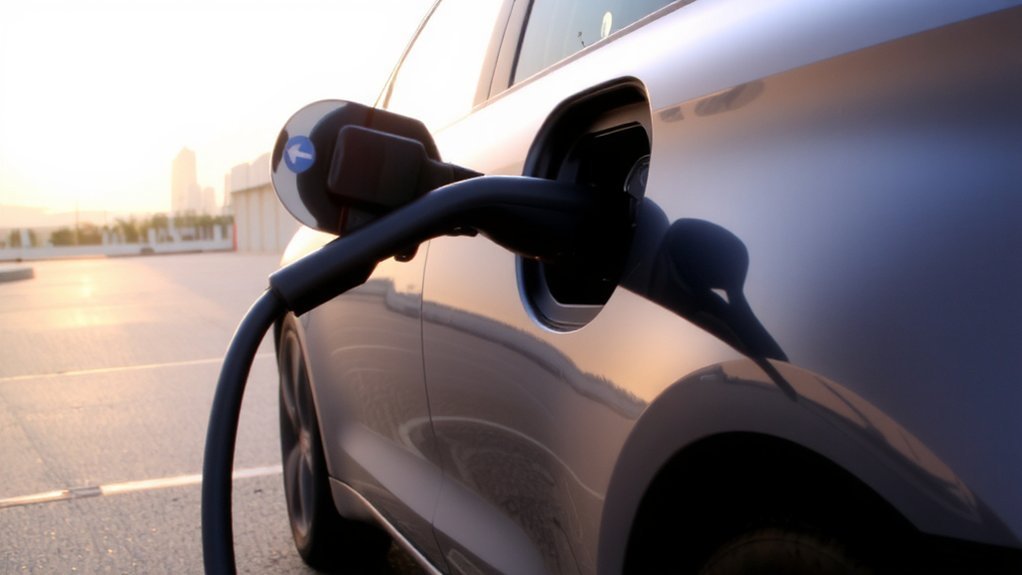
As states like California and Colorado push streamlined permitting, you’ll see EV charging installations treated as-of-right across zoning districts and shielded from discretionary design reviews, conditional use permits, variances, or aesthetic conditions. You’ll still need permits and inspections to guarantee safety and code compliance.
Follow these steps to stay compliant and safe:
- Submit permit application with electrical plans and site location.
- Hire a certified electrician and include circuit, panel, and outlet specs.
- Coordinate with utility for service upgrades or load management.
- Schedule inspections and keep documentation for occupancy and rebates.
New residential builds often require EV-ready wiring or a 240V, 40A circuit; commercial projects need detailed NEC-compliant plans. Contact permitting offices early to avoid delays. Prioritize safety inspections every time. For example, California leads the nation in EV sales, increasing demand for expedited permitting and more public chargers.
2025–2026 Code Updates
Having covered permit basics, expect the 2025–2026 code updates to tighten how chargers are designed, permitted, and inspected. You’ll need to follow NEC Article 625 for circuit sizing, disconnects, and overcurrent protection; treat EV charging as a continuous load and size branch circuits at 125% of that load.
GFCI requirements are becoming stricter with 2026 guidance, and some jurisdictions may require AFCI protection on residential charger circuits. Use NEC Article 220 load calculations to confirm whether service upgrades are required for multiple chargers.
The 2026 NEC adds a “qualified person” requirement, so licensed electricians will generally be required for permanent installs; expect permit applications to demand proof of compliance, though states may adopt this at different paces. Plan inspections and prioritize safe, code-compliant work. Also, many jurisdictions will reference International Codes.
Safety Certification Standards
Because regulators tightened safety and certification rules for 2025–2026, you must install chargers that pass rigorous electrical and mechanical testing, carry ETL or UL certification, and meet updated permit and installation requirements—everything from automatic shutdowns and real‑time fault monitoring to dedicated 240 V circuits with surge, ground‑fault, and (where required) AFCI protection. Also prioritize devices with ETL certification because it signifies independent testing and regular factory inspections.
You should verify ETL/UL labels, confirm automatic cutoffs, and guarantee monitoring integrates with local emergency response. Permits now require documented grounding, enclosure ratings, signage, and operator access to diagnostics. Follow interoperability standards (CCS, SAE J3400) and NEVI rules for publicly funded sites.
- Check ETL/UL certification and test reports.
- Confirm dedicated 240 V circuit with required protections.
- Require automatic shutdowns and real‑time fault telemetry.
- Guarantee installation meets local permits, codes, and NEVI compliance.
Choosing the Right Level 2 Charger and Features
How do you choose the right Level 2 charger for your needs? Start by matching charger output to your car’s maximum input—home units commonly run 7–11 kW (30–50 A) and add about 20–40 miles per hour. Pick connector compatibility (J1772 for most, NACS/Tesla for Teslas) and verify cable length and weather ratings.
Decide between hardwired for reliability and higher amperage or plug-in (NEMA 14‑50/6‑50) for flexibility. Choose smart features—Wi‑Fi, app control, scheduling, energy monitoring and load balancing—to safely manage charging windows and reduce costs. Confirm certifications, firmware update support, and lockable or tamper-resistant housings for safety.
Prioritize chargers whose specs match vehicle limits, home electrical capacity, and smart controls. If you’re unsure, consult a qualified electrician to confirm circuit capacity and safe installation practices. Level 2 chargers operate on a 240V connection.
Installation Costs, Timeline, and What to Expect
When you plan a Level 2 charger installation, expect total costs around $800–$2,500—hardware typically runs $300–$1,200+, labor $400–$1,500, and permits $50–$300—with more if you need panel upgrades, trenching, or major wiring work. Qmerit’s typical home installation ranges from $799–$1,999 and includes a $149 deposit to schedule installation.
You’ll schedule an assessment, a licensed electrician will quote and handle permits, and installation usually takes 2–8 hours on site; inspections may add days. Prepare for potential panel upgrades or long conduit runs that raise costs and time.
Expect to start charging the same day if inspectors clear the work. Keep safety central: use licensed pros and insist on permits and inspections.
Typical steps:
- Site assessment and permit application
- Panel and wiring work
- Mounting and connection
- Inspection and commissioning
Budget contingency for unexpected upgrades and delays is prudent.
Alternatives to Installing a 240V Outlet
Several practical alternatives let you avoid a dedicated 240V outlet while still meeting most charging needs: you can use a standard 120V outlet for Level 1 charging—no electrical work, safe for overnight top-ups, adding about 3–5 miles per hour, suitable if your daily miles are low.
Avoid a dedicated 240V outlet—use 120V Level 1 charging: no electrical work, ~3–5 miles per hour
A NEMA 14‑50 plug gives faster Level 2-like charging (up to ~30 A/7.2 kW) and is often cheaper than hardwiring.
Splitters let two EVs share one 240V outlet by alternating charge sessions, but they extend total charging time and may not be rated for heavy outdoor use. Portable Level 2 units with 120/240V adapters add flexibility, and public/workplace Level 2 or DC fast stations can offset home needs.
Always confirm outlet amperage, ratings, and safe installation and grounding. For faster overnight charging, consider a Level 2 unit that delivers 6–19 kW of power.
Preparing Your Home for Future EV Needs
After weighing the charging alternatives, you should assess your home’s electrical capacity, permit requirements, and likely charger type so you don’t get surprised later. Most Level 2 chargers require a 240V dedicated circuit and may trigger a panel upgrade in older homes. Start by having a licensed electrician perform a load calculation and panel inspection to confirm spare capacity or need for upgrades; older homes often require service or panel work.
Coordinate with your utility early if meter or service-side upgrades may be needed. Secure permits and schedule inspections to maintain insurance and warranty coverage. Choose Level 2 equipment and a location near the panel when possible for lower cost and safer wiring.
Follow this checklist:
- Panel load calculation and spare breaker
- Utility coordination for service upgrades
- Permit application and final inspection
- Professional installation, grounding, and testing
Stay safe.
Conclusion
You don’t always need a 240V outlet, but when your miles or battery demand it, you can’t afford not to install one. You want overnight convenience yet face upfront cost and permits. You crave simplicity yet must navigate codes and electricians. You can rely on public chargers as a stopgap, yet you’ll appreciate home Level 2 comfort. Plan for today’s needs and tomorrow’s upgrades, because small choices now shape your driving freedom later and peace.