
Like a well‑tuned microgrid, you’ll align hardware (AC workplace, DC fast, depot hubs) with software for billing, access, load, and procurement to maximize uptime and revenue. You’ll factor site constraints, permitting, IP/IK resilience, hot‑swappable modules, OCPP/ISO 15118, renewables and storage for demand‑charge mitigation, plus financing to hit TCO targets and 24/7 KPIs. The real question is how your load curve and dwell times reshape the design choices next.
Key Takeaways
- End-to-end hardware portfolio: AC workplace (7–22 kW), DC fast (50–350 kW), depot hubs (50–600 kW) mapped to dwell times and fleet duty cycles.
- High uptime by design: hot-swappable modules, N+1 rectifiers, remote diagnostics, EMC-compliant grounding, and durable enclosures with IK10, IP54–IP65, and wide temperature operation.
- Smart software: billing, authentication, OCPP/RFID, granular tariffs, load management with TOU and demand-charge controls, APIs to ERP and fleet systems.
- Energy optimization: integrate PV and batteries for peak shaving, forecast sessions and solar, prioritize self-consumption, set SOC reserves, track kW shaved and ROI.
- Deployment and finance support: site surveys, utility coordination, scalable infrastructure, incentives and SLAs, interoperable standards (OCPP/OCPI, ISO 15118), and operations with 99.5%+ uptime targets.
Hardware Strategy: AC Workplace, DC Fast, and Depot Hubs
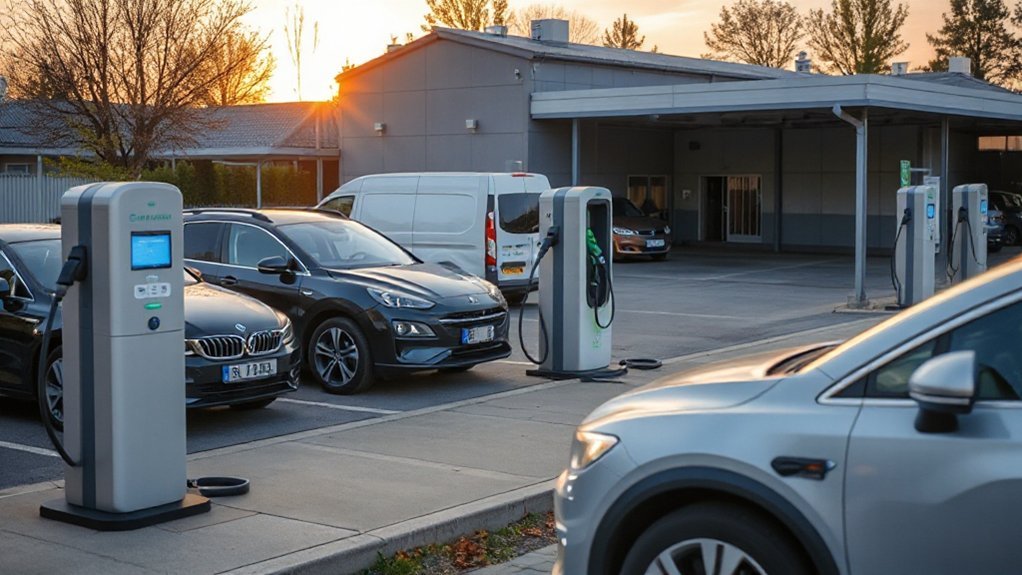
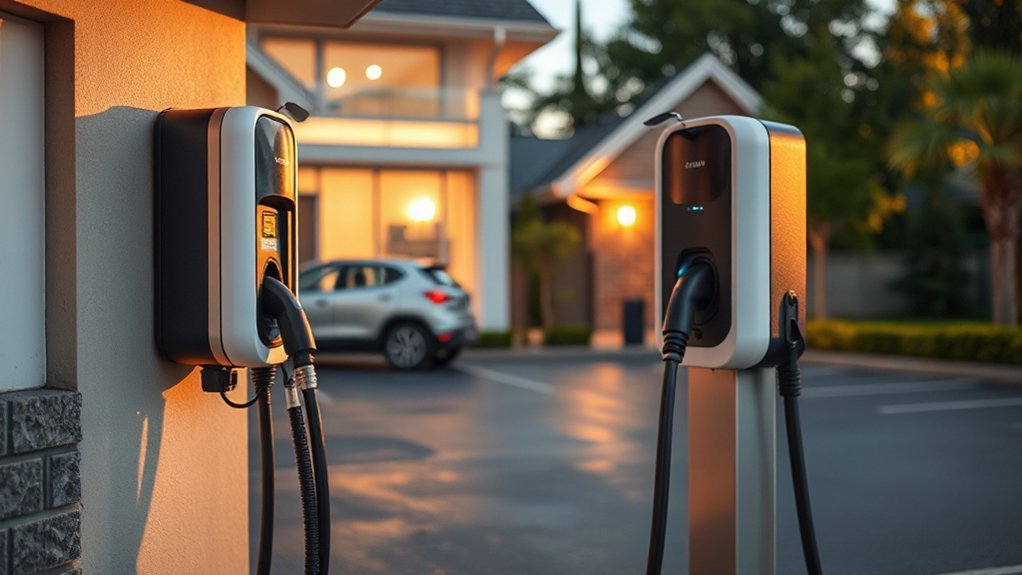
Three hardware tiers anchor the strategy: AC workplace (7–22 kW), DC fast (50–350 kW), and depot hubs (50–600 kW aggregated).
You map use-cases to duty cycles: dwell times over 4 hours favor AC, 30–60 minute turnover requires 100–150 kW, and fleet batching benefits from hub power sharing.
Specify connector mix (CCS, CHAdeMO, Type 2) and sealed contactors.
Prioritize Enclosure Durability: IK10 impact, IP54–IP65 ingress, -30 to 50°C operation, UV-stable plastics, vandal-resistant locks.
Engineer Cable Management to cut strain and tripping—auto-retract reels or overhead booms rated for 10,000 cycles.
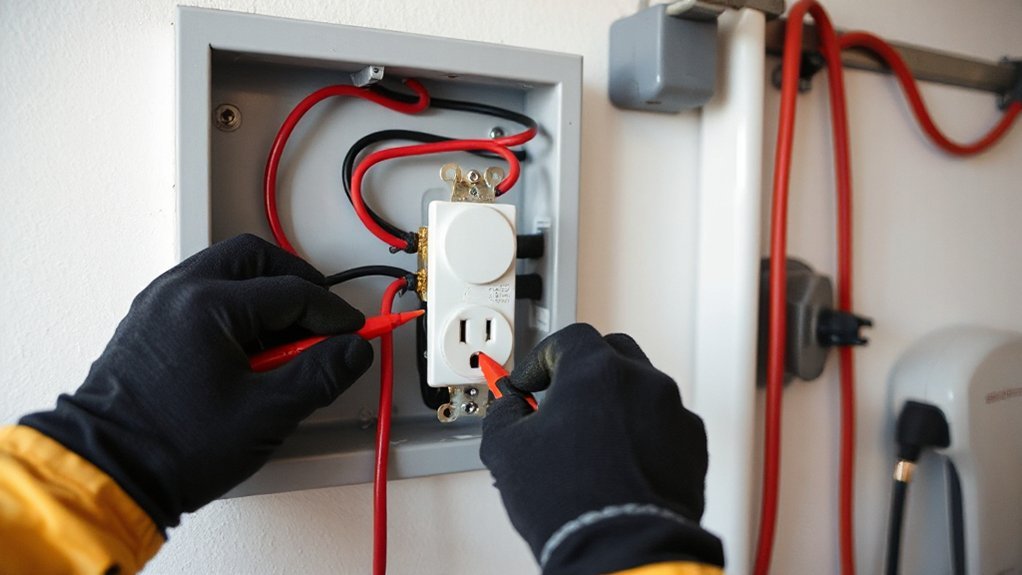
Design for uptime: hot-swappable power modules, N+1 rectifiers, isolated cooling paths, surge protection (Type 1+2), and grounded pedestals.
Plan scalable trenching, conduit, spare circuits, and clear maintenance access.
Validate EMC compliance and earthing per IEC standards.
Software and Energy Management: Billing, Access, Load, and Procurement
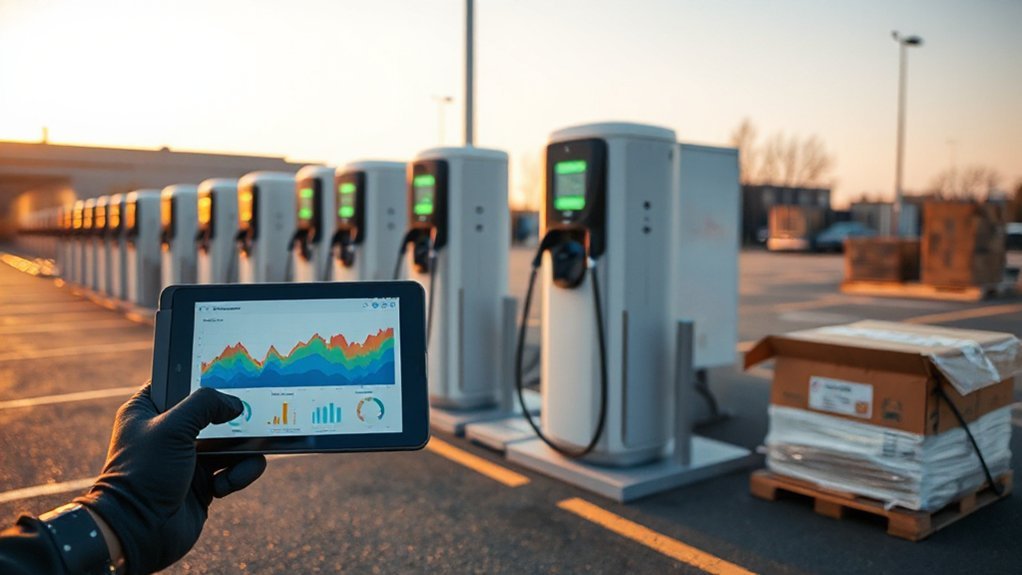
Orchestration ties billing, access, load control, and energy procurement into one platform that maximizes uptime, revenue, and grid compliance. You set granular tariffs, authenticate drivers via RFID/OCPP, and automate settlements with transparent invoices. Smart charging enforces capacity thresholds, shifting sessions against time-of-use and demand charges using Rate Optimization and near-real-time Demand Forecasting. APIs sync with ERP, fleet, and site meters to reconcile cost centers and SLAs.


Function | Outcome
— | —
Billing engine | Accurate CDRs, automated tax/VAT, dispute reduction
Access control | Role-based policies, contractor/visitor tiers
Load management | kW caps per feeder, queueing, phase balancing
Procurement logic | Day-ahead/spot selection, hedging rules
You’ll benchmark sites, simulate scenarios, and iterate policies to protect margins while meeting driver experience KPIs at scale reliably.
Renewables, Storage, and Demand-Charge Mitigation

While EV load is inherently spiky, you can flatten costs by co-optimizing onsite PV, battery storage, and grid import to stay below demand-charge thresholds. Use predictive analytics to forecast solar yield, session arrival, and tariff windows; then schedule charge/discharge to shave peaks and monetize energy arbitrage. Right-size batteries for 2–4 hours of duration, targeting the 95th-percentile interval; prioritize round-trip efficiency and inverter clipping limits.
Implement hierarchical controls: PV self-consumption first, then storage peak shaving, then flexible charging. Set SOC reserves to cover feeder constraints and contingency events. Calibrate demand limits. Track KPIs: kW shaved per day, battery cycle life, cost per avoided kW, and marginal abatement cost. Leverage regulatory advocacy to enable export compensation, dynamic demand charges, and V2G tariffs, enhancing stackable value streams.
Site Planning and Deployment for Fleets, Workplaces, Retail, and Public Networks

How do you translate charging demand into a resilient, scalable site? Start by quantifying duty cycles, dwell times, turn-over, and peak concurrency across fleets, workplaces, retail, and public nodes. Map load profiles to utility capacity, feeder constraints, and transformer headroom. Select charger power levels and port counts to meet service level targets with ≤5% unmet demand.
Conduct site surveys for trenching paths, ADA compliance, clearance, and traffic flow. Stage deployment in phases, reserving conduit and pads for future expansion. Align civil, electrical, and communications drawings, and streamline permitting processes with early stakeholder coordination among utilities, AHJs, landlords, and IT.
Engineer reliability: redundant circuits, smart load management, cybersecurity baselines, and remote diagnostics. Execute commissioning with functional tests, acceptance criteria, and as-builts for lifecycle maintainability documentation.
Financing, Incentives, TCO, Interoperability, Roaming, and 24/7 Operations
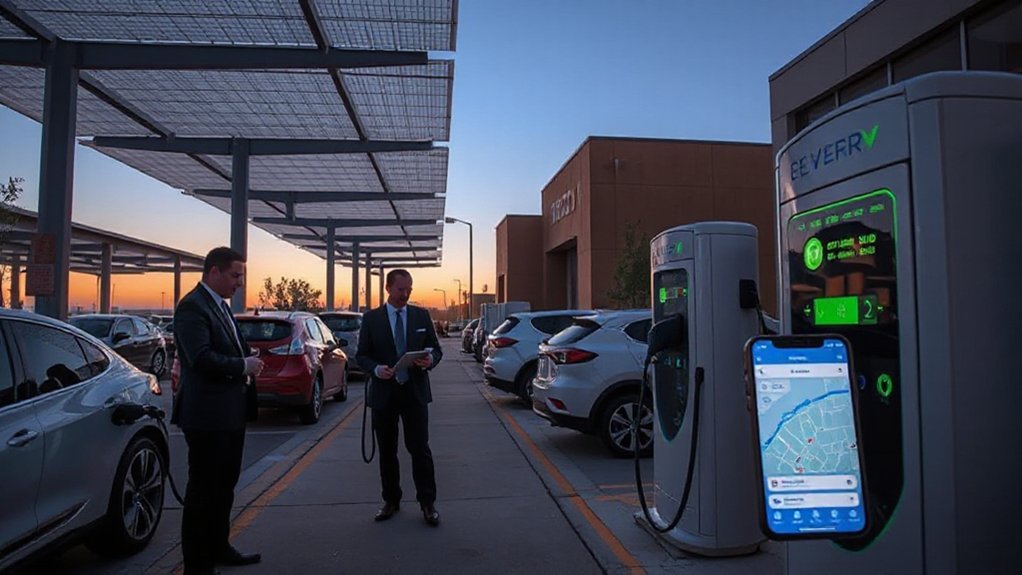
With engineered sites and phased build plans, you now need to make the numbers work and keep chargers online 24/7. Model CAPEX vs. OPEX across purchase, lease, or charging‑as‑a‑service, then map incentives: ITC, state grants, utility make‑ready, and LCFS/GOO revenues. Forecast TCO with demand charges, dynamic tariffs, maintenance, spare parts, and networking fees. Align with the evolving Regulatory Landscape, permitting timelines, and depreciation rules. Specify OCPP/OCPI, ISO 15118, and open roaming to maximize utilization and driver access while avoiding vendor lock‑in. Negotiate uptime SLAs (≥99.5%), remote monitoring, and field response KPIs. Implement energy management to shave peaks and optimize TOU. Bundle Insurance Solutions covering equipment, cyber, and business interruption. Track ROI via utilization, cost per kWh delivered, and revenue per stall, over time horizons.
Conclusion
You’ve now mapped a turnkey EV roadmap: match AC, DC fast, and depot hubs to duty cycles; orchestrate billing, access, and OCPP/ISO 15118 sessions; tame load with smart algorithms; and hedge energy with procurement, solar, and storage to blunt demand charges. With sound site design, permits, and resilient hardware, you’ll drive 98–99% uptime, predictable TCO, and new revenue. Secure financing, monetize incentives, track KPIs, and run 24/7—like a well‑tuned grid symphony, scalable, profitable, and future‑proof.