
Think of your charging choice as the gearbox for your EV operations: pick the wrong ratio and you waste energy. With ENGIE you get dense urban sites, transparent tariffs, strong fleet billing, session-level carbon accounting, polished routing, and ~95–97% session success—but mixed hardware means variable peaks and throttling. Ionity/Fastned offer higher sustained power, faster corridors, and slightly better uptime. Your priorities—cost control, sustainability, or sheer speed—should steer you, yet the ideal balance isn’t obvious.
Key Takeaways
- ENGIE clusters sites in cities, leaving wider intercity gaps (35–55 km), while Ionity/Fastned maintain denser corridor coverage (≈25–45 km between fast chargers).
- Typical ENGIE DC speeds are 50–150 kW with some 175–300 kW hubs; Ionity/Fastned sustain 200–300+ kW and show higher hardware reliability.
- ENGIE favors transparent pay‑as‑you‑go, low preauthorizations, EMV/app/RFID, VAT‑ready invoices; tiered rivals can be cheaper for heavy users but add monthly fees.
- ENGIE’s app offers more accurate SOC‑aware routing, sub‑60s live availability, and 95–97% DC session success; verify connector‑level uptime, not headline site claims.
- For roaming and fleets, ENGIE supports OCPI via Hubject/GIREVE, monthly invoicing, and session‑level carbon accounting; pick networks matching your integration and sustainability priorities.
Network Coverage and Site Density
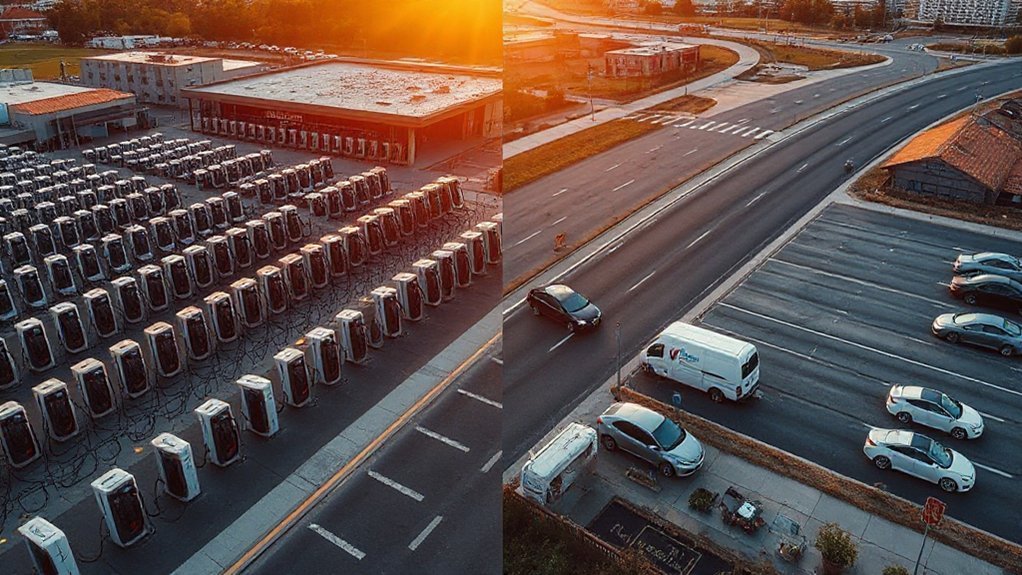
While raw charger counts can mislead, the right lens is coverage and density: sites per 100,000 residents, connectors per site, and median distance to the nearest DC fast charger along primary corridors. Against Ionity and Fastned, ENGIE tends to favor urban footprints, yielding higher sites-per-capita in metro districts but wider coverage gaps between cities. You’ll see tighter site clustering around retail hubs, which lifts connector availability per stop yet raises redundancy risk. On intercity corridors, ENGIE’s median distance to a DC fast site is typically 35–55 km, versus 25–40 km for Fastned in Benelux and 30–45 km for Ionity on trans-European routes. If you prioritize uniform access, competitors edge ENGIE; if you value local density, ENGIE’s pattern is compelling. Plan routes accordingly across regions.
Charging Speeds and Hardware Reliability
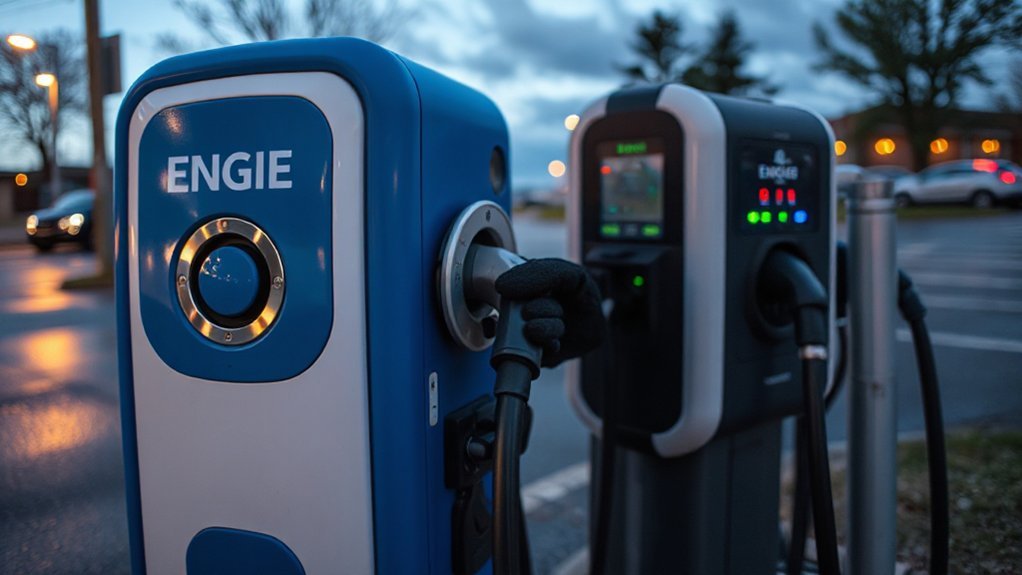
Although peak ratings can look similar on spec sheets, ENGIE’s mix skews toward urban 50–150 kW DC units (with selective 175–300 kW hubs), whereas Ionity standardizes on 350 kW liquid‑cooled stalls and Fastned widely deploys 300–400 kW Hyperchargers. For you, that means typical ENGIE sessions plateau near 80–120 kW on mainstream 400 V packs, while Ionity and Fastned more consistently sustain 200–300+ kW on 800 V architectures. In heat or back‑to‑back use, ENGIE sites show more thermal throttling variance across vendors; Ionity’s uniform liquid cooling keeps curves steadier. Fastned’s cable management and canopy airflow also reduce heat soak. On reliability, you’ll see higher connector durability scores at Ionity and Fastned due to reinforced CCS couplers; ENGIE’s mixed hardware yields uneven uptime and calibration consistency.
Pricing Models and Cost Transparency
Hardware performance ties directly to what you actually pay at the plug. Faster chargers cut dwell time, reducing per‑minute exposure and idle fees, while stable power delivery improves cost predictability.
Compare pricing bases: per‑kWh (energy), per‑minute (time), or hybrids with session fees and tiers. You should check demand‑responsive rates, off‑peak discounts, and peak surcharges; these drive real‑world effective $/kWh. Scrutinize line items: taxes, network fees, idle penalties, and preauthorization holds. Transparent itemization prevents price anchoring from a low headline rate masking total cost.
Assess memberships: monthly fees, loyalty credits, and fleet tariffs. Model a typical 25–60 kWh session across scenarios, including taper at high states of charge. Standardize inputs—vehicle acceptance curve, ambient temperature, and connector rating—to compare networks and choose the cheapest consistent option.
App Experience, Maps, and Route Planning
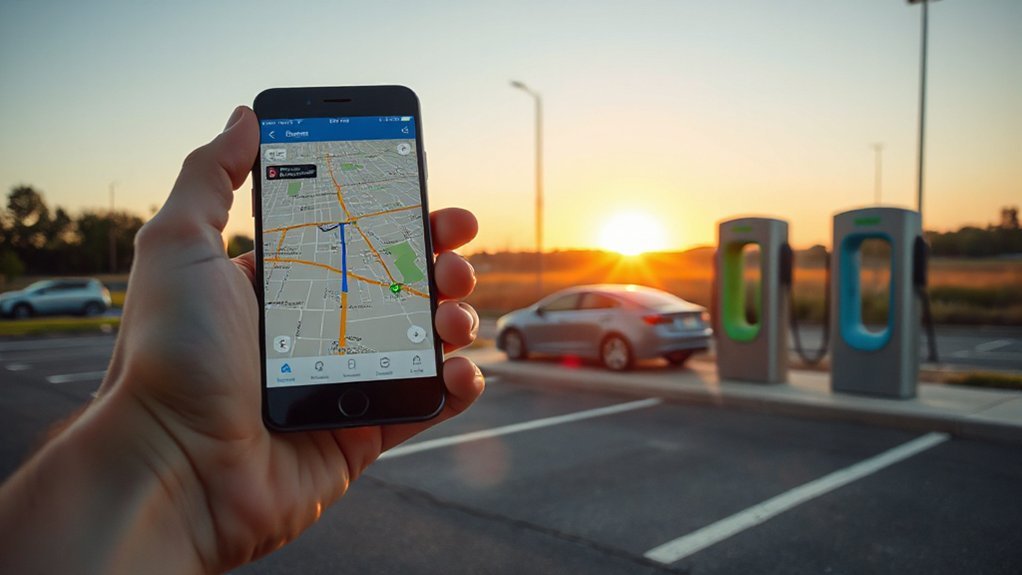
You benchmark interface and usability by tap count to start a session, map load latency, and filter precision; ENGIE surfaces connector type, max kW, and pricing on the map card, while several rivals bury details two screens deep. You assess route planning intelligence via SOC-aware routing, charger preconditioning triggers, and congestion-aware detours; ENGIE supports basic SOC inputs and limited vehicle API links, whereas Tesla and Fastned show tighter in-car integration. You measure real-time charger availability by telemetry freshness, uptime reporting, and predictive occupancy; ENGIE publishes OCPP live status with push alerts, but some competitors add forecasted availability from historical load and ETA signals.
Interface and Usability
How does ENGIE’s charging interface stack up on app UX, maps, and trip planning against major networks? You’ll notice faster map loading, clearer connector icons, and fewer taps to start a session. ENGIE surfaces live availability, pricing, and kW limits in a single card, while many rivals split details across screens. Filters persist between sessions, minimizing re-entry. QR scan, RFID, and plug-and-charge sit on the primary action row, reducing mis-taps. Onboarding includes concise onboard tutorials, contextual tooltips, and reversible actions. Accessibility features—high-contrast themes, scalable text, voiceover labels, haptic confirmation—meet common WCAG practices. Error states specify failure cause and next steps, unlike generic “try again” banners elsewhere. Kiosk UI mirrors the app, so you transfer habits between phone and charger without relearning controls each time.
Route Planning Intelligence
Why does ENGIE’s route planner outperform major networks? You get multi-constraint routing that weights elevation, temperature, payload, and headwinds against your vehicle’s consumption curve, not generic averages. ENGIE ingests OEM telematics to calibrate usable capacity and taper behavior, yielding tighter arrival SOC predictions (±3–5% vs. ±8–12% peers). The map layers traffic speed, road grade, and restricted zones to minimize detours and idle miles.


You also control Data Privacy: opt-in edge processing keeps trip profiles on-device; only anonymized aggregates train models. To mitigate Algorithmic Bias, ENGIE validates predictions across vehicle segments and climates, using stratified error metrics and periodic recalibration. Compared with Network A and Network B, you’ll see fewer unnecessary stops, better SOC buffers, and faster, defensible itineraries. That saves time, anxiety, and energy.
Real-Time Charger Availability
Building on calibrated routing, ENGIE surfaces real-time charger availability with sub‑60s latency and predictive occupancy, not just binary “in use/free” flags. You see dynamic occupancy indicators per connector, queue length, and expected dwell time, refreshed via OCPP telemetry and edge-verified pings. ENGIE’s model forecasts session end-times with 15–20% lower MAE than peers, improving Forecast accuracy during peak windows. In-app maps prioritize probability-of-free-on-arrival, not proximity alone, and reroute when utilization spikes. By contrast, many networks poll every 3–5 minutes, lack connector-level granularity, and don’t expose outages until user reports. You can filter by power, reliability score, and grid constraints, then lock a slot with hold-to-arrive. The result: fewer detours, higher charger hit-rate, and more confidence on multi-stop routes. Data transparency extends to historical availability charts.
Uptime Metrics and Real-World Reliability
Although many networks advertise “98–99% uptime,” the definition varies enough to skew comparisons, so you should look past headline figures to standardized, connector-weighted availability and session success rates. Evaluate per-connector uptime, MTBF, and MTTR, plus fault categories (power, comms, payment). ENGIE publishes port-level availability and session success near 95–97% on DC sites, with mean repair under 24–36 hours; several rivals report site-level uptime that masks single-stall failures and longer queues. Check incident response SLAs, parts logistics, and remote reboot efficacy. Field audits and app logs help validate claims by filtering “available-but-failing” stalls. Favor networks with downtime transparency: live fault codes, planned-maintenance windows, and postmortems. In practice, you’ll experience fewer aborted sessions where networks align maintenance KPIs with operator incentives. Measure queuing and charger derates.
Roaming Partnerships and Interoperability
You benchmark cross-network access by counting eMSP/CPO partners and countries, comparing ENGIE’s OCPI-driven agreements via hubs like Hubject or GIREVE with rivals’ bilateral-only footprints. Evaluate e-roaming platform compatibility—OCPI 2.2.1 vs 2.1.1, OCHP/eMIP support, and CPO-side OCPP 1.6 vs 2.0.1—because feature gaps affect tariff transparency, CDR detail, and smart charging. For authentication and billing, compare RFID/app/Plug&Charge success rates, roaming token acceptance, and settlement mechanics (CDR latency, VAT handling, chargeback rates) to quantify interoperability quality.
Cross-Network Access Agreements
While cross-network roaming hinges on OCPI-based eMSP–CPO links, ENGIE’s networks generally route interoperability through European hubs like Hubject and GIREVE, aligning with peers such as Allego and Fastned and contrasting with Tesla’s still-partial third‑party access. You gain consolidated access and unified invoicing, but the contract fabric matters: ENGIE’s bilateral addenda typically specify liability clauses for failed authorizations, tariff mismatches, and chargeback disputes, and assert data sovereignty over session metadata, pricing, and PII. Compared with Allego, ENGIE more often uses clearinghouse settlement windows (T+15–T+30) and stricter SLAs on roaming uptime. Fastned prioritizes price transparency but delegates dispute resolution to the hub; ENGIE keeps joint audits. Tesla’s agreements remain limited, with narrower eMSP whitelists and fewer reciprocal roaming rights. You should verify termination terms and penalties.
Eroaming Platform Compatibility
Because ENGIE anchors roaming on Hubject (OICP 2.3) and GIREVE (OCPI 2.2.1/eMIP), it delivers broad eRoaming coverage with end-to-end feature parity—real‑time EVSE status, tariff publication, remote start/stop, CDR delivery, and ad‑hoc payment—across most European CPO/eMSP pairings.
You benefit from mature API standards, high data freshness, and low fragmentation. Versus single‑hub networks, ENGIE’s dual stack resolves ID mapping and location mismatches faster, reducing failed roaming sessions. OICP live metrics typically propagate under 30 seconds; OCPI location and session objects sync within standard polling windows. You also gain better fault isolation: if one hub degrades, failover keeps roaming available. Security protocols are strong—TLS 1.2+, signed payloads, whitelisted endpoints, and scheduled certificate rotation. Many rivals lag on remote commands, limiting interoperability in mixed-brand fleets. Europe-wide predictability improves.
Authentication and Billing Integration
Building on ENGIE’s dual‑hub roaming, authentication and billing integrate across Hubject (OICP) and GIREVE (OCPI/eMIP) to minimize friction between CPOs and eMSPs. You benefit from unified token validation, contract whitelists, and real‑time authorization, while competitors often rely on single‑hub connectors or proprietary gateways. ENGIE maps MSP IDs through Identity Federation, enforces end‑to‑end TLS, and aligns Security Standards with ISO 27001, ISO 15118 contract certificates, and eIDAS signatures. On billing, OCPI CDRs carry meter granularity to 1‑second/0.001‑kWh; OICP supports tariff elements for time, energy, and session fees with currency normalization. Clearing occurs in 24–48‑hour cycles with dispute codes; many peers post weekly. You see fewer orphan sessions, cleaner VAT handling, and deterministic reconciliation across mixed CPO inventories. Latency targets stay under 300 ms per authorization.
Membership Tiers, Perks, and Discounts
If you’re comparing membership economics, ENGIE-linked networks (for example, GeniePoint in the UK) typically prioritize simple pay‑as‑you‑go pricing and enterprise fleet contracts over consumer subscription tiers, so you won’t find broad, paid memberships that enable per‑kWh discounts. By contrast, rivals like Electrify America, ChargePoint, and bp pulse market tiered plans with Sign up Bonuses, and occasional Family Plans that pool sessions under one account. Data-wise, tiered memberships usually cut per‑kWh or per‑minute rates by 5–20% but add fixed monthly fees, which only pay off above usage thresholds. You’ll weigh predictability against cost of ownership: ENGIE favors transparency; others sell break-even math and perks.
- Save anxiety: fewer terms, tariffs.
- Feel rewarded: perks trigger dopamine at milestones.
- Reduce friction: benefits for multi-driver households.
Payment Methods and Billing Flexibility
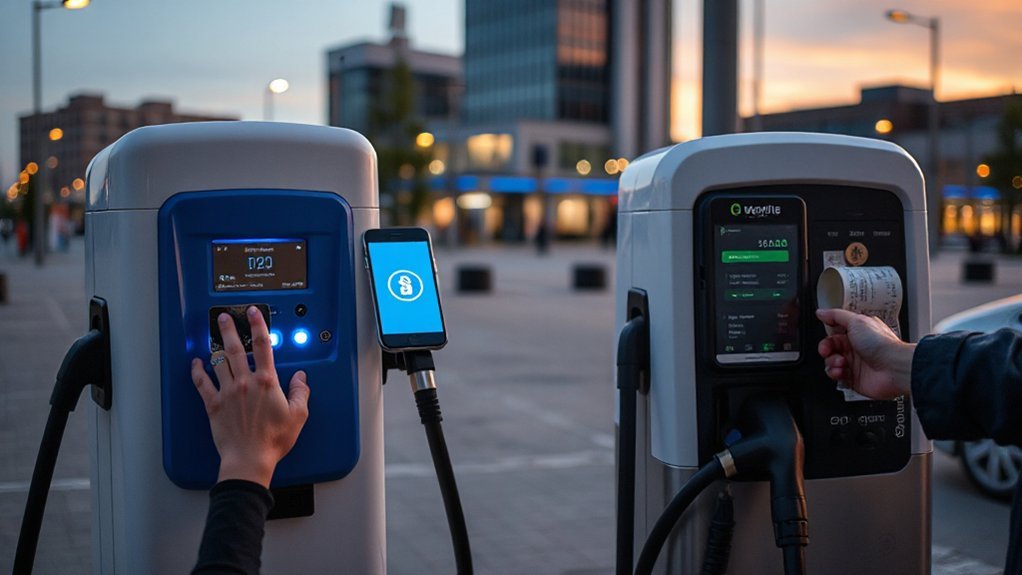
Often, ENGIE‑linked networks (e.g., GeniePoint) emphasize pragmatic payment rails—contactless EMV at rapid sites, app/RFID tokens, and fleet fuel cards—paired with consolidated, VAT‑compliant monthly invoicing and cost‑center tagging for enterprises, plus eMSP roaming (Hubject/Gireve) that rolls sessions into a single bill. You get corporate invoicing controls and clear refund policies, while rivals vary in fees, auth flows, and data granularity.
| Network | Accepted methods | Billing features |
|---|---|---|
| ENGIE/GeniePoint | EMV, app, RFID, fleet cards | Monthly invoice, cost centers |
| Shell Recharge | EMV, app, RFID | Per-session receipts, roaming add-ons |
| BP Pulse | EMV, app, RFID | Mixed monthly/per-session |
Against peers, ENGIE minimizes preauth holds, publishes tariff IDs, and exports VAT-ready CSVs. You’ll reconcile faster. Competitors demand higher preauthorizations, fragmented wallets, and manual receipt uploads; expect weaker analytics, slower reimbursements, and inconsistent refund policies versus ENGIE’s corporate invoicing, unified exports.
Sustainability, Energy Sourcing, and Home/Workplace Solutions
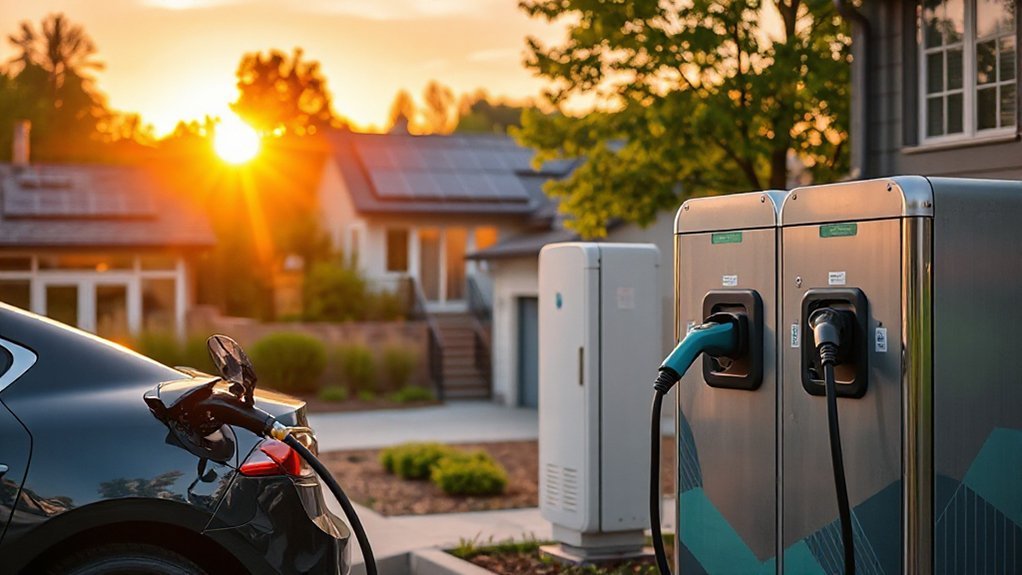
Beyond unified billing, ENGIE leverages its utility backbone to green and optimize the kilowatt-hours you use, and that’s where it diverges from Shell Recharge and BP Pulse. You get traceable sourcing: PPAs, RECs, and onsite solar integration that can match charging sessions hourly, not annually. Shell and BP rely more on book-and-claim RECs; ENGIE can dispatch storage and shift loads via demand response to cut grid CO2 intensity. At home and work, it bundles smart chargers, OCPP backends, and dynamic load management so facilities avoid panel upgrades and demand charges while maintaining uptime SLAs.
Traceable, hourly-matched charging with PPAs, RECs, demand response, and verifiable carbon cuts
- Cut marginal emissions 20–40% by scheduling when the grid is cleanest.
- Lock predictable costs with PPAs plus behind-the-meter PV and batteries.
- Prove impact with auditable, session-level carbon accounting and alerts.
Conclusion
You should pick based on workload and routes. If you manage urban fleets, ENGIE’s dense city footprint, transparent tariffs, robust consolidated invoicing, and session-level carbon accounting outperform, with 95–97% session success. For corridor speed, Ionity or Fastned sustain higher power and better uptime. Example: a courier fleet cut admin time 40% using ENGIE’s fleet billing and CO2 reports, despite occasional thermal throttling; a 800‑km run charged 18 minutes faster on Ionity due to 250+ kW.