Picture a sleek EV quietly sipping power from your garage outlet as LED indicators blink in rhythm. You’ll want to know what amperage, breakers, and wiring that actually requires, and how 2025–2026 code changes could affect your install. Keep going—there are critical sizing and safety details that can save time, money, and headaches.
Key Takeaways
- Size EV circuits using the NEC 125% continuous‑load rule: breakers and conductors = 125% of the EVSE nameplate current.
- Level 1 draws ~12–16 A on 120 V; Level 2 typically 15–80 A at 208–240 V; DC fast chargers require three‑phase high‑voltage service.
- Provide a dedicated branch circuit per NEC 625.40 unless using approved load management or smart‑load sharing.
- Match conductor gauge, conduit, and breaker to continuous ampacity; use weatherproof conduit for outdoor/underground runs.
- Comply with NEC Article 625, install proper grounding, surge protection, GFCI where required, permits, and hire a licensed electrician.
Charging Levels and What They Mean for Amps
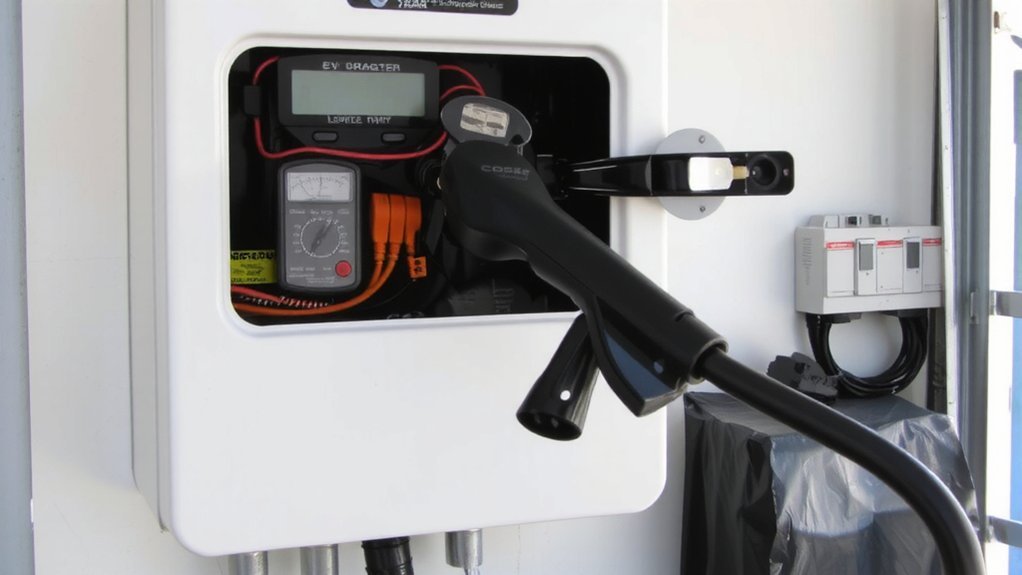
Depending on the charging level, you’ll need very different voltages, amperages, circuits and wiring. You should treat each level as its own electrical design:
Level 1 runs on standard household outlets and typically doesn’t need a dedicated circuit, so you can usually rely on existing breakers and common wiring gauges—still follow GFCI and grounding precautions.
Level 1 uses standard household outlets and usually needs no dedicated circuit—observe GFCI and grounding
Level 2 requires a dedicated 240V circuit, appropriately sized breaker and heavier conductors, so plan panel space and possibly a subpanel. For most daily drivers, Level 2 charging typically delivers about 7-11 kW of power, balancing speed and cost.
DC fast charging operates at much higher voltages and currents, often requiring three‑phase service, large conductors, commercial breakers and utility coordination.
In every case comply with NEC Article 625, use proper grounding, surge protection and emergency shutoffs to safeguard the installation. Consult a licensed electrician for site-specific guidance.
Typical Amperage Requirements for Level 1, Level 2, and DC Fast Charging
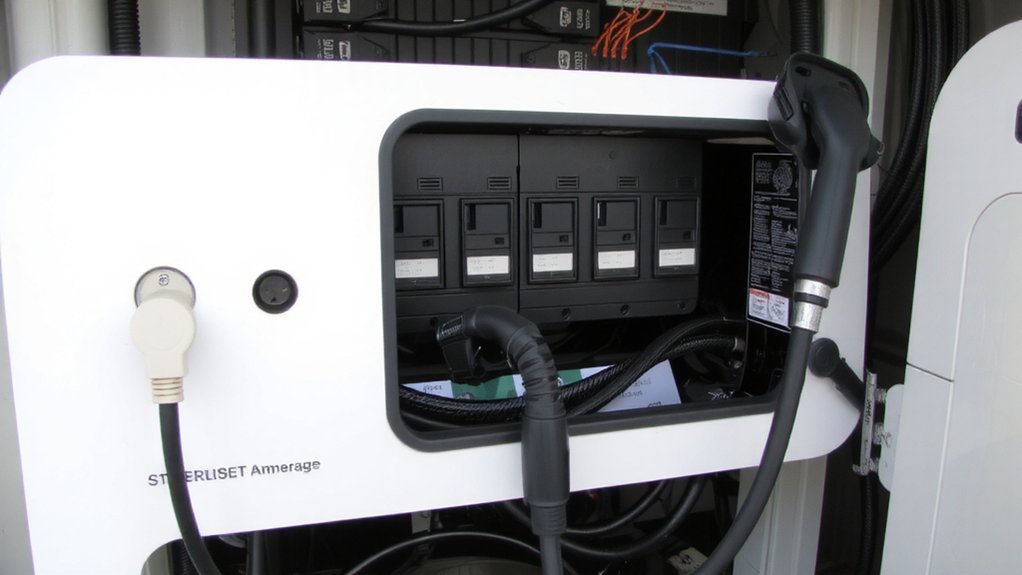
Level 1 typically draws about 12–16 A from a 120 V household outlet. You’ll get about 3–5 miles per hour, so use it for PHEVs or occasional overnight top-ups for BEVs; full BEV charging can exceed 40–50 hours.
Level 2 ranges from about 15–80 A at 208–240 V, delivering roughly 7–19.2 kW and 12–80 miles per hour—common for homes and workplaces.
DC fast chargers operate at 400–1000 V DC and deliver 50–350+ kW, giving 60–100+ miles in ~20 minutes and require commercial-grade equipment and safety measures.
- Confirm your vehicle’s onboard charger limits.
- Match charger amperage to typical daily driving.
- Prefer Level 2 for routine faster charging.
- Treat DC fast charging as specialized, high-voltage work.
Always hire qualified electricians for high-voltage. This rating reflects the vehicle’s maximum AC current capability.
Breaker Sizing Rules and NEC Continuous Load Calculations

You must treat EV charging that runs 3+ hours as a NEC continuous load, which changes how you size breakers and conductors. That means you size breakers at 125% of the charger’s maximum current to satisfy the NEC continuous-load rule and the 80% relationship.
For example, a 40 A charger requires a 50 A breaker (40 A × 125%) and appropriately sized wiring. To comply, installers should provision circuits using the 125% breaker size.
NEC Continuous Load Rule
When you size breakers and conductors for EV charging, remember that the NEC treats EVSE as a continuous load (operating at full current for 3 hours or more) and requires breakers and conductors to be rated at least 125% of the charger’s continuous current, with the branch circuit dedicated to the EVSE unless a load-management system limits the load. The NEC provides guidance for EV charging and is adopted nationally.
You should treat EV charging as continuous per NEC 625, so plan wiring, ampacity, and protection to prevent overheating. Use nameplate ratings for calculations, consider conductor insulation and ambient conditions, and avoid undersized wiring. If you employ load management, document limits.
Key points:
- Verify EVSE nameplate current and treat it as continuous.
- Size conductors to the continuous ampacity considering insulation and ambient temperature.
- Provide a dedicated branch circuit per NEC 625.40 unless load management is used.
- Match protection and wiring to prevent thermal stress and maintain safety.
125% Breaker Sizing
Having established that EV charging counts as a continuous load under NEC 625, you now size breakers to the 125% rule: size the breaker to at least 1.25 times the charger’s rated continuous current (Breaker = Charger Amps × 1.25). Additionally, electricians typically follow the 125% rule when selecting breakers for continuous EV charging loads. This prevents nuisance trips and overheating during prolonged charging.
For common sizes, a 32A charger uses a 40A breaker, 40A → 50A, 48A → 60A, 80A → 100A; commercial 70A needs a 90A breaker.
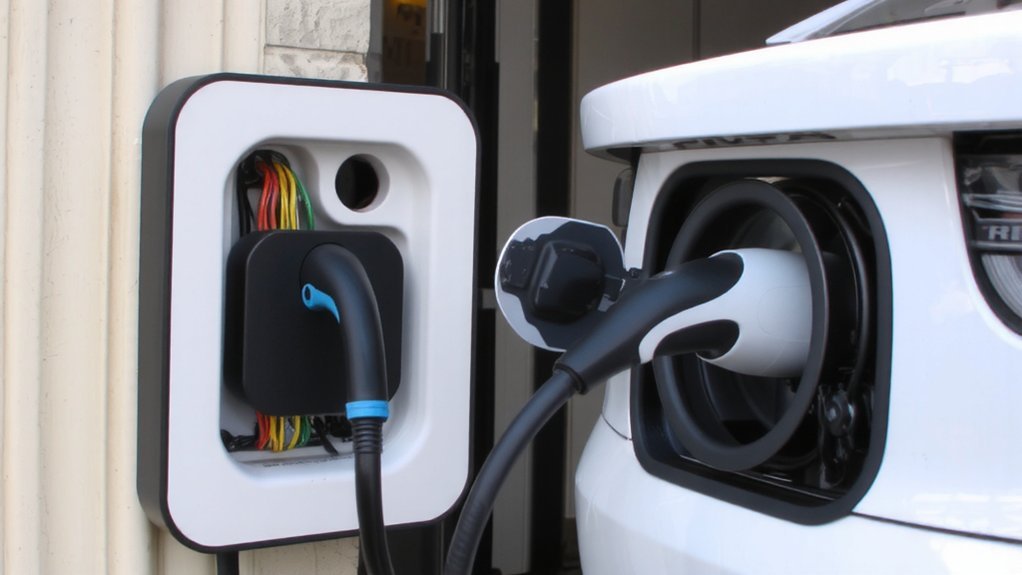
Use a dedicated 240V circuit; wire gauge must match the 125% sizing for code compliance. Remember plug-in options are usually ≤50A; larger breakers require hardwiring. Don’t assume spare breaker slots mean capacity.
Always consult a licensed electrician and follow local code for safe, code-compliant installation. Verify manufacturer instructions and labels.
Load Calculation Example
Start by totaling your home’s existing calculated load per NEC 220, then add the EV charger as a continuous load at 125% of its nameplate amperage (or 7,200 VA, whichever is greater) so you can compare the combined demand against your service or panel rating and determine if upgrades or load management are required. You’ll convert appliance wattages to amps at 240V, include demand factors, add the EV load per NEC 625.14 and 220.57.
If the total meets or exceeds 80% of your panel rating, plan upgrades or install EMS. Follow breaker sizing rules: continuous loads need breakers sized at 125%.
- Calculate existing loads.
- Add EV at 125% or 7,200 VA.
- Compare to panel capacity.
- Choose upgrade or EMS safely. A licensed electrician typically performs a load calculation to ensure the service panel is not pushed beyond safe limits.
Wire Gauge, Conduit, and Circuit Configuration Best Practices
Anyone installing an EV charger must size conductors, conduit, and breakers to the charger’s continuous current rating—using 125% of the charging current to select breaker and wire ampacity.
You’ll choose wire gauge to match breaker: #12 for 20–30 A, #10 for 30–40 A, #8 for 50 A, #6 for 60–70 A, and #4 for 70 A+. Use conductors with at least 60°C insulation, higher ratings allowed.
Install four‑conductor circuits (two hots, neutral, equipment ground) dedicated to the charger. Select conduit type and trade size for cable count and gauge: 1/2″ for smaller runs, 3/4″ for heavier feeds; EMT, PVC, or FMC per environment.
Protect outdoor and underground runs with weatherproof, corrosion‑resistant conduit, follow burial depth and support spacing, avoid exceeding cable pull tension.
As EV adoption grows and public charging networks expand, installers should plan for high-power charging capacity and robust conduit infrastructure.
Electrical Panel Capacity, Subpanels, and When to Upgrade
If you’re planning to add a Level 2 EV charger, check whether your main service can handle the continuous load—many older homes still on 100 amps may support only smaller chargers, while a 200‑amp service gives much more headroom for 40–50 A units and other heavy loads. Remember that Level 2 chargers require a dedicated circuit and properly sized breakers and wiring. Watch for frequent trips or dimming lights. Get a licensed electrician to do a load calculation.
A subpanel can add space but doesn’t increase service capacity; upgrade when the panel is full, aged, or you add high‑amperage chargers.
- Verify service amperage and free breaker slots.
- Note overload signs: tripping, dimming, outdated parts.
- Use subpanel only if main service can feed it.
- Always get professional load calculation and permitted work.
Safety depends on correct sizing.
Grounding, GFCI Requirements, and 2026 Code Changes
Why does grounding and updated GFCI protection matter for your EV charger? Grounding prevents shock and stabilizes voltage; most chargers won’t operate without a proper earth, and charging without it raises risk of faults, equipment damage, and injury. Don’t use adapters or simulated grounds — install a dedicated ground for code compliance and safety.
The NEC mandates GFCI protection for EV circuits; the 2026 edition tightens that to a five‑milliamp trip threshold. Even chargers with built‑in CCIDs must have external GFCI protection per the new code, so expect added hardware, cost, and installation complexity. Though debate continues about redundancy, the intent is clear: stricter GFCI and reliable grounding reduce shock risk and improve operator safety. Plan for compliance now to avoid safety and liability. The 2026 NEC’s qualified person requirement effectively ends most homeowner DIY installations.
Installer Qualifications, Permits, and Inspection Expectations
Because EV charging ties directly to electrical safety and code compliance, you should hire a licensed electrician with EV‑specific training rather than attempt a DIY hookup. Licensed professionals guarantee NEC Article 625 compliance, proper grounding, GFCI application, and correct load calculations. Certification programs from manufacturers and industry groups promote safety and quality in EVSE installations.
Hire a licensed, EV‑trained electrician—ensuring NEC Article 625 compliance, proper grounding, GFCI protection, and correct load calculations.
Most jurisdictions require permits; installers typically submit diagrams, specs, and proof of licensing and manage approvals. Expect inspections to verify breaker sizing, wiring, grounding, and mounting; failures require corrections before operation.
Choose installers with EVITP or manufacturer certifications, insurance, references, and up‑to‑date code knowledge to reduce risk. Insist they handle permits to avoid delays and assure compliance for your safety.
- Verify license, insurance, and certifications.
- Confirm permit submission and timeline.
- Ask about prior EV installations and references.
- Expect municipal final inspection and corrections.
Installation Checklist, Costs, and Practical Considerations
After hiring a qualified electrician, you’ll want a clear installation checklist and realistic cost expectations to guide planning and budgeting. Because EV charger installation requires professional electrical work, you should hire a licensed electrician to handle circuit upgrades and permitting. Conduct a site assessment to confirm panel capacity, ideal charger placement, and distance for wiring runs.
Verify wiring/conduit condition, determine charger amperage (typically 30–50 A for Level 2), and identify required breaker size (usually 40–60 A). Secure permits, submit load calculations, and confirm code compliance.
Expect typical installation costs of $500–$2,000; panel upgrades can add $1,000–$3,000+. Factor trenching, conduit, mounting, and electrician labor ($65–$125/hr). Ensure proper wire gauge (8 AWG for 40 A, 6 AWG for 60 A), GFCI and grounding, weatherproofing, and capacity for future upgrades.
Allow 1–6 weeks for approvals and inspections. Plan for a 3–8 hour installation for standard setups; complex upgrades may take days. Include network connectivity for chargers.
Conclusion
You’ll want to plan carefully: about 80% of U.S. homes can support a Level 2 charger with a modest panel upgrade, but 40% of commercial DC fast‑charger sites need three‑phase service and major electrical work. Follow NEC continuous‑load rules, size breakers and conductors correctly, and hire a licensed electrician to pull permits and pass inspection. Doing so keeps your installation safe, reliable, and code‑compliant for years to come, while protecting property and reducing liability too.