
By coincidence, your car’s inlet and the charger you find tonight might not speak the same language. You must match plug standards (SAE J1772/Type 2 for AC; CCS, NACS, or CHAdeMO for DC), your onboard AC kW limit, and your max DC power curve. Factor model-year changes, firmware, and certified adapters. Precondition and arrive low SOC to maximize rates—but one spec most drivers overlook decides everything.
Key Takeaways
- Identify your car’s AC and DC inlet types (J1772/Type 2 for AC; CCS1/CCS2/NACS/CHAdeMO for DC) via manual, port label, or spec sheet.
- Match charging level to your OBC/DC capability: Level 1/2 AC limited by onboard charger; DC fast bypasses OBC up to vehicle’s max kW.
- Use compatible connectors or certified adapters supporting required protocols (ISO 15118/DIN 70121); verify voltage, current, and firmware ratings before use.
- Expect different speeds: Level 1 ~1–2 kW, Level 2 ~3–19 kW, DC fast 50–350 kW, but power tapers with SOC and battery temperature.
- Check model‑year and VIN for hardware/software changes, recalls, or limits affecting connector support or maximum charging power.
Understanding Plug Types: CCS, NACS (Tesla), CHAdeMO, Type 1 and Type 2
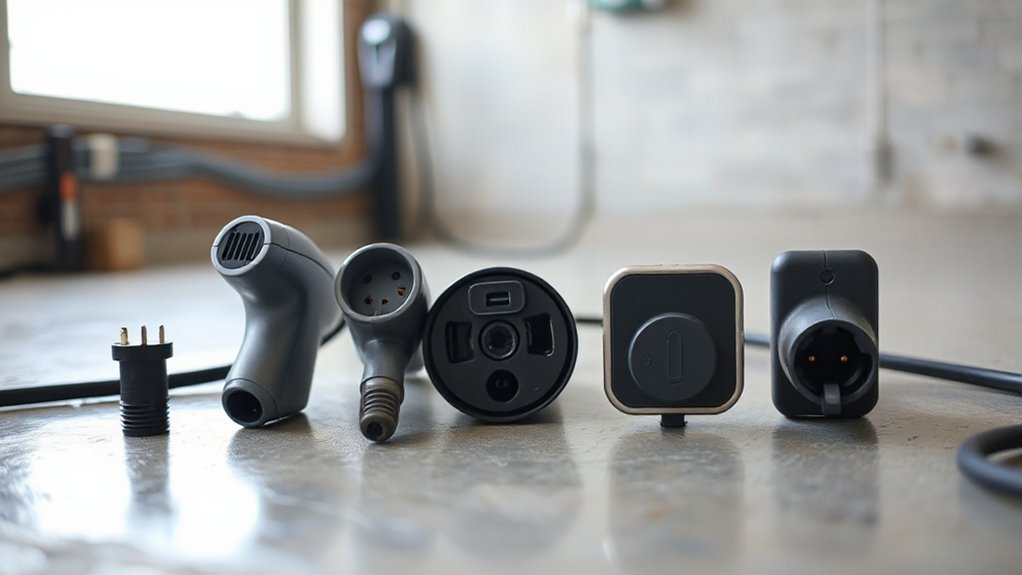
Why does plug type matter? You must match your vehicle inlet to station hardware and communications, or you’ll lose interoperability and functions. Assess Connector Anatomy: pin count, keying, latch, and thermal sensing. Type 1 (SAE J1772) uses 5 pins with control pilot and proximity. Type 2 (IEC 62196-2) uses 7 pins and supports single- or three-phase. CCS1/CCS2 add two high-current pins to Type 1/2 and use PLC per ISO 15118/IEC 61851. NACS (Tesla) integrates AC/DC on a compact 5-pin form factor; published ratings approach 1,000 V and 615 A. CHAdeMO uses a separate DC connector with CAN messaging; typical ratings are ~500 V, 125–200 A. Verify Safety Standards: IEC 62196, UL 2251, IP ratings, ground continuity, isolation, and temperature derating, and mechanical strain relief.
Charging Levels Explained: Level 1, Level 2, and DC Fast Charging
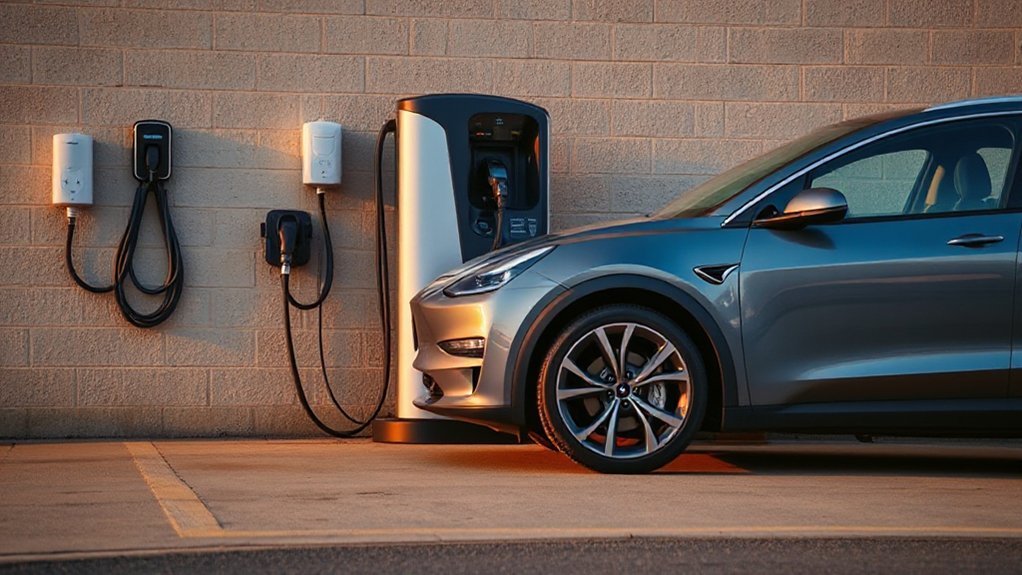
Although connector choice sets physical compatibility, charging level determines power and time-to-charge: Level 1 supplies 120 V AC (North America) at 12–16 A per SAE J1772/NEC, yielding ~1.4–1.9 kW; Level 2 supplies 208–240 V AC at up to 80 A (NEC Article 625), with common EVSE at 32–48 A (~7.7–11.5 kW) and a hard cap of 19.2 kW; DC fast charging (DCFC) delivers regulated DC typically across 200–1,000 V, 50–350 kW, and up to ~500–615 A depending on system and cable cooling. Your car’s onboard charger gates AC rates; DCFC bypasses it but tapers with state-of-charge and thermal limits. Follow Safety standards like UL 2231, UL 2202, and IEC 61851. Plan for Grid impact: charging, demand response, and load sharing reduce peaks and costs.
What Fits Your Make and Model Today
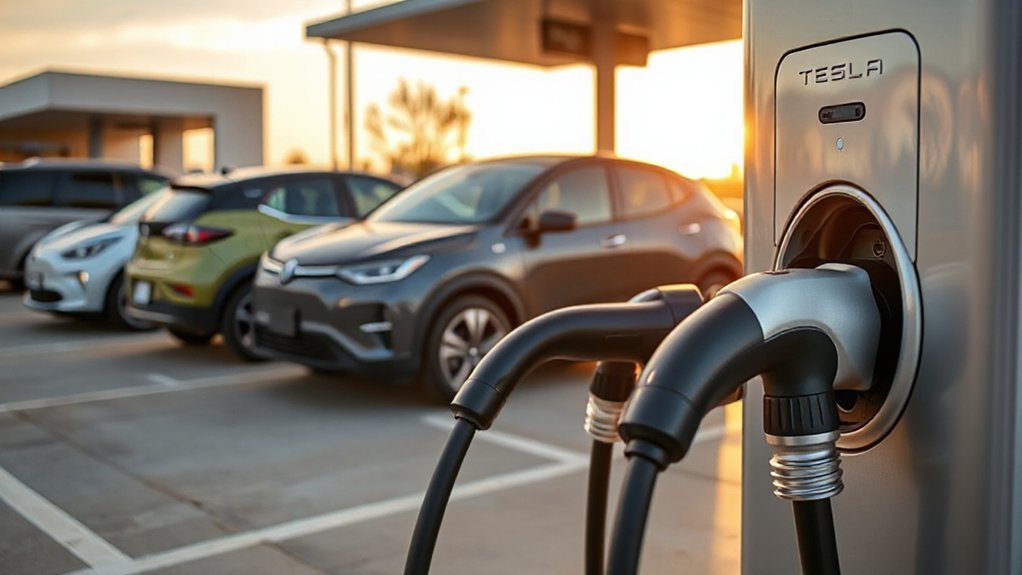
How do you know what plug and power your EV accepts today? Check your manual, charge-port label, and spec sheet. Identify the AC inlet (SAE J1772 or Type 2) and the DC inlet (CCS1/CCS2, NACS, or CHAdeMO). Note onboard-charger AC power (kW) and max DC peak/curve; many models list 7.2–11.5 kW AC and 50–350 kW DC. Verify network support in the telematics app. Confirm cable current limits: 16/32/40/48 A at 240 V for AC; 200–500 A for DC, with pack voltage (400 V or ~800 V) dictating compatibility.
Cross-check build year, trim, and software via VIN lookups and owner forums. Documented standards guarantee resale compatibility; buyers expect the listed connector and charging rates. Use lab tests and network databases to plan reliable charging today.
Adapters and Transition Periods: Bridging Connector Differences
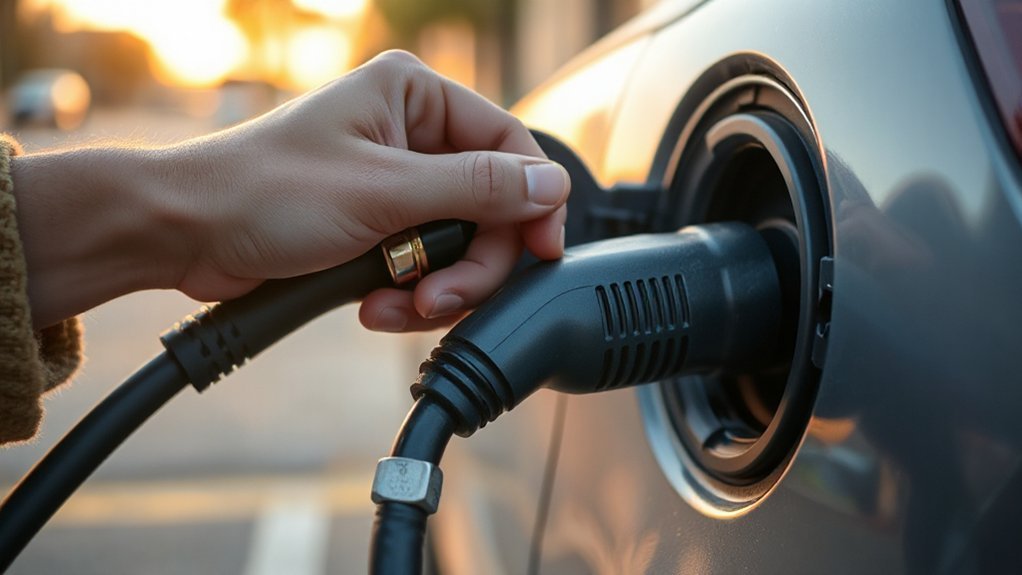
As networks migrate from CCS1 to SAE J3400 (NACS) and legacy CHAdeMO sites retire, certified adapters bridge connector and protocol gaps so you can charge across mixed infrastructure. You should verify Adapter certification (UL, CE) and firmware interoperability with ISO 15118, DIN 70121, and PLC signaling. Monitor Regulatory timelines: NEVI funding mandates, state conversions, and OEM J3400 rollouts, which affect availability and pricing.
- Confirm current rating: 500A continuous, 1000V DC; verify cable temperature sensors and lock mechanisms match vehicle.
- Check handshake support: HLC, extended PLC for authentication, and error mapping to your BMS.
- Validate IP, IK, and -30°C to 50°C environmental specs for roadside reliability.
- Use network whitelists and adapter serial registration to maintain warranty and cyber security, and over-the-air update integrity, compliance logs.
Home Charging Setup and Expected Speeds
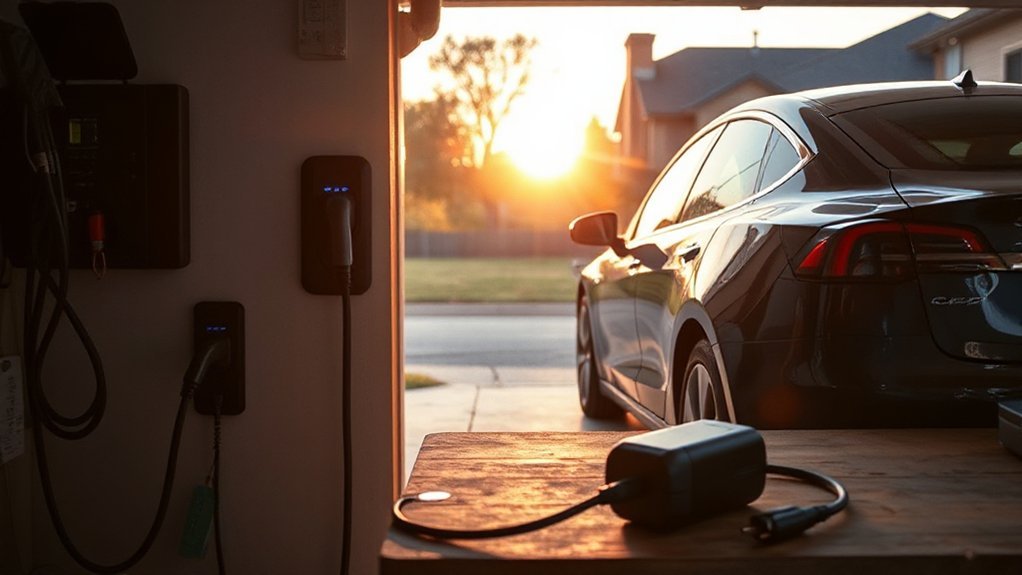
While DC fast charging sets road‑trip pace, home charging depends on AC supply, your EV’s onboard charger (OBC), and code limits: in North America, plan for 120 V Level 1 at 12 A (1.4 kW, ~3–5 mi/h at 280–350 Wh/mi) or 240 V Level 2 at 16–48 A (3.8–11.5 kW, ~10–37 mi/h), with 60 A branch circuits enabling 48 A EVSE per NEC 625 and the 80% continuous‑load rule; some vehicles support 80 A/19.2 kW OBC (~55–65 mi/h) if supplied by a 100 A circuit and compliant EVSE (UL 2594, UL 2231, ENERGY STAR). Your rate is limited by the lowest of circuit, EVSE, and OBC. Do NEC 220 calculations. Permitting requirements and Installation costs vary; verify panel capacity, GFCI needs, and wet-location methods.
Public Networks, Access, and Payment Options
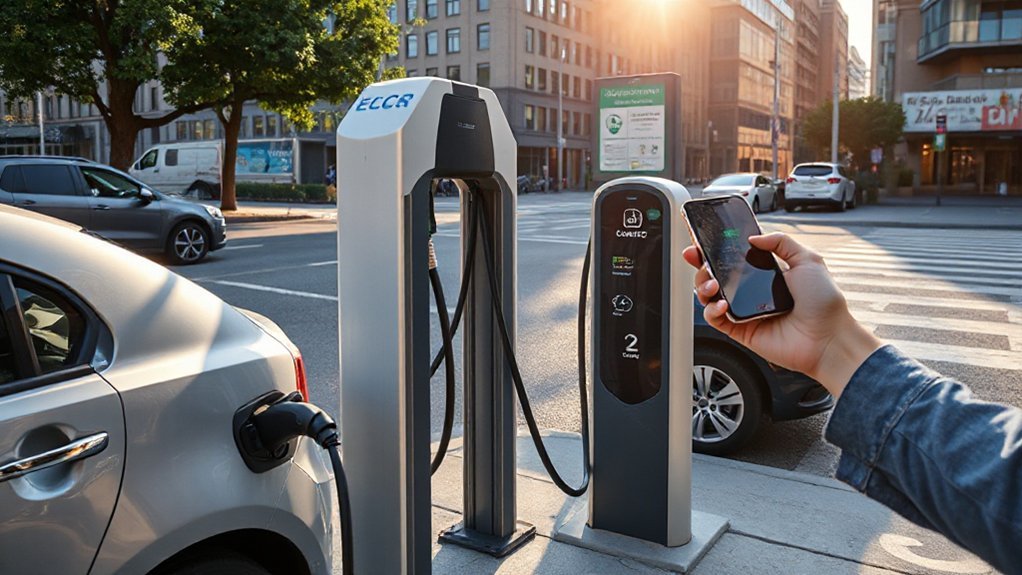
Before you plug in at a public station, know which networks operate in your area, how they authenticate sessions, and what pricing models they apply. Verify connector compatibility, roaming agreements, and payment pathways to reduce failed starts and unexpected fees.
Before you plug in, confirm networks, authentication, pricing, connectors, roaming, and payment to avoid fees.
- Authentication: RFID card, app, contactless EMV, or ISO 15118 Plug&Charge; check OCPP/OCPI support for interoperability.
- Pricing transparency: prefer kWh-based billing; note minute rates, demand charges, idle fees, taxes, and session start fees.
- Membership models: evaluate subscription discounts, roaming surcharges, and per-session authorization holds; verify cancellation terms and data privacy.
- Receipts and reporting: require VAT-compliant invoices, transparent time stamps, meter IDs, energy delivered (kWh), and tariff identifiers.
Favor stations with calibrated, revenue-grade meters and published uptime metrics; monitor session logs to benchmark real-world cost performance.
Road Trip Planning: Finding Compatible Fast Chargers
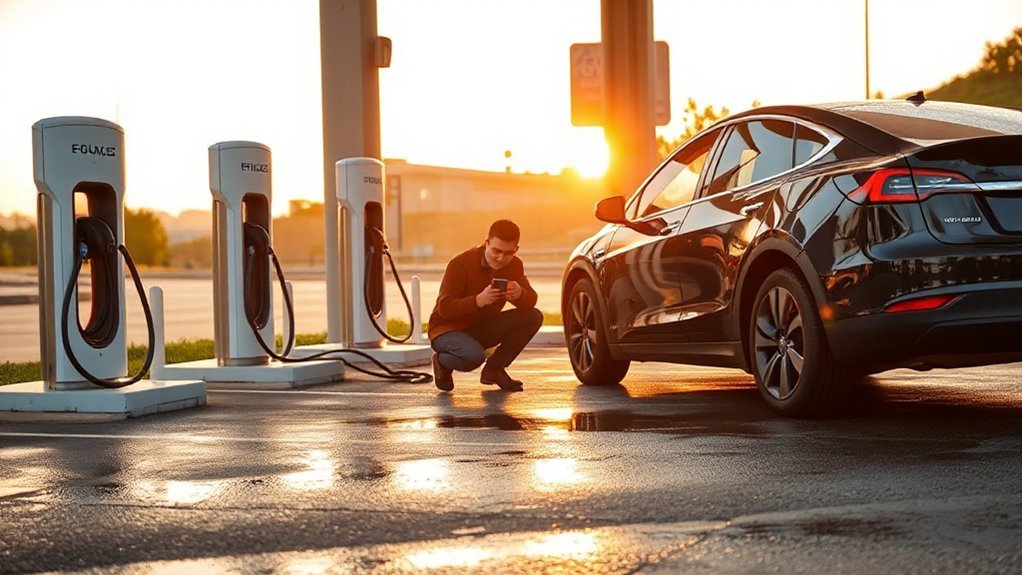
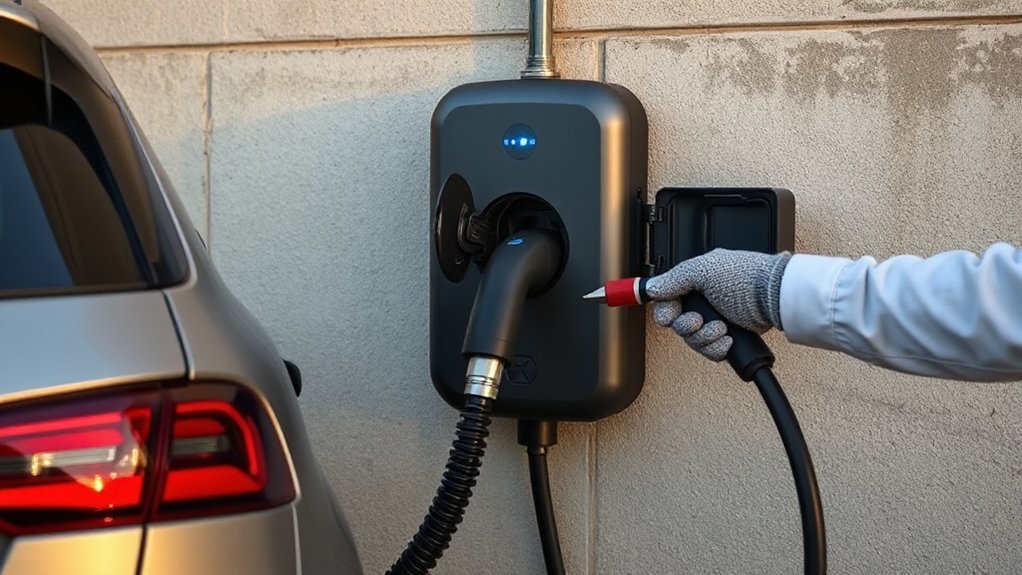
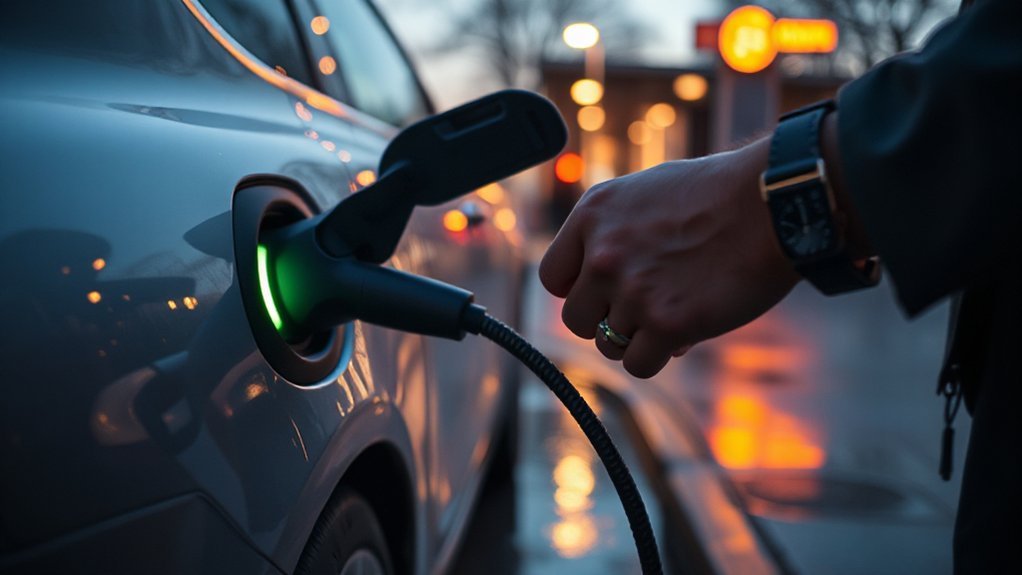
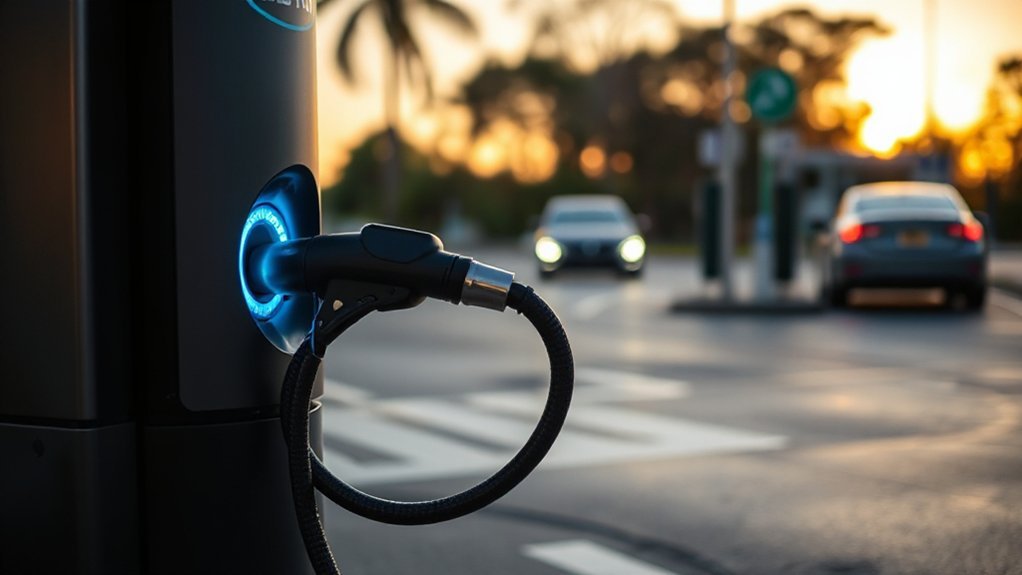

Since route reliability hinges on connector and power compatibility, map fast chargers that match your vehicle’s standards and charge curve. Filter by connector type (CCS1/CCS2, NACS, CHAdeMO), max kW, and site power distribution. Compare your peak charge rate and taper profile to station capabilities, then schedule stops at 10–20% SOC to exploit highest C-rate windows.
Validate uptime metrics: prefer sites with >95% availability, redundant dispensers, and real-time status. Check payment support you can actually use, plus idle fees and session limits that could impact dwell. Evaluate grid constraints: shared cabinets, derating in heat, and peak-hour congestion.
Integrate Scenic Detours and Local Amenities only after confirming compatibility. Quantify buffer: target 15–20% arrival SOC, 10% contingency for weather, elevation, and detours. Recheck status before each leg.
Model-Year Changes That Affect Compatibility
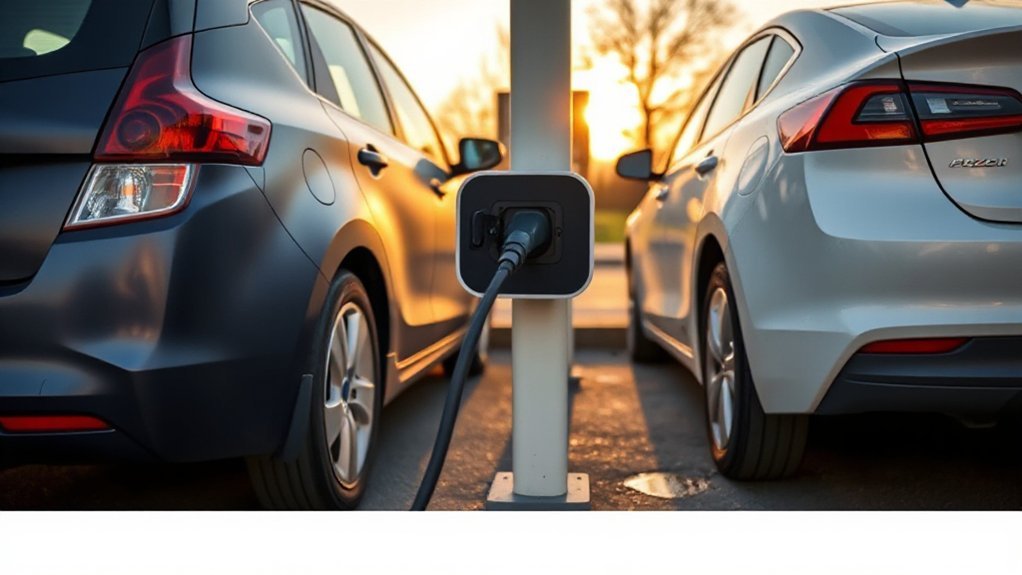
You’ve mapped routes around connector type, peak kW, and charge curve; those assumptions can change with a new model year. Automakers revise hardware, firmware, and certifications that alter interoperability with CCS, NACS, or CHAdeMO. Read the owner’s manual and official homologation notes before you assume legacy behavior.
Model-year changes can upend charging assumptions; check manuals and homologation notes before relying on legacy behavior.
- Connector changeovers: some trims add NACS ports or bundled adapters; others drop CHAdeMO. Verify physical port, pinout, and adapter current rating.
- Power electronics: revised inverters or contactors can raise or cap max kW, amperage, or voltage window (e.g., 400→500 V, 200→300 A).
- Protocol stacks: software updates may change ISO 15118, DIN 70121, or OCPP behavior, affecting plug-and-charge and payment.
- Compliance actions: safety recalls can disable high-power DC or impose SOC caps until remedied; check VIN-specific campaign status.
Weather, Battery State, and Real-World Charging Speeds

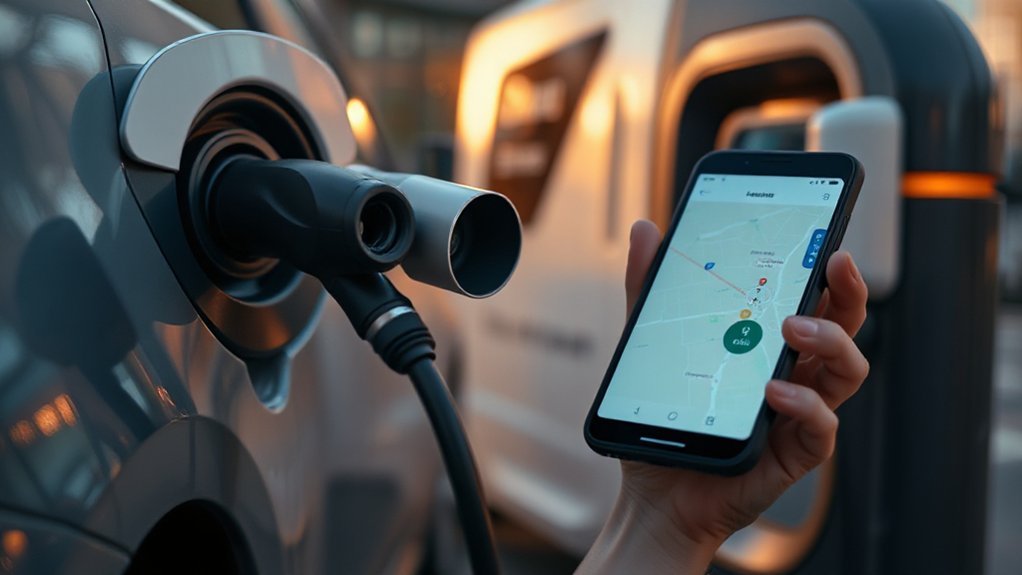
You’ll see DC fast-charge power bounded by pack temperature and state of charge (SOC), consistent with SAE J1772/CCS, IEC 61851-23, and ISO 15118 charge profiles. In cold conditions (pack ≤0–10°C), the BMS limits current to prevent lithium plating, often reducing power 30–70% until the pack reaches ~25–30°C or you precondition. In heat, cells throttle above ~40–50°C and, regardless of temperature, most packs taper from peak power by ~40–60% SOC and fall to While DC fast chargers advertise 150–350 kW, cold‑soaked batteries rarely accept that power because low temperatures raise cell impedance and increase lithium‑plating risk. In practice, at 0°C you’ll often see 30–60 kW until the pack reaches ~20–25°C; at −10°C, intake can sag to 10–20 kW. Use navigation‑triggered preconditioning and arrive between 10–30% SOC to improve C‑rate. For commuter timing and fleet scheduling, budget longer dwell and stagger starts. Verify your car’s CCS/ISO 15118 capabilities for thermal preheat and charge‑curve management. As ambient and pack temperatures rise, DC fast‑charging controllers enforce thermal limits that cut power to protect cells, busbars, and cooling loops. Using ISO 15118/DIN 70121 handshakes, your car negotiates lower current when pack temps exceed ~45–55°C or coolant inlet surpasses spec. Many CCS vehicles derate from 150 kW to 60–90 kW, and some CHAdeMO units halve current above 40°C ambient. Thermal throttling reduces joule heating (I²R) and slows Component degradation in tabs, contactors, and cable terminations. It also aligns with Warranty implications: repeatedly overriding limits or charging with obstructed airflow can be flagged by BMS logs. To mitigate, precondition cooling, avoid sun‑soaked stalls, and prefer chargers with liquid‑cooled cables and shaded pedestals; these maintain stable delta‑T and higher sustained C‑rates during extreme heat. Beyond thermal limits, charge power follows a chemistry‑ and SOC‑dependent CC–CV profile governed by the BMS and negotiated via ISO 15118/DIN 70121. You’ll see high current in CC until a knee, then taper in CV to control lithium plating risk and respect pack voltage and battery chemistry limits. Weather matters: cold raises internal resistance and shifts the knee earlier; heat accelerates taper to protect longevity. State-of-charge dictates the slope; near 80–90% most packs drop below 1C, and cell balancing further reduces power. You’ll use apps that expose real-time charger availability via OCPP/OCPI to prevent stalls and quantify wait risk with uptime metrics. Apply plug-type filters matched to your inlet (CCS1/CCS2, NACS, CHAdeMO) and power class (kW) to guarantee connector, voltage, and protocol compatibility. Integrate route planning that factors SoC, consumption models, elevation, and charger power limits to minimize detours and total charging time. Critically, locating an available, compatible charger hinges on real-time telemetry from charge point operator (CPO) backends, published via OCPP 1.6/2.0.1 and aggregated to apps through OCPI 2.2/2.2.1 and e-roaming hubs such as Hubject and Gireve. You need these feeds to surface status, power, and faults within seconds across open roaming networks. Still, data latency and stale reservations mislead; validate last-seen timestamps and heartbeat intervals. Prefer providers exposing availability sub-states and transaction metrics via OCPP StatusNotification and MeterValues. Use apps that fuse OCPI live status with historical utilization for demand forecasting, routing you before congestion. How do you make sure the map only surfaces chargers your car can actually use? Enable plug-type filters keyed to standards: NACS (SAE J3400), CCS1/CCS2 (IEC 62196-3), CHAdeMO, and Type 2 (IEC 62196-2). Good apps read your vehicle profile, then preselect compatible connectors and power tiers, so you don’t see false positives. Demand UX consistency: icons, terminology, and default states across platforms. Validate datasets against operator IDs, kW ratings, and connector counts. Surface plug-share photos to verify connector faceplates and signage. Address Localization challenges: normalize regional names, units, and scripts; add robust fallbacks for missing metadata records. Plug-type filters only matter if the routing engine respects them end to end, using your vehicle’s connector set, charging curve, and usable battery to compute state‑of‑charge (SoC) constrained routes. Use planners that ingest live availability, tariff data, and weather, and that honor standards like OCPI for roaming and OCPP status to avoid mismatches. For fleets, insist on fleet optimization features and privacy safeguards, including minimal telemetry retention. You’re ready to match plug, power, and policy. Verify your inlet (CCS, NACS, CHAdeMO, Type 1/2), your onboard AC kW, and your DC max/curve, then plan around adapters and station capabilities. Precondition and arrive near 10–30% SOC for peak rates. Use apps with filterable connector, power, and uptime data. In the U.S., 62% of DC fast ports are CCS, 20% Tesla, 18% CHAdeMO—so CCS coverage dominates during the NACS migration. Plan confidently across key corridors.Cold Weather Slowdowns
Heat-Induced Throttling
SOC Tapering Behavior
Best Apps and Tools to Locate the Right Charger
Real-Time Charger Availability
Plug-Type Filters
Filter dimension
Implementation note
Connector standard
Map to J3400, CCS, CHAdeMO, Type 2; deprecate legacy tags
Power capability
Separate AC kW vs DC kW; expose min/max sliders
Route Planning Integration
Conclusion