
On a 400‑mile winter trip in a CCS EV, you target 10–60% SOC and 150 kW chargers, preconditioning en route. You verify NACS/CCS compatibility and avoid legacy CHAdeMO. You plan with live OCPP telemetry, reservations, and ISO 15118 Plug&Charge. You budget Wh/mi by temp and speed, exploit mid‑SOC fast stops, and skip taper. You can cut hours and cost—but only if you align connector standards, site power, and temperature to your car’s charge curve.
Key Takeaways
- Use DC fast chargers (50–350 kW) for road trips; expect 10–80% in 20–40 minutes, slower above ~70–80% due to taper.
- Check your vehicle’s connector (CCS, NACS, CHAdeMO) and maximum charge acceptance; speed is limited by the lesser of station or vehicle capability.
- Precondition the battery en route for faster charging; cold or hot packs will throttle, ideal cell temps are roughly 15–35°C.
- Use charging apps for real-time availability, connector types, and kW; favor sites with multiple dispensers to reduce queue risk.
- Plan stops every 100–150 miles and unplug near 80% to save time and reduce battery stress; rely on Level 2 for overnight top-ups.
Understanding Charging Levels: Level 1, Level 2, and DC Fast
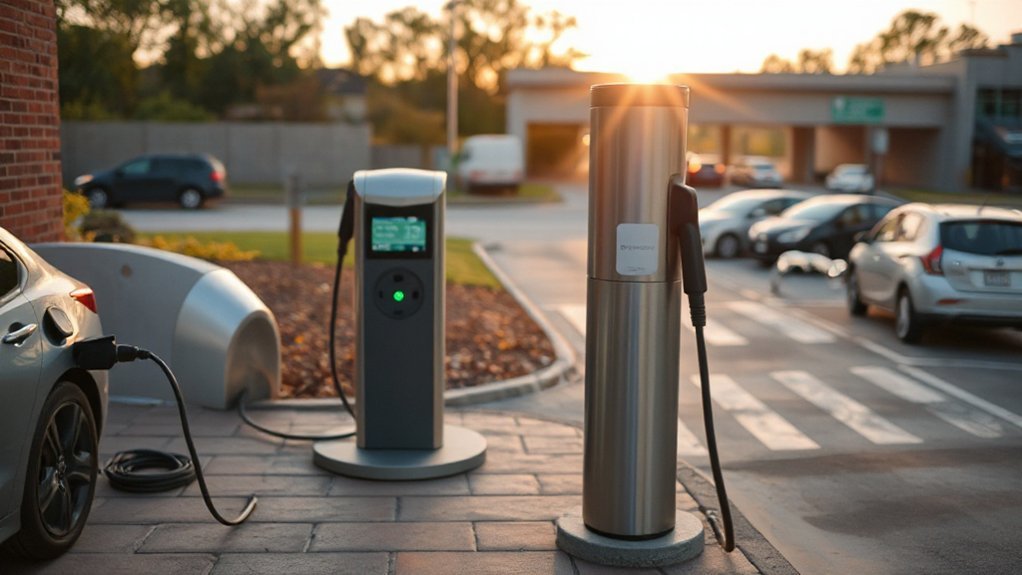
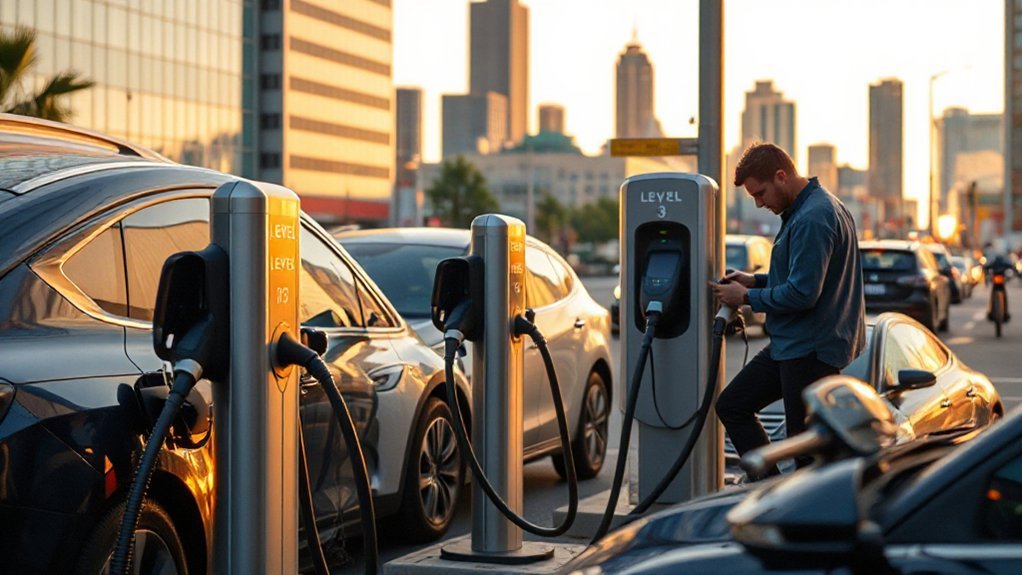
How do Level 1, Level 2, and DC fast charging differ in electrical specs and performance? You’ll see Level 1 at 120 V AC, ~12 A continuous (1.4 kW), adding ~3–5 miles/hour. Level 2 uses 208–240 V AC at 16–80 A; typical 40 A circuits deliver 9.6 kW, adding ~25–40 miles/hour. DC fast supplies direct current at 200–1000 V, 50–350 kW, enabling 10–80% in 20–40 minutes, constrained by pack thermal limits and charge curves. You must meet Installation Requirements: dedicated circuits, load calculations (NEC Article 220), overcurrent protection, GFCI where specified, and proper bonding. Apply Safety Standards: NEC Article 625, UL 2594/2202/2231, and IEC 61851 equivalents. Verify utility capacity, demand charges, and site ventilation/clearances. Commission with insulation, ground-continuity, and functional tests before customer use.
Connector Types and Compatibility
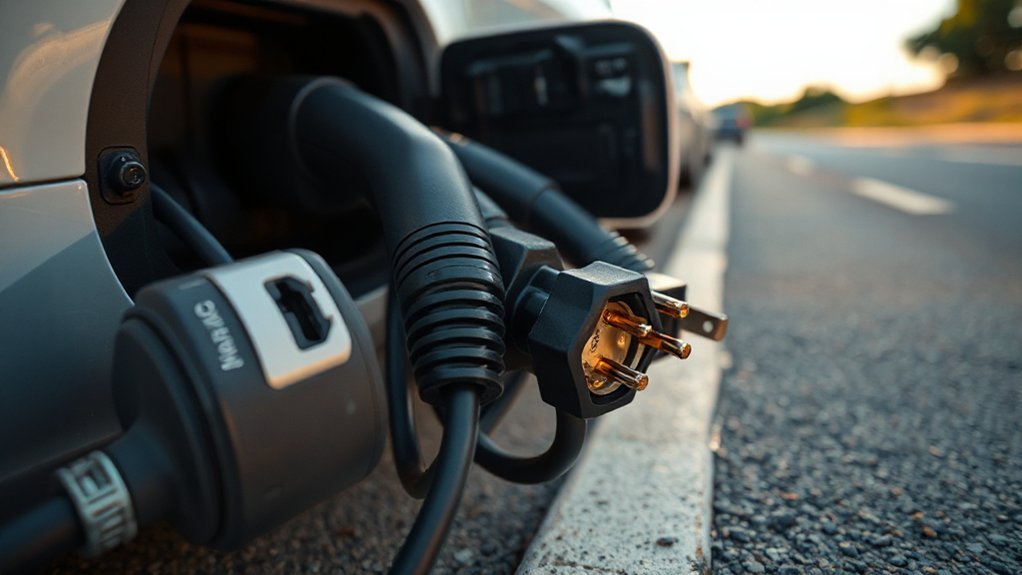
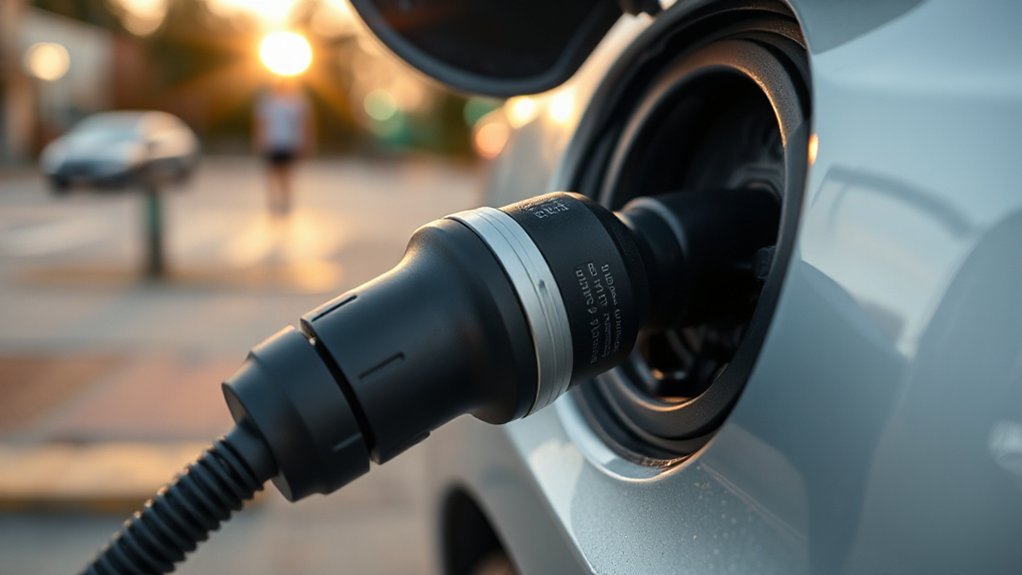
With charging levels defined, connector selection now determines interoperability, signaling, and allowable power. You’ll encounter J1772 (Type 1) for AC in North America, supporting up to 19.2 kW; Type 2 (IEC 62196-2) enables three‑phase AC up to 43 kW. For DC, CCS1/CCS2 (IEC 62196-3) add two high-current pins to AC interfaces, delivering 50–350 kW using PLC per ISO 15118/DIN 70121. CHAdeMO provides 50–200 kW with CAN signaling, while NACS targets compact Pin configurations and up to 250–500 kW. Verify your vehicle inlet against station plug type and rated current/voltage. Check latch geometry, keying, and Safety interlocks: proximity detection, control pilot, and contactor sequencing prevent arcing. Use certified cables with liquid‑cooled conductors for high currents, and confirm firmware supports Plug & Charge and payment authorization.
Planning Routes With Charging Apps
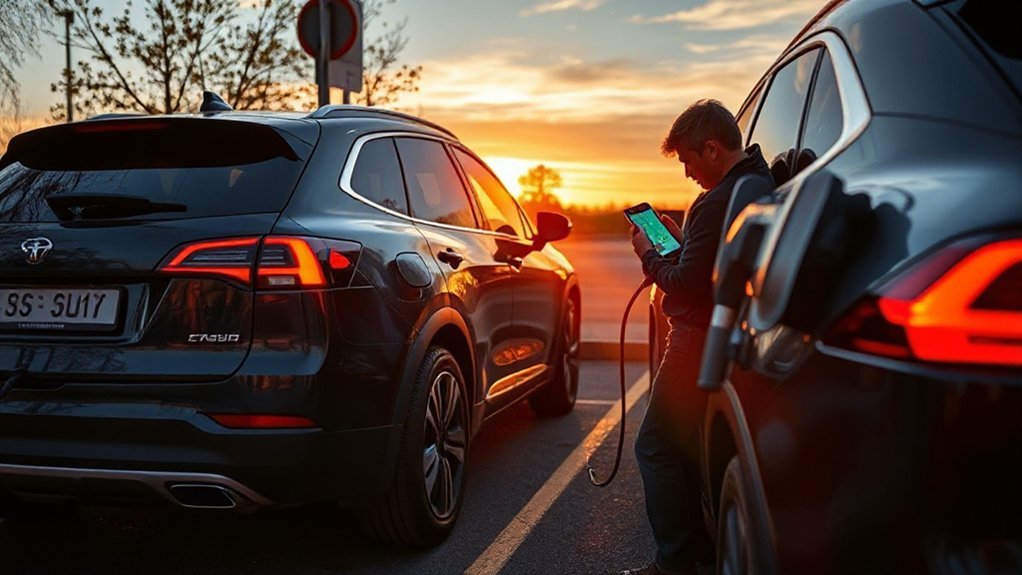
You use charging apps that aggregate real-time station status via OCPI (from EMSPs) and OCPP (from CPOs) to display availability, connector types, power (kW), and update latency. You set constraints for ideal stop scheduling—SOC floor/ceiling, charger power, dwell/queue estimates—while the app minimizes total trip time using energy models calibrated to EPA/WLTP data, speed profiles, elevation, temperature, and wind. Your battery-aware trip plan reads BMS signals (SOC, SOH, temperature, consumption curve) via ISO 15118/vehicle APIs and adjusts stop spacing and charge targets dynamically.
Real-Time Charger Availability
Why rely on static maps when networks expose live status via OCPI roaming directories and OCPP telemetry that routing apps can query in real time? You can see connector availability, power limits, tariffs, and session occupancy pulled from CSMS endpoints, then validated against station heartbeats and transaction events. Apps fuse operator feeds with crowdsourced updates to flag blocked bays, faulty plugs, and send downtime alerts. You benefit from SLA-derived uptime metrics, last-seen timestamps, and fault codes, not guesses. Filter by plug type, minimum kW, price, and access hours, and trust data freshness windows to avoid stale pins. When signals drop, fall back to probabilistic availability modeled from historical utilization, maintenance schedules, and weather impacts, with confidence intervals exposed. User-reported reliability scores are shown too.
Optimal Stop Scheduling
Armed with live OCPI/OCPP status, routing engines schedule charging stops to minimize total trip time under energy, charger, and reliability constraints. You select networks, then the planner quantifies queue risk via historical session data, station uptime, and connector counts. It optimizes Stop Spacing to balance driving segments against charge durations, enforcing Arrival Buffers that reduce stranding probability when traffic or weather extends legs. The algorithm filters sites by plug type, power class, tariff, and access hours, and penalizes detours, low-reliability operators, and single-point-of-failure locations. It computes expected wait plus charge time using kW distributions and occupancy models, then recomputes on deviation events. You confirm the itinerary, lock reservations where supported, and export turn-by-turn guidance via standardized deep links and APIs across supported mobility platforms.
Battery-Aware Trip Planning
How does a planner adapt routes to your pack’s actual state? It fuses BMS telemetry (SoC, SoH, temperature) with elevation, speed limits, and weather to estimate kWh/mile under ISO 15118 and OCPI data feeds. You set Owner Preferences—min SoC, charger networks, dwell time—and it’ll compute feasible corridors, reserving stalls when contracts permit. It also flags Insurance Impacts when repeated DCFC or deep cycling elevates risk scores. The app verifies connector standards, power tiers, and congestion forecasts using historical station uptime. Audit logs support post-trip analysis and compliance reporting securely.
- Predictive SoC at waypoints with 95% confidence intervals.
- Thermal constraints integrated into charge window selection.
- Dynamic rerouting from real-time station availability (OCPP).
- Cost optimization using tariffs, idle fees, and roaming rates.
Estimating Real-World Range and Energy Use
While lab cycles provide a baseline, you should estimate real-world range and energy use by translating standardized ratings (EPA 5‑cycle, WLTP, SAE J1634) to your duty cycle. Map your speed profile, ambient temperature, HVAC load, payload, and elevation to derive adjusted Wh/mi. Start from rated consumption, then apply correction factors for aerodynamic drag (∝ speed^2) and rolling resistance (∝ vehicle mass). Incorporate tire type/pressure, road surface, wind, and accessory loads. For mixed routes, weight city/highway fractions and idle HVAC time. Use SOC windows you actually operate (e.g., 10–80%) and include battery aging degradation. Validate with trip logs or OBD/CAN energy data. Compute usable range as usable kWh divided by adjusted Wh/mi; iterate until prediction error falls below 5%. Document assumptions and update seasonally, quarterly.
Fast-Charging Speeds and What Affects Them

You’ll see fast-charging power track state of charge: peak between roughly 10–50% SOC, then tapering after ~60–80% as the BMS enforces voltage/current limits, often falling below ~50 kW above 80% on 400 V packs. You manage temperature tightly; ideal cell temps around 20–40°C enable peak rates, while cold (<10°C) or hot (>50°C) conditions trigger current limits or preconditioning per OEM strategies and ISO 15118-20 controls. You also match charger and vehicle limits: effective power is min(charger kW, pack voltage × max current, cable rating), with CCS current caps (~500 A) restricting many 400 V cars, while 800 V architectures exploit 350 kW hardware more fully.
State of Charge
Because lithium‑ion cells accept current most efficiently at mid state‑of‑charge (SoC), DC fast‑charging power typically peaks around 10–40% SoC and progressively tapers above ~60–80% as the battery shifts from constant‑current to constant‑voltage control. You’ll see the highest kW when arriving low, then a regulated decline as cell voltage approaches pack limits. The BMS negotiates current setpoints per ISO 15118/IEC 61851, enforcing pack, module, and connector constraints. Differences between charger UI display design and vehicle dashboards can create apparent meter inconsistency, so verify session kWh via receipts or telematics.
1) Arrive 10–30% SoC to maximize average kW.
2) Unplug near your taper knee (~60–70%) to minimize dwell.
3) Prefer stations meeting published nameplate and cable ratings.
4) Track SoC vs kW logs to validate curves.
Temperature and Thermal Limits
Although a charger’s nameplate kW looks fixed, fast‑charge power is fundamentally temperature‑limited at the cell, pack, and connector. You manage Joule heating (I²R) and interfacial impedance; above ~40–50°C, cells throttle to protect SEI and avoid lithium plating. You should monitor inlet coolant ΔT, contact temperature, and cable ampacity per IEC 62196 and ISO 6469 thermal provisions. Robust Insulation Materials, thermal pads, and vapor‑chamber spreads reduce gradients. Keep detection for Thermal Runaway per UL 2580 and UNECE R100; verify venting and fusing. Validate sensors, logs, and alarms against ISO 26262 thermal diagnostics.
| Parameter | Typical Limit | Rationale |
|---|---|---|
| Cell temp | 15–35°C | Maximizes charge rate, mitigates plating |
| Connector pin | <90°C | Prevents softening, resistance rise |
Precondition the pack; you’ll charge faster and safer in cold or hot weather conditions.
Charger and Vehicle Limits
Thermal headroom sets the ceiling at the cell, but fast‑charging speed in practice is the lesser of the charger’s capability and the vehicle’s acceptance map. You negotiate power via CCS or CHAdeMO/GB/T handshakes; voltage limits, current ceilings, and pack SOC define the curve. Even with a 350 kW dispenser, you’ll see less if your pack voltage is low, cables derate, or firmware limits apply. Manufacturer caps, warranty policies, and grid constraints also bound delivered power substantially in operation.
- Charger: max volts/amps, cable rating, cooling status, station derates, uptime data.
- Vehicle: pack voltage window, BMS current limit, cell impedance, thermal model.
- Protocol: ISO 15118/PLC messaging, power contracts, certificate status, fallback behavior.
- Site: feeder capacity, load management, simultaneous sessions, utility demand limits.
Pricing Models and How to Save
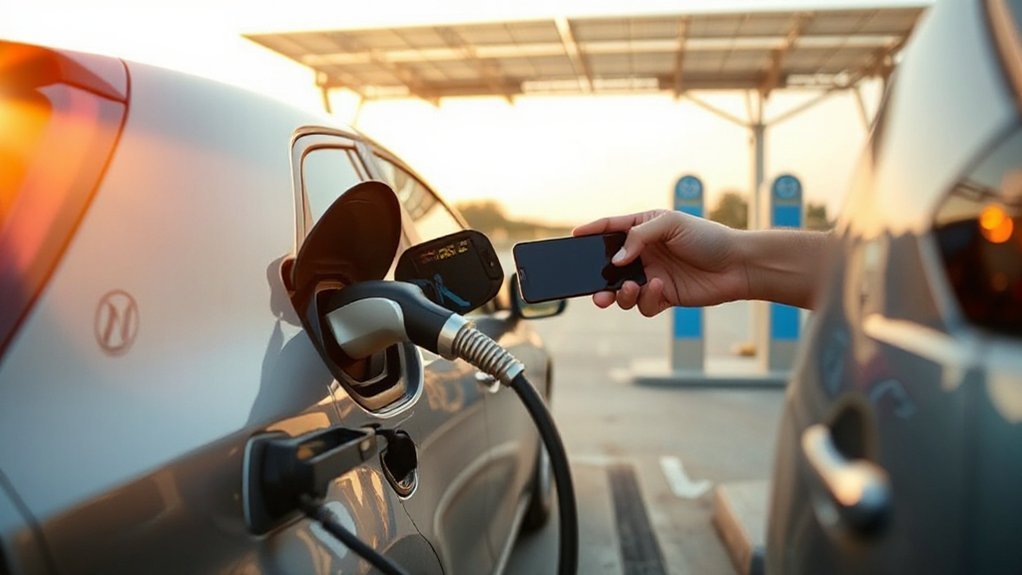
Often, networks price EV charging using one or a mix of models: energy-based ($/kWh, increasingly mandated by state Weights & Measures using MID/ANSI C12.20–class meters), time-based ($/min, still common where kWh pricing isn’t permitted), session fees, tiered power bands (e.g., 1–90 kW vs 90–180 kW), dynamic tariffs tied to TOU or wholesale locational marginal prices, and idle/overstay fees once charging completes. To reduce total cost, compare tariffs, read idle-fee triggers, and prefer kWh-billed sites with certified meters when possible. Stack loyalty programs and tax incentives. Mind power-band thresholds.
| Strategy | Rationale |
|---|---|
| Choose kWh billing | Transparent energy cost; avoids slow-car penalty. |
| Charge off-peak | Lower TOU/LMP, fewer idle fees. |
| Enroll in loyalty programs | Status pricing, credits, roaming discounts. |
| Apply tax incentives | Reduce network fees or card costs. |
Battery Health: Best Practices on the Road

You target a 20–80% state-of-charge for routine use and only charge to 100% just before departure to reduce lithium plating and calendar aging observed across NMC and LFP cells. On the road, you end DC fast-charge sessions around 70–80% SOC and avoid high C‑rates when pack temperatures are below 0°C or above 40°C. You precondition to keep the battery near 15–30°C, park in shade, and skip rapid charging if cell temps exceed ~45°C, aligning with common OEM guidance and IEC/SAE thermal recommendations.
Optimal Charge Ranges
While range matters on a trip, battery health hinges on keeping state of charge (SoC) within chemistry-appropriate bands and minimizing high-SoC dwell. You’ll maximize longevity by targeting partial charges aligned with BMS guidance. For most NMC/NCA packs, plan 20–80% SoC; for LFP, 10–90% suits daily use. Avoid parking above 90% unless you depart. Your Charging Psychology and Owner Habits drive outcomes, so set charge limits and departure timers to keep average SoC moderate. Track energy per 100 km and degradation metrics (e.g., DCIR trends) to validate your strategy.
- Stop DC fast charging near 70% to avoid taper.
- Add 10–30% top-ups; lower DoD and wear.
- Rare 100% charges for BMS sync; otherwise limit.
- Keep DCFC energy share under 30%; prefer AC.
Temperature Management Tips
Beyond SoC windows, cell temperature control dictates degradation rates. Maintain pack temps near 20–30°C during charging; avoid DC fast charging below 10°C or above 45°C to limit lithium plating and SEI growth. Precondition via the vehicle’s thermal management before arriving at a charger; most OEMs meet ISO 6469 and SAE J1772 thermal safeguards, but you should still monitor inlet and pack temps. Park in shade, crack windows, and use portable fans to reduce cabin heat load so the coolant loop works less. In cold weather, wear layered clothing and minimize cabin heat to preserve kWh for the battery heater. Prefer moderate C‑rates; if the station supports it, cap current. After charging, let the pack soak to equilibrate before heavy acceleration. Monitor ambient thermal forecasts.
Charging Etiquette and Station Tips
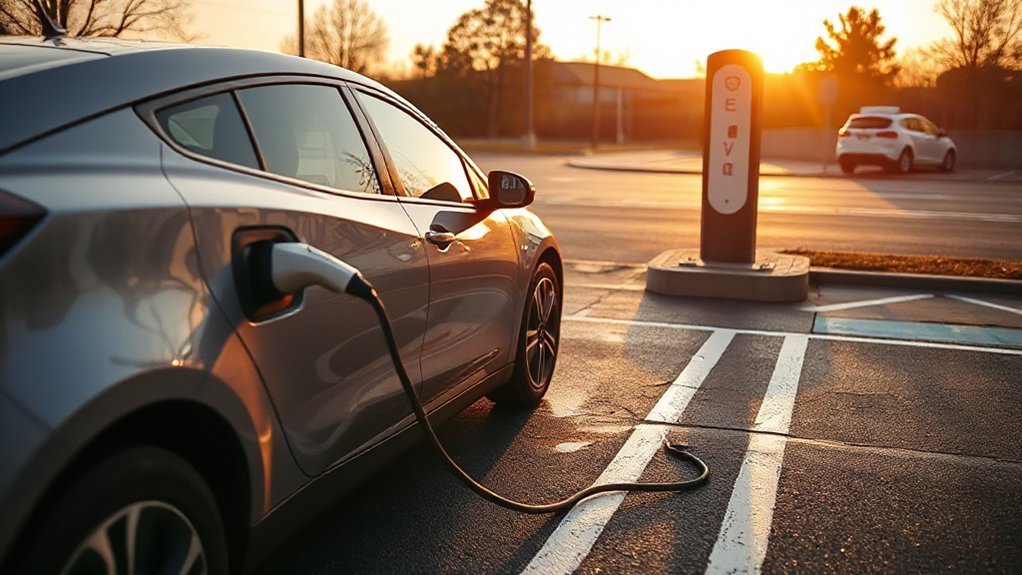
Although networks differ, consistent etiquette and station practices maximize throughput and safety. You’ll reduce dwell time and faults by following site signage, connector ratings, and payment workflows. Practice parking courtesy: center your vehicle, leave buffer for door swing, and vacate at target SOC. Apply cord etiquette: avoid strain, coil slack off-ground, and reholster to prevent ingress and damage.
- Queue management: log arrival in-app, line up by timestamp, and skip if your SOC exceeds 80% to capacity.
- Session optimization: pre-authorize, authenticate once, monitor kW and taper; stop when kW falls below 25% of charger nameplate.
- Interoperability checks: verify CCS/NACS/CHAdeMO fit, latch integrity, and ground fault indicators per SAE/IEC specs.
- Safety: keep exhaust-free zones clear, report arcing, tripped breakers, or hot handles; document with station ID.
Road-Trip Strategies for Different Climates

Because battery performance is temperature-dependent, plan your route, SOC targets, and charge stops around ambient and pack temperatures. In cold (<0°C), precondition to reach ideal charging window, expect 10–30% higher consumption, and favor shorter stops between 10–60% SOC to maintain high kW. In heat (>35°C), use shaded parking, moderate speeds, and avoid arriving above 70% SOC to limit taper from thermal limits.
Calibrate Terrain Adaptations: on climbs, budget +5–15% energy per 1000 m gain; on descents, regen recovers 5–10% depending on pack SOC and limits. Track efficiency in kWh/100 km and adjust targets using real-time averages. For Seasonal Packing, carry tire chains or all-weather tires, a calibrated gauge, and insulation; reduce roof loads to cut drag by 5–10%. Verify connector compatibility and power ratings.
Future Trends: Networks, Tech, and Standards
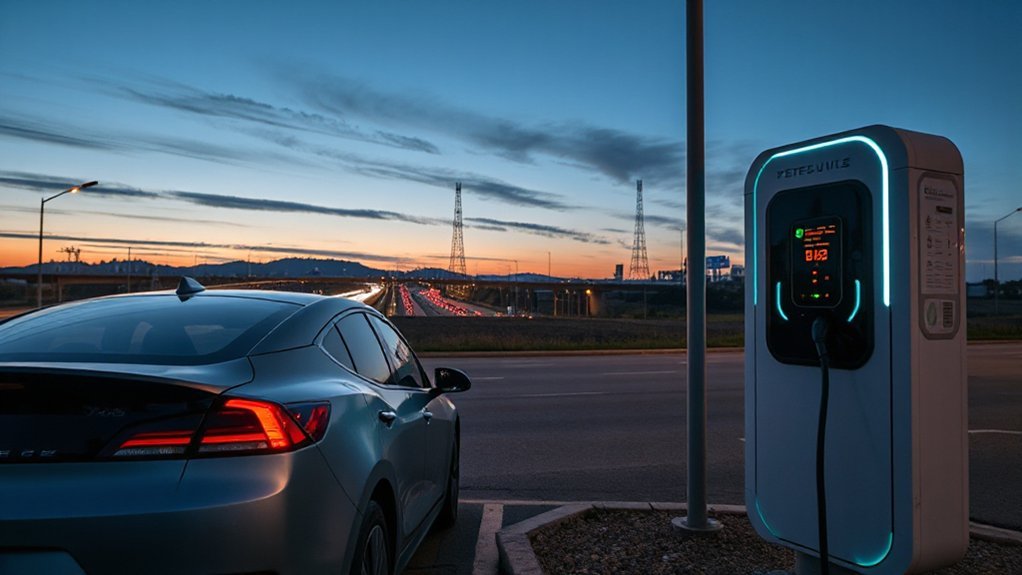
As EV adoption scales, charging will converge on interoperable networks and open standards that boost reliability, power, and secure grid integration. You’ll benefit from OCPP 2.0.1, OCPI roaming, and ISO 15118-20 for Plug & Charge and Vehicle to Grid coordination. Expect NACS and CCS harmonization, open roaming, verifiable uptime SLAs, and revenue-grade, certified metering and billing.
Interoperable, open EV charging: OCPP, OCPI, ISO 15118, NACS/CCS—reliable power, secure grid integration, revenue-grade billing.
- Protocols: OCPP 2.0.1 + OCPI enable remote control, rich telemetry, and roaming with contract IDs and tokens.
- Power: 400–1000 V architectures, 350 kW+ dispensers, liquid-cooled leads, and dynamic load sharing minimize dwell.
- Security: Cybersecurity Standards enforce PKI, mutual TLS, secure boot, IEC 62443 segmentation, and FIPS 140-3 modules.
- Grid: V2G via ISO 15118-20, IEEE 2030.5/CSIP, and OpenADR 2.0b supports DR, frequency services, and settlement.
Conclusion
You’ve got the tools: match connector standards (CCS/NACS/CHAdeMO), plan with telemetry-driven apps, and route within SOC windows that favor mid-pack fast charges. Precondition in hostile weather, monitor kW and taper, and schedule Level 2 overnights to keep the pack from feeling its years. Respect site protocols, share lanes, and prioritize vetted networks. Do this, and you’ll turn range anxiety into a disagreement with physics—efficient, standards-compliant, and on time, without breaking a sweat or the battery.