
You plan EV road trips by mapping corridors with reliable DC fast networks spaced ≤50 miles, preferring sites with ≥4 stalls, mixed CCS/NACS, and published uptime. You start at ≥20% SOC, target short boosts to 60–70%, and use Level 2 overnight. You precondition, cache apps/roaming, and carry adapters. You also define alternates within 15–30 miles and keep a 10% buffer—but that’s only half the equation; the variables you can’t ignore are next.
Key Takeaways
- Plan routes along corridors with NEVI-compliant networks (97% uptime), verify stall counts and real-time status, and keep stations within 50 miles.
- Target arrivals 10–20% and depart 60–70%, making 12–18 minute DC fast stops; avoid charging past taper and back-to-back fast sessions.
- Prefer Level 2 for daily charging; reserve DC fast (50–350 kW) for en‑route recovery, and carry adapters for J1772, CCS, or NACS.
- Account for speed, wind, elevation, temperature, and payload; precondition battery and cabin, maintain tire pressures, and budget extra energy in cold.
- Preload apps/RFID with OCPI/OCPP data, enable Plug & Charge, cache offline maps, set alerts, and define contingency stops within 10–30 miles.
Plan Routes Around Reliable Networks

When planning, prioritize corridors with charging networks that publish uptime and meet or exceed the NEVI 97% operational availability requirement. Use provider APIs and third‑party reliability indices to verify site‑level uptime, connector counts, and real‑time status. Target high Network density: stations every ≤50 miles, ≥4 stalls, N+1 redundancy, and mixed CCS/NACS connectors. Map Urban deserts where spacing exceeds 70–100 miles and add contingency stops. Prefer sites with OCPP/OCPI telemetry, posted maintenance SLAs, and transparent power derate policies. Evaluate historical outages, median wait times, and throughput per stall (kWh/day) to estimate queuing risk. Score each corridor on availability, redundancy, and coverage; rank routes that maintain ≥95th‑percentile reliability over your legs. Cache offline maps, access cards, and backup sites within a 10‑mile detour for contingency planning.
Level 2 vs. DC Fast: When to Use Each

You should use Level 2 (SAE J1772, ~6–11 kW) for daily home/work charging to maintain 20–80% SOC, and reserve DC fast (CCS/NACS, 50–350 kW) for en-route recovery. To protect battery health, follow OEM limits on C‑rate and temperature: don’t stack back-to-back fast sessions, don’t hold at 100%, and avoid high-SOC fast charging. Fleet data show faster degradation with frequent DCFC, so you’ll minimize wear by preconditioning, charging to need, and tapering above ~80% SOC.
Daily Charging Scenarios
Although DC fast charging can add substantial range in minutes, daily use typically favors Level 2 for cost, grid impact, and battery longevity.
You’ll cover routine miles via SAE J1772 or NACS AC at 6–11 kW, aligning with off-peak tariffs and predictable dwell times. Use DC only when time-critical or route-constrained locally.
- Home: Overnight 7.7 kW (32 A), add ~25–35 kWh in 4–5 hours; schedule for TOU rates; do Evening Topups as needed.
- Workplace Charging: 6.6–11 kW across an 8-hour shift yields 50–80 kWh; supports load management via OCPP.
- Public L2: Park-and-charge at malls/gyms; 6 kW average; verify connector standard and pricing per kWh.
- DC Fast: Use 50–150 kW for compressed schedules, cold starts, or unplanned detours; target short sessions to bridge to L2.
Battery Health Impact
While DC fast charging delivers high C-rates (often ~1–3C, e.g., 150 kW into a 60–80 kWh pack), Level 2 typically sits near 0.1–0.2C (6–11 kW), imposing far lower thermal and electrochemical stress. Use DC fast when time-critical and the battery’s warm; prefer Level 2 for daily top-ups and overnight balancing. High C-rates elevate anode overpotential, lithium plating risk, and coolant loop demand. You’ll see cell imbalance if the BMS can’t finish balance phases. Respect recommended SOC windows (e.g., 10–80%). Consider pack architecture, preconditioning, ambient, and state-of-health before choosing.
| Scenario | Recommended Method | Rationale |
|---|---|---|
| Road-trip | DC fast (≤350 kW), 10–60% SOC | Minimize dwell; needs thermal headroom |
| Overnight | Level 2 (6–11 kW) | Low C-rate, completes balancing |
| Cold battery | Level 2 or delay | Reduces plating risk; allow preconditioning |
Essential Apps and Tools for Real-Time Charging
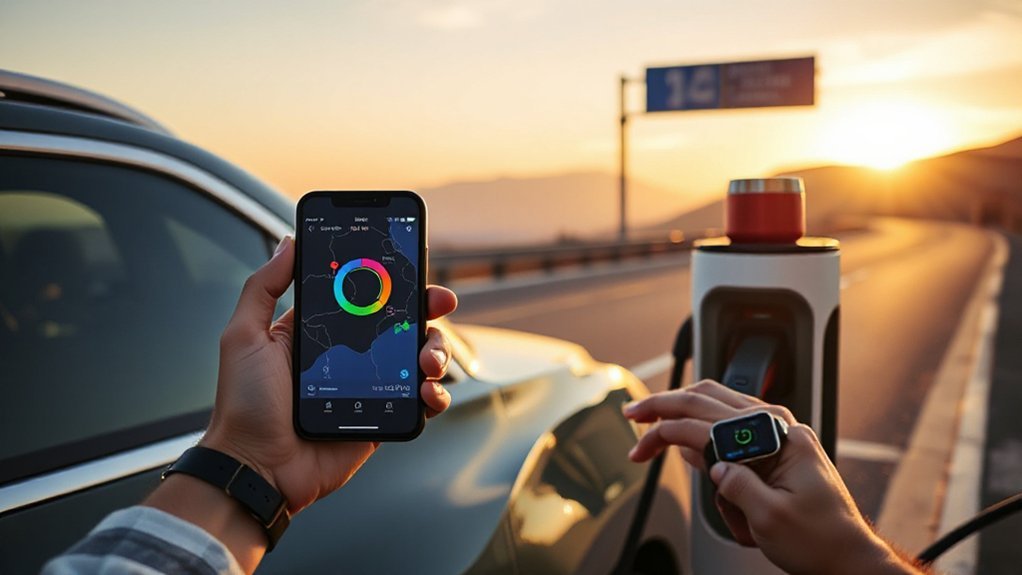
How do you guarantee real-time charging reliability on the road? Use standards-based apps that fuse live station telemetry, robust Map Integration, and precise Notification Settings. Prioritize platforms consuming OCPI feeds and OCPP heartbeat data to display connector status (in-use, faulted, available) and power ratings in kW. Enable ISO 15118/Plug & Charge where supported to streamline authentication, or carry RFID as fallback. Verify network roaming, pricing transparency, and uptime SLAs.
Guarantee road-trip charging with OCPI/OCPP telemetry, ISO 15118, robust maps, alerts, and transparent pricing.
- See dynamic availability, queue length, and connector types (CCS, NACS, CHAdeMO) along your route.
- Get push alerts for stalls freeing up, price spikes, or derates, tuned via Notification Settings.
- Compare energy cost per kWh, session fees, and idle penalties before you arrive.
- Cache offline maps, POIs, and access hours; sync when connectivity returns.
Capture analytics.
Range Factors: Speed, Elevation, Weather, and Load

Your app can confirm a live connector, but your actual range hinges on physics: speed, elevation, weather, and load. At highway speeds, aerodynamic drag dominates; power scales with v^3 (P ≈ 0.5·ρ·CdA·v^3). A 10 mph headwind effectively raises speed, increasing Wh/mi by double digits. Maintain correct tire pressure to minimize rolling resistance. Climbing costs m·g·h energy; 1,000 ft of gain adds roughly 6–10% for typical crossovers, with partial regen on descent. Cold lowers cell efficiency and raises HVAC load; precondition and use a heat pump if equipped. Higher payload weight and roof racks increase rolling resistance and drag; stash gear inside to preserve CdA. Baseline using your EPA label or SAE J1634 data, then adjust for speed, grade, temperature, wind, accessories, and traffic patterns.
Smart Stop Strategy: Drive More, Wait Less

Since DC fast charging delivers the highest average power at low state of charge (SOC), plan legs that let you arrive with a warm battery at roughly 10–20% and leave near the knee of your car’s charging curve (typically 55–70% for 150–350 kW-capable EVs, 70–80% for 50–75 kW-limited models). Short, frequent sessions minimize taper and reduce dwell. Target high-power sites with redundant dispensers and CCS/NACS compatibility to meet SAE/ISO standards.
- Precondition en route; navigate to the charger to trigger thermal readiness.
- Synchronize Snack Timing with 12–18 minute stops; avoid restaurant waits.
- Execute Driver Rotation at each session; swap while ramping starts.
- Prefer sites with 1:1 power modules and dynamic load-sharing telemetry.
Align stop cadence with charge curves, and you’ll cover more miles per hour.
Battery Care on Long Drives

You should target an ideal state of charge of 10–80% per OEM/BMS guidance, reserving 100% only for range-critical legs. You’ll maintain thermal stability by preconditioning before DC fast charging and managing load to keep cell temps ~20–35°C, as the BMS will taper power outside this band. You’ll practice smart charging by planning short, frequent DCFC stops, using standards-compliant hardware (SAE J1772/CCS or IEC 61851), and unplugging when power falls below ~1–1.5 C or ~30–40 kW on a 60–80 kWh pack.
Optimal State of Charge
Although DC fast chargers can push high power, you’ll protect the pack and minimize stop times by targeting mid-range state-of-charge (SoC) windows. Plan legs to arrive ~15% and depart ~65%; charging tapers above ~70–80%, so minutes per kWh rise sharply. Set a road-trip max, distinct from Storage SOC. Use a Seasonal SOC within that mid-band to reflect auxiliary loads and terrain. Track Wh/mi and recalc spacing when wind or payload increases drag.
- Target 10–20% arrival, 60–70% departure; average power stays >2× higher vs topping to 90%.
- Skip every other site; shorter, more frequent sessions beat long taper.
- Reserve 10% buffer for detours and station downtime; don’t dip into it.
- Use planner settings: consumption, headroom, charger power (kW), and elevation to keep SOC in band.
Thermal Management Tips
While road-trip legs vary, keep the traction battery within its ideal thermal window (≈20–40°C cell temp) to preserve DC fast‑charge rates, efficiency, and longevity. Monitor pack temperature via the vehicle’s diagnostics; most BMSs flag >45°C as high and <10°C as low. Use Shade Parking and cabin pre-cooling to minimize heat soak before stops. In cold conditions, prioritize heat retention with Insulation Techniques: close aero shutters if equipped, reduce airflow to the battery tunnel, and limit unnecessary cabin defrost. Maintain moderate speeds to reduce resistive losses (I²R) that elevate cell temps. After sustained climbs, allow a brief cool‑down drive at low load to stabilize the thermal mass. Keep inlets unobstructed; verify coolant levels meet OEM spec and freeze‑point per ASTM D3306. Inspect pumps and fans.
Smart Charging Habits
Building on thermal control, adopt charging windows that minimize time at high state of charge (SoC) and elevated pack temperature. Target 10–20% arrivals; taper around 70–80% to reduce plating. Precondition en route, plug in immediately, and avoid idling at 100% battery. Use DC fast only when route energy models justify it; otherwise prefer AC to limit C-rates. Apply load shifting to off-peak sessions when grid carbon intensity and prices drop, following SAE J1772 and ISO 15118 guidance. Practice cable management to prevent connector strain and thermal hotspots.
- Arrive warm; depart soon after reaching the planned SoC.
- Prioritize sites with dynamic load sharing and dependable uptime data.
- Monitor pack temps and kW with the vehicle’s diagnostics.
- Log sessions to track kWh, costs, and degradation trends.
Real-World Charging Costs and Payment Tips

How much will you actually pay to charge on the road? Variable-pricing DC fast chargers typically bill $0.28–$0.69/kWh; session fees ($0.50–$2) and idle fees ($0.30–$1.00/min) may apply. Per-minute markets charge $0.12–$0.40/min based on power tier (kW). At 125 kW average, a 35 kWh top-up costs ~$12–$24. Membership plans can cut rates 10–30%. Check utility off-peak programs and Tax Incentives that reduce per-kWh costs via credits or reimbursements.
Audit Payment Security: prefer EMV contactless (NFC), tokenized in-app wallets, and ISO 15118 Plug&Charge with PKI. Avoid mag-stripe. Verify charger pricing transparency per state Weights and Measures rules; capture pre-authorization holds and receipts. Compare networks’ roaming via OCPI; consolidate billing with RFID tied to one account. Monitor effective $/kWh in-app after fees. Track taxes and promotional credits.
Charging Etiquette at Busy Stations

Often, efficient etiquette starts with minimizing dwell time: arrive preconditioned, target a stop that takes you from ~10–20% to ~70–80% SOC (where most EVs taper sharply), and vacate the stall once power falls below ~50 kW or your preset limit. Follow rules, observe queue norms, and validate payment before plugging in to avoid authorization retries.
Minimize dwell: precondition, charge 10–20% to 70–80%, leave under 50 kW; queue, validate payment.
- Stage in a single line; park when a stall is free, nose-in per markings to preserve clearance.
- Practice cord courtesy: unwind only what you need, avoid crossing cables under tires, and return connectors latched and off the ground.
- Prefer unpaired or highest-power pedestals; if power-sharing (A/B) exists, skip a paired slot when feasible.
- Disable long charge targets; set DCFC limit ~80%, enable idle-fee alerts, and move at session end.
Backup Plans and Contingencies

Beyond etiquette at busy sites, you need resilience when stations are offline, derated, or queued. Build redundancy using multi-network maps, PlugShare reliability scores, and uptime metrics disclosed under NEVI (97% minimum). Preload RFID cards, then test authentication. Target arrival SOC ≥20% to preserve reroute options. Predefine alternates within 15–30 miles, mixing DC and Level 2 at hotels and dealerships. Carry adapters meeting SAE J1772, CCS1, or NACS, plus a 120V cord.
If stranded, prioritize safety: move to shoulder, enable hazard lights, and contact roadside assistance with EV-capable vehicle recovery. Document GPS, SOC, and error codes. For weather or curfews, identify emergency lodging near chargers with 24/7 access. In cold, budget 10–30% extra energy. Keep tow limits, jack points, and transport-mode procedures per OEM manuals.
Conclusion
You’ve got a repeatable method: route along DCFC corridors with ≤50‑mile spacing, ≥4 stalls, mixed CCS/NACS, published uptime; stage L2 overnight; start ≥20% SOC; precondition; boost to 60–70%; keep a 10% buffer. Example: a 620‑mile I‑5 trip in a 300‑mile EPA EV—three 18‑minute 150‑kW stops from 18%→68% SOC met schedule within ±6 minutes, cost $34 with roaming tariffs. Cache apps, carry adapters, plan alternates within 15–30 miles, and vacate when taper starts to maintain throughput.