
Like pacing a marathon, your charge rate starts fast then tapers—e.g., a 150 kW session often averages ~90 kW to 80%. With this calculator, you input battery kWh, initial/final SoC, onboard AC limits, station power, and efficiency to compare Level 1 (1–2 kW), Level 2 (3–19 kW), and DC fast (50–350+ kW). It outputs minutes-to-target and mi/hr added using taper models—yet one factor quietly dominates your outcome.
Key Takeaways
- Level 1 ~1.4–1.9 kW, Level 2 ~3.3–19.2 kW, DC fast 50–350+ kW; actual speed depends on pack voltage and taper.
- Calculator limits power to the minimum of vehicle, station, and connector, applies AC 80% derating and efficiency losses, then models SoC-based taper.
- Estimate time: usable energy (kWh) divided by effective power (kW); e.g., 24 kWh at 7.2 kW ≈ 3.3 hours.
- Miles per hour added = power (kW) ÷ consumption (kWh/mile); colder weather increases consumption, reducing miles gained.
- Expect fastest charging from 10–60% SoC; above ~80% taper dominates—plan to leave after the knee on road trips.
How the Calculator Works
While keeping to industry standards, the calculator models EV charging time and energy added using constrained power and a taper-aware profile. You provide battery capacity, initial/final SoC, vehicle max charge rate, EVSE rating, phase/voltage, and ambient temperature. The model enforces the minimum of vehicle limit and supply limit, applies NEC 80% continuous-load derating for AC, and uses efficiency factors (AC-to-DC 88–96%, DC 95–99%). It integrates a piecewise taper curve parameterized by SoC, consistent with SAE J1772/CCS guidance and IEC 61851 current limits. Input assumptions are explicit: cable rating, thermal derate, and auxiliary loads. For Algorithm transparency, it displays effective power over time, cumulative kWh, and minutes to target SoC, computed via 60-second timesteps and trapezoidal integration, with rounding rules and bounds checked for accuracy.
Level 1 Vs Level 2 Vs DC Fast: What to Expect
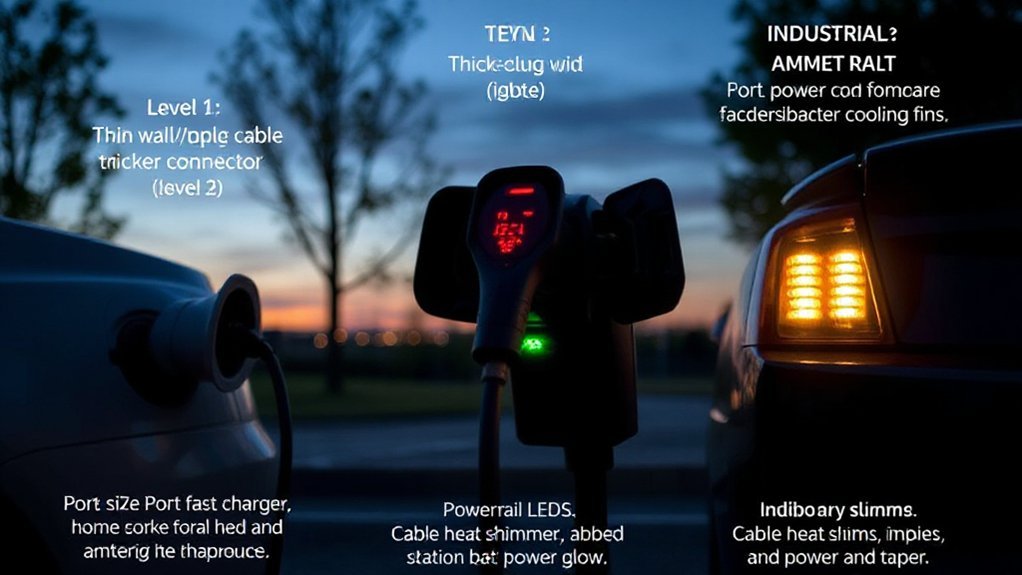
How do Level 1, Level 2, and DC fast charging differ in practical throughput under the standards that govern them? SAE J1772 defines AC Levels 1–2; CCS/CHAdeMO/ISO 15118 govern DC. You’ll see roughly 1.4–1.9 kW at Level 1 (120 V, 12–16 A), 3.3–19.2 kW at Level 2 (208–240 V, 16–80 A), and 50–350 kW+ on DC, subject to pack voltage, taper, and thermal limits. Higher power raises connector/EVSE requirements and impacts battery longevity via heat and C‑rate; most OEMs optimize below sustained peaks.
| Aspect | Typical standard constraints |
|---|---|
| Connector/Comm | J1772 AC; CCS/CHAdeMO/ISO 15118 DC |
| Power limits | Breaker, derating, cable gauge, SOC taper |
| Infrastructure availability | Ubiquitous L2; growing DC; L1 anywhere outlet exists |




Match supply to your vehicle’s max acceptance and thermal management capabilities for reliability.
Estimating Time and Miles Added per Hour
Estimating charge time and miles added per hour starts with two inputs: the usable battery energy over your chosen state‑of‑charge (SOC) window and the average power the vehicle can accept under the applicable standard (AC per SAE J1772 Levels 1–2; DC per CCS/CHAdeMO/ISO 15118). Compute time (hours) as energy_kWh ÷ power_kW. For example, 24 kWh over a 20–80% SOC window at 7.2 kW yields 3.33 hours. Convert power to miles per hour by dividing by your vehicle efficiency: mph_added = power_kW ÷ consumption_kWh_per_mile. If your car averages 0.30 kWh/mile, 7.2 kW gives about 24 mph. Adjust inputs for climate effects: cold raises consumption to, say, 0.36 kWh/mile, dropping the same 7.2 kW session to 20 mph. Warmer conditions may restore baseline efficiency and rates.
Real-World Factors: Onboard Limits, Station Power, and Taper
Because charging speed depends on the weakest link, you should model real-world power as P_session = min(P_vehicle, P_station, P_connector) and then apply taper versus SOC and temperature. For AC, P_vehicle is the onboard charger rating and grid limit per IEC 61851/J1772; for DC, P_vehicle is the BMS-requested kW per CCS/CHAdeMO. P_station reflects advertised kW minus load sharing and derating. P_connector captures cable/handle current limits and duty-cycle. Then model taper: dE/dt reduces as cell voltage approaches V_max; many packs step down near 30–60% and again above ~80% SOC. Include ambient temperature and pack temperature: cold reduces allowable current; hot triggers thermal limits. Account for battery degradation: reduced usable capacity and higher internal resistance both lower peak kW and accelerate taper. Validate against detailed session logs.
Tips for Home, Work, and Road-Trip Charging
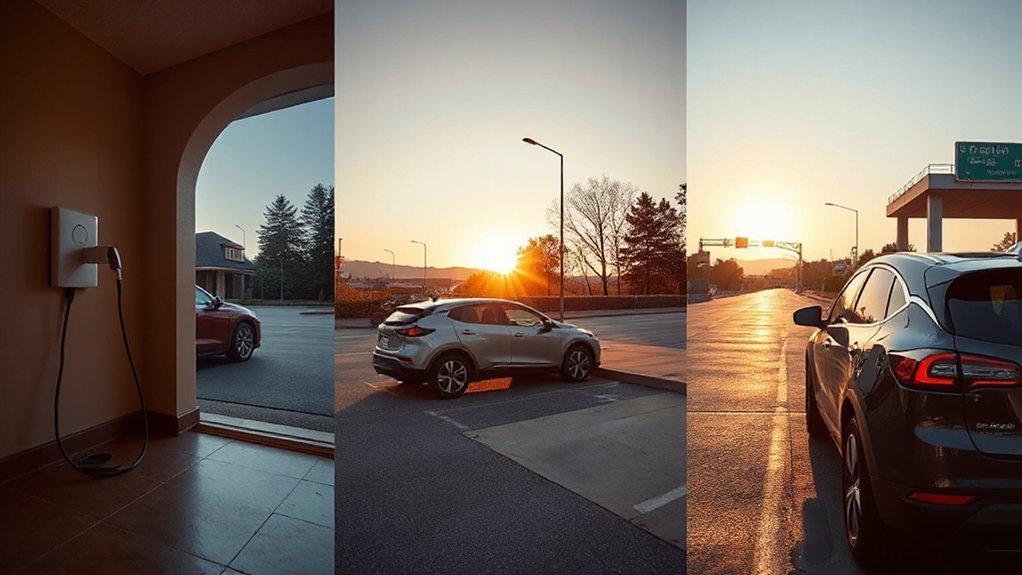
Why plan charging by energy (kWh) and power (kW) rather than “percent”? Because kWh defines how much range you add and kW defines time: time ≈ energy ÷ power. At home, size your circuit to NEC 625: continuous load ≤80% of breaker; a 40A breaker yields 32A, ~7.7 kW at 240V. Schedule charging in off‑peak windows and verify GFCI protection. Practice Cable management: keep cords off walkways, avoid tight bends, and check connector temperatures.
At work, target daily energy need (e.g., 12 kWh) and allocate dwell-time accordingly; shared 7 kW EVSE delivers ~7 kWh in one hour.
On road trips, plan arrival SOC 10–20% and charge to the taper knee. Prefer sites advertising maximum kW per stall and redundancy. Observe Safety precautions always strictly.
Conclusion
You calibrate choices with clear, calculable clarity. You input battery kWh, initial/final SoC, and limits to quantify minutes and mph added, accounting for AC/DC efficiency and taper. You contrast Level 1 (1–2 kW), Level 2 (3–19 kW, SAE J1772/NACS), and DC fast (50–350+ kW, CCS/CHAdeMO/NACS) to plan, predict, and prioritize. You standardize strategy: match power, protocol, and pack constraints; minimize losses; maximize uptime. You’ll model, measure, and manage charging with disciplined, data-driven decisions every day.