
You could wait an eternity—or just minutes—for a charge, depending on the math you use. You’ll estimate time by SOC change × usable kWh ÷ realistic average kW: Level 1 ≈1–2, Level 2 ≈6–19, DC fast ≈50–350 but taper-limited. Account for charging curves, preconditioning, thermal derates, onboard charger caps, and CCS/NACS/CHAdeMO or utility constraints. If you want a precise hh:mm forecast grounded in standards and real curves, here’s how.
Key Takeaways
- Use time ≈ energy to add (kWh) ÷ average charging power (kW).
- Determine energy: usable battery capacity × desired SOC change; account for buffers.
- Know charger power: Level 1 ≈1–2 kW, Level 2 ≈6–19 kW, DCFC 50–350 kW.
- Actual power limited by vehicle/onboard charger, connector, and SOC taper (fast 10–50%, slows above ~60–80%).
- Temperature and station limits affect power; precondition battery and verify station kW to reduce time.
Charger Types and Typical Kw Rates (Level 1, Level 2, DC Fast)
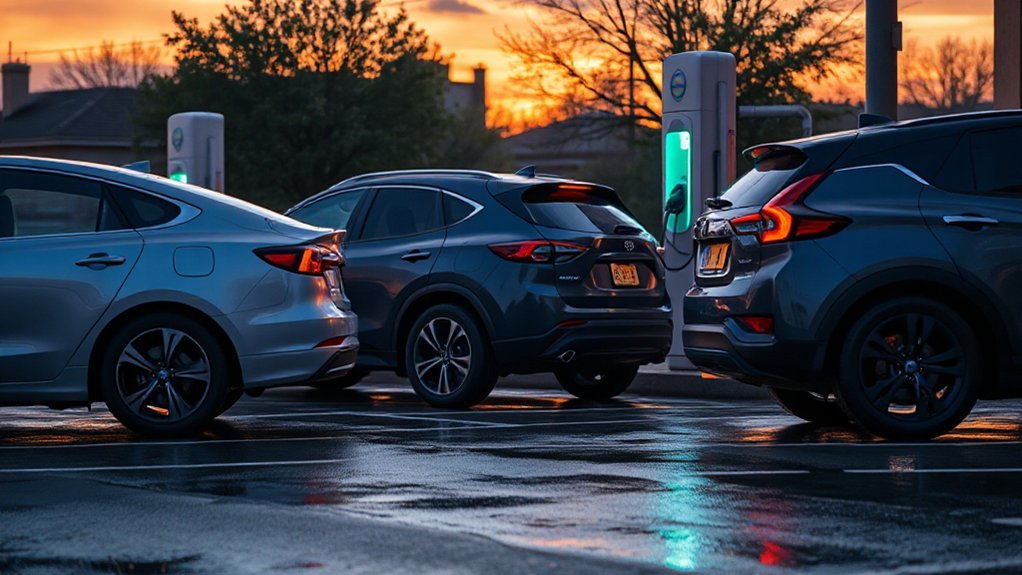
Classifying EV supply equipment by level clarifies expected power throughput. You’ll see Level 1 at 120 V, 12–16 A, delivering about 1.2–1.9 kW via SAE J1772; it’s slow but low Installation Costs. Level 2 uses 208–240 V, typically 30–80 A, yielding 6.2–19.2 kW; homes and workplaces favor it for balanced capacity and manageable wiring. DC Fast Charging (DCFC) bypasses the onboard charger, providing 50–350 kW through CCS, CHAdeMO, or NACS, with site power modules and cooling enabling sustained output. For planning, you should match panel capacity, circuit ratings, and load management requirements to these levels. Evaluate Grid Integration needs—demand charges, smart scheduling, and interoperability (OCPP, ISO 15118)—to optimize operating cost, reliability, and future scalability. Document utility service upgrades and permitting to control project timelines.
What Determines Charging Time: Battery Size, SOC, and Taper
You can estimate charge time as energy to add (kWh) divided by sustained power (kW), so at equal power a 77‑kWh pack takes ~1.5× longer than a 50‑kWh pack. SOC drives allowable C‑rate: from ~10–50% SOC many EVs hold peak power, then above ~60–80% the BMS tapers current to meet cell voltage and thermal limits. Standards and protocols (IEC 61851, ISO 15118, CCS) and OEM charging curves govern that taper, so your average power—and therefore time—depends on your start/stop SOC.
Battery Capacity Impact
Although peak kW headlines grab attention, charging time is fundamentally set by energy and power: time ≈ energy added (kWh) ÷ average charging power (kW). Bigger usable capacity means more kWh to replenish per mile, even when two vehicles share the same charger rating. You should account for pack buffers, nominal versus usable kWh, and auxiliary loads. Higher energy density cells can shrink mass but not the kWh you must replace. Degradation patterns reduce usable capacity over time, subtly shortening sessions for the same arrival state.
- Validate usable capacity: consult EPA/UNECE standards data and BMS readouts.
- Estimate energy needed: trip kWh = distance × consumption (kWh/mi or kWh/100 km).
- Compute time: charging minutes = (energy needed ÷ average kW) × 60.
SOC and Taper Effects
Because charging power varies with state of charge (SOC), taper—not peak kW—sets how long a session takes. Most packs follow a CC–CV profile: you see near-constant power at low-mid SOC, then current limits rise to voltage limits and power tapers as you approach 80–100%. Actual time equals the integral of P(SOC) over your target window. You influence it by arriving warm and low (e.g., 10–60%); you can’t beat BMS limits driven by cell impedance, temperature, and safety margins.
Standards matter: IEC 61851 and ISO 15118 govern negotiation of current, voltage, and limits; UL 2580 and OEM specs constrain taper. Demand Algorithm Transparency in apps: show the expected P(SOC) curve, not just peak kW. This improves User Perception, planning accuracy, and station utilization and grid efficiency.
Vehicle and Connector Limits: Onboard Chargers, CCS/NACS/CHAdeMO
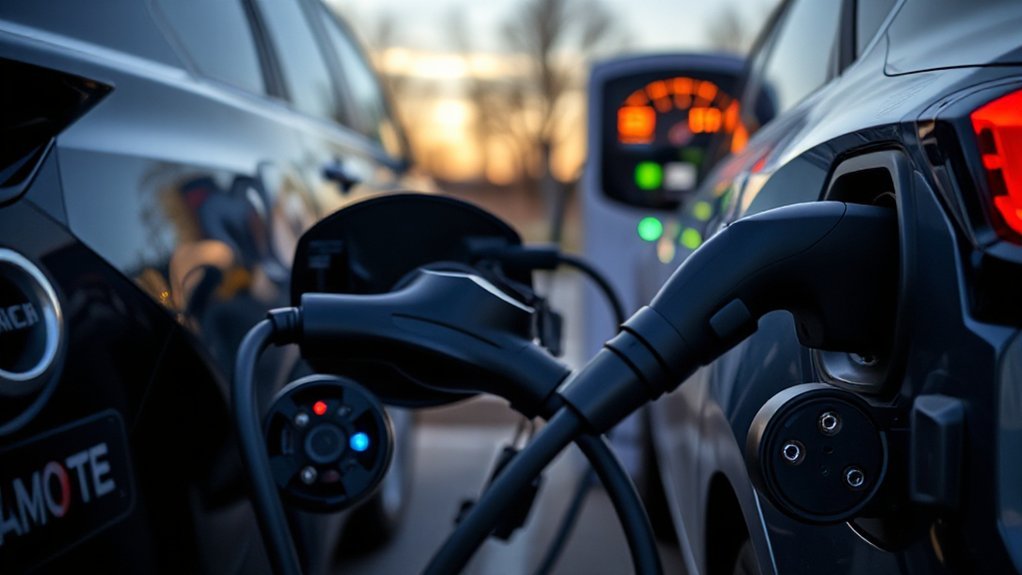
While the EVSE may advertise a headline kW, the actual charge rate is capped by both the vehicle’s power electronics and the connector standard’s voltage/current envelope.
Headline kW isn’t real throughput—vehicle electronics and connector envelopes cap charging power.
- Onboard AC charger: You’re limited by the inverter’s kW rating (e.g., 7.2 kW single-phase, 11–22 kW three-phase) and the grid phase available. Connector compatibility (J1772/Type 2) and Protocol security (IEC 61851, ISO 15118) govern negotiation and safety.
- DC fast charging: The pack’s max voltage and allowable charge current set the ceiling. CCS and NACS typically support 400–1000 V, up to 500 A; CHAdeMO often 400–500 V, ~125–200 A.
- Thermal and cable limits: Station cables, vehicle busbars, and contact resistance drive derates. Liquid-cooled leads sustain higher currents; overheated hardware triggers real-time current reductions.

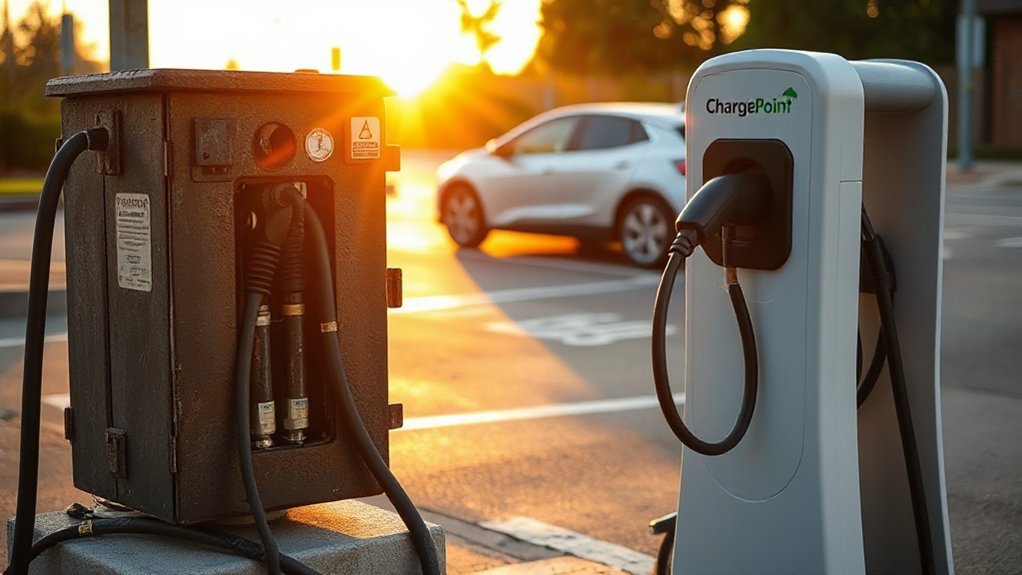
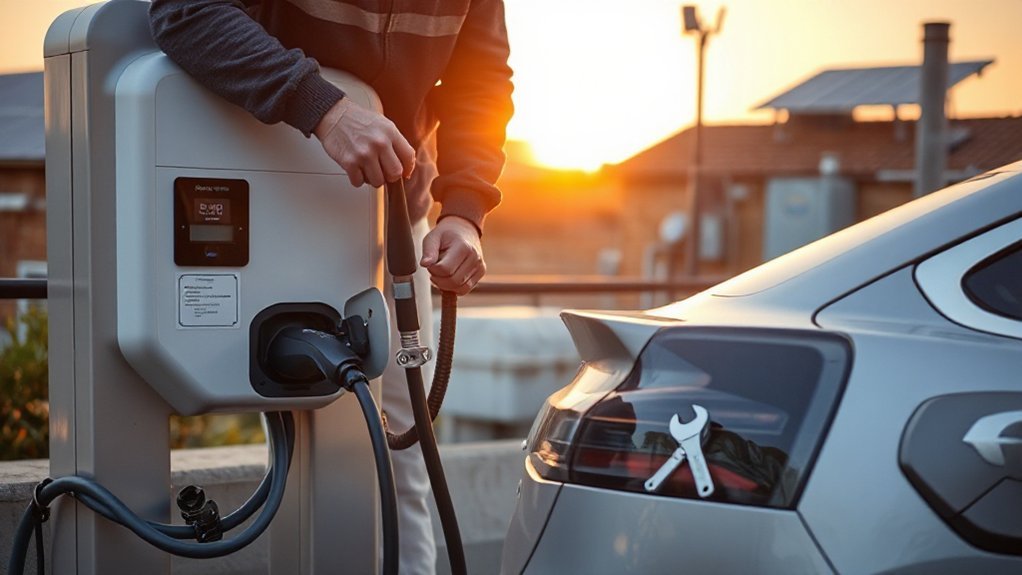

Firmware limits further constrain session power.
Step-by-Step Method to Estimate Hours and Minutes
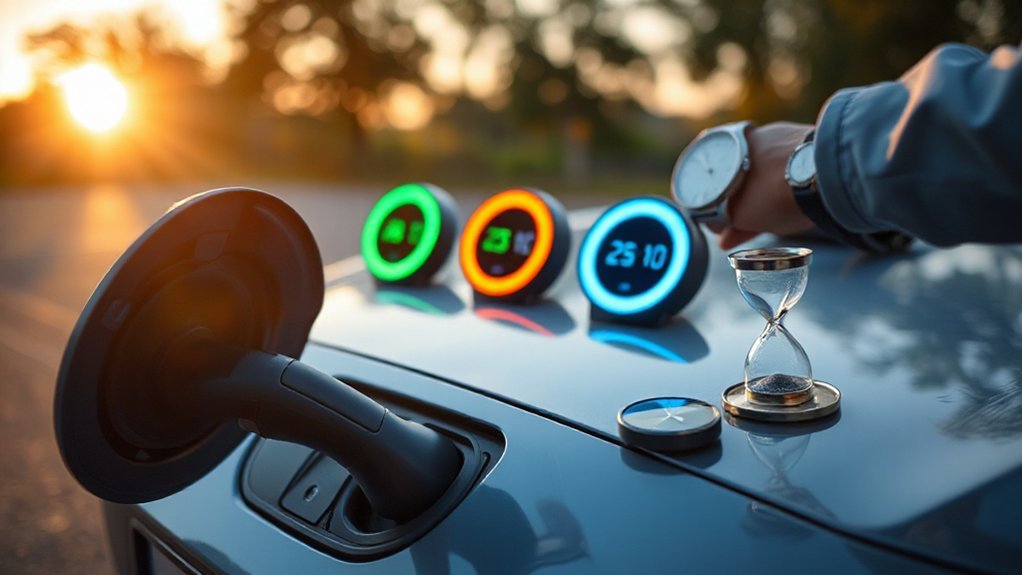
Start by defining the energy to add and the average power the session can sustain. Determine usable battery capacity, target state-of-charge delta, then compute energy (kWh = capacity × ΔSOC). Obtain average charging power considering limits and taper; use measured logs or manufacturer curves. Time (h) = energy (kWh) ÷ power (kW). Apply Unit Conversion for minutes: minutes = fractional hours × 60. Use Rounding Rules: round power and energy to significant digits consistent with IEC 60050 and display minutes to the nearest whole. Present both hours and hh:mm. Validate with a check: power × time ≈ energy. Document assumptions and precision.
| Input Parameter | Example Value (calc) |
|---|---|
| Usable capacity nominal | 75 kWh |
| ΔSOC range | 20% to 80% target |
| Average power session mean | 90 kW |
Real-World Scenarios: Home, Workplace, and Road Trip Stops
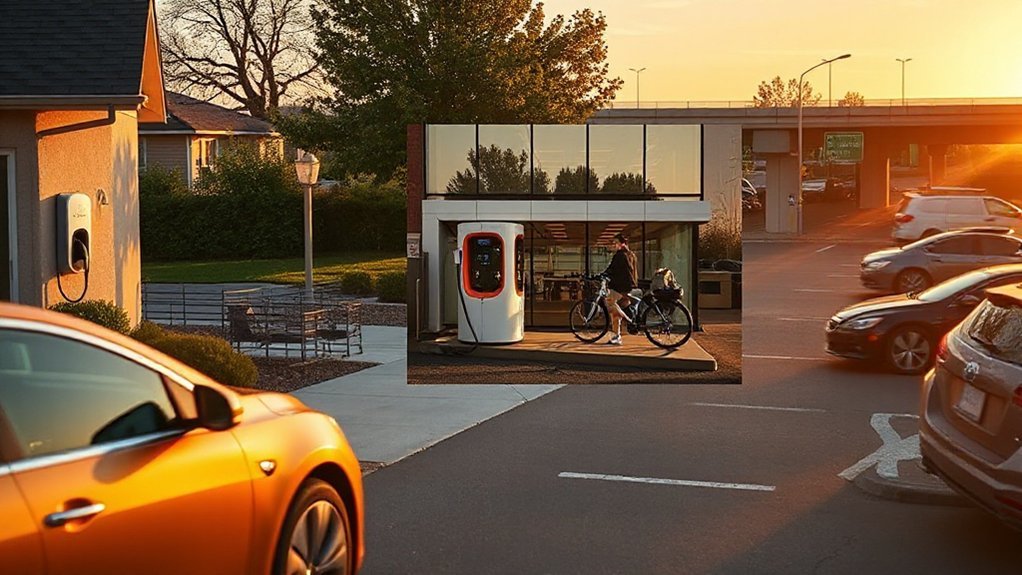
You size overnight home charging using Level 2 (SAE J1772/NACS) at 7.2–11.5 kW, adding ~7–12 kWh per hour (≈21–45 miles/hour at 3–4 mi/kWh) so you return to 80–100% by morning. On road trips, you plan fast stops on DCFC (CCS/NACS) rated 150–350 kW, but you assume an effective 70–150 kW from 10–80% SOC due to charge taper and thermal limits. For a 77 kWh usable pack, you’ll take in ~54 kWh from 10–80% in ~15–30 minutes at 150–250 kW, while 8 hours on Level 2 adds ~60–90 kWh at 7.2–11.5 kW.
Overnight Home Charging
At home, “overnight” typically means 8–12 hours on AC, where charge rate is limited by your circuit, EVSE, and onboard charger per SAE J1772/NACS and NEC continuous-load rules (80% of breaker rating). On a 240 V, 40 A breaker, you’ll charge at 32 A (~7.7 kW); on 60 A, 48 A (~11.5 kW) if your onboard charger supports it. A 120 V, 15 A circuit yields ~1.4 kW.
1) Size it: kWh added ≈ power (kW) × hours × 0.90. Example: 7.7 kW × 10 h ≈ 69 kWh.
2) Specify hardware: J1772/NACS connectors, NEC 625 load calcs, UL-listed EVSE, GFCI, load sharing, and cable ratings.
3) Plan install: installation aesthetics, conduit paths, wall vs pedestal, permit processes, HOA, TOU rates, 80 A ready.
Road Trip Fast Stops
While home charging is about energy over hours, road‑trip fast stops are about instantaneous power and charge curves: DC fast charging (DCFC) via CCS1 or SAE J3400/NACS typically offers 150–350 kW per stall, constrained by site cabinet limits, cable ratings, and your pack’s voltage/thermal envelope.
You’ll add energy fastest between 10–60% SOC; above ~60% taper follows the cell’s CCCV profile. Precondition to reach peak kW. 400 V packs often cap near 200–250 kW due to 500 A cables; 800 V can approach 350 kW on 1000 V sites. Expect 3–7 kWh/min early. Confirm power sharing, uptime, and ISO 15118 Plug & Charge; OCPP sites expose telemetry. Plan stops by Scenic Stops or Local Dining so a 10–20 minute dwell matches charger’s curve and needs.
Temperature, Preconditioning, and Charging Curve Behavior
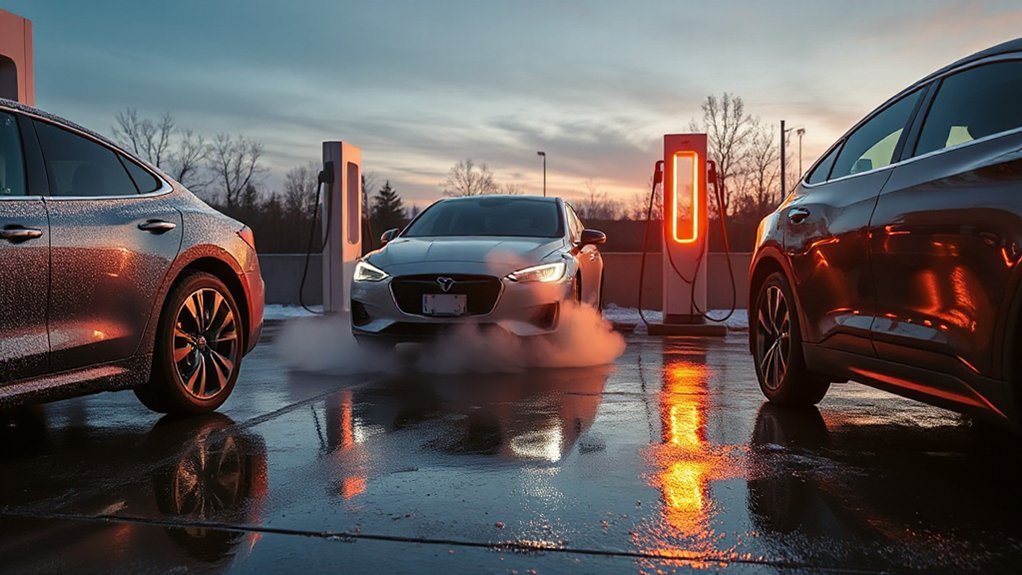
Because lithium‑ion electrochemistry is temperature‑dependent, pack temperature—more than ambient—governs achievable charge power and the shape of the charging curve. Peak kW occurs when you keep cells within the BMS’s ideal window (~25–40°C). Below that, internal resistance rises; above it, safeguards taper current to protect longevity. Preconditioning uses the traction inverter and coolant loops to heat or cool the pack before arrival, reducing time-to-peak and smoothing the constant-current phase. Accurate Thermal Modeling and Software Optimization align pack temperature with charger capability (CCS, NACS).
- Monitor inlet, cell, and coolant temps; target advertised current without exceeding voltage ceilings.
- Trigger preconditioning via navigation waypoints; verify pack hits setpoint before plug-in.
- Interpret curves: expect a high-current ramp, a plateau, then SOC-based taper near 50–60% under load.
Planning Strategies to Reduce Stop Time and Avoid Queues
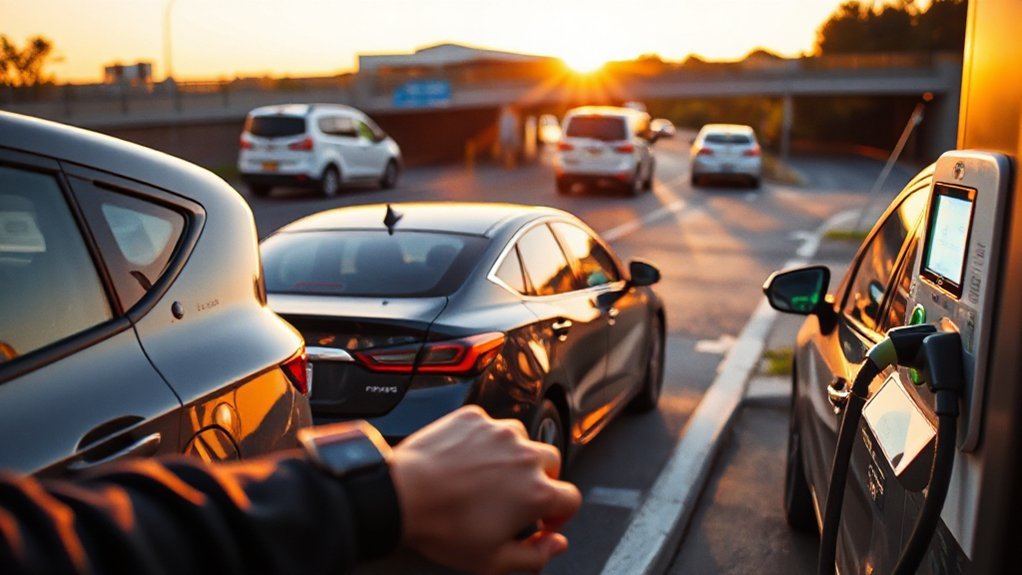
Optimizing pack temperature is only half the equation; plan stops using live network telemetry and charger capabilities to minimize dwell and avoid queues. Query station utilization, connector availability, and power derates via OCPP/OCPI feeds; prefer sites with >150 kW dispensers and <40% occupancy. Align arrival SOC to hit the charger’s peak window, then depart at the knee of your curve. Use ISO 15118 Plug&Charge to cut session overhead, and preauthorize in-app to avoid failed handshakes. Model contingency nodes within your departure windows, weighting by historical uptime and mean-time-to-repair. Observe reservation etiquette: book only when supported and release promptly. Stagger meals and restrooms off-peak, and select hubs with redundant stalls and split cabinets to mitigate pairing conflicts. Favor sites reporting real-time wait estimates and pricing.
Conclusion
You’ve seen how charging speed hinges on kW, usable kWh, SOC window, and taper. Apply the method: kWh to add ÷ realistic average kW = hh:mm. Account for SAE J3400/NACS, CCS, CHAdeMO limits, onboard charger ratings, and preconditioning. One striking stat: on DC fast, most drivers add 10–80% in 20–40 minutes because average power typically lands at 40–65% of the station’s nameplate. Plan stops to arrive warm and low SOC, avoid queues, and minimize dwell.