
You might test the theory that a “150 kW” charger always gives you the fastest session. You manage kW, but your pack accepts amps until the BMS tapers near high SoC or cold temps. Rate also caps at vehicle and connector limits (CCS/NACS), and site sharing matters. Convert kW to mph only with usable kWh, start/target SoC, and losses. See how our calculator and taper‑aware comparison chart reshape the timeline and cost.
Key Takeaways
- Distinguish kW vs kWh; convert charger power and vehicle consumption to miles per hour (W ÷ Wh/mi).
- Charging time ≈ usable battery kWh ÷ average kW, adjusted for 5–12% losses; larger packs take longer.
- SoC-dependent taper limits peak power above ~60–80% SoC; model CC–CV curves for realistic time estimates.
- Levels: L1 ~1.4–1.9 kW (3–5 mph), L2 6–19 kW, DC fast 50–350 kW but vehicle/site limits dominate.
- Calculator inputs: usable kWh, start/target SoC, charger/station limits, efficiency, ambient; outputs: minutes, energy added, average kW, cost estimates.
What Kw Means and How It Translates to Miles per Hour
Clarity starts with units: kilowatt (kW) is power—the rate of energy transfer—and in charging it equals kilowatt-hours per hour delivered to the battery. You read kW as Instantaneous power at the EVSE output per SAE J1772/IEC 61851. To translate kW to charging miles per hour, you’ll divide power by your vehicle’s energy consumption (Wh/mi) measured on the EPA label or onboard telemetry. Example Conversion method: charging at 11 kW with an efficiency of 300 Wh/mi yields 11,000 W / 300 Wh/mi ≈ 36.7 mi/h. For DC, apply the same ratio; display kW is net to the pack in most standards-compliant logs. Distinguish kW (rate) from kWh (quantity). Use ISO 15118 or OCPP metrology data to verify readings. Prefer averaged readings over spiky sampling windows.
Battery Size, State of Charge, and Charging Time
You estimate charging time as usable battery capacity (kWh) divided by average charge power (kW), bounded by vehicle and EVSE limits per SAE J1772/CCS and IEC 61851. At a fixed power, you’ll see a 77‑kWh pack take ~54% longer than a 50‑kWh pack; higher allowable C‑rates or higher max charge power can offset this. State of charge drives taper: expect near-peak power from ~10–50% SoC, then stepped reductions above ~60–80% to protect cells, so you plan faster sessions in the mid band.
Battery Size Impact
Most charging times boil down to pack energy (kWh), usable state-of-charge window, and the vehicle’s allowable charge power across its curve. Bigger packs store more energy, so you’ll add more kWh for the same percent change. At a fixed charger rating, time scales roughly with pack size: time ≈ energy added (kWh) ÷ effective charge power (kW), adjusted for losses (5–12%). With identical chemistries, a 100‑kWh pack at 150 kW typically needs about 40–55 minutes to add 70 kWh; a 60‑kWh pack needs 25–35 minutes for 40 kWh. Larger packs can reduce deep cycling, supporting Battery longevity, but they carry mass penalties that increase energy per mile and Environmental footprint. Right-size your battery to your daily load profile, leaving margin for aging reserve.
State-Of-Charge Effects
Beyond pack size, state of charge (SoC) governs instantaneous charge power and the time integral to reach a target. At low SoC, most packs allow constant-current charging near the site or vehicle limit; as SoC rises, the BMS tapers to protect cell voltage and thermal margins. You should model a CC–CV curve, not a flat kW rate, to predict minutes added per percent.
Standards matter: IEC 61851 and SAE J1772 define AC limits; CCS/ISO 15118 handshake negotiates pack constraints; implementations vary by chemistry and temperature. Displayed SoC depends on gauge calibration and buffer windows, so “10–80%” may mean 5–85% actual. Accurate SoC handling reduces range anxiety and yields realistic arrival times, energy costs, and charger dwell planning. Integrate kW over SoC to estimate kWh.
Why Charging Tapers Near Full

As the pack approaches a high state of charge (SoC), the battery management system switches from constant‑current to constant‑voltage control to keep cell voltages within chemistry‑specific limits (e.g., ~4.2 V/cell for NMC, ~3.65 V/cell for LFP), which inherently forces charge current to taper. Internal resistance rises with SoC, so voltage headroom shrinks and you see declining amperage to avoid lithium plating. Thermal limits and safety margins drive the BMS to modulate current per IEC 61851 and UN 38.3 test assumptions. Manufacturer policies may also reserve a buffer above displayed 100% to preserve cycle life.
| Parameter | Effect | Control response |
|---|---|---|
| Cell voltage | Approaches upper limit | Hold voltage, reduce amps |
| Temperature | Rises under high IR | Cut current, increase cooling |
| Degradation risk | Plating/SEI stress | Enforce taper window |



Predictable.
Level 1 vs. Level 2 vs. DC Fast: Real-World Speeds
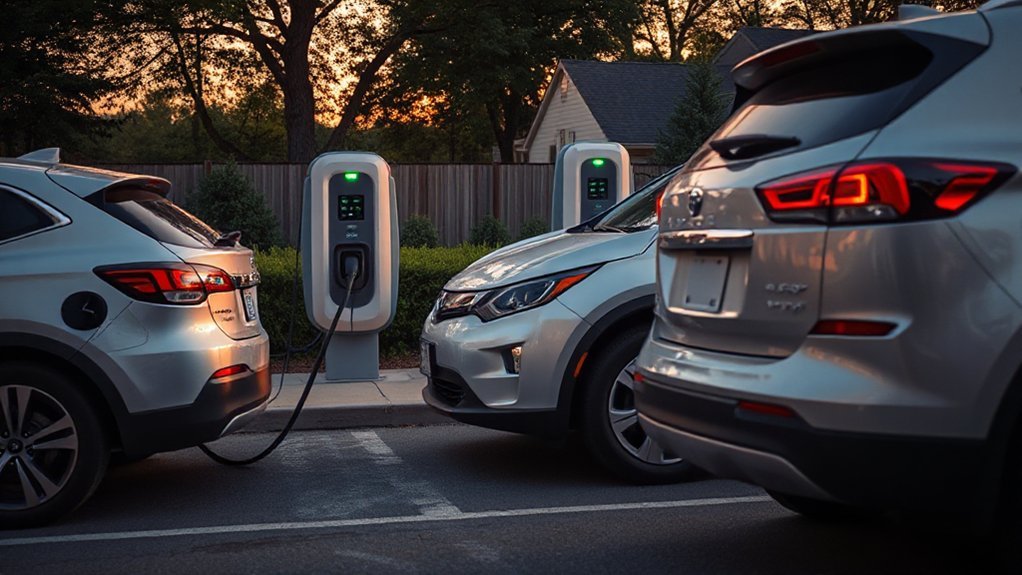
While spec-sheet power looks straightforward, real-world EV charging speed depends on the interface standard, available voltage/current, and your vehicle’s limits. Level 1 (120 V, 12–16 A) yields 1.4–1.9 kW, about 3–5 miles per hour. Level 2 on 208–240 V delivers roughly 6–19 kW; you’ll see 208 V workplaces charge slower than 240 V homes. DC fast charging (CCS/NACS/CHAdeMO) lists 50–350 kW, but site capacity, shared cabinets, cable cooling, and ambient heat limit output. Larger sites modulate power to reduce grid impact and demand charges, shaping throughput and pricing variability.
Spec sheets mislead: interface, supply, vehicle limits and site conditions dictate real charging speed.
- Standards: J1772 for AC; CCS/NACS for DC; CHAdeMO in legacy sites.
- Supply: 208 vs 240 V, breaker size, and NEC derating define kW.
- Cost: session fees, time-of-use, demand pricing, and idle fees.
Vehicle and Charger Limits That Cap Your Rate
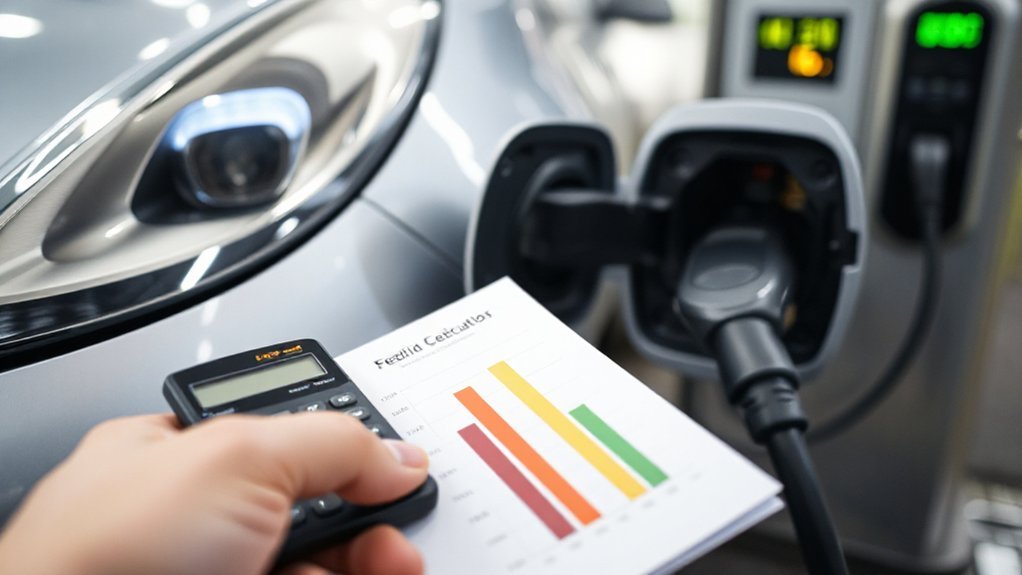
Even at a high-kW station, your charge rate caps at the lowest limit across the vehicle, connector, and site. Your car’s onboard AC charger sets the ceiling on Level 1 and 2 (e.g., 7.2 kW at 240 V/30 A). On DC, the BMS enforces a charge curve: a peak power bounded by max pack voltage and allowable current (e.g., 400 V × 300 A = 120 kW). Connector and cable ratings matter: CCS/NACS pins and liquid-cooled leads may allow 500 A; CHAdeMO versions cap lower. The EVSE may derate via Firmware throttling for cable temps or contact resistance. Site hardware and Grid constraints cap power: limited transformer kVA, power-sharing across stalls, or ISO/utility curtailment. Standards (IEC 61851, ISO 15118, SAE J3400) govern limits negotiation.
Temperature Effects and Preconditioning
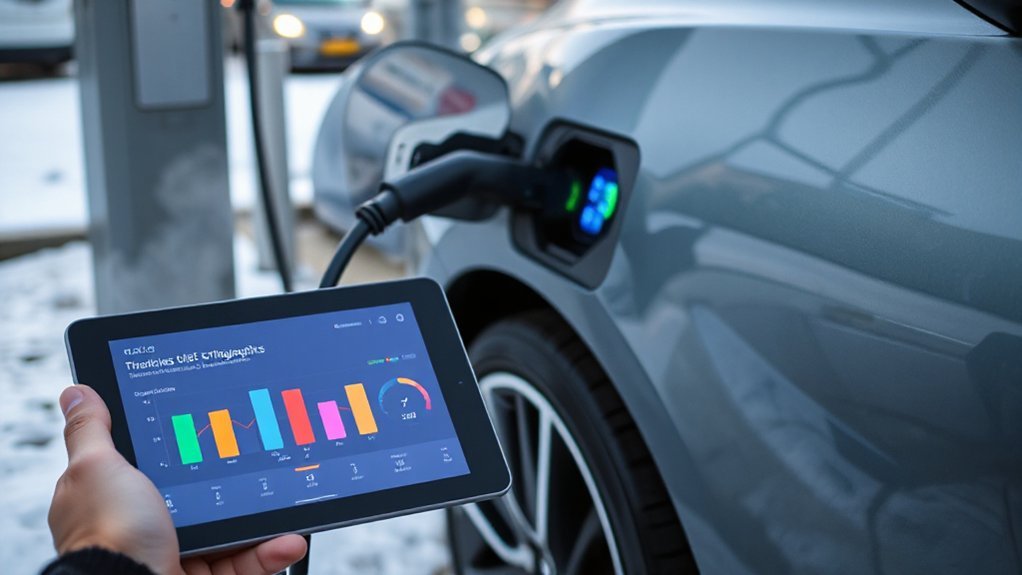
Because electrochemical kinetics slow in cold cells and internal resistance rises, battery temperature strongly dictates your achievable charge power. BMS algorithms gate current until pack temps reach ideal ranges (typically 25–40°C). Below 10°C, you may see the taper start early and peak power cut by 30–60%. Use preheat scheduling before fast stops; most vehicles heat the pack en route using waste heat or resistive elements, improving C‑rate without exceeding lithium plating thresholds. At home, garage insulation and overnight Level 2 charging keep the pack warm and reduce preconditioning energy.
- Target inlet temps: 30–35°C for NMC; 40–45°C for LFP in winter to avoid plating.
- SAE J2929, IEC 62660 guidance: prioritize temperature limits over time-to-80%.
- Monitor delta-T across modules; >5°C spreads trigger current derate during charging.
Connector Types and Compatibility
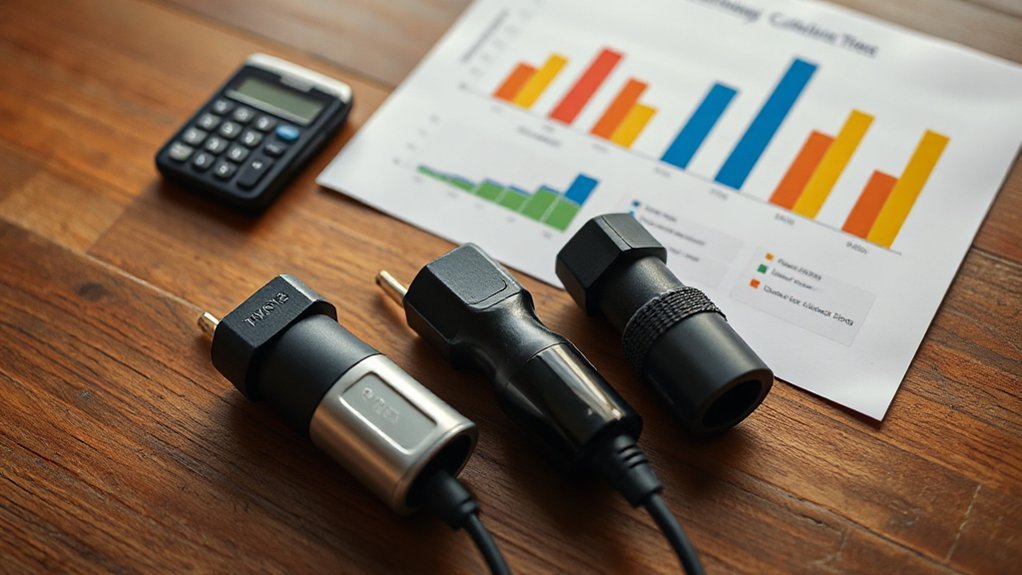
You need to distinguish AC vs DC connectors: AC (SAE J1772 Type 1, IEC 62196-2 Type 2) typically delivers 3.3–22 kW, while DC fast charging (CCS1/CCS2 per IEC 62196-3, CHAdeMO, NACS/SAE J3400) supports ~50–350+ kW depending on station and vehicle limits. Your vehicle’s port standard (e.g., J1772+CCS1, Type 2+CCS2, NACS/J3400, CHAdeMO, GB/T) sets the physical pinout and comms (IEC 61851, ISO 15118), gating allowable voltage/current and peak power. Verify compatibility and adapter constraints, since adapters can cap power or omit features (e.g., Plug & Charge), directly affecting charging speed.
AC Vs DC Connectors
How do AC and DC connectors shape charging speed and cross-compatibility? AC connectors (per IEC 61851/62196) deliver onboard-charger-limited power—typically 3.3–22 kW, up to 43 kW legacy—using single or three phase. DC connectors (per ISO 15118/IEC 61851-23/24, CCS/CHAdeMO/GB/T) bypass the onboard charger and scale to 50–500 kW+ with 200–1000 V architectures. You’ll see faster sessions with DC because current and voltage are negotiated directly with the rectifier. Cross-network operability depends on common signaling, Safety Standards, and Cable Durability under high current, not just plug shape.
- AC: thinner cables, passive cooling; typical 16–32 A continuous; lower connector mass reduces wear.
- DC: liquid-cooled cables support 300–500 A; temperature sensing enables higher duty cycles.
- Communication: PLC or CAN enables metering, isolation checks, and fault clearing.
Vehicle Port Compatibility
Charging capability hinges on the vehicle’s inlet standard, which fixes pinout, voltage/current limits, and the communication stack the car can speak. You must match the inlet to the site’s coupler: J1772 for North American AC, Type 2 for EU AC, CCS1/CCS2 for DC combo, NACS for Tesla/North America, and CHAdeMO on legacy models. Verify max current and pack voltage so the charger negotiates safe amps. Port placement dictates cable reach and allowable stall orientation. Lock mechanisms vary: motorized inlet latches (CCS), Tesla/NACS actuator pins, or manual locks; they affect plug retention and theft resistance. Check adapter allowances: J1772-to-NACS works AC; DC adapters depend on certified signaling. Firmware revisions matter—older CHAdeMO may cap power. Always confirm connector class in the car’s specs before trip planning.
Charge Time Calculator and Comparison Chart

Why guess at EV charge time when a calculator can model it with standard-conformant inputs and loss factors?
Feed it usable battery capacity, SoC window, onboard-charger limit, and station kW. It applies IEC 61851/SAE J1772 and a tapered curve to estimate AC and DC time. With API integration to OCPP/ISO 15118, you’ll pull live capabilities while preserving user privacy. Use the comparison chart to benchmark L1, L2, and DC fast, normalized to net kWh. Voltage/current limits and ambient temperature inform derating, realism, and accuracy.
Standards-based EV charge modeling with tapered curves, OCPP/ISO 15118, and L1–DC comparisons
- Required inputs: usable kWh, start/target SoC, max AC kW, DC peak kW, cable limit.
- Assumptions: 90–98% AC efficiency, 2–8% DC overhead, taper near 50–70% SoC.
- Outputs: minutes, energy added, average kW, cost via tariff API, standards violations.
Conclusion
You now understand how kW translates to mph, why usable kWh, SoC, and BMS limits set charge time, and how taper, temperature, and site constraints shape rates. Use the calculator to input usable kWh, start/target SoC, charger/vehicle caps, and efficiency to get minutes and net kWh. Compare Level 1/2/DC fast with the chart normalized to kWh. As the adage goes, measure twice, cut once—plan to standards (SAE J1772, CCS, IEC 62196) and you’ll charge smarter.