
By coincidence, your timing aligns with falling equipment prices, but EV charging franchises still demand rigor. You’ll budget $25k–$75k for franchise fees, $1k–$6k per Level 2 port (plus $4k–$12k install) or $30k–$160k+ for DC fast chargers ($40k–$100k+ install), utility upgrades of $30k–$200k, 10%–20% contingencies, and ongoing 4%–8% royalties and 1%–3% marketing. Permitting, networking, and uptime SLAs shape ROI. Yet the lever that decides payback is…
Key Takeaways
- Initial franchise fee typically $25,000–$75,000, plus training, site-approval, and software onboarding charges.
- Ongoing royalties run 4%–8% of gross revenue, with marketing fund 1%–3% and potential per‑kWh or per‑port fees.
- Capital costs vary: Level 2 $1,000–$6,000 per port plus $4,000–$12,000 install; DCFC $30,000–$160,000 plus $40,000–$100,000 install, utilities $30k–$200k.
- Recurring OPEX: software $10–$30 per port/month, connectivity $8–$25/month, field maintenance $300–$600 per visit; higher-tier features can lift revenue 5%–12%.
- Stack incentives to reduce capex 30%–70%; typical payback targets: Level 2 in 3–5 years, DC fast charging in 5–8 years.
Franchise Fees and Brand Requirements

While fee structures vary by brand, expect an initial franchise fee of roughly $25,000–$75,000, ongoing royalties of 4%–8% of gross revenue (or a per-kWh/port fee), and a 1%–3% marketing fund—costs that directly affect payback and EBITDA margins. You’ll also see training, site-approval, and software-platform fees, plus required local marketing spend. Study Brand Guidelines, because signage, pricing displays, and app standards drive capex and operating procedures. Lock in Territory Rights with clear radius, carve-outs, and performance thresholds to protect utilization. Scrutinize renewal, transfer, and termination fees. Model royalties, support assessments, and HQ audit costs against forecast sessions and uptime SLAs. Confirm data-reporting obligations, ADA compliance, insurance minimums, and utility-permit timelines. Negotiate KPIs and remediation windows to preserve ROI. Document incentives and liquidated damages before signing.
Hardware Options and Price Ranges (Level 2 vs. DC Fast)

Because site economics hinge on hardware choice, you should size Level 2 versus DC fast by power, capex, and expected throughput. Level 2 (7 to 19 kW) suits dwell-time sites; units run $1,000–$6,000 per port, with modest maintenance and OCPP networking. DC fast (50 to 350 kW) captures en-route demand; cabinets cost $30,000–$160,000+, with higher service plans. Match Power Density to dwell time, turnover, and pricing strategy. Standardize Connector Types (J1772, CCS, NACS, CHAdeMO legacy) to maximize utilization and eligibility for incentives. Verify metrology, ADA, and cybersecurity certifications to avoid retrofit risk.
Size Level 2 vs DC fast by power, capex, throughput; standardize and certify
- Target payback: Level 2 3–5 years; DCFC 5–8.
- Throughput model: sessions, kWh, dwell, price tiers assumptions.
- Reliability SLA: 97–99% uptime protects revenue and incentives.
- Plan modularity for future Power Density, Connector Types.
Installation, Utility Upgrades, and Permitting Costs
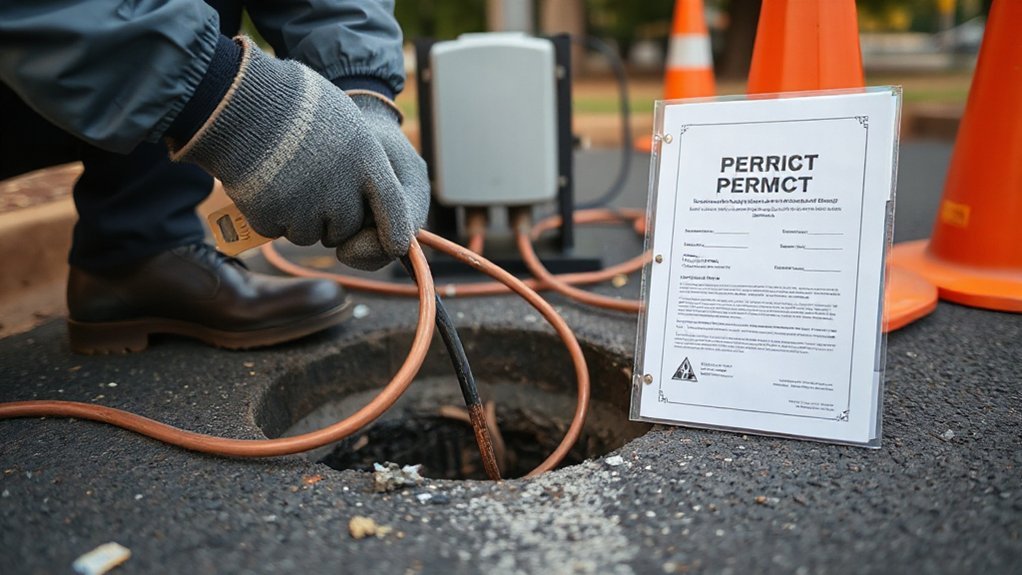
You’ll budget for installation labor and materials—trenching, conduit, wiring, panels, and bollards—typically $4,000–$12,000 per Level 2 port and $40,000–$100,000+ per DC fast charger, depending on site conditions. You should factor permitting, inspections, and utility interconnection fees and timelines, which can add $1,000–$10,000 and 4–12 weeks, with make-ready incentives offsetting 30%–100% where available. Align scopes with NEC, ADA, and utility standards to avoid change orders, shorten time-to-revenue, and protect ROI.
Installation Labor and Materials
Budgeting for installation labor and materials drives your EV charging franchise’s ROI. Focus on crew efficiency, code-compliant workmanship, and durable parts that minimize callbacks. Every hour saved and failure avoided compounds revenue uptime.
- Scope labor: certified electricians, trenching, coring, mounting; benchmark 35–55% of installed cost for Level 2, 25–40% for DC fast.
- Buy right-sized panels, conduit, wire, pedestals, and Cable Management to cut waste and speed installs; standardized SKUs reduce delays and scrap 5–10%.
- Prioritize Safety Gear, lockout/tagout kits, GFCI breakers, and labeled disconnects; OSHA/NFPA 70E compliance lowers incident risk and avoids costly downtime.
- Schedule commissioning, firmware, and load tests during installation; document torque values, insulation resistance, and as-builts to pass QA and maximize uptime.
Track KPIs per site to refine future bids accurately.
Permitting and Utility Upgrades
While permits and utility upgrades don’t sell a single kWh, they set your project’s critical path, capex, and operating costs.
Budget permit fees at $5k–$50k per site, plus plan review and inspections. Utility upgrades drive swings: new service, transformer, and switchgear can add $30k–$200k, with 6–18 month lead times. Demand charges and transformer sizing influence lifetime ROI as much as hardware.




Engage the utility early: submit load letters and interconnection applications; verify make-ready incentives. Map zoning, ADA, and right‑of‑way requirements; some jurisdictions require Public hearings. Track Policy changes affecting fire codes.
To compress schedules, run design, permitting, and procurement in parallel, and secure easements upfront. Carry a 10–20% contingency for trenching surprises and utility scope creep; missed dates escalate labor, damages, and lost revenue.
Software, Networking, and Ongoing Operating Expenses

You’ll quantify software licensing fees (per-port or per-session) against transaction revenue, payment processing, OCPP interoperability, and performance reporting to protect margin. You’ll budget network connectivity (LTE/5G or Ethernet) with redundant SIMs and encrypted traffic to meet PCI DSS and privacy requirements while controlling $/GB per kWh or session. You’ll set maintenance and remote monitoring SLAs to sustain 97–99% uptime, cut truck rolls via OTA updates, and reserve a fixed percent of gross for parts and labor to stabilize payback.
Software Licensing Fees
Most EV charging franchises incur recurring software and networking fees that materially affect unit economics and compliance. You’ll license the management platform that runs pricing, access control, payments, and OCPP monitoring; negotiate License Tiers and Usage Caps to align fees with throughput and uptime targets.
- Pricing model: per-port/month ($10–$30) plus transaction fees (1%–3%); model cash margin impact by session volume.
- Feature bundles: demand-response, dynamic pricing, and fleet tools can lift revenue 5%–12% when utilized.
- Compliance: PCI, SOC 2, and data-retention settings add costs but reduce audit and chargeback risk.
- Scalability: APIs, white-label, and multi-site dashboards cut labor hours 15%–25%, improving EBITDA.
Audit invoices quarterly, benchmark vendor SLAs, and renegotiate when utilization shifts to protect ROI. Document terms and renewal dates.
Network Connectivity Costs
Budgeting for network connectivity means quantifying the recurring costs that keep chargers online and compliant: carrier data plans ($8–$25/SIM/month for LTE; $20–$40 for 5G), pooled data to avoid overages ($10/GB if exceeded), static IP/VPN or private APN ($5–$15/site), and remote monitoring tools ($1–$3/port).
To maximize ROI, you should benchmark usage per port (typical 50–200 MB/month on OCPP) and right-size plans. Use carrier negotiation to lock multi-year rates, zero-rating for firmware traffic, and roaming riders for rural coverage. Enable data aggregation across sites to pool allowances and cut variance. For high-traffic corridors, provision dual-SIM failover (+$2–$4/month) to protect transactions and uptime SLAs. Budget for compliance: encrypted tunnels, audit logs, and penetration tests from vendors. Reconcile invoices monthly; dispute overages and throttle telemetry when thresholds trigger.
Maintenance and Monitoring
While hardware gets the headlines, maintenance and monitoring drive day‑to‑day ROI by protecting uptime, payments, and compliance. You’ll budget for software licenses, remote diagnostics, cybersecurity, and SLAs that guarantee response times. Routine Inspections minimize outages and warranty risk; Technician Certification reduces liability and speeds first‑time fixes. Expect 24/7 network monitoring to flag faults, payment failures, and load‑balancing issues before revenue suffers.
- Software/Cloud: $15–$40 per port/month for OCPP, analytics, billing, and firmware.
- Networking: $8–$20 per site/month for SIMs, VPNs, static IPs, redundancy.
- Field Ops: $300–$600 per visit for Routine Inspections, calibration, and cleaning.
- Compliance: $500–$2,000 annually for Technician Certification, meter tests, and PCI.
Bundle these services in multi‑year contracts, target 98–99.9% uptime, and tie bonuses to SLA adherence for predictable cash flow and higher margins.
Incentives, Grants, and Financing Strategies

A well-structured incentives stack can cut your upfront EV charging capex by 30–70% and de-risk cash flow. Layer federal and state tax credits, utility make-ready support, and targeted local grants. Prioritize programs with stackability, milestone-based disbursements, and prevailing-wage rules so you stay compliant and fundable.
Map eligibility: site host type, charger power, location, and network requirements. Use community partnerships to access Justice40, brownfield, and corridor funds, while strengthening permitting and public buy-in. Pre-qualify vendors that meet Buy America, NEVI uptime, and cybersecurity standards.
Close remaining gaps with financing: low-interest green banks, C-PACE for equipment and installation, utility on-bill repayment, and leases or PPAs that shift capex to opex. Model draw schedules against grant timelines to minimize carry costs and avoid costly clawbacks and delays.
Revenue Models, Utilization, and ROI Planning

With incentives lowering capex and shaping your cost of capital, now model revenue and utilization to lock in bankable returns. Quantify demand by segment, map dwell times, and forecast sessions per connector by hour. Layer tariffs, demand charges, and uptime SLAs into cash flows. Use dynamic pricing to balance queue risk with throughput, and secure fleet partnerships to stabilize baseline utilization. Build scenarios: weekday commuter, weekend retail, and peak-event overlays. Track CAC and LTV to refine channels.
- Pricing architecture: time-of-use, kWh, idle fees; publish terms and tax treatment.
- Utilization targets: 20–35% DCFC year-one, ramp via location and apps.
- Revenue mix: retail cross-sell, ads, subscriptions, fleet contracts.
- ROI and compliance: model WACC, payback, IRR; meet NEVI, OCPP, and local metering rules.
Conclusion
You’re not just buying chargers—you’re buying a revenue engine. Nail franchise fees ($25k–$75k), right-size hardware (Level 2: $5k–$18k installed; DCFC: $70k–$260k+), budget utility upgrades ($30k–$200k), add 10%–20% contingency, and model royalties 4%–8% and marketing 1%–3%. Stack incentives, smart financing, and uptime SLAs. Hit 10%–20% utilization and you’ll bend payback toward two to five years. Miss permitting or compliance, and costs explode. Execute ruthlessly, and ROI roars. Model cash flows monthly, monitor KPIs, pivot with data.