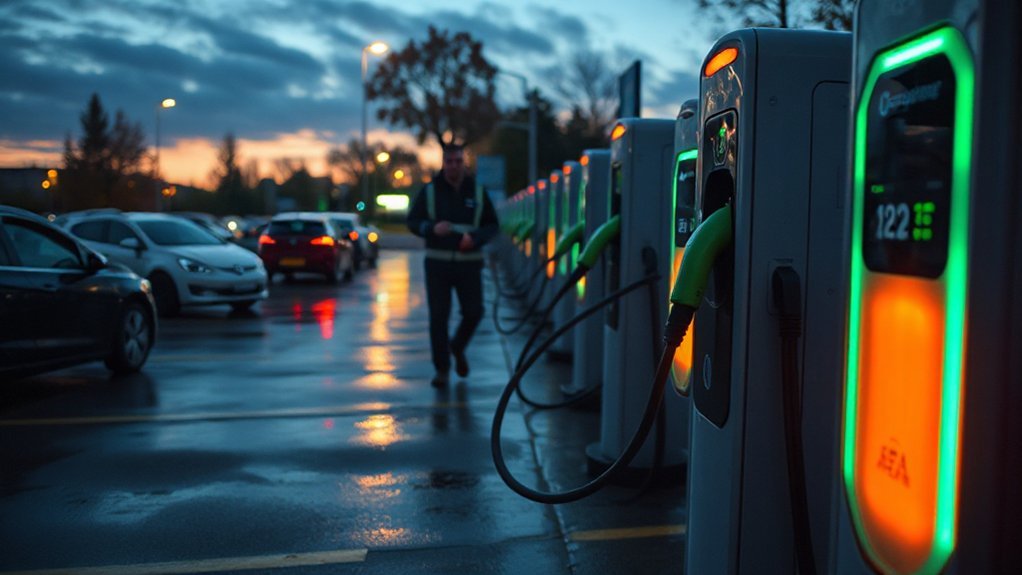
It’s not exactly a roadside miracle, but the F-150 Lightning charges faster than you might assume. You’ll want to know how long home Level 2 charging takes, what DC fast charging costs, and how towing or cold weather changes the math. Keep going and you’ll get concrete times, tips, and cost figures to plan smarter trips.
Key Takeaways
- Charging speeds: Level 2 overnight 11.9 hours (standard) and 15 hours (extended); DC fast peaks ~155 kW, averages 55–94 kW.
- Battery and range: Standard 98 kWh ≈240 EPA miles; Extended 131 kWh ≈300–320 miles; Flash 122 kWh slightly lower.
- Costs: Home charging ≈$0.13/kWh; public DC fast charging ≈$0.43/kWh plus station fees.
- Connectors and installation: Level 2 uses J1772, DC fast uses CCS; 80A Pro onboard charger requires a 100A circuit.
- Best practices: Keep daily SOC 20–90%, reserve DC fast charging for trips, precondition battery and schedule off-peak charging.
Charging Speeds and What to Expect
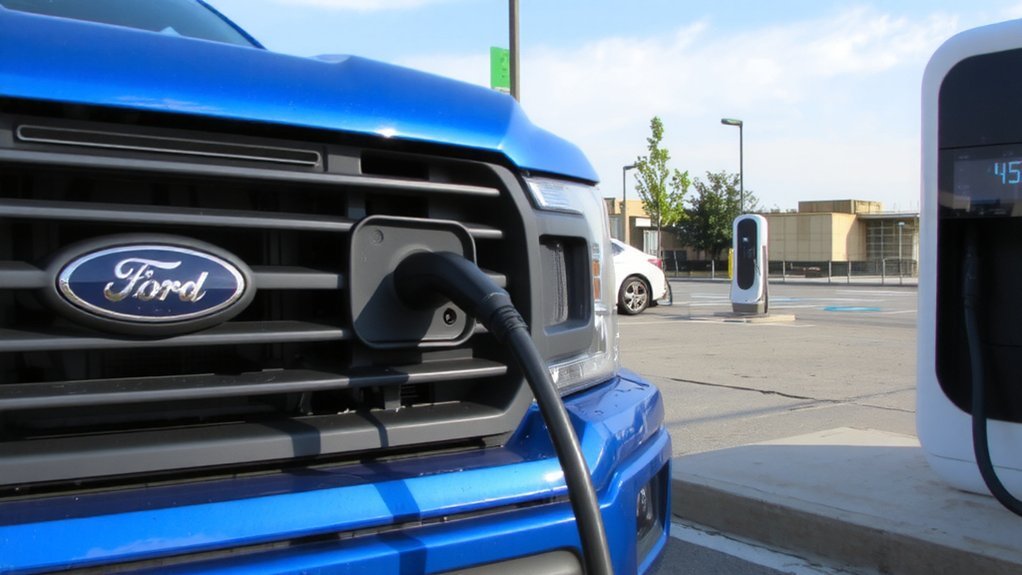
Typically, charging the 2025–2026 F‑150 Lightning depends on where you plug in: at home you’ll see 11.3 kW on standard‑range models and up to 19.2 kW on extended‑range trucks when you install Ford’s 80A Charge Station Pro (extended‑range trucks include that unit; standard‑range models don’t).
You’ll typically get full overnight recovery on a Level 2 supply—about 11.9 hours for standard models and roughly 15 hours for extended models on common 48A chargers—while DC fast charging peaks near 155 kW and commonly averages 55–94 kW through the fast‑charge window.
Use J1772 at Level 2 and CCS for DC fast charging. Extended trims include the 80A Pro; installing one needs a 100A hardwired circuit. Follow safe installation and charging practices to protect you and the vehicle. DC fast charging from 15% to 80% typically takes about 32–38 minutes.
Battery Options, Capacity, and EPA Range
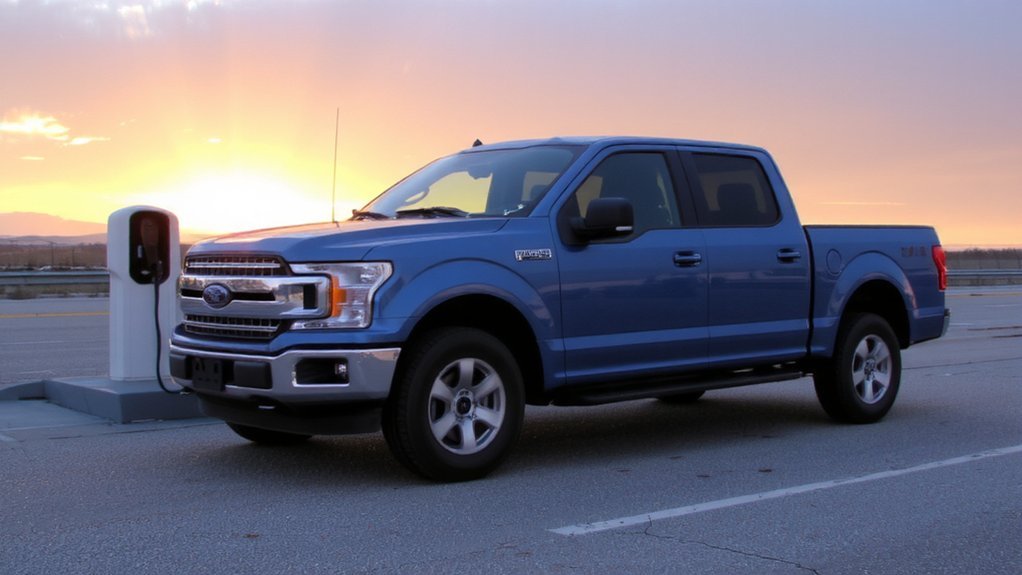
Ford offers two main battery choices for the 2025–2026 F‑150 Lightning: a 98 kWh usable Standard Range pack and an Extended Range pack that’s generally 131 kWh usable (the 2025 Flash trim uses a 122 kWh usable pack). The Extended Range pack can produce 580 hp in certain configurations. You’ll pick Standard for roughly 240 EPA miles or Extended for 300–320 miles depending on trim; higher capacity also supports up to about 580 hp and increased towing when equipped.
Two battery options: 98 kWh Standard (~240 EPA miles) or Extended around 131 kWh (~300–320 miles); Flash uses 122 kWh.
Batteries use lithium‑ion chemistry, include Ford recycling partnerships, and carry a 96‑month/100,000‑mile traction battery warranty. Monitor state of charge and driving conditions to protect range and battery health.
Safety-focused highlights:
- Standard Range: 98 kWh usable, ~240 EPA miles.
- Extended Range: 131 kWh usable, ~300–320 EPA miles.
- Flash: 122 kWh usable, slightly reduced range.
Home Charging Vs Public Fast Charging: Time and Cost
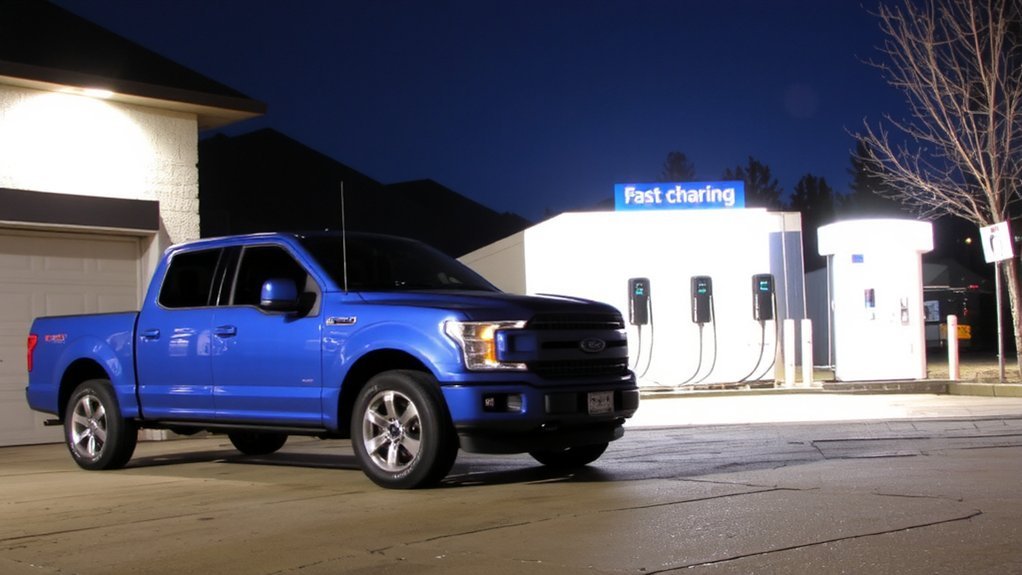
You can charge at home with a Level 2 (240V) charger — roughly 10 hours for the standard battery and about 14.6–15 hours for the extended pack from empty.
Public DC fast chargers will get you to about 80% in ~38 minutes but typically cost around $0.43/kWh (plus possible session or idle fees), far above home rates near $0.13/kWh.
For most drivers, charge overnight at home for daily use and save fast charging for road trips or when you need a quick top-up. Keep in mind that AC charging through the Ford-supplied 30-amp charger is much cheaper at $0.13/kWh.
Home Charging Time
While home Level 2 charging takes overnight hours, public DC fast chargers can replenish the F-150 Lightning much faster. Keep in mind that public charging is not cheap compared with home electricity. At home you’ll typically see 7–10.3 kW chargers that bring a standard-range pack to 100% in about 10–14.6 hours and an extended-range pack in roughly 14–15 hours. Charging slows near full so the last 10% can take many hours; avoid unnecessary 100% fills for safety and battery longevity.
Use a 48‑amp Level 2 unit if you want faster overnight restores and consider electrical upgrades done by a licensed electrician.
- Schedule charging in the Ford app to use off-peak hours safely.
- Keep daily state-of-charge near 20%–80% to reduce stress.
- Monitor sessions to stop extended topping-up.
Always follow manufacturer guidelines and let certified technicians handle electrical work.
Public Fast-Charging Cost
After scheduling slow overnight charging at home, you’ll rely on public DC fast chargers when time matters — but that convenience usually costs more. Public stations bill by kWh or minute, and rates often exceed home electricity (home ≈ $0.13–$0.16/kWh). BlueOval Charge shows prices in FordPass so you can compare before plugging in; Tesla Superchargers are available via NACS adapters on 2025 Lightnings, adding options but variable pricing.
Fast charging delivers up to 150 kW and 54 miles per 10 minutes, cutting 15–80% charging to roughly 32–38 minutes, yet providers may add convenience or idle fees that raise total cost. For safety, monitor charge sessions, avoid lingering plugged-in, and factor higher public costs into trip planning. Carry emergency charger kit; always follow station instructions. The Lightning uses a 145-kWh battery that supports fast charging on compatible public chargers.
When To Fast-Charge
Two clear charging patterns emerge: charge at home overnight for daily driving and use public DC fast chargers only when time or access demands it. The Lightning supports 150 kW DC for faster public charging when needed. You should set your Level 2 charger to off-peak hours, so you’re charged safely and cheaply by morning; slower AC charging also preserves battery health.
Reserve DC fast chargers for trips, emergencies, or when you can’t access home charging. Fast fills cost more and stress the battery.
- Charge nightly at home for most commuting; it’s safer and far cheaper.
- Use DC fast charging for long-distance legs or urgent top-ups.
- Plan routes and backups; rural gaps and fees mean you should confirm availability first.
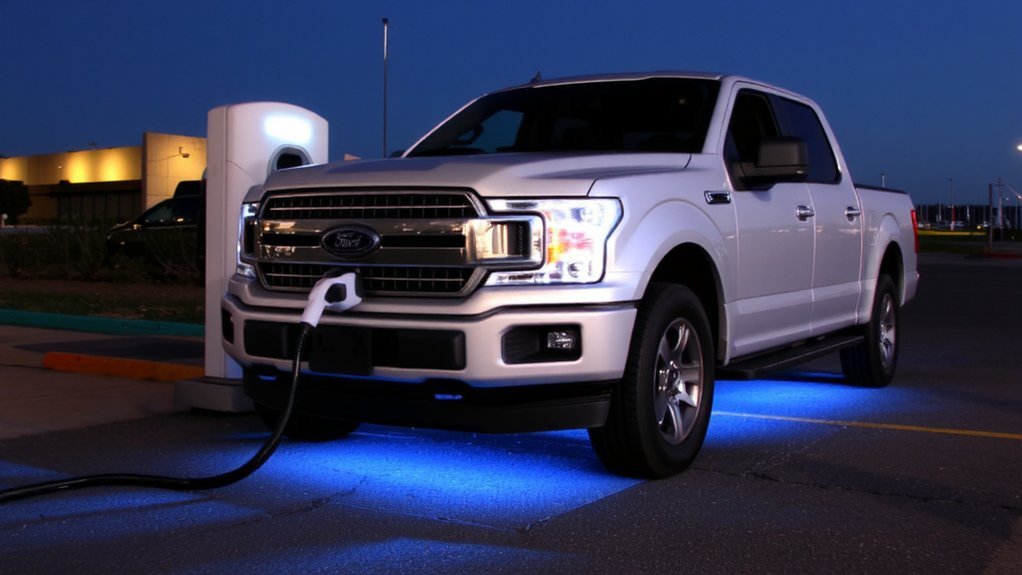
When possible, schedule charging and carry a charger adapter to stay safe and avoid unexpected stops.
Best Practices to Maximize Charging Efficiency and Battery Life
You should keep your F-150 Lightning around 70–80% for daily use, avoid drops below 10%, and do a monthly 100% only if you have an LFP pack for recalibration.
Use Level 2 charging for routine top-ups and reserve DC fast charging for long trips to limit accelerated wear. For road trips, take advantage of DC fast charging to add range quickly when needed.
Precondition the battery and park in shade or a garage when charging to keep temperatures in the ideal range.
Optimal State of Charge
When managing your F-150 Lightning’s battery, aim to keep the charge between about 20% and 90% for daily use—charge to 90% routinely and only top to 100% via AC when you need the extra range for a long trip.
You should avoid regular deep discharges below 10–15% and steer clear of prolonged 100% storage. For extended parking, store near 50% and check it periodically. Charging above 90% gives minimal extra range and increases charging losses.
- Maintain daily charge within 20–90% to reduce stress.
- Use 100% AC charging only for planned long trips.
- Store at ~50% for long-term parking and top up if it falls below 30%.
This preserves battery health and keeps your truck safe and reliable. Follow these simple rules.
Limit Fast-Charging Frequency
Keeping your Lightning at 20–90% for daily use reduces stress, and you should also limit how often you rely on DC fast charging to preserve battery life. Relying on fast chargers regularly accelerates battery wear compared with Level 2, so reserve DC charging for trips or urgent turnarounds.
When you do fast-charge, start from a low state of charge (around 15%) and stop near 80% to minimize cell strain. Avoid back-to-back fast sessions; give the battery time to recover between high-power events. Use overnight Level 2 or a Ford Charge Station Pro for routine top-offs—it’s safer and cheaper.
Frequent DC charging can raise ownership costs through faster degradation and higher public kWh rates, so plan charging to protect range and resale value and long-term reliability. When possible, plan longer stops at public stations since many Lightning models support 150 kW fast charging to reduce downtime.
Manage Battery Temperature
Few things affect charging efficiency and battery longevity as much as temperature, so manage it proactively. You’ll use preconditioning via FordPass or SYNC to heat or cool the LMR battery before charging or departure; plug in and set a departure time so the system preserves range and cabin charge.
Watch the dashboard’s color-coded temperature display—green is good, red needs action—and avoid fast charging when the pack’s hot. The Lightning’s dual coolant loops and chiller kick in automatically, but you should park shaded, avoid heavy towing in heat, and let the pack cool after hard use before DC fast charging. Modules rest on individual stamped coolant plates, which means the cooling path includes multiple interfaces that affect how quickly the pack heats or cools.
Precondition while plugged in before charging
Monitor dashboard temp and adjust driving
Park shaded and avoid high-load activity
Prioritize safety and patience.
How Towing, Payload, and Driving Conditions Affect Range and Charging
Towing, payload and driving conditions can slash the F-150 Lightning’s real-world range—tests show towing can cut range by 50% or more—so you’ll need to plan charging stops and expect slower charge times after heavy loads. The Lightning comes standard with two electric motors, which help deliver strong performance even as range drops.
When towing heavy trailers or carrying max payload, expect large range drops: a 6,100‑lb trailer cut a Lightning Platinum to about 100 miles at 70 mph. Drive slower, keep steady speeds, and monitor Intelligent Range and payload adjustments to avoid surprises.
Hot or cold weather and climate-control use will further reduce range. Charging frequency rises after towing, and charging rates may taper if the battery’s been heavily drained.
For safe trips, plot chargers more often, reduce speed when possible, and distribute payload to minimize steep energy penalties and monitor.
Software Updates, Adapters, and Charging Network Access
Software updates and plug-in adapters are widening how and where you charge your F-150 Lightning. Ford’s updates optimize battery management, safely boosting DC fast-charge rates on 2022–2023 models toward 150 kW and trimming 15%–80% sessions by several minutes; ongoing tuning should improve 2025+ charging curves and peak amps.
Adapters give you NACS access to Tesla Superchargers while retaining CCS compatibility, expanding reliable fast-charge options. Use integrated navigation to find compatible stations and monitor costs; expect roughly $29 for a substantial range top-up depending on provider. Charge at approved stations, follow connector and software prompts, prefer Level 2 overnight for safety, and monitor battery health. The Lightning’s extended-range pack is a 131 kWh battery.
- Faster, safer DC charging via software tuning
- NACS adapter expands Supercharger access
- Use nav and approved stations; prioritize safety
Conclusion
You’ll love how the Lightning charges overnight or zips to 80% in half an espresso break, and you’ll adore paying a tiny fortune at public fast chargers while telling yourself it’s worth the convenience. You’ll try to baby the battery between 20–90%, then top to 100% before a trip. You’ll plan routes like a pro, then still be surprised. That’s modern EV life: clever, efficient, and slightly theatrical, and you’ll call it progress, every time.