
You can estimate charge time with a simple model: hours = usable kWh × (target SOC − start SOC) ÷ (charger kW × efficiency). Account for Level 1/2 AC limits via the onboard charger (SAE J1772/NACS), DC fast (CCS/NACS) power ceilings, and taper from ~60–80% SOC. Factor temperature and BMS constraints. Next, translate kW to miles per hour and plan 10–80% sessions efficiently—if you know your numbers.
Key Takeaways
- Charging speed equals power: kW; energy added kWh = kW × hours; time = battery usable × SoC delta ÷ (charger kW × efficiency).
- Level 1: 120 V at ~1.2–1.9 kW (~3–5 mph); Level 2: 3.3–11.5 kW typical, up to ~19.2 kW if onboard allows.
- DC fast charging: 50–350 kW station ratings, but car limits and taper mean peak power at low SOC, declining above ~60–80%.
- Actual power is the minimum of EVSE limit, vehicle acceptance (onboard charger/DC curve), and site or grid derates and voltage sag.
- For quickest trips, arrive preconditioned near 10–30% SOC and leave around 70–80% to minimize time lost to taper.
Understanding Kw Vs Kwh and Charging Levels
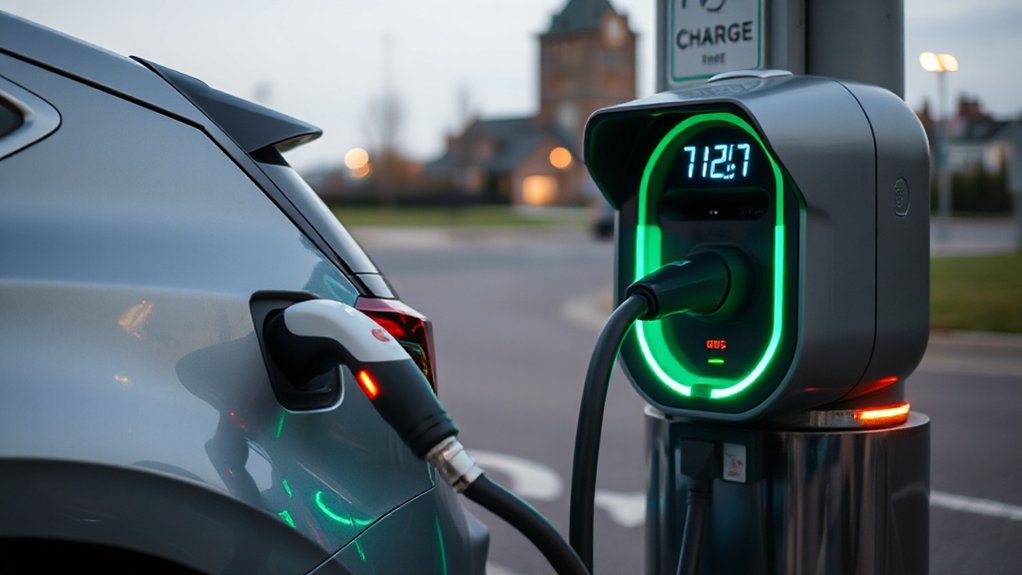
Why does kW differ from kWh? kW is power (the instantaneous charging rate), while kWh is energy (the capacity added), with Energy (kWh) = Power (kW) × Time (h). You quantify power as volts × amps; its unit origins trace to SI definitions. Under regulatory standards (SAE J1772, IEC 61851/62196, ISO 15118), Level 1 AC uses 120 V, typically 12 A (~1.4 kW). Level 2 AC uses 208–240 V, up to 80 A (max 19.2 kW), constrained by the EVSE and onboard charger. DC fast charging (CCS/CHAdeMO) supplies 400–1000 V, up to 350 kW, but your vehicle’s limits and the charge curve taper govern actual kW. Expect 90–95% efficiency; losses convert some kW to heat, reducing delivered kWh over time, in real-world operating conditions.
Using the EV Charging Speed Calculator
With the EV Charging Speed Calculator, you turn charger power (kW), battery capacity (kWh), and state-of-charge (SoC) limits into charging time and range added using Time (h) = [Battery (kWh) × (Target SoC − Start SoC)] ÷ [Power (kW) × η].
Enter AC or DC power rating, pack usable kWh, Start/Target SoC, and efficiency η (default 0.90–0.95). Select connector standard (J1772, CCS, NACS, CHAdeMO) and set max vehicle acceptance to obey onboard-charger or pack limits. Choose distance units and consumption metric (Wh/mi or Wh/km) to compute range added. Use Privacy Settings to keep inputs local or anonymized. Save scenarios, compare sessions, and audit assumptions via notes. Export Options include CSV and JSON with timestamps, inputs, results, and metadata for compliance or fleet reporting.
Estimating Time to Charge From Start to Target State of Charge
You estimate charge time by entering usable capacity (kWh), start/target SoC, station power, vehicle acceptance limits (AC/DC per IEC 61851/ISO 15118), and end-to-end efficiency. You shouldn’t assume constant power; charging follows a tapered curve constrained by temperature, voltage rise, and BMS limits, so integrate power vs SoC to compute minutes. Use manufacturer or measured curves (e.g., CCS/CHAdeMO profiles), apply connector/cable power ceilings, and report results with stated assumptions and error bounds.
Key Inputs
Several inputs govern a reliable time-to-charge estimate from start to target state of charge (SoC): usable battery capacity (kWh), initial and target SoC (%), charger type and available power (AC per IEC 61851/IEC 62196; DC CCS/ISO 15118 or CHAdeMO), the vehicle’s charge-power curve including taper behavior, thermal and BMS limits, and end-to-end efficiency. You’ll enter these to quantify energy required = usable capacity × (target − initial). Constrain power by AC phase count, voltage, current, pilot limits (IEC 61851), connector ratings (IEC 62196), and DC max power, voltage window. Include onboard-charger kW, BMS current/voltage ceilings. Assume typical efficiencies: AC 85–93%, DC 92–98%. Respect dwell-time, SoC caps, user preferences. Verify station capability and protect identity/Plug&Charge tokens given privacy concerns. Return minutes and energy with buffer.
Charging Curve Effects
Accurate time estimates hinge on the vehicle’s charge‑power curve, which is non‑linear due to CC–CV control, pack voltage rise, and thermal/BMS ceilings. You shouldn’t assume constant kW; integrate P(SOC,T) over SOC. In the CC phase, cable, inlet, and voltage sag bound current. As pack voltage rises, CV taper dominates; power drops per cell impedance and thermal limits. Temperature, preconditioning, and state‑aware BMS rules introduce charge hysteresis between sessions.
Use charger limits and protocol caps (IEC 61851/SAE J1772 for AC, ISO 15118/CHAdeMO/CCS for DC) to set Pmax, then apply the vehicle’s published curve or fleet‑averaged telemetry. Compute time by summing ΔSOC/Pavg across SOC bins (e.g., 5%). Include derates for cold cells, high SoC, and shared-site power management. Validate results against logged session data, variance.
Miles of Range Added per Hour by Charger Type
You can estimate miles of range added per hour by multiplying charger power (kW) by your vehicle’s EPA efficiency (mi/kWh). Using 3–4 mi/kWh: Level 1 (120 V, 1.2–1.8 kW) ≈4–7 mi/h; Level 2 (240 V, 6.6–11.5 kW) ≈20–45 mi/h; DC fast (50–250 kW+) ≈150–800 mi/h, with taper at higher SOC. These ranges reflect SAE J1772/CCS power capabilities and typical AC/DC losses; your results vary with ambient temperature, onboard charger limits, and thermal management.
Level 1 Miles/Hour
In SAE J1772 AC Level 1 charging (120 V, North America), a 15 A branch circuit supplies 12 A continuous (~1.44 kW) and typically adds about 3–5 miles of range per hour; a 20 A circuit at 16 A continuous (~1.92 kW) delivers roughly 5–7 mi/h. You’ll see variance from efficiency and voltage sag. Level 1 aids Apartment Access; raise Public Awareness with clear outlet policies.
| Config | kW | mi/h |
|---|---|---|
| 5-15 | 1.44 | 3–5 |
| 5-20 | 1.92 | 5–7 |
| 110 V sag | 1.32 | 2–4 |
| 250 Wh/mi | — | +20–30% |


Follow NEC 80% continuous-load limits and use dedicated circuits. Check plug temperature periodically.
Level 2 Miles/Hour
Stepping up from Level 1, SAE J1772 AC Level 2 (208–240 V single‑phase) supplies up to 80 A continuous (≈19.2 kW), with common EVSE settings at 16, 24, 32, 40, and 48 A (≈3.3, 5.0, 7.7, 9.6, 11.5 kW at 240 V; ≈3–10% lower at 208 V). At 3.0 mi/kWh, those power levels add 10, 15, 23, 29, and 35 miles per hour; at 4.0 mi/kWh, expect 13, 20, 31, 38, and 46 mph. Your onboard charger rating caps intake (e.g., 7.2 kW ≈ 24–29 mph at 3–3.6 mi/kWh), and shared circuits or cold packs reduce rates. Use a dedicated 240 V circuit, breaker sizing (125% rule), and UL‑listed EVSE to guarantee code compliance, lower fire risk, support resale value, and reduce insurance implications.
DC Fast Charging Mph
Although peak kW ratings grab attention, DC fast charging speed is best expressed as miles of range per hour (mph) from charger power and vehicle efficiency. You convert kW to mph by multiplying charger power by drivetrain efficiency (mi/kWh) and applying taper curves defined by SAE CCS/NACS charge profiles. A 150 kW unit at 3.5 mi/kWh delivers up to ~525 mph at low SOC; taper trims to ~200–300 mph near 80%. Power sharing, preconditioning, and thermal limits further bound results.
- 50 kW: ~175 mph typical; older CCS/CHAdeMO caps apply.
- 150 kW: ~350–525 mph early; plan to unplug at 60–80% SOC.
- 350 kW: peak >1,000 mph in rare cases; pack voltage sets ceiling.
Here, mph informs range planning—not road speed—avoiding speed perception with traffic enforcement.
Vehicle and Charger Power Limits Explained
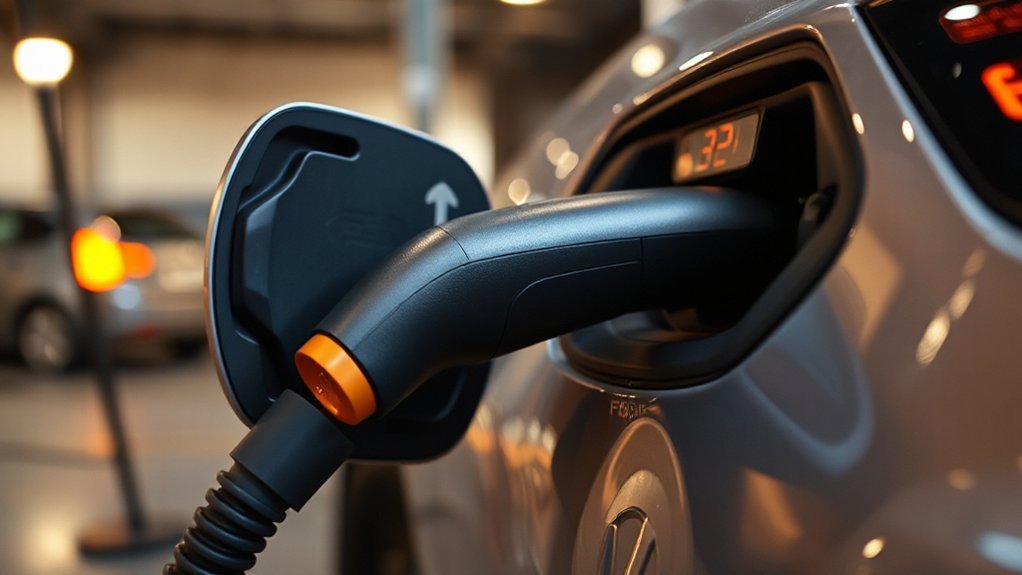
Because both sides impose hard caps, charging power equals the lesser of the vehicle’s acceptance and the EVSE’s capability, computed as P = V × I within the negotiated voltage/current window. Your BMS declares allowable pack voltage, current, and temperature; the charger reports supply limits, cable ratings, and site derates. Protocols (ISO 15118, DIN 70121, SAE J1772, CHAdeMO) coordinate setpoints and taper. Safety standards force headroom for connector temperature, insulation, and isolation monitoring. As cell voltage rises or coolant warms, firmware limits reduce current to keep you within SOA. Cable gauge and connector pins define thermal capacity; longer cables often derate. Grid constraints, power-sharing, and utility demand response can cap output. Expect peaks, then taper, with power bounded by whichever side’s constraint tightens first.
AC Home Charging: Levels, Connectors, and Real-World Speeds
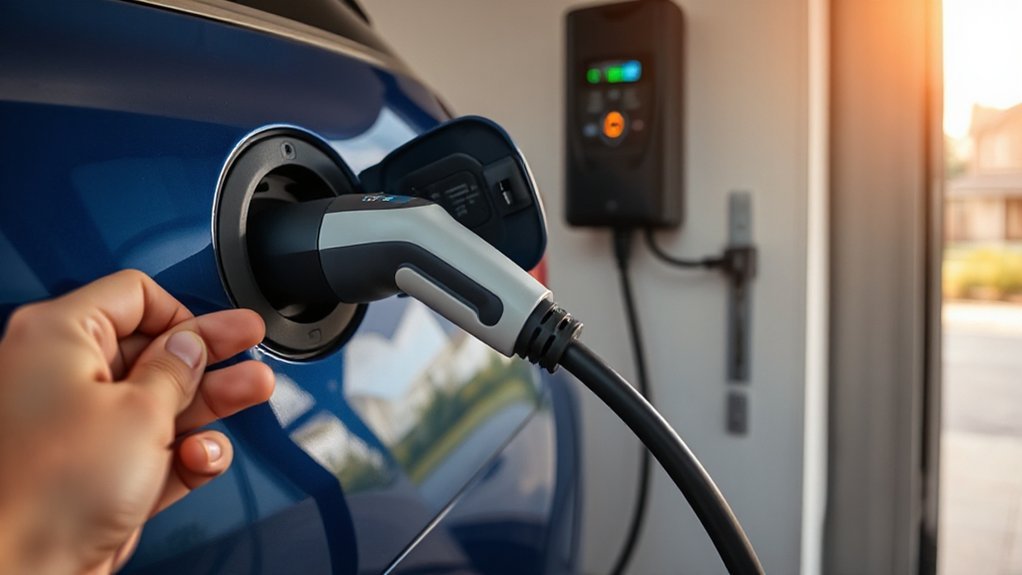
While DC fast charging grabs headlines, everyday AC home charging depends on your onboard charger rating, branch-circuit capacity, and connector standard. Level 1 (120 V, 12–16 A) yields ~1.2–1.9 kW, ~3–5 miles/hour. Level 2 (240 V) scales with current: 24 A≈5.8 kW, 32 A≈7.7 kW, 40 A≈9.6 kW, 48 A≈11.5 kW. NEC 625’s 80% rule governs load, so a 40 A EVSE requires a 50 A circuit. Connectors: SAE J1772 (North America), NACS/Tesla, and Type 2 per IEC 62196 in Europe; obey signaling via SAE J1772/IEC 61851. Real-world speed is min(utility voltage sag, EV onboard charger kW, EVSE limit). Plan for permit requirements, load calculations, and service upgrades; don’t ignore installation aesthetics, cable reach, or enclosure ratings.
- Verify compatibility
- Choose connector
- Size capacity
DC Fast Charging: Curves, Tapering, and Session Strategy

Even on a 350 kW dispenser, your EV rarely holds peak power: DC fast charging follows a pack-defined voltage–current curve that the BMS negotiates with the EVSE (CCS via DIN 70121/ISO 15118, IEC 61851-23/-24; NACS/SAE J3400 analogous). Power rises quickly, hits a chemistry-limited plateau, then tapers as cell voltage approaches limits to protect cycle life and impedance margins. To minimize time-to-charge, target the high-power SoC window and avoid chasing the last few percent.
| SoC | Power | Strategy |
|---|---|---|
| 10–30% | Near-peak | Arrive low; split sessions |
| 30–60% | High-stable | Ride plateau; stop early |
| 60–80% | Tapering | Leave at 70–80% |
Plan stops around adjacent hubs to share load, improving grid resiliency and uptime. Prefer sites with multiple dispensers, load sharing, and clear power ratings; good station siting reduces queuing and derates.
Temperature, Battery Conditioning, and Seasonal Effects
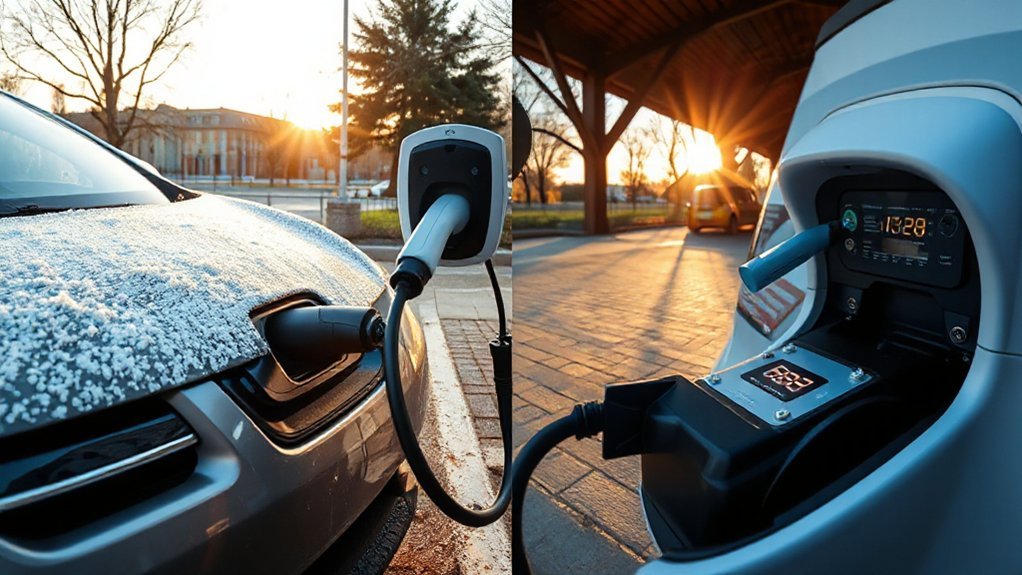
Temperature governs how much current the BMS will accept, so charging power depends as much on cell thermal state as on SoC. Ideally, lithium plating risk is minimized near 25–35°C; below ~15°C, most packs cap current, and above ~45°C, they throttle to protect SEI. You can precondition: the vehicle heats or cools the pack to target temperature before arrival using waste heat or a dedicated heater, improving C-rate and session time. Cold-soaked cells raise internal resistance; thermal insulation and garage parking reduce warm-up energy.
- Monitor inlet, pack, and cell temps via OBD; correlate kW vs °C.
- Enable navigation-linked preconditioning for DCFC; verify with plateaued kW on plug-in.
- In winter, expect higher SOC deltas before taper; factor seasonal degradation on capacity.
BMS limits protect cells.
Planning Stops: Balancing Speed, Cost, and Battery Health
You quantify cost–time tradeoffs by matching charger power to tariffs: DC fast (150–350 kW) at roughly $0.35–$0.60/kWh vs Level 2 (7–11 kW) at ~$0.12–$0.25/kWh, noting that adding ~33 kWh (~100 miles at 3 mi/kWh) takes ~13–15 minutes at 150 kW before taper. You plan stops around battery‑friendly SOC windows (≈10–80%) to stay in the high‑C‑rate region, minimize taper, and limit high‑SOC dwell per OEM guidance and cell standards (e.g., IEC 62660 performance/aging profiles). You then select sites that match your connector and vehicle limits (SAE J3400/NACS or CCS, vehicle max kW and charge curve) and compute ETA and total energy cost accordingly.
Cost–Time Tradeoffs
While DC fast charging minimizes dwell time, planning efficient stops means quantifying the trade among charge rate, pricing model, and pack stress under real charge curves. Model trip minutes as drive time plus charging minutes at the marginal kWh accepted between taper points. Compare $/kWh vs $/minute; convert to your effective $/hour of driving added. Account for demand charges in station pricing, TOU windows, and roaming fees. Leverage incentive programs and memberships to cut cost without stops.
- Compute cost per added mile (¢/mi) and time per added mile (min/mi) from EPA efficiency and charger logs.
- Prioritize stations with verifiable peak power, low congestion, and audited uptime (NEVI, OCPP).
- If queues exceed 10 minutes, reroute to slower, cheaper sites with zero wait; ETA often improves.
Battery-Friendly Charge Levels
Because high SOC and heat accelerate degradation, plan stops to keep charging in the fast, lower-stress band of your pack’s curve. Target an ideal SoC window where taper hasn’t begun: typically 10–60% for NMC/NCA and 15–70% for LFP. Most packs reduce current above ~60–70% SOC and >35°C cell temp; you’ll add miles slower and stress the SEI. Schedule shorter sessions when cells sit at 15–35°C. Use AC or DC power levels matched to standards limits (IEC 61851, ISO 15118, CCS) and your BMS’s published charge curve. Make Charge Habits measurable: arrive ≤30% SOC, leave ~60%, skip topping to 100% unless needed. Precondition only when DC fast charging. Store near 40–60% SOC. This balances speed, cost, and cycle life, and maintains thermal and voltage margins.
Connector Types and Compatibility on the Road

How do connector standards affect charging speed and road‑trip compatibility? You match your inlet to the site’s plug and power class. CCS (CCS1 North America, CCS2 Europe) delivers up to 350 kW; NACS targets 250–500 kW; CHAdeMO usually 50–100 kW. AC Type 2 offers 11–22 kW; Type 1 ~7.2 kW. Regional standards shape network density, roaming, and pricing. Your pack voltage (400 V vs 800 V), cable rating, and station firmware set the real ceiling. Check PlugShare data and OEM maps for live compatibility flags.
- Verify connector, max kW, and voltage/current limits in the app before arrival.
- Practice Adapter etiquette: use certified adapters; expect possible current caps and reduced reliability.
- Prefer sites matching your native standard; carry a fallback AC option for sparse corridors.
Conclusion
You’ve got the tools to predict charge time: apply Time = usable kWh × (target–start SOC) ÷ (charger kW × efficiency), assume ~85–93% on AC and ~92–98% on DC, and aim 10–80% to dodge CV taper. Match onboard limits, temperature, and BMS behavior to the site’s rating. Plan stops by dollars, minutes, and standards—SAE J1772/Type 2 for AC, CCS/NACS for DC. Do this, and your road map clicks into place like a precisely machined geartrain.