
You probably don’t know that ISO 15118’s certificate handling can enable true plug‑and‑charge economics, not just convenience. Level 3 DC fast chargers push 50–350+ kW via liquid‑cooled cables, negotiate with the BMS for ideal current, and coordinate via CCS/NACS, OCPP, and OCPI. With smart demand management and onsite storage, they cut session times to minutes while improving >97% uptime and lowering demand charges. See how this reshapes interoperability, grid impact, and ROI.
Key Takeaways
- Deliver up to 350 kW DC directly to batteries, slashing 10–80% charge times to roughly 18–35 minutes.
- Smart protocols coordinate safely with BMS using ISO 15118/DIN 70121, optimizing current, pre‑charge, and interlocks for faster, safer sessions.
- Plug & Charge enables tokenless payments and sub‑5‑second authentication, improving convenience and reducing failed transactions.
- Network reliability and modular hardware target >99% uptime, hot‑swappable rectifiers, and rapid remote diagnostics to minimize downtime.
- Grid‑aware sites use OCPP controls, on‑site batteries, and load shaping to integrate at scale while shaving peaks and connection costs.
What Level 3 DC Fast Charging Is and How It Works
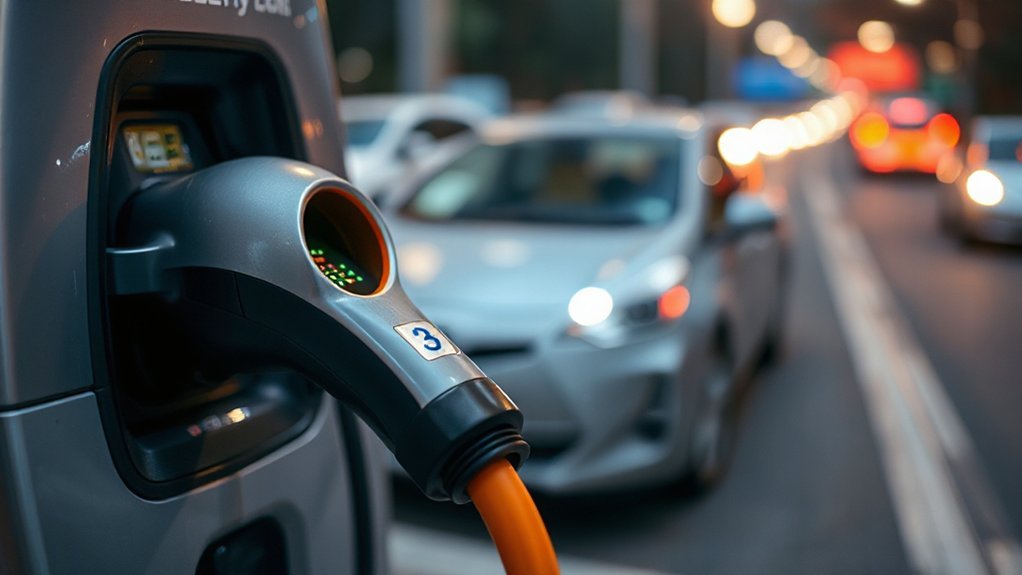
DC fast charging (Level 3) supplies high-voltage DC directly to an EV’s battery (typically 200–1000 V) at 50–350 kW, with currents up to ~500 A using liquid‑cooled cables, bypassing the onboard AC charger. You connect via CCS, CHAdeMO, or NACS; the charger’s power conversion stages rectify and regulate grid input to isolated DC. Through ISO 15118 or DIN 70121 over PLC, the charger and your vehicle exchange capabilities, authenticate (e.g., Plug & Charge), and negotiate voltage/current limits per SAE J1772/Combo profiles. The BMS and charger’s control electronics coordinate pre-charge, contactor closure, leakage monitoring, and continuous insulation checks (IEC 61851, IEC 62196). The charger modulates output using DC/DC converters and closed-loop current control, enforcing pack temperature, SOC, and cell voltage constraints. Ground fault protection included.
From Hours to Minutes: Real-World Charging Speeds
Now that you know how Level 3 negotiates voltage and current, the next question is how fast energy actually moves into the pack: real cars typically average 60–180 kW over a 10–80% session, not the headline 150–350 kW peak, because the BMS‑defined charging profile (per ISO 15118/DIN 70121 control and SAE J1772/Combo limits) tapers with SOC and temperature. At 800 V, 150 kW yields ~190 A; at 400 V, 150 kW requires ~375 A, stressing cables and Thermal Management. You’ll see 10–80% in roughly 18–35 minutes for 70–100 kWh packs, assuming preconditioned cells. Battery Chemistry dictates allowable C‑rates: high‑nickel NMC often sustains 2–3 C briefly; LFP prefers 1–2 C. Cold packs clamp current until ~25–35°C; hot packs taper to protect longevity. Plan dwell time.
Interoperability Across CCS, NACS, and Beyond
While CCS remains the global baseline, North America is converging on NACS (SAE J3400), and true interoperability hinges on alignment across physical, electrical, and communication layers. You guarantee plug-and-charge works by harmonizing ISO 15118, SAE J1772/3400 pinouts, and DIN 70121 fallbacks. Specify 500–1000 V, 500 A envelopes, liquid-cooling thresholds, and fault classes. Demand rigorous conformance, roaming via OCPI/OCPP 2.0.1, and clear Standards governance. Validate Adapter ecosystems with load/thermal derating data, EMI limits, and handshake timing. Require field firmware upgradeability and cybersecurity (TLS 1.3, certificates).
| Layer | Key standard | Interop test metric |
|---|---|---|
| Physical | SAE J3400/CCS2 | Pin resistance/temperature delta < 5 C |
| Electrical | IEC 61851-23 | Output stability ±1% @ step load |
| Communication | ISO 15118-2/-20 | HLC success rate >99.5% |
Document results, publish APIs, and align certification cycles annually.
Reliability, Uptime, and Maintenance Best Practices
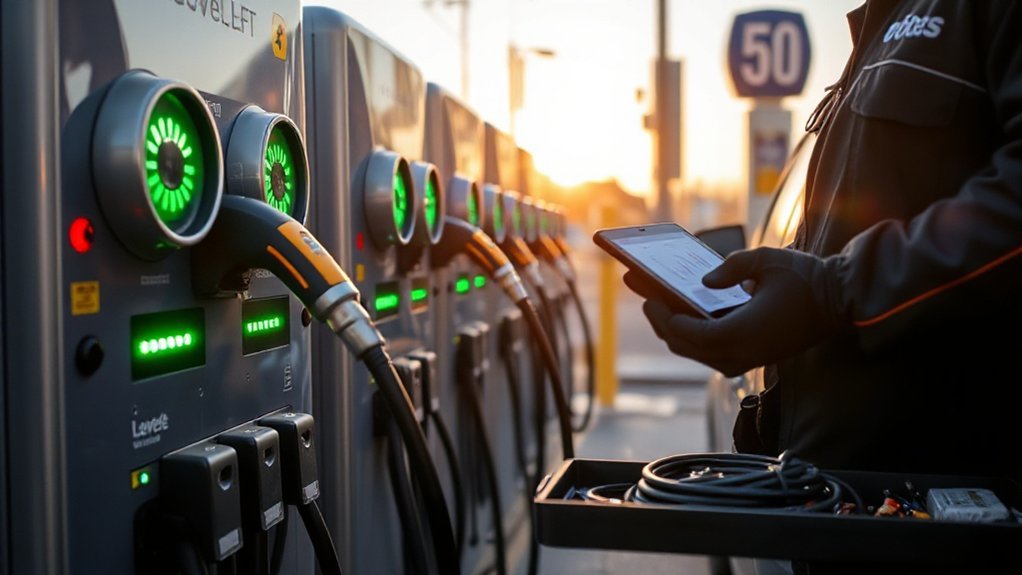
You set proactive maintenance schedules based on OEM MTBF, environmental duty cycles (IEC 60721), and UL 2202/IEC 61851 safety checks to sustain ≥99% uptime. You architect redundancy and failover with N+1 power modules, redundant cooling and comms paths (dual SIM/ethernet), and automatic session migration using OCPP 2.0.1 Transaction Events to eliminate single points of failure. You enable remote monitoring and diagnostics via OCPP 2.0.1 and ISO 15118 logs, applying predictive analytics to reduce errors per 1,000 sessions and drive MTTR below 4 hours.
Proactive Maintenance Schedules
Implementing a proactive, standards‑aligned maintenance schedule for Level 3 DC fast chargers sets clear reliability objectives—e.g., ≥99% network uptime, MTTR ≤4 hours, and documented MTBF improvements—while tying tasks to recognized standards and telemetry. You align inspection and calibration to IEC 61851, ISO 15118, and UL 2202 intervals, and you use OCPP heartbeat/error codes to trigger condition‑based work orders. Define checklists for connector wear, contactor cycle counts, filter differentials, insulation resistance, and firmware integrity. Establish spare stocking for contactors, cables, power modules, and cooling components based on failure distributions. Coordinate vendor coordination SLAs for parts and remote diagnostics, with escalation paths. Verify torque, thermal profiles, and harmonics via periodic IR and power‑quality audits. Track KPIs in CMMS, close feedback loops, and update tasks quarterly accordingly.
Redundancy and Failover Design



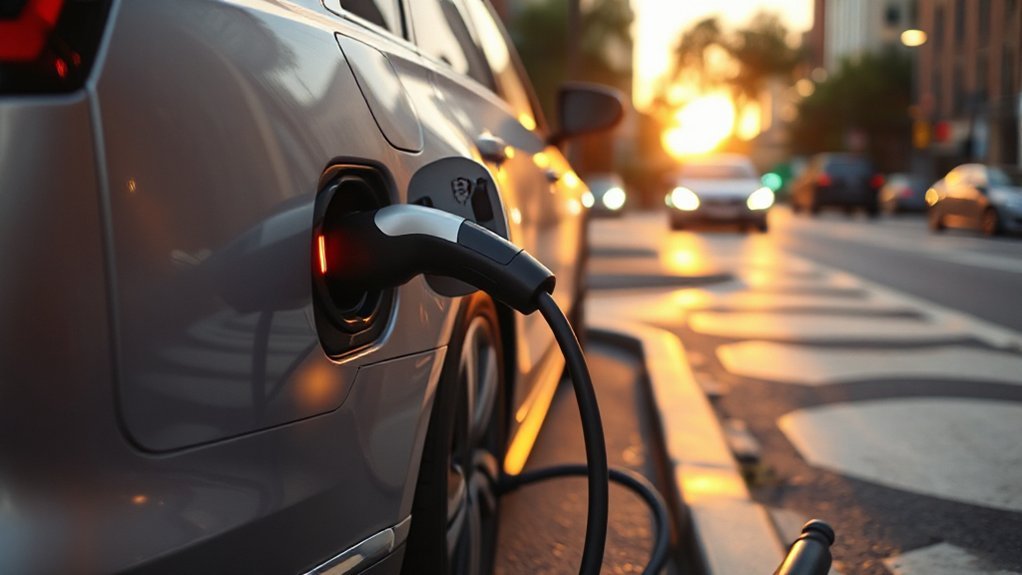
From proactive maintenance, reliability scales further through engineered redundancy and deterministic failover in Level 3 DC fast chargers. You design for N+1 power modules, hot‑swappable rectifiers, and dual cooling loops so a single fault doesn’t derate throughput. Dual utility feeds or utility plus on‑site storage provide ride‑through; coordinated transfer switches keep step changes within IEC 61851 current limits. You specify independent control PCs with heartbeat arbitration and sub‑second switchover to maintain ISO 15118 sessions. Hardware Diversity—multi-vendor rectifiers, contactors, and fans—reduces common-cause failures and improves MTBF. Geographic Segmentation spreads identical capacity across sites, improving fleet uptime and disaster resilience. You target ≥99.9% availability, budgeting MTTR under 2 hours and validating failover with scripted load tests per UL 2202 and IEC 62955, and IEC 62477-1 verification.
Remote Monitoring and Diagnostics
How do Level 3 DC fast chargers sustain ≥99.9% availability outside the lab? You instrument assets with high-frequency telemetry, edge health checks, and standards-based remote control. OCPP 2.0.1 and ISO 15118 event logs stream to your NOC, where analytics flag drift in contactor temps, insulation resistance, and rectifier efficiency. You push OTA firmware with signed images, reducing MTTR to hours, not days. You enforce cybersecurity protocols aligned to IEC 62443 and NIST SP 800-53, while maintaining privacy compliance for driver data.
- Real-time KPIs: uptime, MTBF, MTTR, connector cycles, kWh dispensed per port, anomalies thresholded.
- Automated root-cause playbooks; remote resets, EVSE self-tests, isolation checks, and alerts.
- Predictive maintenance using thermal, vibration, and harmonics models; parts staging.
- SLA orchestration via ticketing APIs; technician dispatch, parts ETAs, reports.
Smart Software, Payments, and Driver Experience
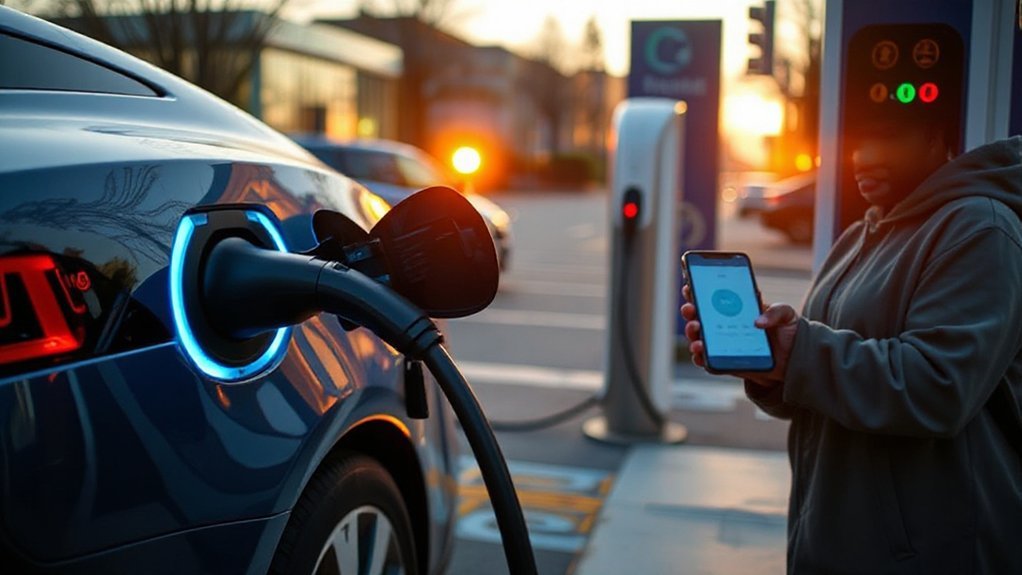
You implement ISO 15118-2/-20 Plug & Charge with OEM/CSO PKI and OCPP 2.0.1 to cut authentication to under 5 seconds and push transaction success above 98%, enabling tokenless payments and secure roaming. You integrate in‑app route planning using OCPI 2.2.1 feeds and real‑time charger telemetry (available power, queue length, uptime) to compute SOC‑aware stops, energy costs, and charger selection. Set KPIs: ETA error under 2 minutes, arrival SOC error under 5%, wait‑time MAE under 3 minutes, with QR/RFID fallback on ISO 15118 handshake failures.
Seamless Plug-And-Charge
Streamlining authentication, authorization, and payment at Level 3 DC fast chargers hinges on true Plug-and-Charge per ISO 15118, where the vehicle’s contract certificate authenticates over a TLS-secured link and the session starts without apps, RFID, or card taps. You benefit from certificate-based PKI, mutual TLS, and tariff selection negotiated between the EV and EVSE. ISO 15118-20 improves robustness, covering DC metering, load management, and contract handling across roaming via OCPP 2.0.1 and OCPI.
- Strong security protocols: CSMS-rooted PKI, OCSP stapling, and HSM-protected keys.
- Address privacy concerns with pseudonymous contract IDs and minimal data retention.
- Faster start times: sub-2s handshakes and fewer failed sessions.
- Accurate billing: signed meter values meeting PTB/Weights & Measures.
Deploy CPO/eMSP interoperability, support revocation, and schedule renewals to avoid orphaned sessions.
In-App Route Planning
While Plug-and-Charge removes on-site friction, in-app route planning determines trip reliability by fusing vehicle telemetry with network signals over open protocols. Your app ingests SOC, consumption maps, elevation, and weather to forecast energy at arrival, then queries CPOs via OCPI/OICP and station controllers via OCPP 2.0.1 for live connector status, power derates, queues, and pricing. It prioritizes sites with ISO 15118-20 support, payment token roaming, and audited uptime, using historical dwell-time distributions to minimize wait risk. You can filter by Accessibility features and Local amenities, and avoid stalls incompatible with your plug or trailer length. Dynamic rerouting reacts to outages, heavy load, or tariff shifts, and verifies charger IDs (EVSE/EVSEID) to prevent mismatches. The result: predictable ETAs, accurate charge windows, fewer detours, less stress.
Grid Integration, Demand Management, and Onsite Storage
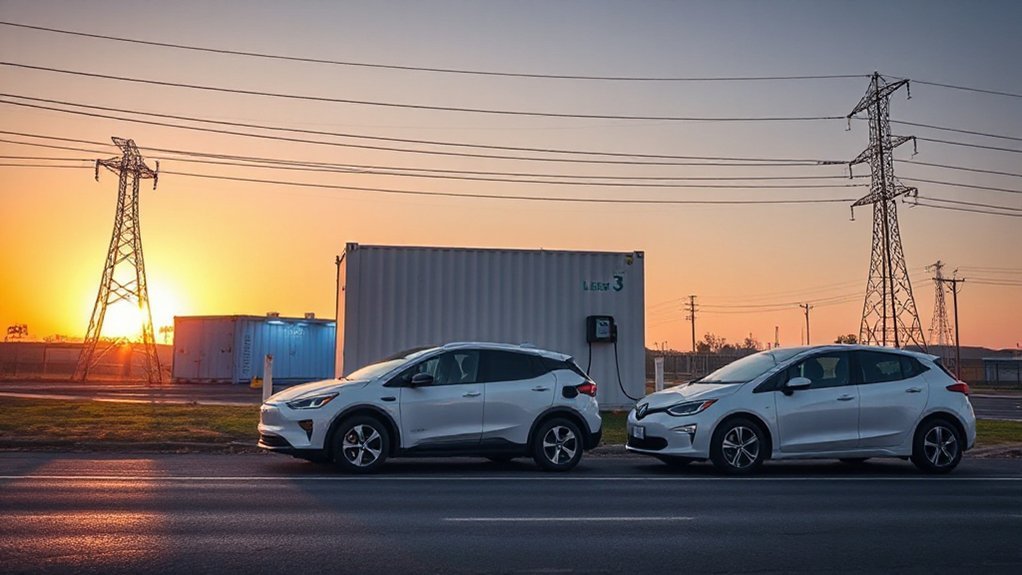
As DC fast charging scales to multi‑megawatt sites, grid integration, demand management, and onsite storage become design‑critical to meet interconnection, reliability, and cost targets. You’ll right‑size service at MV, deploy ISO 15118‑20/OCPP 2.0.1 controls, and couple batteries with solar integration to shave peaks. Use IEEE 1547‑compliant inverters and UL 9540 systems; validate transient response and fault‑current limits. Apply tariff optimization with TOU, demand charges, and export rules; coordinate OpenADR 2.0b.
Scale DC fast charging with MV interconnects, ISO 15118‑20/OCPP 2.0.1, IEEE 1547/UL 9540 storage, and tariff-optimized, OpenADR-coordinated peak shaving.
- Size BESS at 0.5–2 hours, 0.5–3 MW; enforce SOC windows (20–80%) to extend life.
- Implement load shaping: stagger start, cap site kW, ramp 10–50 kW/s per feeder thermal limits.
- Prioritize critical chargers using droop control and SAE J3072 anti‑islanding settings.
- Enable grid services (FR, TO, NEM) with telemetry at 1–4 s; maintain uptime >99.5%.
ROI for Site Hosts: Business Models and Revenue Streams

How do you make DC fast charging pencil for a site host? You model cash flows by utilization, tariff structure, and uptime. Assume 150 kW units, $120k CAPEX each, 97% uptime, and 15% utilization (1.8 hours/day). Price per kWh aligns with state rules; add session and idle fees to cover demand charges. Open standards (OCPP 1.6/2.0.1, ISO 15118) reduce vendor lock‑in and enable dynamic pricing, remote monitoring, and automated billing, lowering OPEX. You can offload CAPEX via leasing partnerships or revenue‑share with a CPO. Layer in advertising revenue from 55–75 inch displays and EV roaming fees. Retailers quantify lift via basket analysis; target $0.10–$0.20/min margin. Track KPIs: energy dispensed, occupancy, churn time, CAC, and payback months. Model incentives, maintenance contracts, and warranty risk explicitly.
The Road Ahead: Higher Power, V2G, and Megawatt Charging
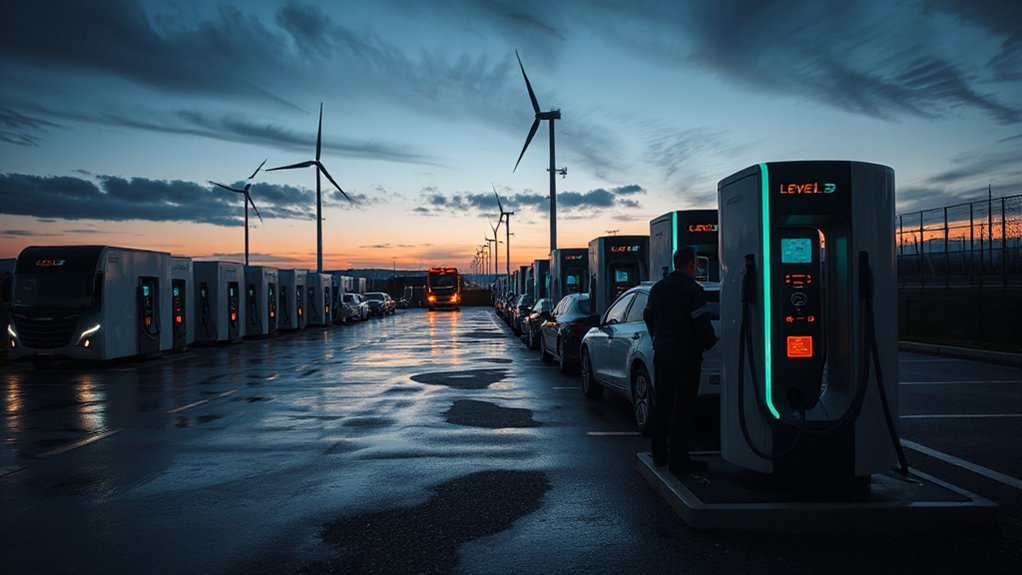
You’ve modeled ROI around 150 kW assets and tariff risk; the next planning horizon alters both hardware and revenue logic with higher power, bidirectional capability, and megawatt-class charging. Plan for 350–500 kW liquid-cooled dispensers, ISO 15118-20 V2G, and MCS ≥1 MW for HDVs. Your grid interconnects must address short-circuit duty, IEEE 1547.9 coordination, and hosting limits. Use storage to clip peaks. Align financing with incentives and evolving policy frameworks.
Plan for 500 kW+ V2G and megawatt MCS, grid-ready interconnects, storage-clipped peaks, and policy-aligned financing.
- Adopt OCPP 2.0.1, Plug&Charge (ISO 15118-2/-20), and meter-grade accuracy (ANSI C12/Weights & Measures).
- Design for 1000 V–1500 V systems, 500 A–3000 A cables, and cyber baselines (IEC 62443, TLS 1.3).
- Stack revenues: retail charging, V2G capacity, demand response, and ancillary markets.
- Invest in workforce development: HV safety (NFPA 70E), coolant handling, certification, and MCS tooling.
Conclusion
You navigate a charging paradigm where minutes replace hours, 350 kW replaces 7 kW, and ISO 15118 handshakes replace RFID taps. You specify CCS/NACS connectors, OCPP 2.0.1 backends, and 97–99% uptime SLAs, while balancing electrons against economics—demand charges vs. peak shaving, kWh throughput vs. dwell time. You orchestrate BMS‑aware profiles, liquid‑cooled leads, and onsite storage to curb peaks, as you’ll prepare for V2G (IEEE 1547) and megawatt charging, turning corridors into reliable kilowatt pipelines everywhere.