You probably don’t know the 2025–2026 Model 3 comes in two battery sizes that change charging behavior a lot. Depending on charger type, battery state, and temperature, a top-up can be 15 minutes while a full charge may take several hours. Keep going and you’ll see which chargers give rapid range boosts and which make sense for overnight home charging.
Key Takeaways
- Home Level 2 (Tesla Wall Connector) at up to 11.5 kW adds about 30–44 miles/hour, charging most Model 3s overnight (5–8 hours).
- NEMA 14-50 (240V, ~32A) delivers ~30 miles/hour, typically fully charging overnight (6–10 hours depending on battery size).
- V3 Superchargers can add roughly 175 miles in 15 minutes — typical 10–80% sessions take about 15–20 minutes under ideal conditions.
- V2 or slower DC fast chargers peak near 150 kW and take longer; shared stalls and site power further reduce individual rates.
- Charging tapers above ~65–80%, and cold or unpreconditioned batteries accept charge slowly; favor 10–80% for fastest, battery-friendly sessions.
Charging Speed Fundamentals for the 2025–2026 Model 3
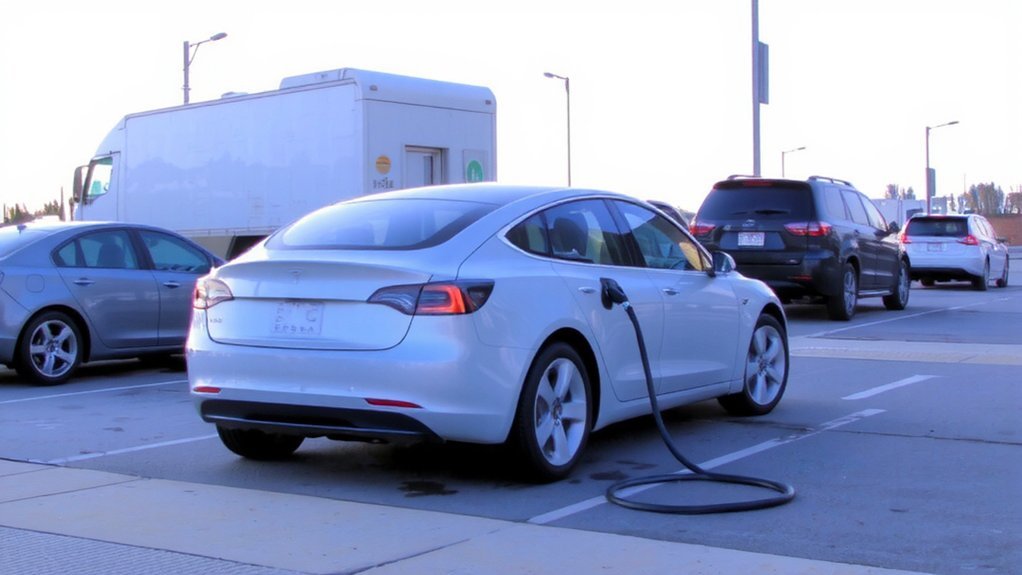
Because charging speed hinges on both hardware and chemistry, you should first note which 2025–2026 Model 3 you have: the RWD runs a 57.5 kWh pack and charges faster than the 75 kWh Long Range and Performance versions. Keep in mind that battery size matters, since larger batteries take longer to charge. Battery chemistry (NMC or LFP) and cell improvements change charge acceptance and thermal behavior, so you’re monitoring battery temperature for safety.
At home, the Tesla Wall Connector supplies up to 11 kW (typically 7.4 kW single‑phase), letting the 57.5 kWh fill in about 5.5–6 hours and 75 kWh versions in roughly 7–8 hours. Level 1 120V charging is very slow—expect 30–50+ hours—so only use it for emergencies. Always follow manufacturer guidance and safe practices.
V3 Supercharger Charging Times and Real-World Rates
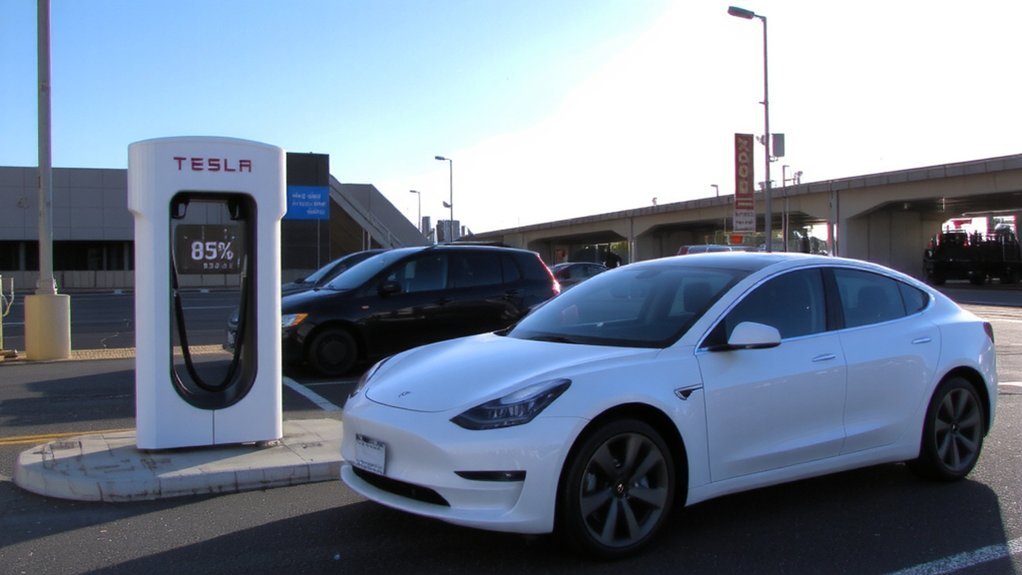
You’ll typically go from 10% to 80% state of charge in about 15–20 minutes on a 250 kW V3 Supercharger. Under ideal conditions your Model 3 can add roughly 175 miles of range in 15 minutes (about 11.7 miles per minute).
Preconditioning, temperature, and site power will affect those rates, so plan to charge to ~80% for the fastest stops. Tesla models support all three charging levels.
10–80% Charge Times
Anyone charging a 2025–2026 Model 3 on a V3 Supercharger can expect to reach about 80% in roughly 15–20 minutes when conditions are good, thanks to the 250 kW peak rate (V3 can even put back about 75 miles of range in 5 minutes at peak). You should plan stops assuming 15–20 minutes to 80% from low state of charge; colder batteries or high starting SOC slow rates. Use Tesla’s battery preconditioning to improve speed and reduce charge time variation.
Expect charging to taper considerably after about 65–80% to protect battery health, so avoid relying on the final 20% for quick top-ups. Older V2 stalls take longer. Monitor connector and battery temperatures and follow on-screen guidance for safe, efficient sessions. Check software updates regularly. In real-world conditions, Tesla models typically charge 25% faster when their batteries are preconditioned.
Range Added in 15 Minutes
A V3 Supercharger’s 250 kW peak means you can add roughly 150–200 miles of Model 3 range in about 15 minutes under ideal conditions, with bursts like ~75 miles in 5 minutes at peak power. You should plan stops so the battery is lowish (10–30% SOC) and preconditioned for fastest, safest charging and battery health. Enabling battery preconditioning before arrival can improve peak charging speeds and reduce overall charge time.
Real-world rates vary with temperature, SOC and charger availability; expect somewhat less than peak and watch the charging curve as you approach 80%. Keep safety in mind: avoid full charges on long trips and monitor cable and connector for heat.
- Low SOC (10–30%): adds ~150–175 miles in 15 minutes.
- Mid SOC (30–65%): near-peak speeds, 150–200 miles possible.
- High SOC (>80%): tapering, much slower, avoid if possible.
V2 and Older Superchargers: What to Expect

You’ll notice V2 and older Superchargers deliver reduced peak power compared with V3/V4, topping out around 150 kW. That lower ceiling means a Model 3 typically takes up to about 40 minutes to reach 80% state of charge.
Expect longer sessions when stations are shared or the battery’s already high, so plan stops accordingly. Also, battery preconditioning can help maintain faster charging in cold conditions.
Reduced Peak Power Output
Many V2 Superchargers cap peak output around 150 kW per car. You’ll see slower charge rates than V3 stations, especially for Long Range and Performance Model 3s, so plan for longer dwell time. Power sharing at V2 stalls can further reduce your individual rate when others charge.
The charging curve peaks roughly between 10% and 60–65% SOC, then tapers considerably, so charging past 80% is inefficient and less safe for battery longevity. Consider topping to 80% for practical trips and use home or Level 2 charging to avoid pressure at public bays.
- Peak power: ~150 kW; falls after ~65% SOC.
- Sharing: stalls split power, slowing you.
- Tip: favor 10–80% charges for safety and speed.
Check station status before arrival frequently. They use DC charging to deliver high power quickly.
Up to 40 Minutes
Because V2 and older Superchargers cap output around 150 kW and taper heavily after roughly 65% SOC, expect up to about 40 minutes to reach 80% on a depleted Model 3. You’ll typically add 100–150 miles in 30–40 minutes on V2 equipment; initial 10–65% charging can be fast (about 13–17 minutes) then slows, so plan stops accordingly.
Cold or hot temperatures, battery age, and a low starting SOC lengthen sessions. Preconditioning the battery before arrival can shave roughly 25% off times and improves safety by reducing stress on the cells. Since charging past 80% takes as long as earlier charging and stresses the pack, limit Supercharger sessions to 80% for safer, faster, and more predictable results. Always monitor temperature and cable condition while charging. Note that charging is fastest between 0-80% charge, so most rapid gains occur in that window.
Level 2 Home Charging With the Tesla Wall Connector
If you want the fastest home charging for a Model 3, the Tesla Wall Connector can deliver up to 44 miles of range per hour (11.5 kW/48A) when your car accepts that current, but some trims — particularly certain RWD Model 3/Y versions — are limited to about 32A (~30–32 miles per hour).
Also, remember that charging is best measured in energy (kW) and the Wall Connector’s capacity is 11.5 kW.
Install a Wall Connector hardwired by a certified electrician to reach output and follow code. Check your trim’s onboard charger limit in Tesla guidance upgrading.
Expect about 5–6 hours for a 60 kWh battery from ~10% at max rate; real results vary with temperature and efficiency. Use the Tesla app to schedule charging and monitor safely.
- Verify vehicle max current.
- Hire a licensed electrician.
- Keep firmware, Wi‑Fi active.
NEMA 14-50 and Other 240V Home Charging Options
You can get up to 30 miles of range per hour from a NEMA 14-50 (240V, 32A) using the Tesla Mobile Connector.
A hard-wired Tesla Wall Connector can supply higher continuous amperage and cut charging time if it’s installed on a larger circuit. Compare installation cost, future flexibility, and how many miles per hour you need when choosing between them.
The vehicle supports up to 11.5 kW on AC charging, which affects how quickly you can add range at home.
NEMA 14-50 Charging Speed
When you plug a Model 3 into a NEMA 14-50 240V outlet, you’ll get a practical overnight charging solution that delivers roughly 30 miles of range per hour. The outlet is capable of supplying 50 amps when properly wired. You’ll draw about 32 amps from the outlet for typical Model 3 onboard charging, staying well within the outlet’s safe continuous-use limit when circuits are sized correctly.
Expect a 20%→80% charge in roughly 8–12 hours depending on battery size. Follow code and the 80% rule (40 A continuous limit) and have a qualified electrician install or inspect the circuit. Use Tesla’s charge limits to protect battery health and avoid prolonged maximum charging. Also monitor connections and breakers regularly.
- Charge rate: ~30 miles/hour.
- Typical time: 8–12 hours (20→80%).
- Safety: respect 40 A continuous rule.
Wall Connector Comparison
How do NEMA 14-50 outlets stack up against dedicated wall connectors for charging a Model 3? You’ll find NEMA 14-50 and similar 240V outlets offer reliable Level 2 charging at lower installation cost, typically delivering 30–45 miles per hour depending on amperage. A NEMA 14-50 is cheaper to install than a Tesla Wall Connector, but a dedicated Wall Connector or universal unit can provide higher sustained power (up to ~44 mph) and smart features like scheduling and monitoring.
Choose certified installers, proper breakers, and correct wiring to meet codes and protect your home. If you need flexibility, consider non‑Tesla chargers with adapters; if you prioritize peak rate and seamless integration, opt for a Tesla or universal Wall Connector. Verify permits and follow safety rules. Many owners choose chargers like the Emporia Pro for its load balancing and detailed energy tracking.
Level 1 (120V) Charging: Overnight and Emergency Use
A standard 120V household outlet (Level 1) will charge a Model 3 at about 3 miles of range per hour, delivering roughly 1.3–1.4 kW and making it the slowest, emergency-or-overnight option; you should treat it as a backup or occasional overnight top-up rather than a primary solution. Level 1 uses standard NEMA 5-15 plugs found in household outlets. It’s simple and requires no installation, but expect 30–40+ hours for a full charge depending on battery size, and longer if the circuit is shared or temperatures are low.
For safe, practical use follow these points:
- Use a dedicated, properly grounded outlet and avoid extension cords, and check the circuit breaker.
- Monitor charging overnight and keep the car in a ventilated area.
- Limit Level 1 to daily top-ups under ~30–40 miles or emergency situations.
DC Fast Charging (10%–90%): Speeds and Tapering
If you need far quicker top-ups than overnight Level 1 provides, DC fast charging (10%–90%) gives the jump in speed: on a Tesla V3 Supercharger at up to 250 kW you can go from about 10% to 80% in roughly 15–20 minutes, while slower V2 or non‑Tesla stations take longer.
You’ll see peak power from roughly 10% to 50%–60%, then charging tapers to protect the battery as SOC rises. V2 (150 kW) sessions to 80% can take up to about 40 minutes; non‑Tesla DC chargers often top near 183 kW, and V4 Superchargers keep 250 kW with better accessibility.
For routine stops, aim for 80% to minimize time in the taper; reserve higher top‑offs for long trips and monitor charging safely while plugged in. The Model 3 uses the CCS standard for its charging inlet.
How Battery State, Temperature, and Charge Limits Affect Times
Many factors — state of charge, battery temperature, and your chosen charge limit — determine how long a charging session takes. You’ll know lower SoC means more energy and longer sessions, while charging above 80% slows substantially to protect the battery.
Charging time depends on state of charge, battery temperature, and your chosen charge limit—tapering above 80%.
Cold batteries accept charge slowly; Tesla preconditions on route to cut time and protect cells. Set sensible limits: daily ~80% for longevity, 100% only for trips. Also consider battery age and accessories running while charging, which can lengthen sessions.
- State of charge: lower start SoC = longer charge; taper after 80% slows final stage.
- Temperature: cold reduces acceptance; preconditioning helps; extreme heat also affects performance.
- Charge limits: lower targets shorten sessions and reduce wear; override sparingly.
Always follow Tesla’s charging guidance carefully.
Typical Charging Scenarios and Estimated Time-To-Range
Understanding how different chargers add range helps you plan stops and daily charging around your battery’s state, temperature, and chosen charge limit. Level 1 (120V) gives about 3 miles per hour — fine for emergencies but impractical for daily use; expect 30–40+ hours to fully charge.
Level 2 home or destination chargers deliver up to ~44 miles per hour (Wall Connector) and typically fill a Model 3 overnight in roughly 5–8 hours, depending on battery.
DC fast charging varies: Tesla Supercharger V3 can add up to 200 miles in 15 minutes (10–80% in ~15–25 minutes). Third‑party DC fast chargers usually charge slower (50–150 kW) and may need a CCS adapter; monitor rates and avoid charging above 80% unless necessary.
The Model 3 is offered in rear-wheel drive and dual-motor all-wheel-drive configurations. Stay informed and charge safely.
Charging Management: Apps, Scheduling, and Best Practices
Anyone can streamline Model 3 charging with the right apps and simple scheduling. PlugShare is useful because it aggregates networks so you can compare stations across providers. You’ll use the Tesla app to monitor progress, schedule off‑peak charging, and precondition the battery for faster Supercharger fills. Combine PlugShare, Electrify America, NextCharge or EVgo to plan routes, reserve chargers, and compare costs, keeping safety and battery health foremost.
Streamline Model 3 charging with the Tesla app, smart scheduling, route apps, and battery-friendly habits
- Use scheduled charging at home, avoid charging above 80% for daily use.
- Precondition en route to Superchargers, monitor sessions remotely, and stop charging at your target SOC.
- Prefer Level 2 for routine charging; reserve DC fast charging for long trips and emergencies.
These steps reduce time, cut costs, and protect your battery. Always follow charger signage, keep cables intact, and attend vehicle while charging to guarantee safe operation.
Conclusion
You’ve seen how charging varies by battery, charger, and conditions. Stick to home Level 2 for daily top-ups, use a V3 Supercharger for long trips, and avoid charging to 100% unless you need range. Monitor temperature and set charge limits to protect the battery. Use scheduling and apps to optimize costs and readiness. Charging’s like filling a cup—faster at first, then it slows as you reach the brim. You’ll get predictable results with these habits.