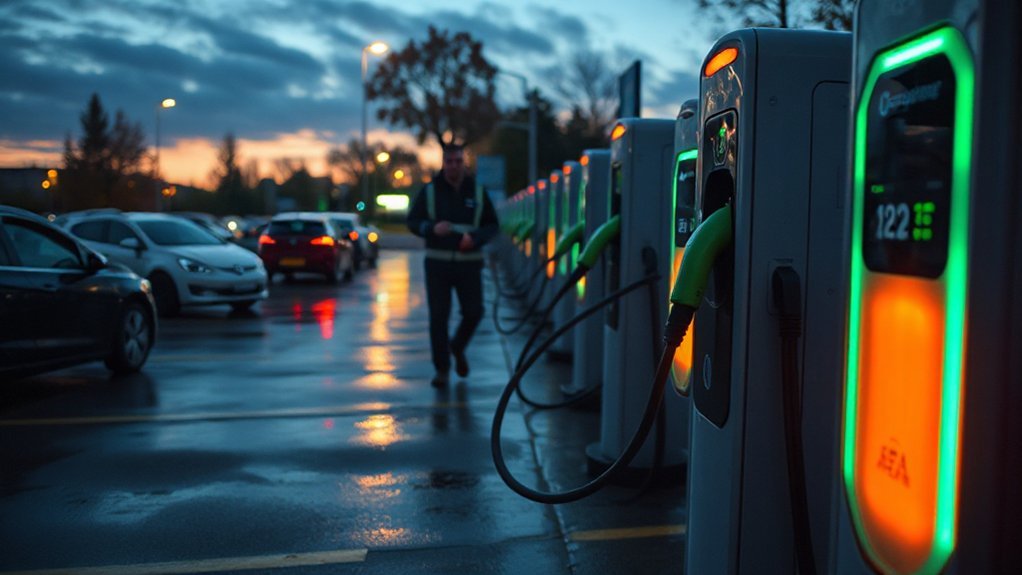
In 2025 failed charging attempts fell to 14% from 19% the year before, so you can expect fewer interrupted trips. You’re still likely to hit trouble depending on region, network, and station age. Tesla Superchargers keep leading, while non‑Tesla networks are improving unevenly. So you’ll want to know which providers score best for uptime and fast repairs.
Key Takeaways
- As of 2025, failed charging attempts dropped to 14%, reflecting roughly 85.5% station reliability in Q2 2025.
- Tesla Superchargers remain significantly more reliable than most third‑party networks, topping uptime and user satisfaction rankings.
- About 60% of charging failures stem from chargers being out of service or malfunctioning, not payment or app issues.
- Reliability varies widely by region — the Pacific reports higher failed‑visit rates while other regions show better uptime.
- Reliability is improving via software upgrades, newer hardware, and proactive maintenance; plan routes and report faults promptly.
Current State of U.S. Public Charger Reliability

How reliable are public chargers right now? You’re seeing steady improvement: failed charging attempts dropped to 14% in 2025 from 19% in 2024, but that still means roughly one in seven attempts fails. Overall reliability metrics have improved, with reported station reliability rising slightly to 85.5% in Q2 2025.
Most failures—about 60%—come from chargers being out of service or malfunctioning, so you should plan backups. Reliability varies widely by region and network; the Pacific reports high failed-visit rates and long waits in cities like Seattle and Los Angeles, while East South Central performs much better.
Tesla Superchargers stay highly reliable, yet many non‑Tesla networks are improving slowly. Disadvantaged communities and renters face far fewer chargers and lower accessibility, increasing risk for drivers without home charging. You should map alternatives and allow extra time to stay safe and carry contact numbers.
Paren’s Reliability Index and Metrics Explained

You’ll want to know Paren’s Reliability Index is built around first-time plug success—the percentage of charging attempts that start and complete without retries or failures.
The index is calculated on a 0–100 scale by aggregating real-world charging events across U.S. public fast chargers (excluding Tesla) and factoring in failed sessions, availability, and downtime.
You can use the quarterly-updated score to compare networks and pinpoint where operators need to improve. Recent data shows the national index saw a 1.7% improvement in Q1 2025 versus Q4 2024.
First-Time Plug Success
Because getting a charge on the first try matters to drivers, Paren’s Reliability Index zeroes in on first-time plug success — a 0–100 score that rose to 85.5 in Q2 2025 and captures whether a connector starts charging immediately and is actually available. You rely on that initial connection; the metric tracks successful immediate plugs without errors, giving you confidence and safer trip planning.
Improvements come from backend upgrades, newer hardware, and proactive maintenance that cut failed connections and downtime. Still, regional and operator variations persist, and aging stations remain weak spots that can compromise safety and reliability.
Use the index to choose networks and avoid risky, outdated chargers until operators modernize infrastructure. Report persistent failures to operators and regulators to accelerate fixes promptly. The broader network’s measured U.S. Reliability Index rose 1.7% versus Q4 2024.
Index Calculation Method
The Paren Reliability Index quantifies charger reliability as the percentage of charging sessions that start and complete as intended, using real-world session outcomes rather than just reported uptime. As EV adoption reached a historic high in 2024, the index has become even more critical for drivers and policymakers. You’ll see a 0–100 score reflecting successful sessions across hardware, software and payment systems, updated quarterly as stations and data change.
We aggregate session-level data from major U.S. networks (excluding Tesla in some reports), classify each attempt as success or failure, then compute percent successful sessions. Calculations adjust for new or decommissioned stations and coverage shifts so scores stay comparable.
You can use the index to choose safer chargers, guide routing decisions, and hold operators accountable. Operators and regulators use it to pinpoint failures like broken connectors, glitches, or payment problems. That improves confidence and safety.
Network-by-Network Satisfaction Rankings (2025)
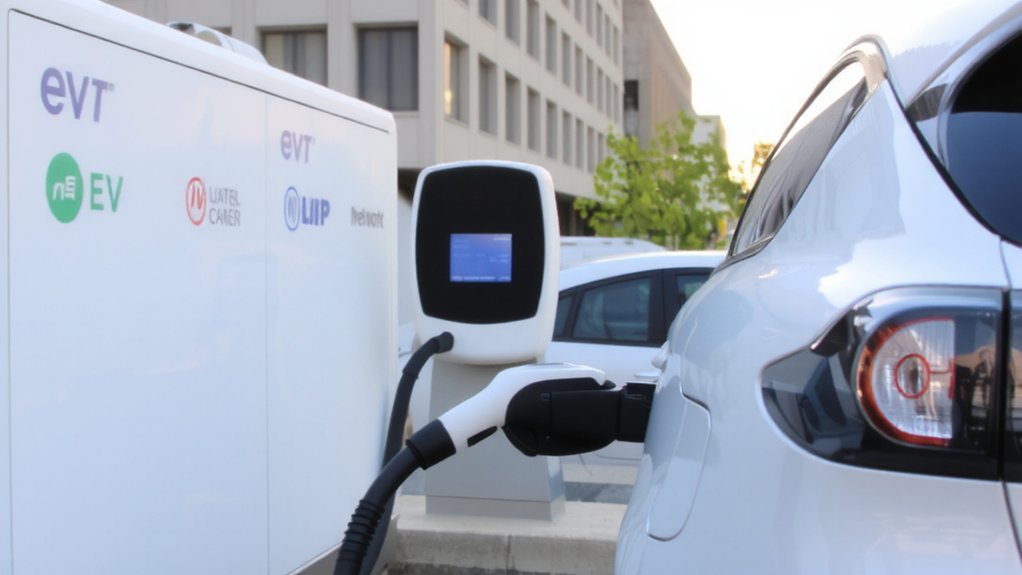
You’ll see a clear ranking of top networks and how they stack up across Level 2 and DC fast charging. Tesla leads both categories (709 DC, 661 L2), followed by Red E (668 DC) and ChargePoint (628 L2), while lower-performing networks push the DC gap to over 200 points and the AC gap to about 100 points.
Keep those score spreads in mind when you compare reliability and user experience across providers. Survey results also show that failed charging visits are at their lowest level since the study began in 2021, indicating improved reliability overall.
Top Networks Ranked
While regional preferences vary, Tesla tops 2025 satisfaction rankings—leading in countries like France and Switzerland, commanding over 54% market share in the US with nearly 32,000 ports and more than 60,000 global stalls, and offering up to 250 kW speeds plus NACS compatibility. Across multiple countries, Tesla Superchargers consistently claim the top spot in user ratings. You can rely on Tesla’s broad coverage and rapid charging to reduce range anxiety and support safer trips, thanks to integrated renewables and robust software.
Other top networks offer complementary strengths:
- Fastned: ultra-rapid, clean sites with high availability for predictable stops.
- Electrify America: wide US metro coverage and high-capacity stations.
- ChargePoint: largest location count, strong app integration; ownership varies, so check status.
- EVgo/BP Pulse: strategic growth, rapid deployment and safety-focused installations with documented emergency procedures regularly reviewed.
Network Score Spread
Across major networks, satisfaction scores span from Tesla’s top 709 down to Blink’s 557, revealing clear tiers in 2025. You can see Tesla and Red E (668) leading DC fast charging, with ChargePoint (628) ahead among Level 2 providers and above the 607 industry mean.
Electrify America (601) and Shell Recharge (579) sit lower, creating practical performance gaps you should note when planning routes. Tesla’s advantage reflects reliability, payment ease, and coverage, though its score fell 22 points year‑over‑year. Costs and payment problems drag many networks’ ratings despite fewer failed visits.
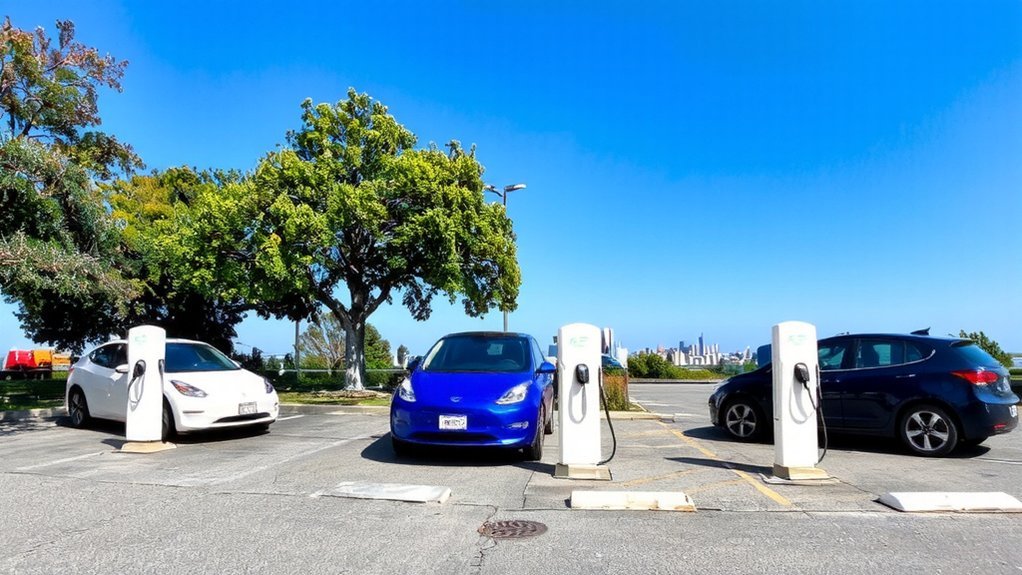
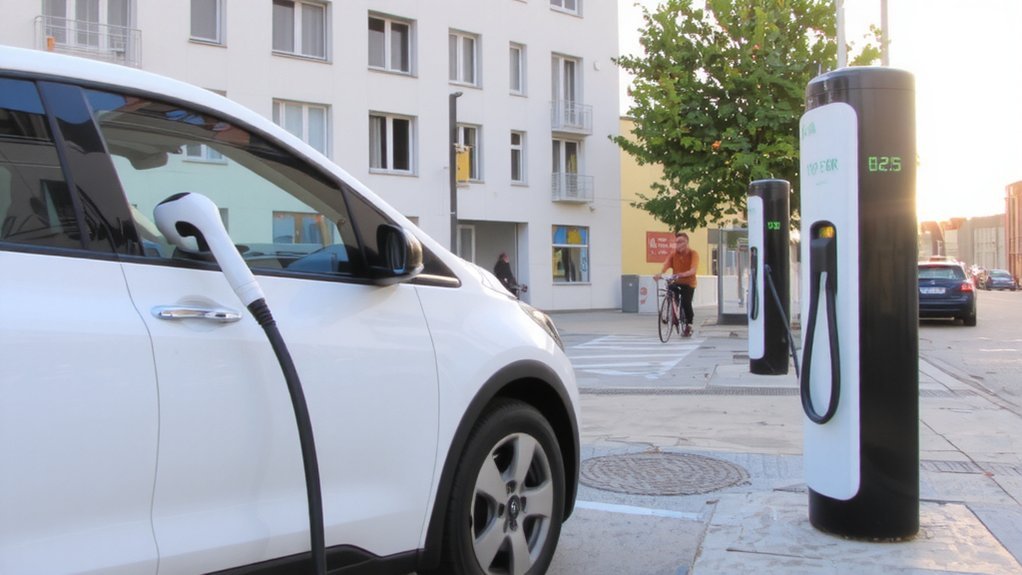
For safety and predictability, prioritize networks with higher scores and proven uptime; keep backup options in mind for longer trips. You should also monitor regional differences and new entrants that match Tesla’s performance today. Survey results also show that 53% unable to charge.
Tesla vs. Third-Party Providers: Performance Gap
Comparing Tesla’s Supercharger network to third-party providers, reliability ratings for 2025–2026 favor Tesla by a noticeable margin: you’ll generally encounter fewer outages and more consistent power delivery, which reduces safety risks and keeps charging predictable. When choosing charging options, prioritize networks that score higher for uptime and maintenance responsiveness. The Supercharger system is industry standard for charging reliability.
Supercharger uptime: higher average availability, quicker repairs.
Third-party variability: wider performance range, some hubs lag.
Safety impact: consistent service lowers exposure to stranded or hazardous situations.
Maintenance transparency: Tesla posts more frequent status updates; third parties vary.
You should plan routes around higher-rated networks, keep emergency contacts handy, and report faults promptly to help improve overall safety. Carry a charged mobile phone and basic supplies in case you need assistance immediately.
First-Time Plug Success and Failed Visit Trends
Although first-time plug success has improved — the Paren US Reliability Index rose to 85.5 in Q2 2025, and failed-visit reports fell to 14% from 19% in 2024 — you’ll still encounter uneven performance: operators differ, some stations remain unreliable, and urban centers show higher failure rates. Nationally, only 14% of EV owners reported failed charging attempts in 2025, down from 19% the year before, highlighting fewer failed attempts. When a visit fails, 60% are due to chargers being out of service or malfunctioning, so you should plan backups and report faults promptly. Networks are investing in backend fixes, maintenance and diagnostics to raise first-time success, but pockets of risk persist in certain high-use cities. For safety, always verify charger status before leaving your vehicle and have an alternate charging option. Carry a charger app screenshot, an emergency contact, and report failures promptly and share location data.
Regional Variations and Aging Infrastructure
You’ll find reliability varies sharply by region and city: the Pacific saw 21% non-charge visits in 2025 versus a 14% national average, Seattle and Los Angeles logged 25% and 24% failed attempts, and San Francisco and Denver had the longest waits for access at 18% and 14% respectively.
You should plan routes with redundancy, avoid single-point setups, and favor networks with strong uptime scores. Aging stations drive many outages; upgrades are uneven and slower where old hardware concentrates. Federal and industry efforts aim to raise standards, but funding gaps slow progress.
Consider safety steps: stay charged, report faults, and choose stations with maintenance records.
- Prefer high-reliability networks.
- Check real-time status apps.
- Report broken equipment promptly.
- Keep a safety buffer charge.
Also, cable design affects efficiency, weight, and powertrain performance, which can indirectly influence real-world charging behavior and EV range.
Customer Experience: Cost and Payment Frictions
Why is cost become the top complaint for DC fast charging? You’re paying more as operators raise rates and add time‑of‑use pricing, and non‑Tesla drivers often face higher Supercharger fees than Tesla owners. That rising cost, combined with inconsistent price transparency, makes you wary of unexpected bills and unsafe detours to find cheaper power.
Payment frictions worsen trust: app failures, card‑reader glitches, and tangled account linking delay charging and leave you stranded. Networks are piloting battery storage, subscriptions, and loyalty plans to steady prices and simplify payments, and support teams are expanding.
Until payment reliability and clear pricing become standard, you should plan routes conservatively, confirm costs before plugging in, and keep backup payment options available. Carry a charged card and emergency charger adapter. Networks with higher uptime, such as ChargePoint and Tesla, typically report 98% uptime, which reduces the risk of being stranded.
Policy, NEVI Funding, and Industry Coordination
NEVI directs $5 billion from the Infrastructure Investment and Jobs Act to build out public fast charging, prioritizing designated EV corridors while letting states fund other public sites once corridors are served. You’ll see state plans updated annually and, after 2025 guidance changes, many states can resubmit to access frozen FY22–26 funds. Following the executive order and agency review, the FHWA paused NEVI disbursements and later issued interim guidance to realign the program with administration priorities, known as the FHWA pause.
The Joint Office coordinates technical assistance so utilities, DOTs, and operators align on safe, reliable deployment. Minimum standards (four ports, 150 kW each), Build America requirements, and quarterly EV‑ChART reporting help you monitor performance and safety.
- Expect flexible site selection and reduced federal spacing rules.
- Watch for MHD and station upgrade funding.
- Look for resumed awards and accelerated builds.
- Verify data reporting and grid coordination for safer operations.
Outlook: Emerging Standards, New Entrants, and Next Steps
Several industry shifts—widespread NACS adoption, California’s Plug & Charge mandate, automaker-backed networks, and emerging megawatt, bidirectional, and AI‑driven maintenance technologies—are reshaping public charging.
You’ll soon see more universal NACS ports and Plug & Charge reducing touchpoints and transaction errors, improving safety and predictability.
New entrants and automaker networks expand access, but you should watch for consistent OCPP support and NEVI/California 97% uptime rules to guarantee reliability.
Ultra‑fast megawatt chargers and V2G pilots promise rapid recovery and grid resilience, yet installers must follow forthcoming NEC GFCI rules to safeguard users.
Expect AI predictive maintenance and stronger cybersecurity to cut downtime.
For your safety, favor networks that publish uptime, support Plug & Charge, and comply with local mandates. Also carry EV safety gear and emergency contacts. Regulators increasingly enforce clear standards to ensure charger interoperability and safety, most notably the NEVI uptime requirement.
Conclusion
You’ve seen the gains: fewer failed visits, smarter maintenance, and networks waking up to reliability. But don’t relax—geography, aging hardware, and clunky payments still lurk. When you plug in next, you’ll want to pick a high-scoring network, not gamble. Policy moves and new entrants could flip the script, yet outcomes hinge on execution. Keep watching uptime and responsiveness closely—the next few quarters will tell whether progress becomes dependable or merely promising or disappointingly stalled.