
Over 80% of EV charging happens at home, so your Leaf’s Level 2 setup must be safe, code‑compliant, and sized right. You’ll match the EVSE amperage to the Leaf’s onboard AC limit, apply the NEC 125% rule for the circuit, and choose a UL‑listed J1772 with the right outdoor rating and cable length. Decide plug‑in versus hardwired and plan permits with a licensed electrician. Next, we’ll size it to your daily miles.
Key Takeaways
- Match EVSE amperage/kW to your Leaf’s onboard AC charger limit; confirm in owner’s manual to avoid overspec.
- Size the circuit at 125% of EVSE output (e.g., 40A EVSE on 50A breaker) and use a dedicated 240V two-pole breaker.
- Choose UL-listed J1772 EVSE with proper outdoor rating (NEMA 3R/4 or IP54+), temperature range, and durable 20–25 ft cable.
- Prefer hardwired for higher amperage and reliability; ensure adjustable current, scheduling, and local control for TOU savings.
- Verify app configuration, firmware security, permits, incentives, and that EVSE can be locked/configured to respect vehicle and wiring limits.
Know Your Nissan Leaf’s Onboard Charger Limits
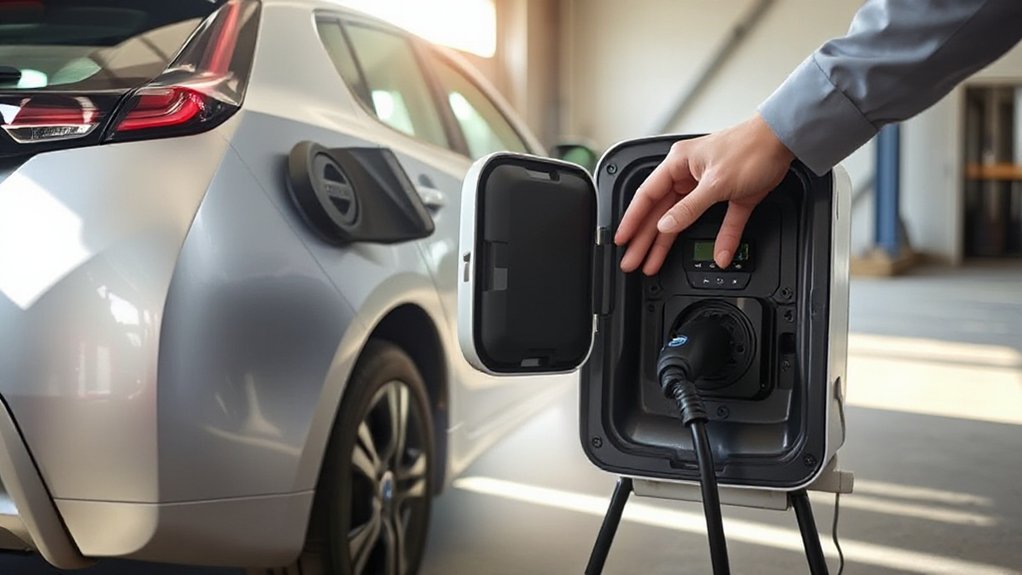
How fast can your Leaf actually charge? Start by confirming the onboard charger rating in your owner’s manual or service label. Nissan Leaf model variations ship with different onboard chargers, so you must match expectations to the car’s AC intake limit, not the station’s headline number. Firmware and software limitations can also cap draw, especially after battery or BMS updates. For a safe, code-compliant installation, document the vehicle’s maximum AC current and continuous-load status, then size wiring, breaker, and receptacle accordingly under NEC 625 and 210 rules. Verify the EVSE can be configured to respect that limit, and lock settings. Use conductors rated for the ambient, proper GFCI protection as required, correct grounding, and labeling that states the continuous EV load for installer reference.
Choosing the Right Amperage and Kw Output
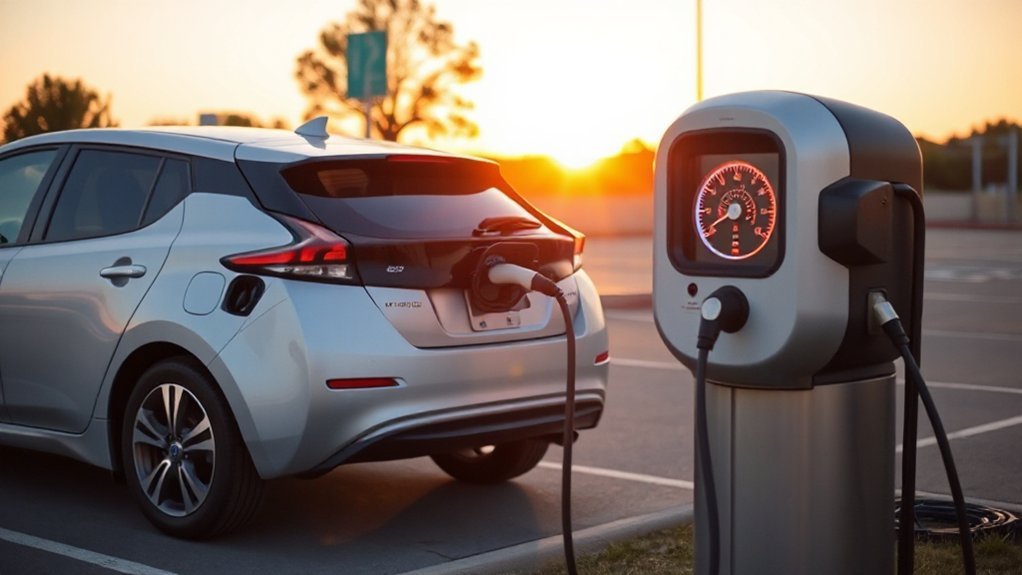
With your Leaf’s onboard AC limit documented, choose an EVSE amperage and kW rating the car can use while meeting NEC continuous-load rules. Size the circuit at 125% of continuous current: a 40A EVSE needs a 50A breaker and appropriately rated conductors. Don’t overspec beyond the Leaf’s onboard charger; unused capacity raises install cost without faster charging. Prefer UL-listed units, GFCI protection, and a plug or hardwire method suited to the circuit.
Match EVSE to Leaf’s onboard limit; size circuits per 125% NEC, avoid overspec, choose UL-listed GFCI units suited to circuit.
- Match amperage to the Leaf’s max AC draw; set the EVSE’s adjustable current to protect wiring and battery longevity.
- Select kW output based on supply voltage: 240V x amps ÷ 1000.
- Consider panel capacity and energy costs; balance demand charges, time-of-use rates, and cable heat for safe, efficient operation.
Matching Charging Speed to Your Daily Driving
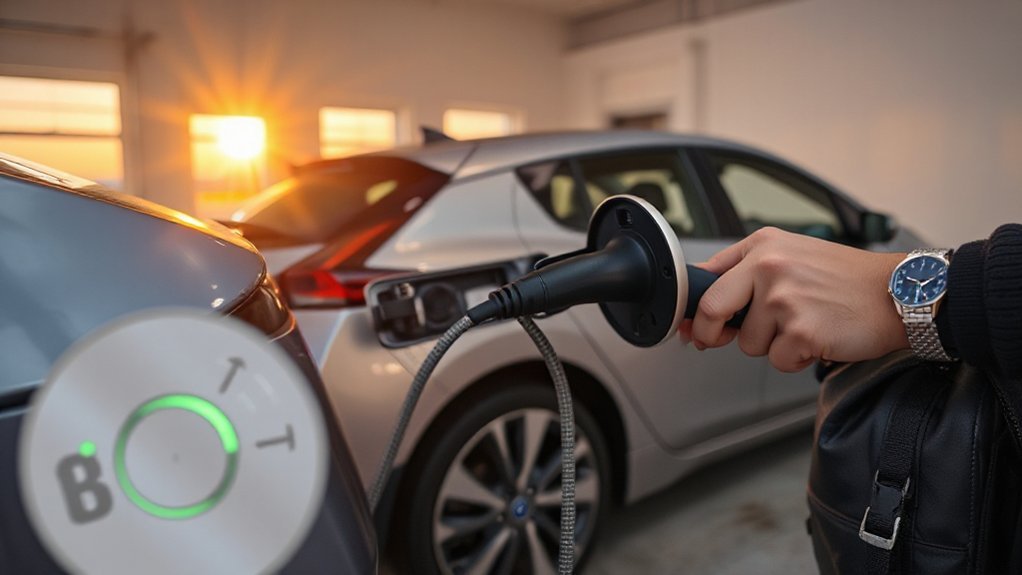
Why size charging speed to your routine? You’ll avoid overspending and guarantee safe, code-compliant installation. Start by mapping daily miles, commute variability, and typical dwell time at home. If you often return with low state of charge, choose a higher kilowatt unit; if not, a mid-range model balances cost, load, and lifestyle alignment. Confirm panel capacity, breaker rating, conductor size, and run length to support a continuous load at 125% per NEC.
| Daily miles | Home dwell | Suggested charging speed |
|---|---|---|
| <30 | Overnight | 3.3–4.8 kW |
| 30–60 | 6–8 hours | 7.2 kW |
| >60 or variable | 3–5 hours | 9.6–11.5 kW |
Choose hardwired for higher amperage and outdoor durability; use a dedicated circuit, GFCI protection where required, and permit/inspection. Schedule load calculations and panel upgrades with a licensed electrician first.
J1772 Connector Compatibility and Cable Standards
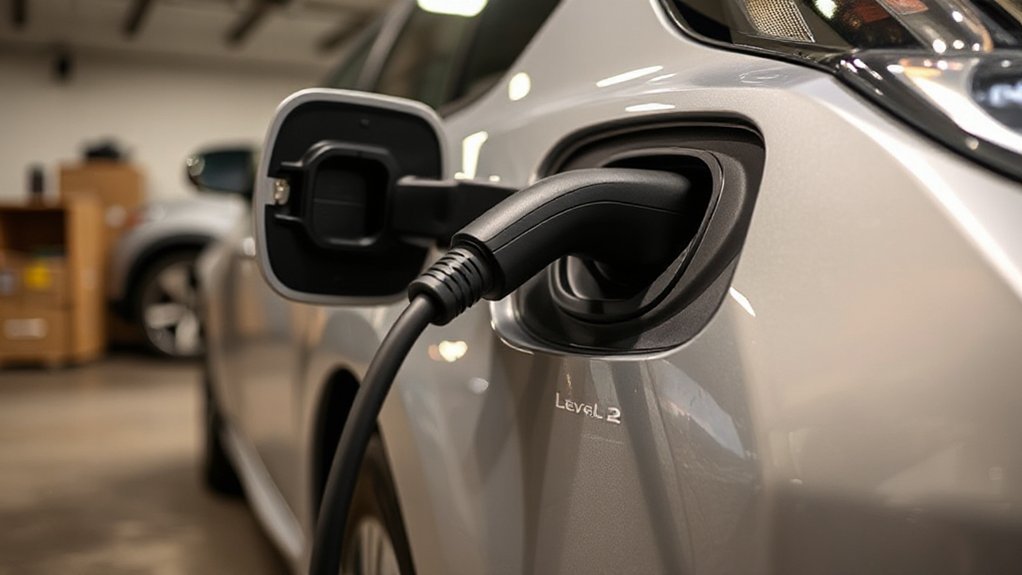
A Nissan Leaf uses the SAE J1772 coupler for all Level 2 AC charging, so select a UL-listed EVSE with a J1772 handle and cable assembly tested to UL 2594/UL 2251/UL 2231. Verify the connector’s latch, gasket, and strain relief feel robust, and confirm temperature ratings you need for outdoor duty. Make sure communication protocols between EVSE and Leaf negotiate current properly; that’s your safety gate.
- Choose a cable length that reaches your charge port without extensions; longer runs add drop and clutter. Prefer 32–40A-rated, oil/UV-resistant jackets.
- Check adapter interoperability carefully. Avoid dodgy adapters; they can break pilot signaling and ground paths.
- Look for a molded handle with ingress protection, capped holster, and flexible cold-weather cable. Confirm labeling, warranty, and third-party listings.
Plug-In Vs Hardwired Installation Considerations
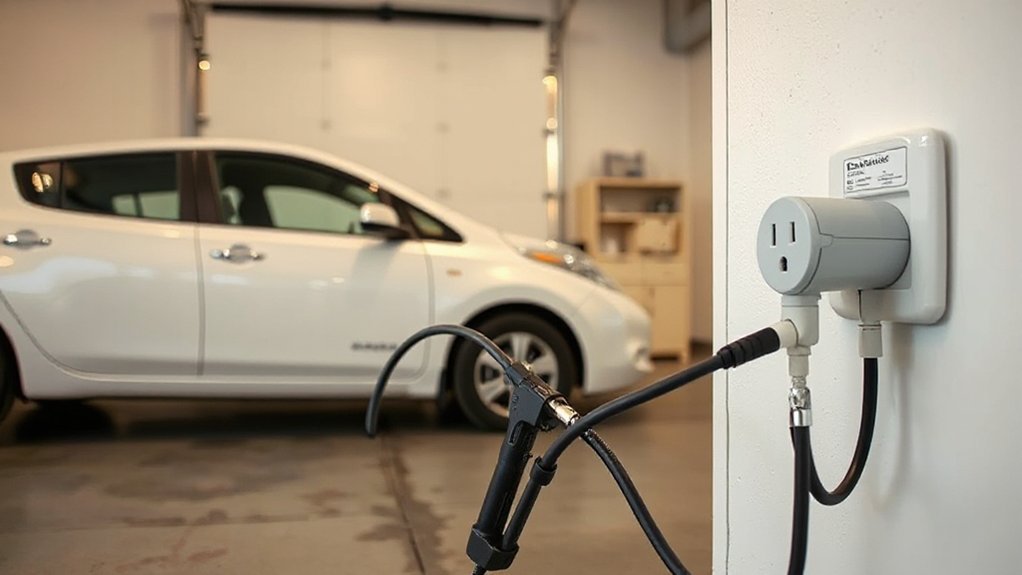
Before you buy, decide whether a plug-in (NEMA 14‑50/6‑50) EVSE or a hardwired unit fits your site and local code. Plug-in units install faster: mount the bracket, verify a properly grounded, listed receptacle, and use a weatherproof in-use cover outdoors. They offer Portability advantages if you move or need Tenant permissions in multifamily housing. However, cords and plugs must be supported, not strained, and located within the EVSE manufacturer’s allowed distance from the outlet. Hardwired units reduce exposed connections, simplify exterior installations, and often satisfy HOA rules; they also cut risks of loose receptacles or heat at the blades. Either path demands permits, inspection, and adherence to NEC, including GFCI protection where required, correct conductor types, drip loops, and secure bonding by qualified electricians.
Circuit Sizing, Breaker Selection, and Panel Capacity
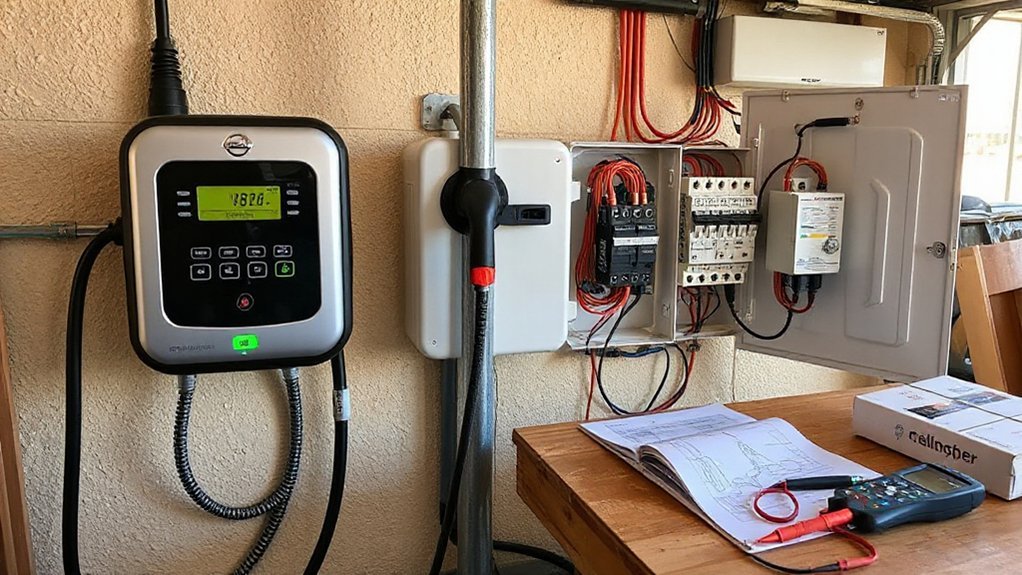
Start by determining the charger’s nameplate amperage and the Leaf’s onboard limit, then treat the EVSE as a continuous load at 125% per code. Choose a dedicated circuit and breaker sized to that 125% value, and match conductor and receptacle ratings accordingly. Confirm panel capacity with a proper load calculation and available spaces; if you’re near limits, plan a service upgrade or subpanel.
Determining Charger Amperage
How do you pick the right amperage without overloading your panel or violating code? Start by confirming the Leaf’s onboard charger limit, then size the EVSE output to match charging needs, inrush current behavior, and your service capacity. Account for continuous-load rules (EV charging is continuous), feeder ampacity, and any demand-response from utility tariffs.
- Calculate available capacity: review panel rating and main, subtract diversified household loads using NEC 220, and leave headroom for simultaneity.
- Select an EVSE with adjustable current (16–40A) that aligns with wire gauge, conductor count, and conduit fill; future‑proof within limits.
- Validate the circuit: confirm conductor temperature rating, voltage drop over run length, and listing requirements; obtain a permit and inspection.
Collaborate with a licensed electrician to finalize safe, code-compliant amperage.
Matching Breaker Rating

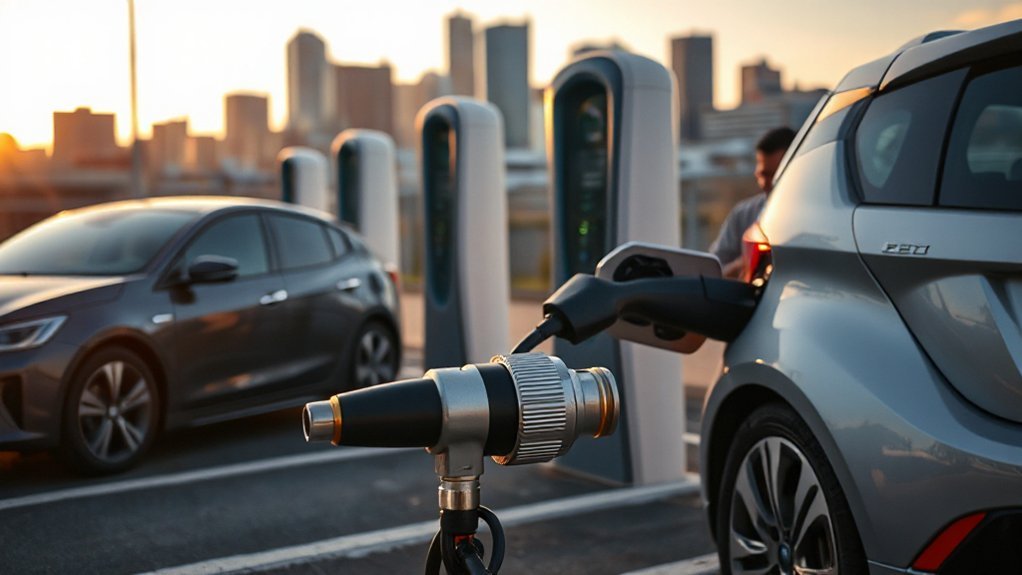

With your EVSE charging current chosen, match it to a dedicated 240V two‑pole breaker and conductors using the NEC 125% continuous‑load rule: the breaker must be at least 125% of the EVSE’s maximum output (16A → 20A breaker, 24A → 30A, 32A → 40A, 40A → 50A). Use copper THHN/THWN conductors sized for the breaker (e.g., 12 AWG for 20A, 10 AWG for 30A, 8 AWG for 40A, 6 AWG for 50A), in a properly rated raceway. Keep the EVSE on a dedicated branch circuit. If receptacle-fed, apply GFCI where required; hardwired units typically provide integral protection. Verify breaker trip curves to support Selective Coordination upstream. Account for Breaker Aging: replace questionable devices and torque lugs to spec. Label the circuit clearly at panel.
Assessing Panel Capacity
Why check panel capacity first? Your Leaf’s Level 2 charger adds a continuous load, so you need enough amperage headroom before selecting circuit size and breaker. Calculate service rating, existing loads, and available spaces; confirm the panel’s bus rating and main breaker.
- Tally loads: Use the NEC 220 load calc or a 125% continuous-load rule for EVSE. For a 32A EVSE, size the circuit to 40A and verify the panel can spare it.
- Inspect hardware: Note panel age, bus rating, and manufacturer specs for approved breakers and tandem limits. Replace obsolete gear.
- Verify capacity: Check main service amperage, breaker count, and temperature derating. If short, plan a subpanel or service upgrade.
Hire a licensed electrician to pull permits and verify compliance.
Cable Length, Holster Options, and Mounting Layout
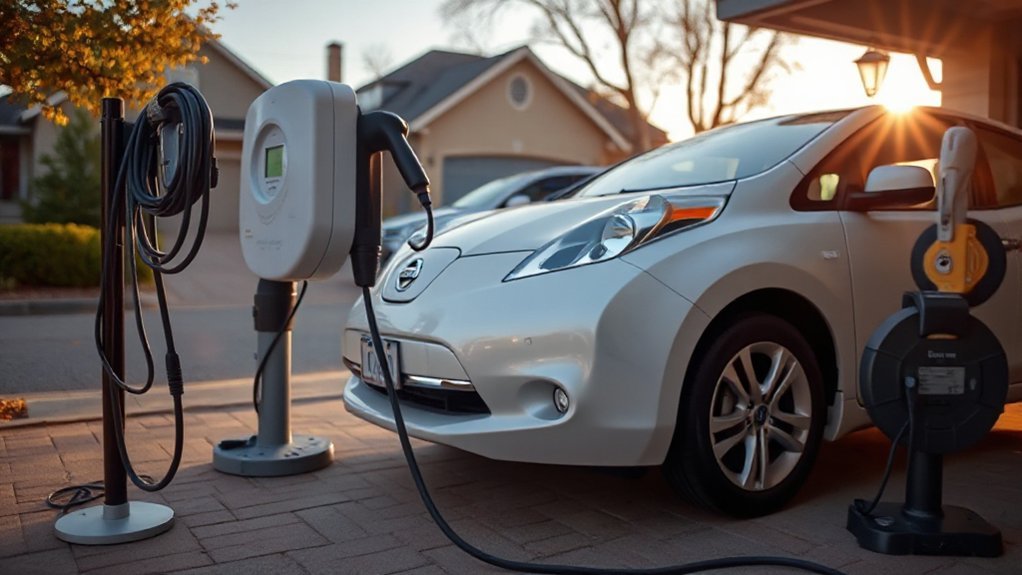
Before you pick a unit, plan cable length, holster placement, and mounting so the Leaf can charge safely without strain or trip hazards. Measure your usual parking spot and the Leaf’s front charge port; a 20–25 ft cable usually reaches with slack for proper bend radius. Route the cord along walls, not across walkways, and include a strain relief at the holster. Mount the holster 36–48 in above the floor for accessibility compliance and easy one-hand docking. Place the EVSE on a stud or masonry anchors, allowing clearances for ventilation and service. Position the holster near the vehicle’s front centerline to minimize drag on the connector. Coordinate conduit, junction box, and bracket locations for clean aesthetic integration and code-compliant labeling, per NEC Article 625.
Outdoor Ratings, Temperature Tolerance, and Weatherproofing
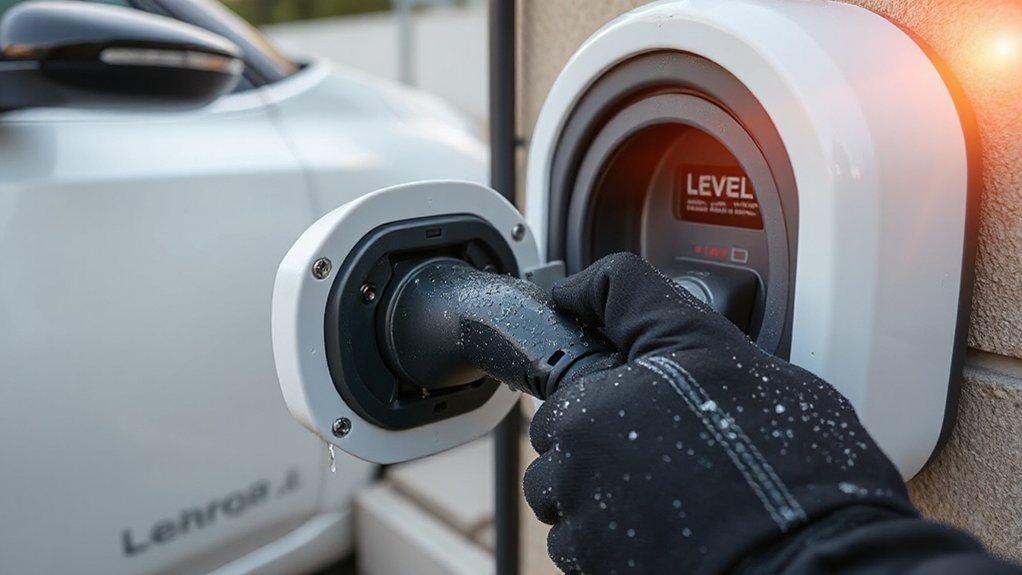
For outdoor installs, you should select a charger with appropriate NEMA or IP ratings that match exposure conditions and satisfy local code. Confirm the operating temperature range matches your climate to prevent derating, nuisance trips, or premature failure. Inspect enclosure seals, connector gaskets, and cable jacket durability (UV resistance, abrasion resistance, cold flexibility) to guarantee long-term weatherproof performance.
NEMA and IP Ratings
How do you choose an EVSE enclosure that won’t quit outdoors? Start by reading NEMA and IP markings. NEMA 3R, 4, and 4X define enclosure protection against rain, hose-directed water, and corrosion; IP54–IP66 map dust/water ingress levels. Know the rating origins: NEMA standards come from NEMA/UL in North America; IP codes come from IEC. Verify listings and testing procedures on the nameplate and datasheet. For safe, code-compliant installs, mount the unit under an eave or use a NEMA 4/4X or IP65+ enclosure, proper drip loops, and in-use covers on receptacles.
- Check third-party certification (UL/cUL) and IP test reports.
- Match enclosure rating to exposure: rain, wash-down, coastal salt, dust.
- Seal conduit entries, use stainless hardware, and maintain gaskets.
Document everything for inspection.
Operating Temperature Range
While enclosure ratings address water and dust, you also need the EVSE’s listed operating temperature range to match your site’s extremes. Verify the UL/CSA listing and spec sheet; many units are rated around -22°F to 122°F (-30°C to 50°C). In hotter microclimates or direct sun, choose a higher ceiling or provide shade to prevent thermal derating and nuisance trips. In severe cold, confirm the contactor and display operate reliably, and that standby heaters, if present, meet NEC and manufacturer instructions. Mount on a rigid surface with clearance for ventilation. Use weatherproof conduit entries and fittings to maintain enclosure integrity. Temperature abuse accelerates electronics degradation patterns, shortening life and affecting charge rates. Expect possible range impact if repeated hot-soak charging elevates battery temps, over time.
Seals and Cable Durability
Beyond the unit’s operating temperature range, the enclosure seals and charge cable must survive sun, rain, ice, and grit without losing their rating. Choose a UL-listed EVSE with NEMA 4 or 3R enclosure, gasketed seams, and IP‑tested connectors. Verify the cable jacket resists UV degradation and remains flexible in cold to prevent micro-cracks and arcing. Use weatherproof hubs, tighten torque-spec fittings, and form drip loops.
1) Inspect gaskets, cable glands, and strain relief at install; replace hardened parts to maintain ingress protection.
2) Mount under an eave or pedestal with clearance from sprinklers and snow loads; keep the handle off ground.
3) Follow NEC 625: outdoor-rated circuit, GFCI protection, correct conductor size, and dedicated breaker; label disconnects and test regularly, at least twice yearly.
Smart Features: Wi‑Fi Apps, Load Sharing, and Scheduling
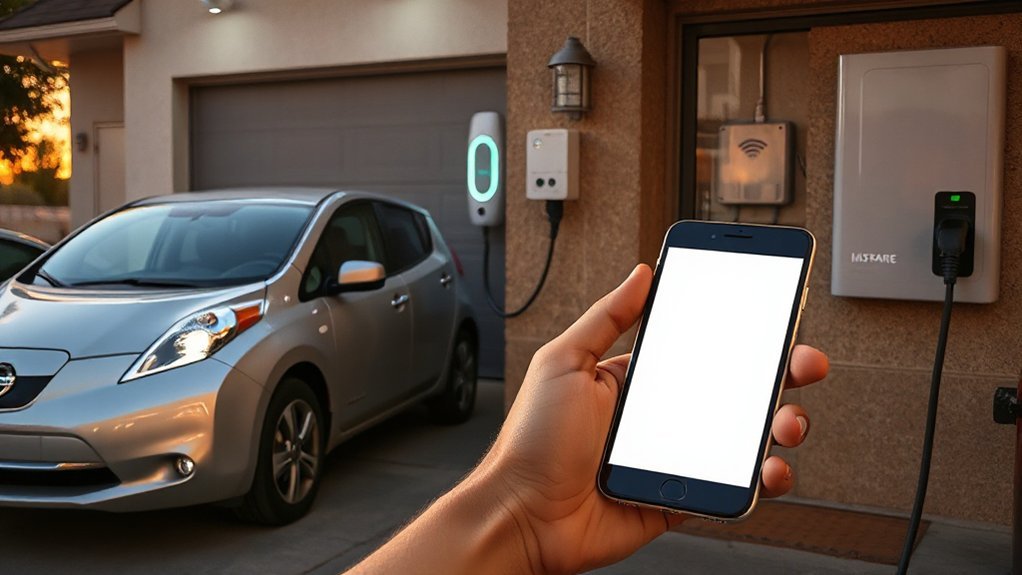
Because smart chargers add networked controls, you should treat their features as tools to enhance a code‑compliant installation—not shortcuts.
Use Wi‑Fi apps to configure amperage to match circuit rating per NEC 625, set schedules to charge off‑peak while respecting continuous‑load limits, validate ground‑fault checks, and lock the connector. Enable load sharing: balance current between two EVSEs on one branch circuit using pilot limits, not daisy chains; have an electrician set aggregate current in the panel. Prefer units with local control if internet drops. Demand User Privacy: encrypted connections, no selling telemetry, and data retention. Allow Over the Air Updates, but require signed firmware and option to defer until you’re onsite. Create strong passwords, disable unused integrations, place EVSE on a guest VLAN, record settings.
Safety Certifications, Incentives, and Total Installed Cost
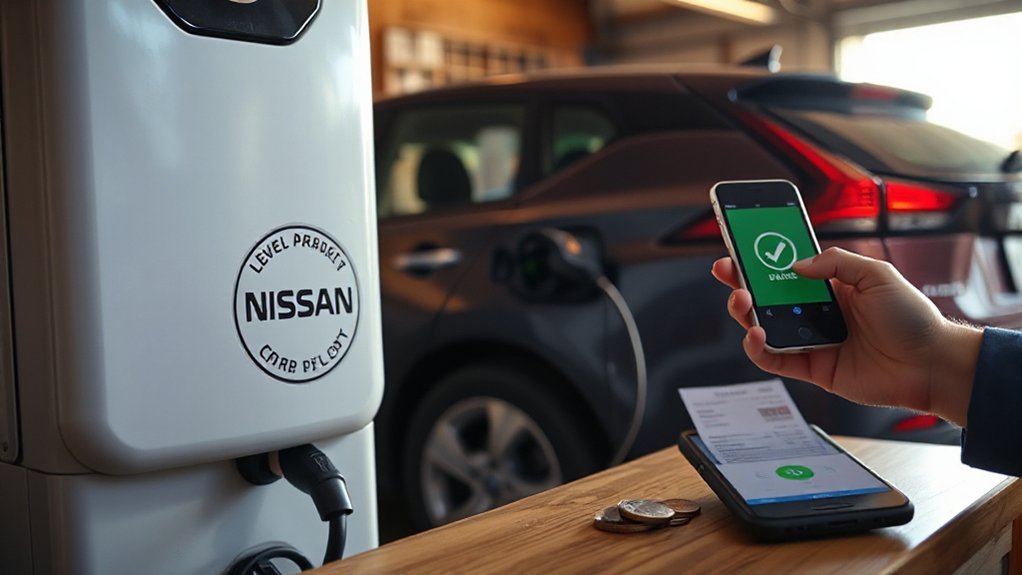
How do you make sure the unit is safe, rebate‑eligible, and accurately budgeted before you drill a hole? Verify third‑party safety marks: UL Compliance or ETL to UL 2594/2231, NEMA 4/4X enclosures, and integrated ground‑fault and thermal protection. Confirm permit, load calculation, and disconnect rules with your AHJ. Then price the full install: charger, mounting, dedicated circuit, GFCI breaker, conduit, trenching, and inspection fees.
- Safety and code: choose copper conductors, correct breaker size, proper bonding, and weatherproof in-use covers for outdoor installs.
- Incentives: check utility and state Rebate Programs, TOU rates, and federal credits; many require ENERGY STAR or networked units.
- Cost control: get three quotes, measure run length, plan panel upgrades, and size amperage to your Leaf’s onboard charger capacity.
Conclusion
You’ve got the blueprint to pick a Leaf-ready Level 2 like a maestro conducting electrons. Check your onboard limit, size the circuit at 125%, and insist on UL/cUL, J1772, and weather armor that laughs at storms. Choose adjustable amperage, locking mounts, and smart scheduling. Plan your cable run like a moon mission, then hire a licensed electrician for permits, load calcs, and a clean install. Do it right, and your driveway becomes a fueling station.