
You need a portable Level 2 EVSE that matches your car’s onboard AC limit (kW/amps), supports adjustable 16–40 A to meet NEC 80% rules on mixed circuits, and fits common NEMA 14‑50/6‑50 outlets with proper adapters. Prioritize UL 2594/2231, GFCI, IP54+, and SAE J1772 with 20–25 ft 8–10 AWG cable. Evaluate metering/app accuracy, weight, and warranty. Miss any of this, and you’ll trip breakers—or worse. Here’s what actually matters next.
Key Takeaways
- Match EVSE output to your car’s onboard AC charger; choose adjustable current steps and verify UL 2594/2231 certification.
- Ensure plug and adapter compatibility with common NEMA receptacles; use UL/ETL‑listed adapters; confirm voltage, grounding, and international Type 1/Type 2 needs.
- For RV parks and mixed circuits, set current ≤80% of breaker rating; seek voltage sag detection and easy 8–40 A adjustability.
- Prioritize safety and durability: IP65 enclosure, 20–30 mA GFCI, thermal protections, UV‑stable housing, IK08 impact resistance, and robust, oil‑resistant cable.
- Choose practical features: 20–25 ft cord, 10 AWG for 32 A or 8 AWG for 40 A, accurate metering, reliable app, low weight, strong warranty.
Match Charger Output to Your EV’s Onboard Limit

Before you buy, confirm your EV’s onboard AC charger rating and size the portable Level 2 EVSE to that limit. If your car accepts 7.2 kW (32 A at 240 V), a higher-output EVSE won’t reduce time; the vehicle’s Onboard acceptance caps AC power. Match current settings in 1 A or 2 A steps to align with the car’s maximum and site constraints. Review the manufacturer’s Charge curve to understand taper behavior near high state-of-charge; AC rates often stay flat until thermal limits. Use EVSEs certified to UL 2594 and UL 2231, with adjustable pilot signaling per SAE J1772. Verify displayed kW against the vehicle’s telemetry to confirm true delivered power. Right-sizing minimizes cost, weight, and heat while protecting circuits and connectors and cabling.
Plug Types, Adapters, and Outlet Compatibility
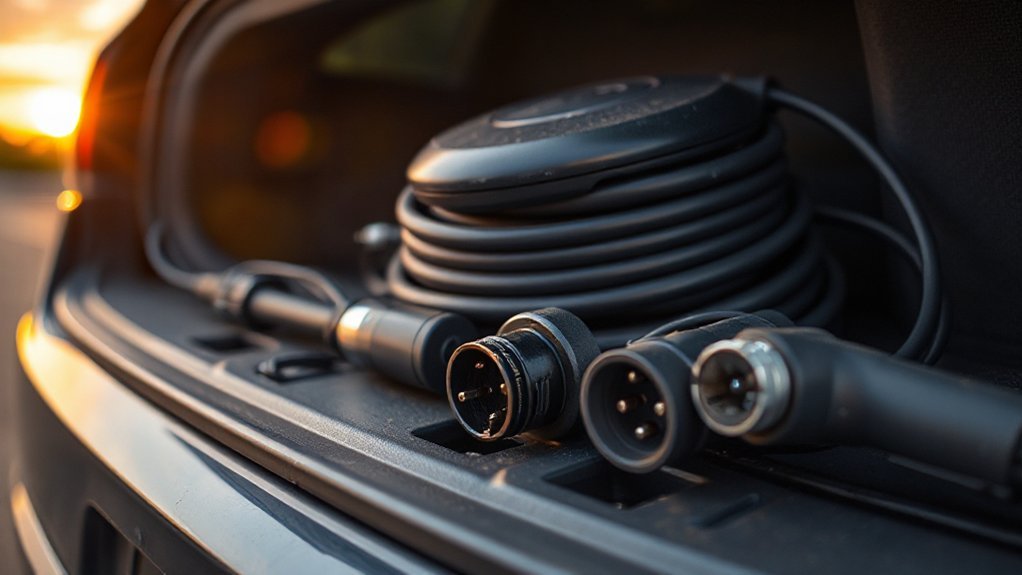
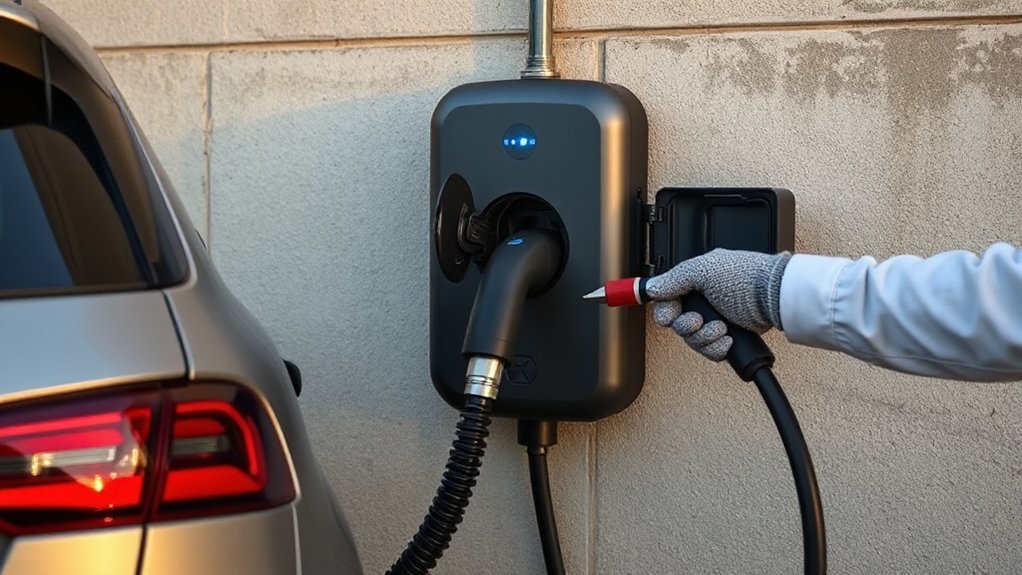

How you plug in determines where you can charge and at what rate. Select a portable EVSE with plug options matched to common NEMA variations and verify third‑party adapters carry UL/ETL listings. Confirm outlet specs: voltage (120/240 V), poles/grounds, and receptacle rating (e.g., 14‑50 at 50 A, 6‑50 at 50 A, 10‑30 at 30 A). For travel abroad, check international connectors and regional mains: J1772/Type 1 vs IEC 62196 Type 2, single‑phase vs three‑phase, and frequency.
- Audit destinations: RV parks, rentals, workplaces; inventory available receptacles and permissions.
- Validate pinout compatibility; avoid cheater adapters that bypass grounding or neutral.
- Inspect condition: heat discoloration, loose blades, or cracked faceplates indicate replacement, not use.
Use weather‑rated cords and strain relief to protect terminations safely.
Adjustable Amperage for RV Parks and Mixed Circuits

Why does adjustable amperage matter in RV parks and mixed circuits? Because supply conditions vary: 14‑50 pedestals may be on 40–50 A breakers, TT‑30 is 30 A at 120 V, and some parks derate. Per NEC 625 and 210, EV charging is a continuous load; you should set current to ≤80% of the breaker (e.g., 50 A → 40 A, 30 A → 24 A). An EVSE with selectable 8/12/16/24/32/40 A lets you match the site without tripping. Voltage sensing confirms 120 V vs 240 V and flags sagging voltage under load, so you can step down current to keep power factor and heat in check. If you’re sharing a pedestal, circuit load sharing features coordinate current between vehicles to stay within the branch rating. This preserves uptime, efficiency, and neighbor-friendly electrical behavior overall.
Safety Certifications, Weatherproofing, and Build Quality

Although portability matters on the road, prioritize a unit with third‑party safety certification and robust environmental protection. Look for UL 2594/2231 or ETL listings that verify ground-fault, isolation, and temperature protections. Confirm compliance with relevant certification standards and labeling traceability. For weatherproofing, target at least IP65 enclosures and UV-stable housings; in cold climates, verify operation to −30°C. Demand durable strain reliefs, welded seams, and stainless fasteners for corrosion resistance. Prefer connectors rated to 10,000 mating cycles and cables with oil‑ and ozone‑resistant jackets. Seal cable entries with compression glands; avoid open vents that admit water or dust.
- Key tests: dielectric withstand, leakage current, thermal rise, impact (IK08+).
- Materials: polycarbonate/PA blends, silicone gaskets, 304/316 hardware.
- Protections: GFCI 20–30 mA trip, ground continuity monitoring, thermal derate.
Cable Length, Portability, Smart Features, and Warranty
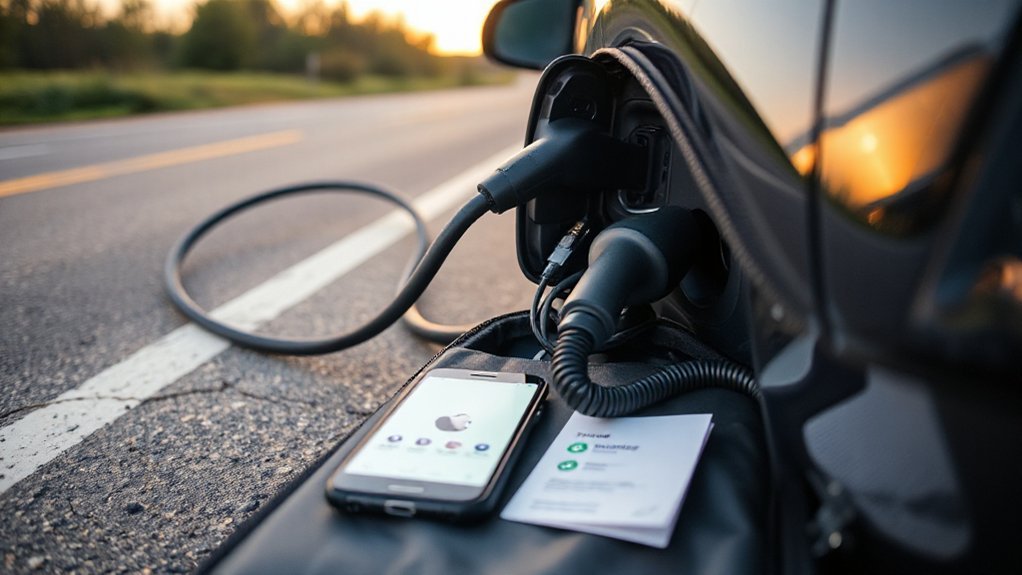
While a longer cord improves reach in mixed parking scenarios, stay within code and handling limits: NEC 625 caps EVSE output-cord length at 25 ft, so target 20–25 ft and size conductors appropriately (10 AWG for 32 A; 8 AWG for 40 A) to control voltage drop and heat. For portability, favor units under 8 lb with NEMA 14‑50 or 6‑50 plugs, a compact brick, and secure coil management to prevent kinking. Select models with adjustable current (8–40 A), accurate metering (±2%), and reliable apps that work offline; avoid cloud‑only locks. Look for SAE J1772 compatibility, firmware update support, and GFCI self‑test. Verify warranty length (at least 2–3 years), clear exclusions, and warranty transferability; require US‑based service, spare-cable availability, and UL/ETL listings, and CSA.
Conclusion
You’ll wrap this up by selecting a portable Level 2 charger that matches your car’s onboard AC limit, supports adjustable amperage, and fits common NEMA outlets via certified adapters. Prioritize UL/ETL listing, 20–25 ft cable with adequate gauge, integrated GFCI, IP weather rating, and robust connector strain relief. Choose compact, lightweight housing, accurate metering/app support, and a clear warranty. Do that, and you’ll hit the road with power to spare, not skating on thin ice.