
What’s a Level 2 charger but a purpose-built power tool for your Jeep 4xe? You’ll match the 7.2 kW (32 A) onboard limit, pick a UL-listed EVSE with adjustable current, NEMA 3R+ enclosure, and a 40 A-capable cable. Decide between hardwired or NEMA 14‑50 per NEC 625, verify panel capacity, and require Wi‑Fi scheduling. Next, you’ll weigh installation, rebates, and future-proofing—so you don’t miss critical tradeoffs.
Key Takeaways
- Confirm Wrangler/Grand Cherokee 4xe onboard charger ~7.2 kW; any Level 2 J1772 works, higher amperage won’t charge faster today.
- Pick UL/ETL-listed EVSE (UL 2594/2231), NEMA 3R/4 enclosure, 18–25 ft, 40A-rated cable, IP54+, outdoor-ready hardware.
- Choose adjustable 32–40A unit; set current to circuit capacity (32A on 40A breaker; 40A on 50A breaker) for safety and future-proofing.
- Prefer hardwired installs outdoors for reliability; NEMA 14-50 plug offers portability but may run hotter and need GFCI per code.
- Seek smart scheduling, load management, and preconditioning support; verify precise current limits, firmware updates, and clear charge logs.
Know Your Jeep 4xe’s Charging Capabilities
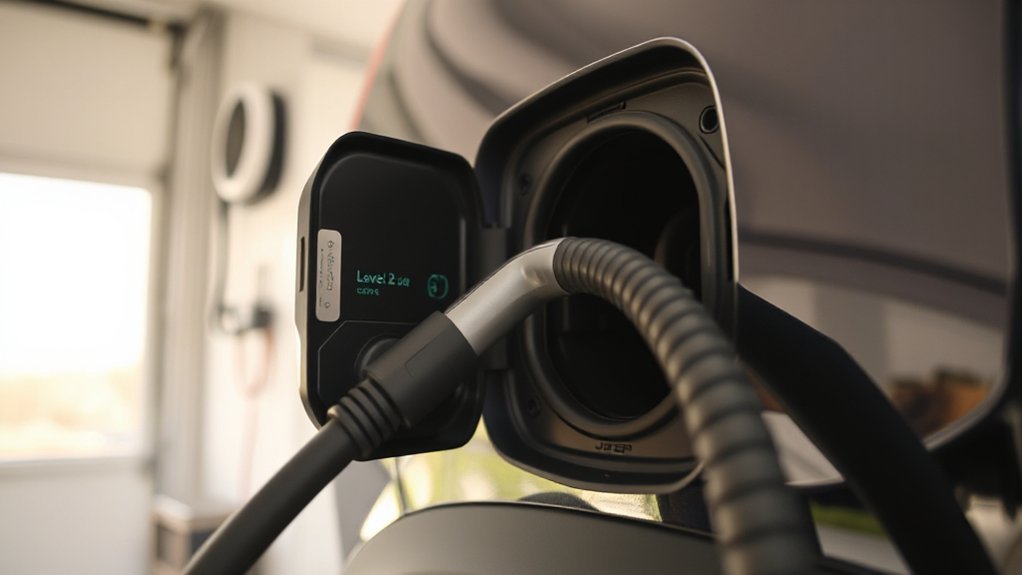
How fast can your 4xe actually take power? Start by identifying the onboard charger spec in your owner’s manual and Uconnect app; that sets the maximum AC intake. Verify SAE J1772 compatibility, firmware revision, and thermal management behavior. Use the EVSE’s pilot signal and your vehicle’s charge logs to confirm stable sessions from 10–80% SoC without throttling. Monitor line voltage, connector temperature, and ground integrity before enabling scheduled charging. Optimize electric range by preconditioning while plugged in and selecting a regen strategy that suits terrain and traffic. Avoid repeated deep discharge; maintain a conservative SoC window to reduce heat and preserve charge rates. Keep traction battery cooling paths clear, update software, and validate charge completion with OBD-II or CAN data for accuracy and safety.
Amperage and Kw: How Much Power Do You Really Need
Your Jeep 4xe’s onboard charger sets the AC ceiling; power (kW) ≈ 240 V × A ÷ 1000, so 32 A ≈ 7.7 kW and 40 A ≈ 9.6 kW, but the car won’t pull more than its limit. Choosing 32 A vs 40 A affects circuit sizing: NEC continuous-load rule requires 32 A EVSE on a 40 A breaker, 40 A EVSE on a 50 A breaker, with conductors sized accordingly. Verify home capacity—panel amperage, available breaker spaces, wire gauge, GFCI/listed EVSE, and voltage drop—before installation, and don’t exceed the weakest link.
Onboard Charger Limits
Before you pick a Level 2 unit, anchor the decision to the 4xe’s onboard charger limit: most Wrangler 4xe and Grand Cherokee 4xe models accept about 7.2 kW AC, which corresponds to roughly 30–32 A at 240 V. The onboard charger is the bottleneck; the EVSE only advertises a pilot current (SAE J1772), and the car decides what to draw.
Real‑world draw can dip due to firmware limits, thermal throttling, battery temperature, or voltage sag. Choose an adjustable, UL‑listed EVSE, verify a dedicated 240 V circuit, and set current within code. For a continuous load, size the breaker and conductors at 125% of the EVSE setting (NEC 625). Minimize voltage drop with correct wire gauge and short runs. Avoid extension cords and shared circuits.
32A Vs 40A
Given the 4xe’s ~7.2 kW onboard limit, the 32A vs 40A question is about circuit capacity, thermal headroom, and future needs—not faster charging today.
Both units deliver ~7.2 kW to your Jeep; higher amperage mainly changes conductor size, connector heating, and derating margin. A 40A EVSE often uses thicker cabling and runs cooler at a 32A setting, improving longevity and uptime. If you may share the EVSE with a higher-capacity EV later, 40A preserves optionality and resale value. Document installation, labeling, and settings; underwriters may ask, and proper configuration can reduce insurance implications.
1) Choose an EVSE with precise, lockable current limits.
2) Verify cord, plug, and connector temperature ratings.
3) Check ambient heat and enclosure ventilation.
4) Prefer UL-listed hardware with a warranty.
Home Circuit Capacity
While the 4xe tops out near 7.2 kW, sizing the home circuit is a code and safety exercise: treat EV charging as a continuous load and apply the 125% rule. For a 32A EVSE, you need a 40A breaker; for 40A, use 50A. Use appropriately rated copper conductors (10 AWG for 30–35A, 8 AWG for 40–50A), adjusted for run length and temperature. Verify your panel’s load calculation so the service can handle the added 30–50A branch circuit. Prefer hardwired installs; if using a receptacle (e.g., NEMA 14-50), provide GFCI protection per local code. Pull permits and get inspection—reduces Insurance Implications. Expect Billing Impact: more kWh usage; mitigate with off-peak schedules. Label the circuit, torque lugs to spec, and test. Record measurements and document compliance.
Plug Options: NEMA 14‑50 Vs Hardwired
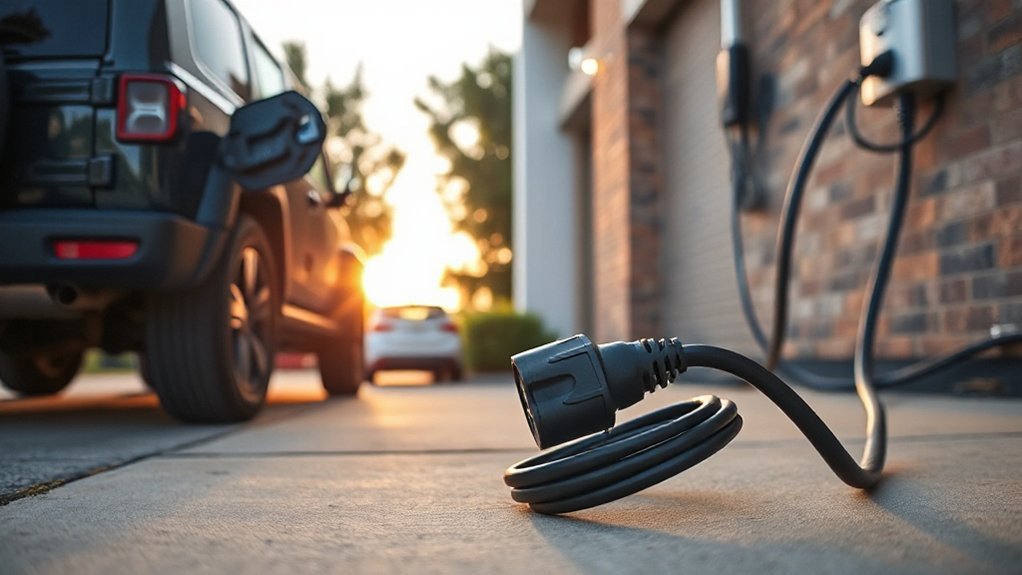
Compare installation first: a NEMA 14‑50 uses a 50A receptacle, while a hardwired unit lands conductors in the EVSE—both need a load calc, correct wire gauge, properly sized breaker, permit, and inspection (with GFCI where required by code). If you want portability, the 14‑50 lets you unplug and relocate or use compatible outlets; hardwired is fixed, sealed, and not movable. For speed, most 14‑50 setups are limited to 40A continuous on a 50A breaker, while hardwired units can run 48A continuous on a 60A breaker for faster charging.
Installation Complexity
Because EV charging is a continuous load, your choice between a NEMA 14‑50 plug‑in EVSE and a hardwired unit drives circuit sizing, protection, and inspection details. You’ll apply the 125% rule: a 40A EVSE needs a 50A breaker and #6 Cu if runs are long or derating applies; a 48A hardwire needs a 60A breaker and appropriately sized conductors.
1) Verify service capacity: perform load calculations per NEC 220; confirm spare breaker spaces and main rating.


2) Plan routing: assess driveway access, wet‑location fittings, GFCI/WR receptacle needs for 14‑50, or a listed disconnect for hardwired.
3) Select protection: GFCI breaker for 14‑50 often required; hardwired EVSE may integrate GFCI—avoid double‑GFPE trips.
4) Coordinate authorities: confirm permit timelines, inspection sequencing, and utility meter/panel seals requirements.
Portability and Relocation
Although both options meet NEC Article 625, a NEMA 14‑50 cord‑and‑plug EVSE prioritizes portability: you can de‑energize at the breaker, verify zero load, then unplug and take the unit when you move or need temporary power elsewhere; the plug also serves as the required disconnecting means. For relocations, label the circuit, photograph terminations, and store the EVSE in padded transport cases to protect the enclosure and coupler. A hardwired unit ties into fixed wiring and typically requires a lockable disconnect within sight; relocating it means opening the raceway, retorquing lugs to spec, and closing permits. Plan relocation logistics: confirm receptacle height, mounting pattern, cord reach, and strain relief. Use listed components, torque per manufacturer, and perform insulation and continuity checks before energizing the system.
Power Capacity and Speed
When sizing for power and speed, anchor decisions to code limits and the 4xe’s onboard charger. The 4xe accepts ~32A at 240V (~7.7 kW), so higher‑rated EVSEs won’t charge faster. A NEMA 14‑50 on a 50A circuit delivers 40A max continuous by the 80% rule; set the EVSE to 32A. Hardwiring allows 48A on a 60A circuit, but you’ll see no gain; you may, however, reduce plug heat and nuisance trips.
- Verify breaker, conductor gauge, and GFCI per NEC 210/625; avoid shared circuits and clear labeling.
- Use EVSE load‑limiting to avoid panel overload and manage utility tariffs.
- In hot garages, watch for thermal throttling; choose derated cables or hardwire.
- Prefer hardwire for outdoor installs; choose 14‑50 for modularity with safe, tested cord strain relief.
Connector Standards and Cable Length Considerations
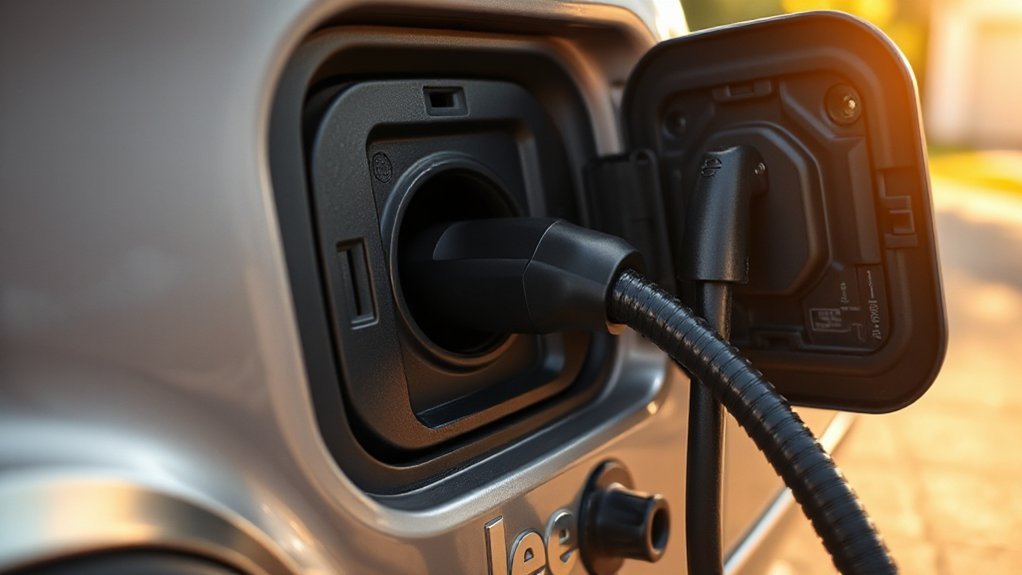
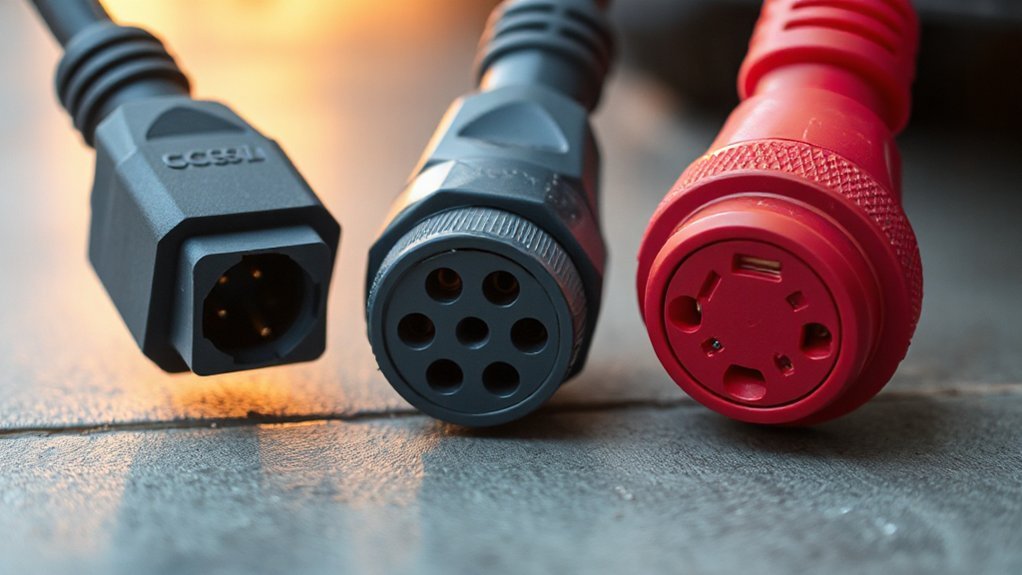
Even as connector options proliferate, the Wrangler and Grand Cherokee 4xe use an SAE J1772 inlet for Level 2 AC charging, so pick a J1772 EVSE (Tesla units require a J1772 adapter) and ignore CCS since that’s DC.
| Aspect | Spec | Rationale |
|---|---|---|
| Connector Ergonomics | Curved handle, firm latch, IP54+ | Reduces drop risk; gloved use |
| Cable Length | 18–25 ft, 40A-rated, 105°C jacket | Manages reach without voltage sag |
Check cable gauge: 8 or 10 AWG conductors minimize drop at 40 A. Favor UL-listed EVSE with strain relief and overmolded heads. Route to avoid trip hazards; keep bend radius >10× cable diameter. For outdoor installs, demand NEMA 4 or better. Plan mounting so the connector parks dry and off the ground. Inspect periodically for Cable Aging and insulation cracks.
Smart Features: Apps, Scheduling, and Load Management
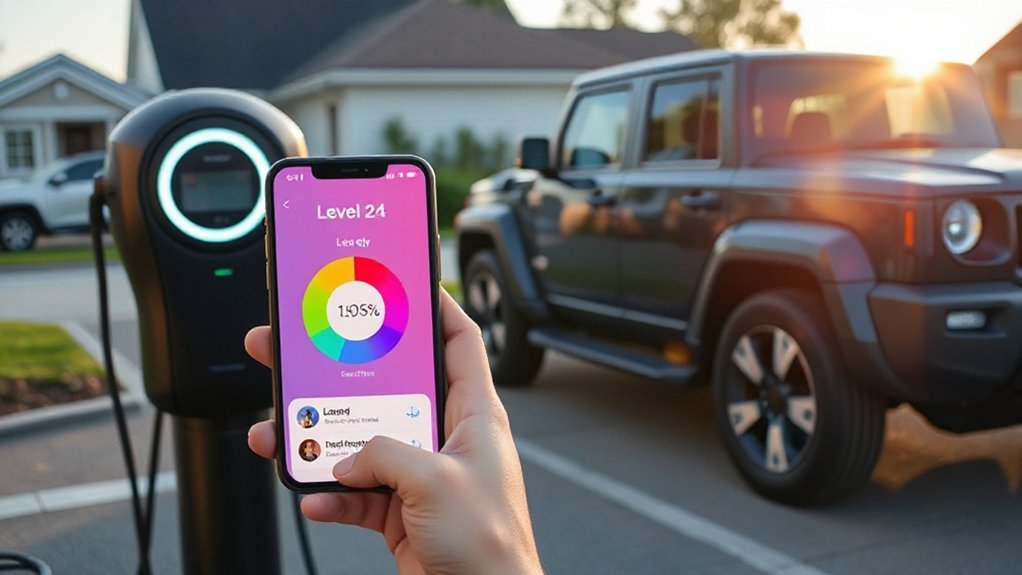
With the hardware sorted, focus on the software layer: smart EVSE features—apps, scheduling, and load management—govern how safely and efficiently your 4xe charges.
- App control: set charge windows to match TOU rates, cap amperage, and lock the connector. Look for Wi‑Fi/LTE, OTA updates, and Remote Diagnostics.
- Scheduling: define weekday/weekend profiles, precondition departure times, and fallback rules if the grid is offline. Validate time zone and daylight‑saving handling.
- Load management: enable dynamic current sharing across circuits, respect panel limits, and follow per‑circuit max settings. Prefer OCPP support for site controllers.
- Integrations: use Voice Control, Home Assistant, or Alexa to start/stop sessions; expose a secure API with OAuth and roles. Export logs for billing.
Verify data privacy terms and local data storage options before purchase carefully.
Safety, Certifications, and Weatherproof Ratings
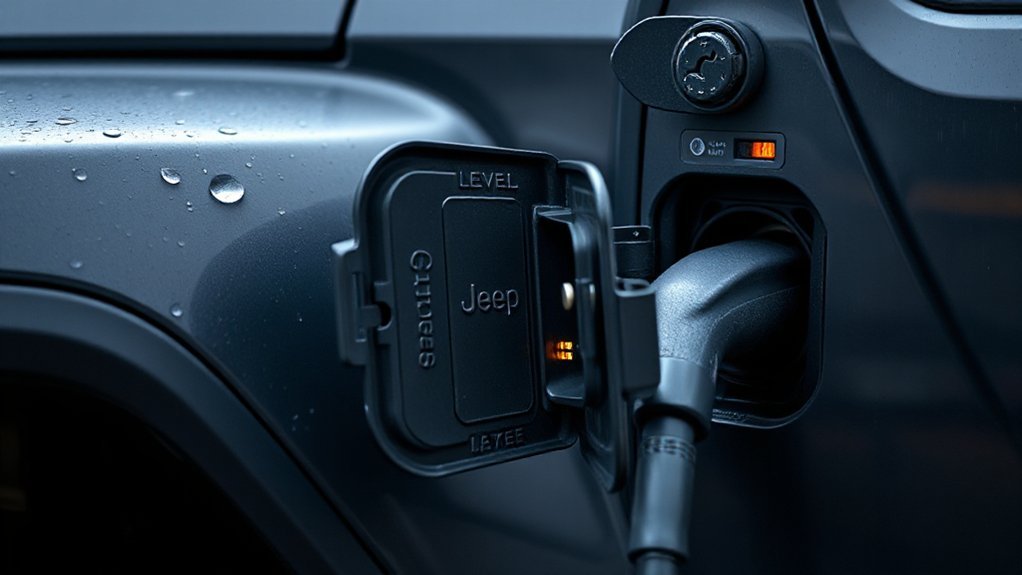
Verify an NRTL listing—UL or ETL—showing compliance with UL 2594 and UL 2231-1/-2, and labeling per NEC 625. Require integral ground-fault personnel protection (CCID ~20 mA with auto self-test), and don’t stack it with upstream GFCI devices that cause nuisance trips. Match enclosure to environment: NEMA 3R for rain/snow outdoors; NEMA 4X for hose-down, dust, and coastal corrosion resistance.
UL/ETL Listings
Although features and price matter, treat third‑party safety certification as non‑negotiable. For a Jeep 4xe Level 2 charger, insist on a UL Listed or ETL Listed mark (NRTL tested to UL 2594/UL 2231) on the product label and manual, not just the box. Understand Label Evolution: modern ETL marks equal UL in rigor; avoid Consumer Misconceptions that ETL is “less safe.” Verify enclosure ratings (NEMA 3R or better outdoors, IP54+), flame ratings, conductor gauge, and temperature rise data.
- Check the listing file online (UL iQ or Intertek Directory) and match model numbers.
- Confirm ratings: input voltage, output current, duty cycle, ambient.
- Inspect permanent markings: NRTL logo, control number, wiring diagram.
- Require installation instructions referencing NEC 625 and torque specs.
Ground-Fault Protection
Since ground faults are the primary shock risk in EV charging, choose a UL 2594/UL 2231-1/-2 listed EVSE that integrates a CCID (ground-fault interrupter) designed for personnel protection and that self-tests on power-up and periodically, latches out on failure, and clearly indicates trip status. Specify a CCID with trip thresholds of 20 mA AC for personnel protection and integrated 6 mA DC Leakage detection to prevent RCD blinding. Confirm the unit monitors pilot/ground continuity, detects welded relays, and opens contactors within milliseconds on fault. Require immutable event logs for trips and self-test results. Verify NEC 625 compliance and label markings. For outdoor installs, select an enclosure with a tested weatherproof rating and sealed connectors. Finally, require that serviceable test/reset controls without defeating protection during maintenance.
NEMA 3R Vs 4X
When you choose an outdoor EVSE, decide early whether you need NEMA/UL Type 3R or 4X because the enclosure rating drives safety and uptime. Type 3R handles rain, sleet, and external ice; Type 4X adds hose-directed water and corrosion resistance for coastal or salted-road environments. Verify UL 50E enclosure construction and UL 2594/2231 listings, then check gasket quality, drain paths, and UV-stable plastics. Prioritize lockable enclosures and clean service access.
- Climate: temperate and sheltered → 3R; marine, industrial washdown, or snow blowback → 4X.
- Materials: powder-coated steel (3R) vs stainless/FRP with sealed hinges and hardware (4X).
- Maintenance: hinged doors, clear Service access, replaceable gaskets; security via Lockable enclosures.
- Compliance: NEC 625 labels, bonding, overcurrent specs; ingress tests, corrosion hours, warranty, and documentation verification records.
Installation Factors: Panel Capacity, Breakers, and Wiring Runs
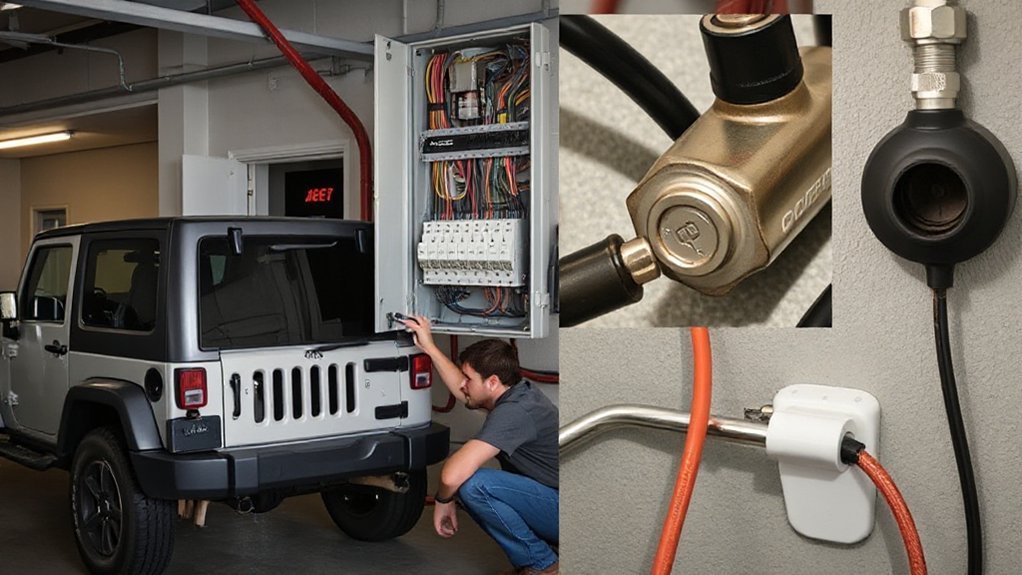
Before you install a Level 2 EVSE for your Jeep 4xe, verify the service panel can handle the new continuous load and plan the circuit accordingly. Perform a load calculation, check spare spaces, and meet Permit Requirements. Use a dedicated 2‑pole breaker sized at 125% of EVSE current (NEC 625); e.g., 32A EVSE → 40A breaker; 40A → 50A. Run copper conductors sized per the 75°C column, derate for ambient and bundling, and keep voltage drop under 3% on long wiring runs. Choose THHN in EMT or PVC; NM‑B only within dry walls. For outdoor routing, evaluate Trenching Options, burial depths, and tape. Hardwire when possible; if using a receptacle, apply GFCI where required and label circuit.
| Breaker | EVSE Output |
|---|---|
| 40A | 32A |
| 50A | 40A |
Budgeting and Total Cost of Ownership

A clear budget prevents surprises and unsafe shortcuts. Define total cost as hardware + install + operations + lifecycle risk. Price the EVSE, required GFCI breaker, conduit, and permit fees. Model operating cost with electricity forecasting using your utility’s TOU rates and Jeep 4xe kWh per mile. Include maintenance expenses, potential replacement parts, and out‑of‑warranty risk. Don’t ignore networking or RFID fees if you want access control.
- Hardware: EVSE, holster, cable length, NEMA enclosure rating, warranty term.
- Installation: panel work, breakers, wiring runs, trenching, permits, inspection.
- Operations: kWh cost = rate × energy; idle fees; demand charges (if applicable).
- Lifecycle: annual maintenance, firmware support, failure probability, downtime cost.
Verify code compliance (NEC 625), size conductors correctly, and document serials, receipts.
Future‑Proofing for Your Next EV
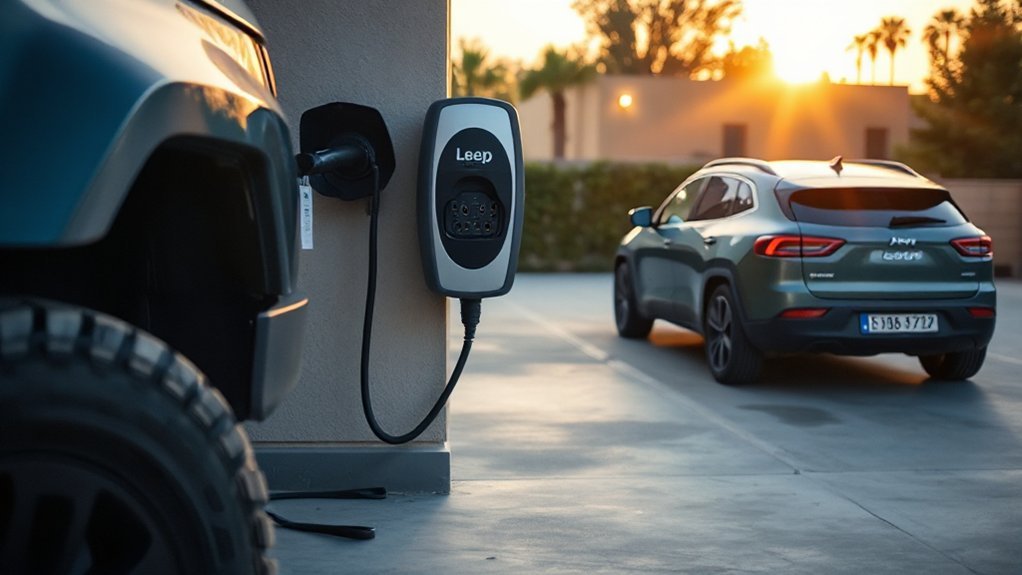
Though your 4xe only pulls ~7.2 kW, spec the infrastructure for your next EV: install a 60A–100A branch circuit (125% continuous-load rule, NEC 625), run copper conductors sized for 75°C terminals (e.g., 6 AWG Cu for 60A, 3/4–1 in PVC/EMT conduit with pull string), and leave panel capacity or a subpanel for future load growth. Choose a 48–80A-ready EVSE with field-adjustable current, OCPP 1.6/2.0.1, and ISO 15118 Plug&Charge. Mount in conditioned space or use NEMA 3R, GFCI protection, and proper bonding. Verify torque, labeling, and clearances per NEC 110. Track manufacturer roadmaps; prioritize firmware cadence and parts availability. Plan for bidirectional readiness and second life batteries integration. Provide spare conduit, junction box volume, and a drip loop for strain relief outside.
| Feature | MinSpec | Why |
|---|---|---|
| Breaker | 60–100A | Higher-amp-ready |
Rebates, Tax Credits, and Where to Buy
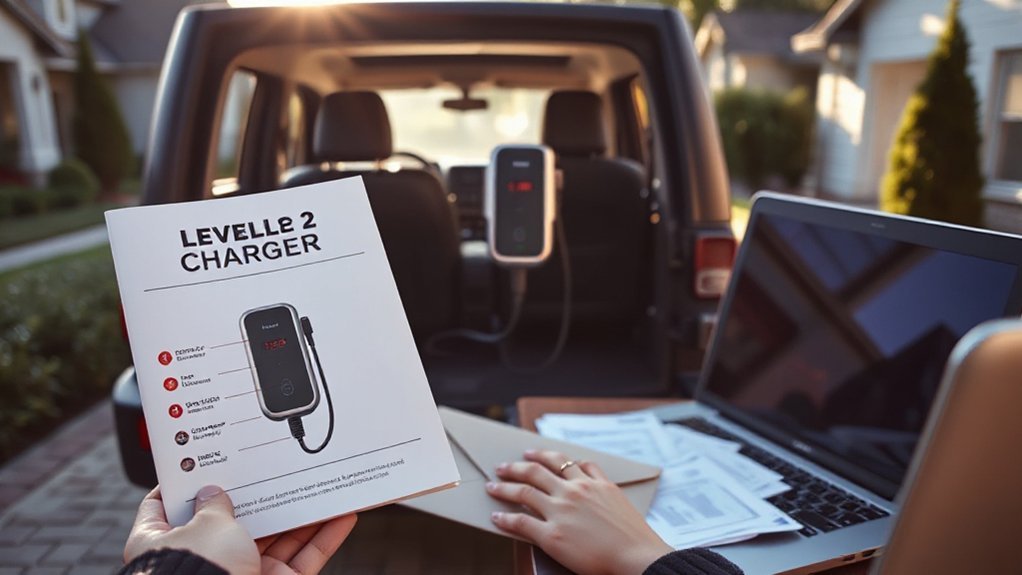
How do you maximize incentives and buy from reputable channels without compromising code compliance? Start by mapping every program’s eligibility criteria to your home setup, panel capacity, and charger specs (UL-listed, Energy Star, Wi‑Fi where required). Keep receipts, model numbers, and electrician license info ready; most portals verify these. Check income caps and residency rules carefully.
- Do a provider comparison: utility rebate, state credit, federal 30C, and local air-district grants; stack only when rules allow.
- Confirm install requirements: NEC 625, GFCI where applicable, load calculations, permit/inspection—rebates often demand proof.
- Buy smart: manufacturer direct or authorized distributors; avoid marketplaces without serial-number traceability and warranty.
- File cleanly: submit within deadlines, attach permit, inspection sign‑off, photos of label/amp setting, and paid invoice; track status until funds arrive.
Conclusion
You’re ready to spec, not guess. Set jeep_4xe_limit=32A (~7.2 kW). Choose EVSE: UL-listed, adjustable ≤32A, 40A circuit, NEMA 3R+, 40A cable, Wi‑Fi, OCPP/ISO 15118-ready, load management. Decide plug: hardwired or NEMA 14‑50 per NEC 625. Verify panel capacity, permits, breaker, wire gauge, GFCI integral. Schedule TOU. Budget hardware+install, chase rebates. Then you land the final line: flip breaker, authenticate, pilot=OK, ramp to 32A… and watch safe kWh stack, session after session without trips or surprises.