
Installing an EV charger in your garage starts with safety and code compliance: assess your driving needs, choose Level 1 or Level 2, confirm service and panel capacity, and size the circuit at 125% of the EVSE rating. Plan permits, GFCI/grounding, and mounting to studs. If you’re unsure, hire a licensed electrician. Here’s what to verify before you pick up a drill—and how to avoid costly failures at inspection.
Key Takeaways
- Assess charging needs and choose Level 1 or Level 2 EVSE based on daily mileage, charging window, vehicle connector, and panel capacity.
- Perform NEC Article 220 load calculation; verify service rating, spare breaker spaces, and size a dedicated circuit at 125% of charger nameplate.
- Obtain permits; coordinate with utility for TOU programs; follow NEC 625, local amendments, GFCI, grounding, and labeling requirements.
- Plan location and cable management: mount on studs, proper conduit, strain relief, drip loop, and cord reach without tripping hazards or stretching.
- Install and test: run correctly sized conductors and conduit, install breaker, GFCI/protection, torque to spec, then commission and schedule inspections.
Assess Your Home’s Charging Needs
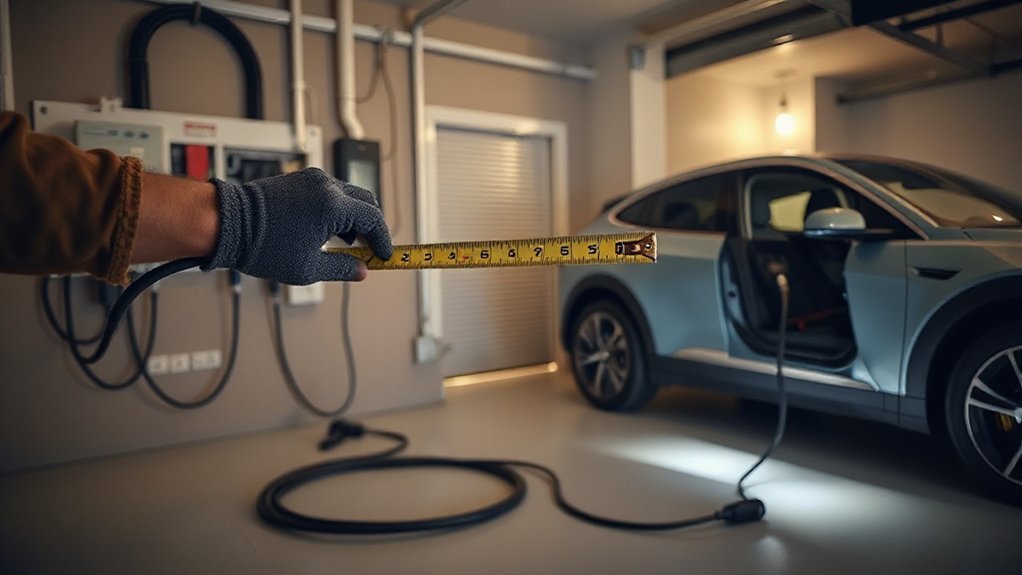
Before you buy hardware, quantify how much charging power you actually need. Start by logging your daily mileage for two weeks and noting which household vehicles will use the garage. Determine required kWh per day: multiply miles by your car’s Wh/mi rating from the manual. Add a 20% buffer for weather and battery conditioning. Map your charging window—typically overnight—to translate kWh into required amperage. Perform a preliminary load calculation per NEC Article 220, considering existing large loads and diversity. Verify service rating, panel space, and feeder capacity; you’ll likely need a dedicated branch circuit and a properly sized breaker. Plan for GFCI protection, correct wire gauge, and a listed, indoor-rated unit. If capacity’s tight, schedule charging to stay within limits and document load calculations.
Compare Level 1 and Level 2 Chargers
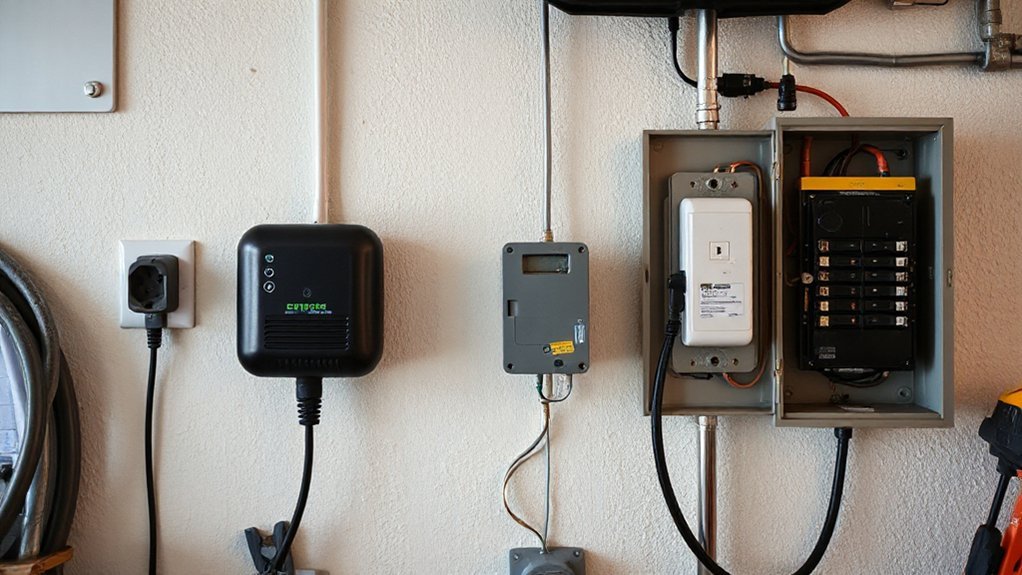
Why choose Level 1 or Level 2? Level 1 uses a standard 120‑volt outlet and adds roughly 3–5 miles of range per hour. It’s simple, low-cost, and safest when you use a dedicated receptacle, a GFCI, and a UL‑listed cord set. Level 2 operates at 240 volts and typically delivers 20–40+ miles per hour, ideal if you drive daily or have larger batteries. It should be hard‑wired or plugged into a properly rated receptacle, listed equipment, and installed under local code with permits.
Level 2’s faster charging lets you schedule off‑peak sessions, which can lower costs and your carbon footprint. A neat, code‑compliant installation can also boost resale value. Confirm connector type (usually SAE J1772) and smart features like load scheduling and lockout options.
Check Electrical Panel Capacity and Available Amperage
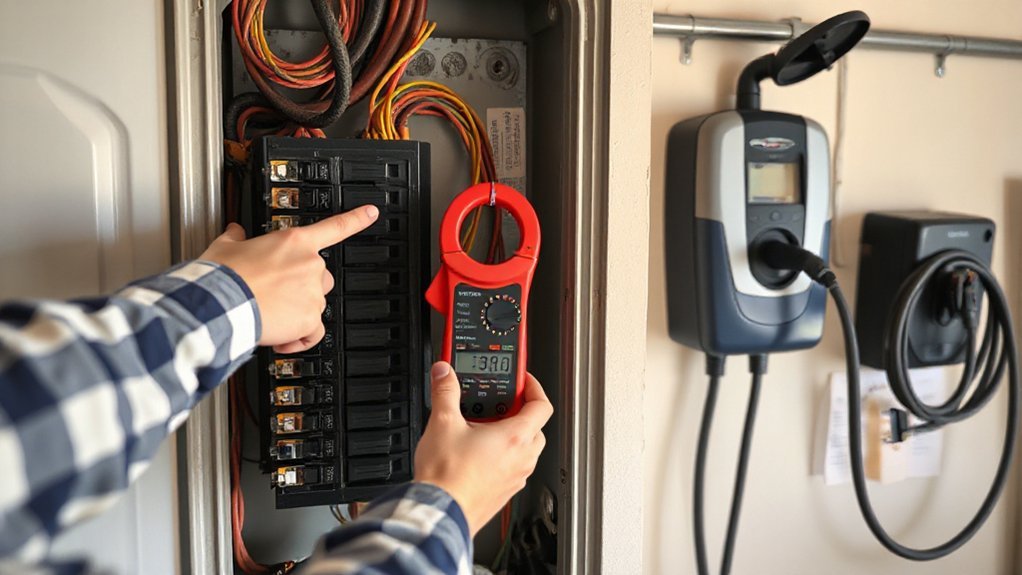
You start by confirming your service rating (100A/150A/200A) from the panel nameplate or utility records and verifying the main breaker size. Next, calculate spare amperage with an NEC load calculation, subtracting existing demand and applying the 125% continuous-load factor for the EVSE. If capacity is insufficient, don’t add the circuit—have a licensed electrician assess a service upgrade or subpanel to remain code-compliant and safe.
Determine Service Rating
How do you know your service can handle an EV charger? Start by confirming the service rating on the main breaker or service disconnect. Use Label Verification on the panel door, meter base, and service equipment; look for 100A, 150A, 200A, etc. Cross-check the Service History for utility upgrades, permits, or prior panel changes. Inspect conductor sizes and service-entrance markings; they must match the listed rating per NEC. Don’t remove covers unless qualified; de-energize when required. When labels are missing or damaged, stop and call a licensed electrician to verify the service and document compliance.
| Component | Where to check | Typical rating |
|---|---|---|
| Main breaker | Panel top/disconnect | 100–200A |
| Service conductors | Meter to main | Sized to rating |
Photograph labels and keep records for future permitting and inspections.
Calculate Spare Amperage
Start by performing a code-compliant load calculation to determine spare amperage in the service and panel. List all fixed appliances, general lighting loads, small-appliance and laundry circuits, HVAC, and any demand factors per NEC Article 220. Use recent utility bills for realistic demand if allowed locally. Verify main breaker rating and bus capacity; your EV branch circuit load must not exceed available capacity. Confirm accurate circuit labeling, then measure actual loads with a clamp meter at peak conditions, or use a virtual simulation tool from your utility to model demand diversity. Account for continuous load rules: size EVSE at 125% of nameplate. Document calculations for your records. If capacity is marginal, plan load management, a lower-amperage charger, or a panel/service upgrade before pulling permits.
Choose the Right Charger and Connector
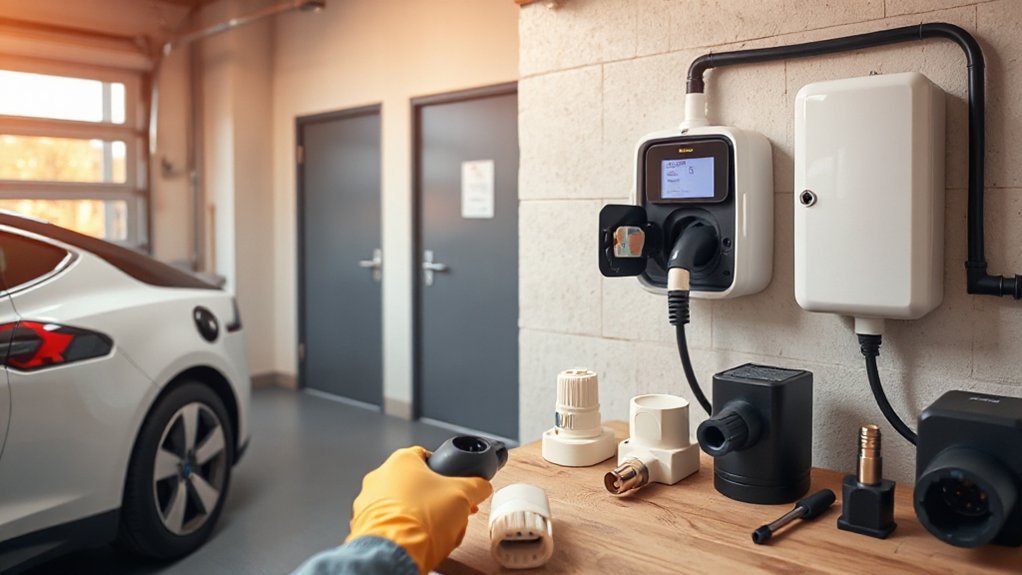
First, compare Level 1, Level 2, and DC fast charging so you balance charge speed with your daily range needs and panel capacity. Confirm connector compatibility—J1772 for most North American EVs, NACS/Tesla or CCS as required—and use only manufacturer-approved adapters. Match the charger’s amperage and circuit rating to your available supply, and you’ll install a dedicated, correctly sized breaker and conductors per NEC and local code.
Charging Levels Comparison
Which charging level and connector you choose drives installation cost, charge time, and code requirements. Level 1 (120V) is slow but simple: 2–5 miles/hour, often using a dedicated 15–20A receptacle on a GFCI where required, with labeling and cord management per NEC 625. Level 2 (240V) is the residential standard: 20–45 miles/hour, a permitted, dedicated 30–60A circuit, appropriate breaker and wire gauge, and load calculations per NEC 220. It usually needs a shutoff means, proper overcurrent protection, and outdoor-rated enclosures if exposed. DC fast charging isn’t practical at home due to massive service capacity, utility coordination, and ventilation concerns. Faster charging adds heat; manage charge rates and limits to protect battery longevity. Off-peak charging can reduce costs and emissions impact, and improve grid reliability.
Connector Types Compatibility
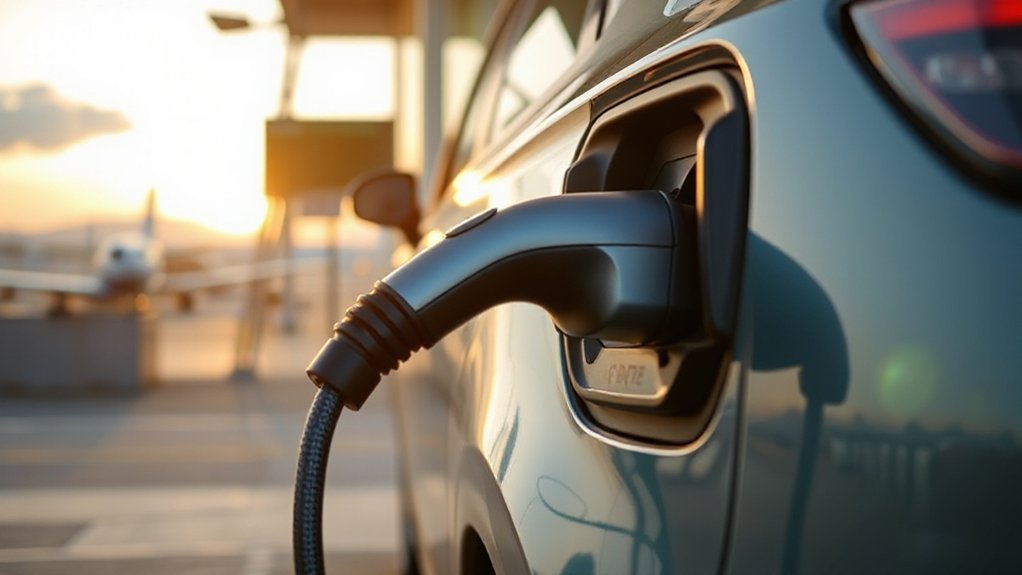

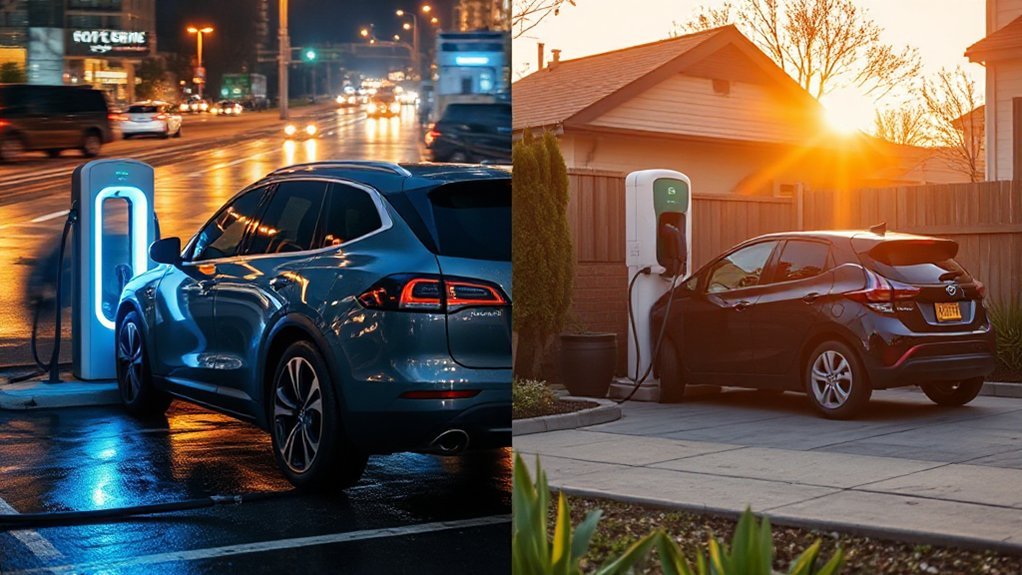
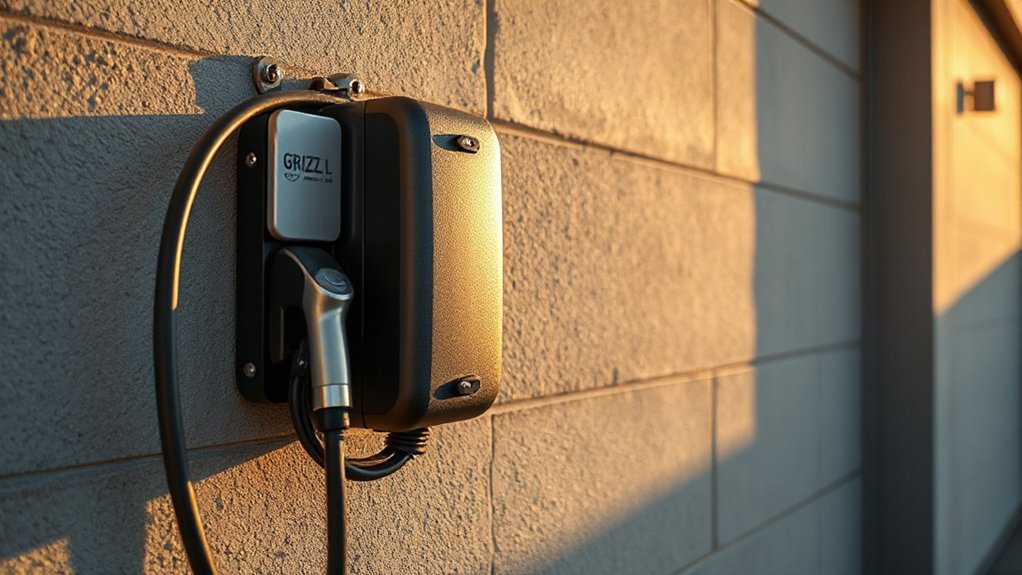
How do you pick the right plug for your EV and still pass inspection? Start by matching your vehicle’s inlet to the charger’s connector: J1772 for most North American EVs, NACS for Tesla and many new models, and CCS for fast-charge compatibility on some dual-inlet cars. Verify Adapter interoperability only with manufacturer-approved, UL-listed adapters; improvised solutions risk arcing and code violations. Confirm the connector and cable are rated for outdoor use, have strain relief, and meet International standards like SAE J1772, ISO 15118 communication, and IEC 62196 geometry. Choose a charger labeled “Listed” by a Nationally Recognized Testing Laboratory. Document model numbers for the inspector, keep adapter usage minimal, and post clear labeling so drivers select the correct plug every time and avoid damage.
Power Supply Requirements
Before you mount anything, confirm your service and panel can support the EVSE’s continuous load and size everything to code. Perform a load calculation; most Level 2 units draw 32–48 A continuous, so plan a breaker at 125% of nameplate and a dedicated circuit. Verify conductor size, copper THHN/THWN, proper grounding, and GFCI where required. Check voltage stability at the intended location; poor sag shortens charger life. If you use backup generators or transfer equipment, interlock them correctly and verify the charger’s compatibility with generator output and neutral bonding. Provide surge protection and a disconnect within sight when required. Confirm connector rating, cord length, and ambient temperature limits. Document labels, torque lugs to spec, and schedule inspection. Follow NEC articles for garage branch circuits.
Plan the Charger Location and Cable Management
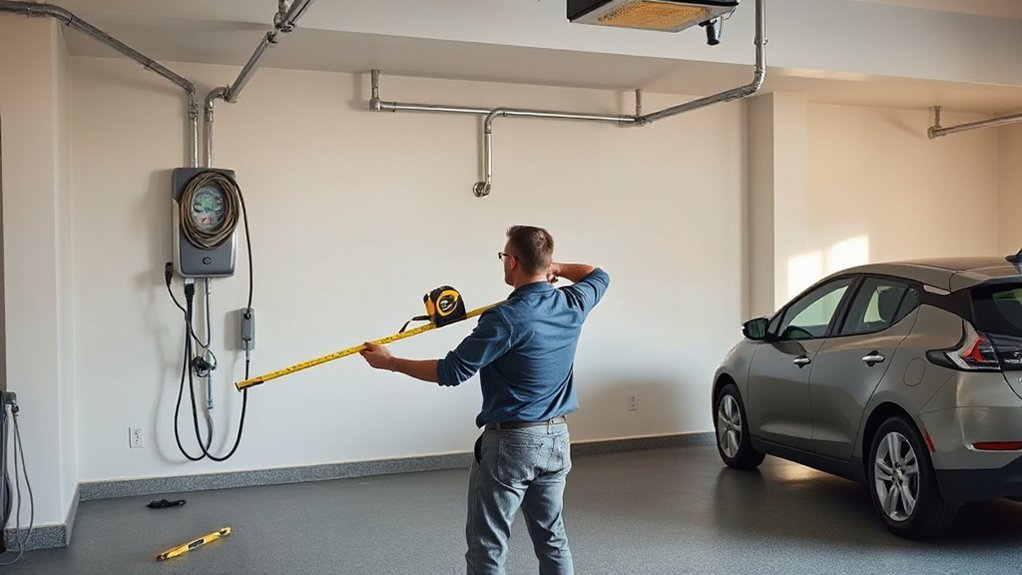
While it’s tempting to mount the charger wherever there’s wall space, plan its location and cable path to meet code and prevent hazards. Place the EVSE where the cord reaches the vehicle inlet without stretching or crossing walkways. Mount between typical working heights, keep it clear of doors, shelves, and flammables, and anchor into studs for strength and Mounting symmetry. Provide Cable concealment with EMT or PVC conduit and protect cables from impact along walls and garage floors. Route above bumper height, add strain relief, and include a drip loop below the connector. Use hooks or a retractable reel so the cord never lies on the floor. Keep outlets and disconnects visible and accessible. Maintain ventilation clearances and lighting for safe plug-in and stowing.
Permits, Codes, and Utility Requirements
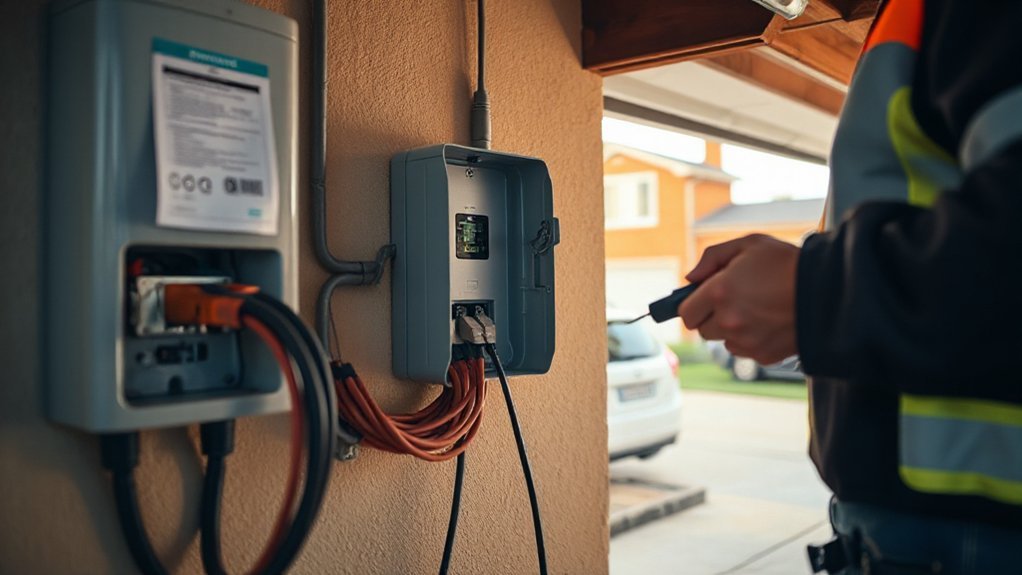
Because EV chargers draw significant current, you must secure the proper permit and comply with your local Authority Having Jurisdiction (AHJ), the National Electrical Code (NEC)—notably Articles 625, 220, and 110—and any local amendments. You’ll submit a load calculation, show circuit rating, overcurrent protection, and grounding method. Verify panel capacity, clearances, GFCI requirements, and conduit/fill rules your AHJ enforces.
Contact your utility early to confirm service capacity, meter class, and any required transformer upgrades. Ask about demand response programs, TOU rates. Some utilities require a separate meter or managed charging enrollment. Plan Inspection Scheduling with the AHJ and utility as needed; obtain rough-in and final approvals before energizing. Monitor Code Updates and keep stamped plans on-site. Post labeling, torque to specifications, and maintain documentation.
Tools, Materials, and Parts Checklist
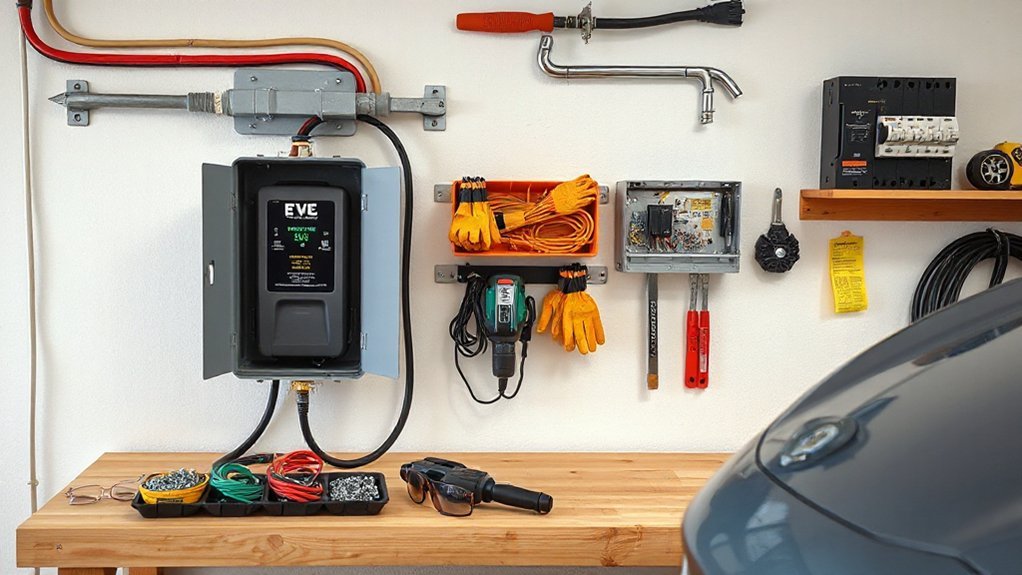
A solid checklist keeps you safe, compliant, and efficient. Gather PPE (safety glasses, insulated gloves), a calibrated multimeter or voltage tester, torque screwdriver, insulated drivers, wire stripper/cutter, fish tape, conduit bender, drill/hammer drill with masonry bits, stud finder, level, and tape measure. Stock the EVSE, manufacturer backplate, appropriately sized copper THHN/THWN-2 conductors, EMT or PVC conduit with connectors, couplings, straps, bushings, bonding bushings, anti-short bushings, weatherproof box (if receptacle), NEMA-rated disconnect (if required), and a dedicated breaker matched to the load. Keep stainless or rated anchors, lag bolts, and corrosion-resistant fasteners.
Use Inventory Templates to track quantities and lot numbers. Apply clear Labeling Methods for conductors, terminations, the panel directory, and disconnects to meet NEC 110.22 and 408.4(A). Keep torque specs documentation on hand.
Step-by-Step Installation and Mounting
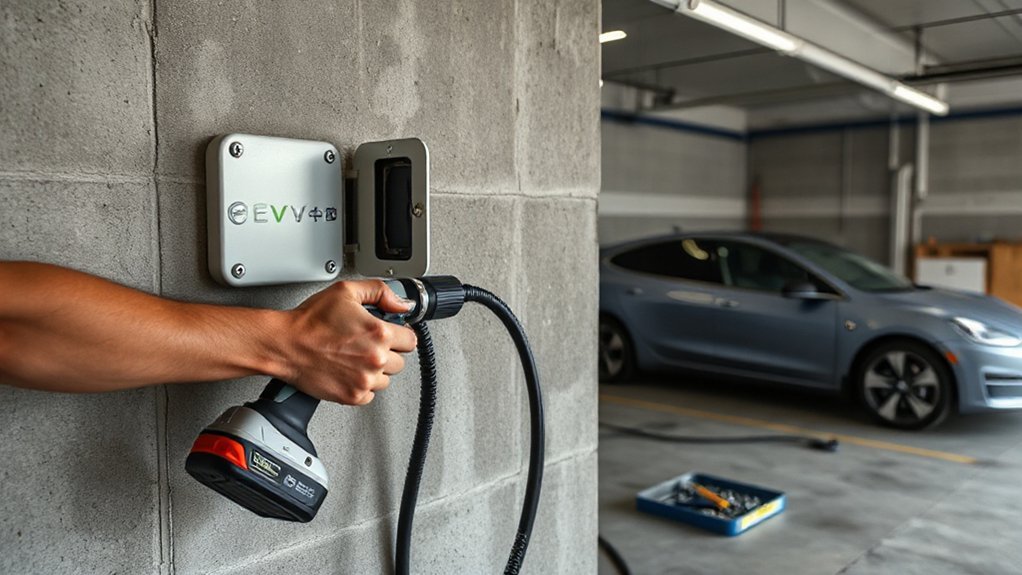
With tools staged and materials verified, start by de-energizing the panel, applying lockout/tagout, and testing for absence of voltage with a calibrated meter. Verify working clearances. Mount the EVSE backer board to studs or masonry anchors rated for the unit’s weight. Use the manufacturer’s mounting templates to mark holes, confirm bracket orientation, and maintain the recommended cord reach. Drill, set anchors, and fasten the wall bracket; recheck level and torque to spec.
Lay out the circuit path. Install conduit with proper fittings, bushings, and support intervals; avoid physical damage and sharp bends. Pull conductors sized for the breaker and run length, observing color codes and temperature ratings. Land wires on the EVSE and in the panel, torque lugs per listing, and label the circuit.
Testing, Safety Checks, and GFCI Requirements
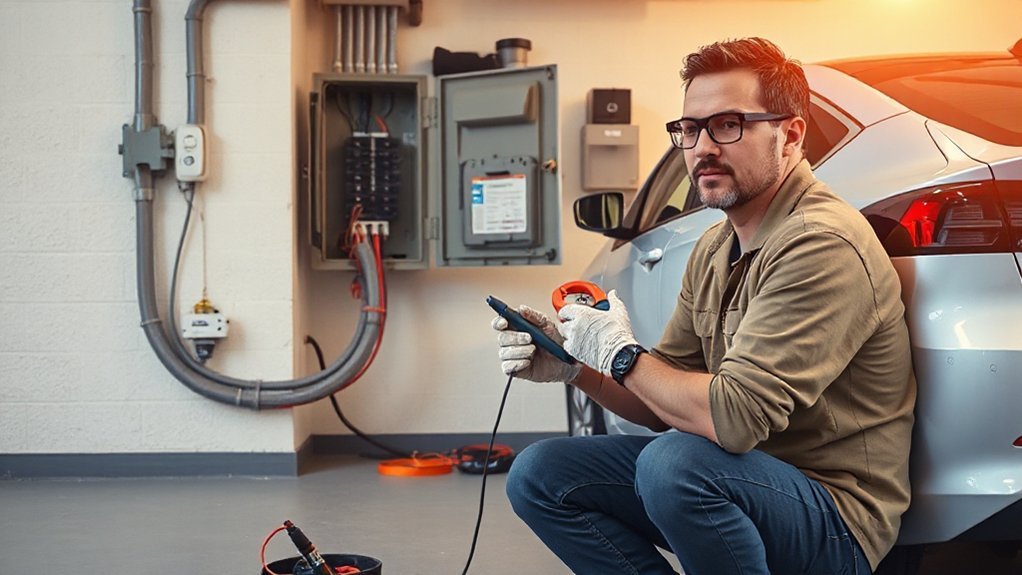
Before energizing the circuit, run a systematic safety check: verify conductor size and breaker rating, confirm terminations are torqued to spec and labeled, inspect bonding/grounding continuity, and meter correct polarity and voltage at the EVSE. Document Insulation Resistance with a megohmmeter between ungrounded conductors and equipment ground; reject anything below manufacturer or code guidance. Verify Ground Continuity from the panel to the EVSE frame with a low-resistance reading. Test GFCI protection: press the device’s test button, then induce a fault with a plug-in tester to confirm trip at 4–6 mA. Validate breaker resets and nuisance trips don’t occur under no-load. With power on, measure current draw during a pilot-enabled charge and confirm temperature rise at lugs is minimal. Label date, results, and tester models.
Costs, Rebates, and When to Hire a Licensed Electrician
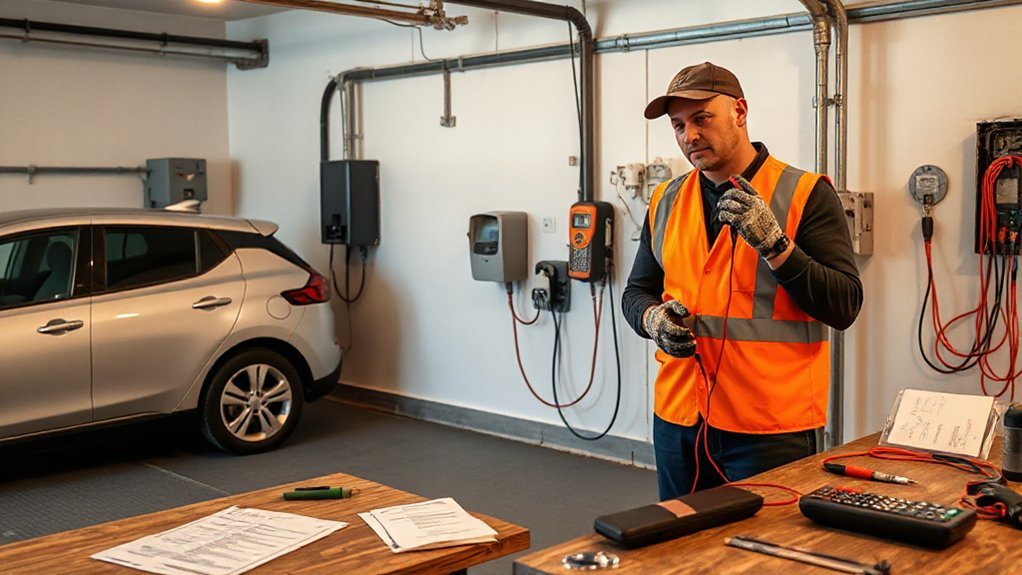
You’ll budget for the charger, permits, wiring upgrades, and labor—and offset costs with utility, state, and federal rebates or tax credits. Verify permit requirements, panel upgrade pricing, and itemized quotes, and confirm rebate eligibility before work starts. Hire a licensed electrician when your panel is near capacity, a new circuit or service upgrade is needed, or local code mandates permitted, inspected work.
Costs and Rebates
Although prices vary by home and charger, plan for the EVSE hardware plus code‑compliant installation, permits, and inspections. Expect $400–$900 for a Level 1/2 unit, plus $300–$1,500 for materials and labor when the panel has capacity. Panel upgrades, long conduit runs, or trenching can raise costs $1,500–$4,000. Include permit fees ($50–$300) and utility meter work if needed. Keep safety first: require properly sized breakers, copper conductors, GFCI protection where required, and load calculations per NEC 625 and 220. To reduce out‑of‑pocket cost, search State Incentives and utility rebates that pay for a portion of equipment, wiring, or make‑ready work. Also watch Manufacturer Promotions, retailer coupons, and bundled installation offers. Document invoices; many programs require pre‑approval and final inspection. Confirm deadlines and keep copies organized.
When to Hire
If the work goes beyond plugging into a known‑good 120‑V receptacle, hire a licensed electrician. Service upgrades, new circuits, and panel work require permits, load calculations, and code compliance you shouldn’t DIY. A pro protects you from fire risk, inspections, and insurance implications.
- Verify capacity: assess service size, available breaker spaces, and continuous-load limits.
- Pull permits: follow local code, NEC requirements, and schedule inspections.
- Install safely: correct conductor size, GFCI/AFCI where required, proper grounding and bonding.
- Document work: keep load calcs, permits, and photos for warranty preservation and resale.
Many rebates and utility programs demand licensed installation and final inspection. Pros also optimize charger placement, conduit routes, and labeling, reducing faults. If costs seem high, get multiple bids and ask about bundling panel upgrades.
Conclusion
You’ve got the roadmap to install a safe, code-compliant EV charger at home. Assess needs, size circuits at 125% of EVSE rating, verify panel capacity, use properly sized copper conductors, and mount securely. Pull permits, follow torque specs, install required GFCI and grounding, label the panel, and schedule inspections. If anything’s unclear, hire a licensed electrician. Do it right and your charging routine will run like a well-oiled machine—reliable, efficient, and ready every night ahead.