
A 12-site highway corridor in Ohio hit an 18% IRR by stacking NEVI funds with utility make‑ready, locking 15‑year host deals, and modeling demand charges at P95 utilization. You can do similar if you target grid‑ready sites with strong dwell‑times, choose OCPP hardware, and budget O&M and uptime SLAs into unit economics. The real edge comes from incentives, easements, and conservative cashflow stress tests—if you know where to start.
Key Takeaways
- Conduct market due diligence: growth >30% annually; target high EV density, strong traffic, long dwell-time anchors, and limited competing chargers within 3–5 miles.
- Prioritize grid-ready sites with interconnection queues under 12 months and access to IRA, NEVI, and utility incentives to de-risk capex and timelines.
- Model unit economics: utilization 10–35%, dynamic pricing vs TOU and demand charges, break-even around 18% at $0.35/kWh, forecast EBITDA per port.
- Stack revenues: pay-per-kWh, subscriptions, and advertising; choose high-dwell sites for DOOH; secure 97–99.9% uptime SLAs and strong processor/eMSP session-success terms.
- Lock real estate and compliance: long-term host agreements, claim §30C (up to 30%/$100k), use MACRS/bonus depreciation, and track rebates, prevailing wage, tariff pilots.
Market Landscape and Investment Pathways

How fast is the opportunity scaling? You’re looking at a market compounding above 30% annually in ports installed across North America and Europe, with public funding and mandates compressing deployment timelines. Map demand by traffic corridors, multifamily density, and fleet depots; Consumer Behavior shows dwell-time clusters and range-anxiety hotspots that de-risk utilization. Prioritize grid-ready sites with interconnection queues under 12 months and access to IRA, NEVI, and CFIP incentives; capex drops 20–40% when you stack grants and accelerated depreciation. Underwrite by throughput, uptime, and queue probability; discount cash flows with policy step-downs and rising capacity charges. Monitor permitting SLAs, make-ready programs, and utility tariff pilots. Investor Appetite favors scale-ready platforms with contracted offtake, robust O&M, and open-standards interoperability. Prioritize cybersecure, upgradeable hardware and analytics.
Business Models: Pay-Per-kWh, Subscriptions, and Advertising

You’ll benchmark pay‑per‑kWh economics by mapping price to energy cost (TOU rates + demand charges) and realistic utilization (often 10–25%), while checking jurisdictional rules on reselling electricity and any pricing caps. For subscriptions, model tiered ARPU uplift, break‑even sessions per tier, and churn to test LTV/CAC and margin sensitivity, ensuring transparency rules and roaming fee disclosures are met. Advertising partnerships can add $8–$20 CPM via DOOH at high‑dwell sites, but you’ll validate signage ordinances, landlord covenants, and revenue‑share terms.
Pay-Per-Kwh Pricing
While simple on the surface, pay‑per‑kWh pricing hinges on metering accuracy, local utility tariffs, and evolving regulations that determine whether non-utilities can sell electricity by the kilowatt-hour. You’ll capture margin by aligning rates with demand, hedging tariff risk, and prioritizing certified meters. Budget for Meter Calibration, periodic audits, and Customer Education to reduce disputes and chargebacks. Model contribution profit per site using utilization, electricity cost, payment fees, and maintenance. Prioritize transparency in price displays and receipts. Avoid demand charges through load management.
| Metric | Typical Range | Investment Note |
|---|---|---|
| Meter calibration tolerance | ±0.5%–1.0% | Lower error reduces refunds, boosts trust |
| Tariff spread (off-peak vs peak) | 2x–4x | Price dynamically to protect gross margin |
| Uptime SLA | 97%–99.9% | Downtime crushes utilization and LTV |
| Utilization | 10%–35% | Break-even often ~18% at $0.35/kWh |
Subscription Tiers Profitability
Why do subscription tiers often outperform pure pay‑per‑kWh on unit economics? You convert volatile session revenue into predictable ARPU, raise utilization, and compress CAC via referrals. With Tier Bundling (e.g., off‑peak kWh blocks, idle-fee waivers, highway-premium access), you segment by WTP and lift gross margin. Churn Modeling lets you price anchor and optimize term lengths; even a 100 bps churn reduction can add 2–3 turns to LTV/CAC. Subscriptions also smooth demand, improving load‑weighted electricity costs and demand‑charge exposure, key in regulated tariff structures. You’ll negotiate fleet and HOA contracts that lock in minimums, de‑risking cash flows for project finance. Track cohort payback, kWh per member, and breakage. Stress test against rate cases, roaming fees, and PCI/EMV compliance costs. Model upgrade paths and seasonal elasticity.
Advertising Partnerships
After optimizing subscriptions, unlock a third revenue rail: advertising partnerships that monetize dwell time and location data across charger screens and apps. You’ll package inventory via Brand Collaborations and programmatic pipes, using Audience Targeting tied to site, time, and vehicle segment. Benchmark $8–$20 CPMs, 1–3% CTR, 5–10% in-stall conversion; model ARPU lift and EBITDA accretion net of rev-share.
| Lever | Investor takeaway |
|---|---|
| Screen ads | High-margin, scalable CPM revenue |
| App interstitials | Retargeting boosts LTV and upsells |
| Co-promos with retailers | Drives basket size; share-of-sales |
| Data licensing | Privacy-safe, aggregated insights |
Secure consent flows (GDPR/CCPA), honor do-not-sell flags, and avoid utility-like rate entanglements. Pilot, measure, then roll network-wide at scale now.
Capex vs. Opex: Budgeting, Forecasts, and Unit Economics





Because EV charging economics hinge on capital intensity and recurring costs, you need to separate capex from opex and model each with discipline. Map capex: site acquisition, utility upgrades, make-ready work, hardware, network integration, and commissioning. Map opex: demand charges, electricity, monitoring, maintenance, data, insurance, rent, and payment processing. Build unit economics per port: kWh sold, price/kWh, utilization, uptime, gross margin, and opex/port. Layer Depreciation Scheduling to allocate hardware and civil works over useful lives; align Cashflow Timing with construction draws, energization, and ramp curves. Stress-test tariffs, demand-charge ratchets, and local interconnection rules. Set hurdle rates, calculate NPV/IRR, and incorporate reserve accounts for replacements. Track KPIs monthly: revenue/kWh, EBITDA/port, cash conversion cycle, break-even utilization, and variance versus forecast. Update assumptions with metered data regularly.
Incentives, Grants, and Tax Credits You Can Leverage

You’ll claim the federal IRC §30C credit—up to 30% of eligible basis, capped at $100,000 per charger if you meet prevailing wage/apprenticeship and location rules (eligible census tracts)—to compress after-tax capex and lift IRR. Layer state programs and utility rebates/make-ready incentives that can fund 40–100% of interconnection, panel upgrades, and network costs, plus demand-charge relief or fleet TOU rates. Map incentives site-by-site to model net installed cost, cash timing, and compliance risk, ensuring you stack benefits without violating non-duplication or triggering clawbacks.
Federal Tax Credit Programs
Where can federal dollars move your IRR the most? Focus on the Section 30C Alternative Fuel Refueling Property Credit and accelerated depreciation. After the Inflation Reduction Act’s legislative history reset, 30C yields a 30% credit (base 6%) up to $100,000 per charger if you meet prevailing wage/apprenticeship and place assets in eligible census tracts. Claim on Form 8911, document costs by unit, and prepare for rigorous compliance audits. Pair it with MACRS (5-year) plus 40% bonus depreciation in 2026; model basis reductions from credits and grants to avoid double counting.
- A pro forma waterfall with 30C trimming capex
- A detailed map shading eligible census tracts
- A construction payroll log satisfying PWA
- An asset ledger tagged per charger/site
- A tax schedule showing 1-year carryback/20-year carryforward
State and Utility Rebates
How much can state and utility money move your pro forma? Model rebates as capex offsets and demand-charge relief that lift IRR 200–500 bps. You’ll stack utility make-ready funds, state grants, and tariff credits, but map Eligibility Criteria to site use, charger power, and uptime commitments. Track Application Deadlines; most funds are first-come or quarterly. Tie milestones to interconnection, permits, and commissioning so you don’t miss payout triggers. Stress-test cash flows under clawback rules and time-in-service requirements. Verify stacking rules, prevailing wage, and domestic-content clauses; align scope with NEVI, LCFS, or state ZEV mandates to preserve eligibility and certification audits.
| Program | Typical Value | Key Notes |
|---|---|---|
| State grant | $2k–$6k/port | Competitive; match 20–50% |
| Utility make-ready | $5k–$15k/site | Covers conduit/transformer |
| Demand-charge credit | 2–4 years | Tariff pilot; sunset risk |
Site Selection and Load Profiles That Drive Utilization

Because location dictates revenue, prioritize sites with high EV density, strong traffic counts, long dwell-time anchors, and limited competing chargers within a 3–5 mile radius. Evaluate Pedestrian flow, turning movements, and ingress/egress to forecast realistic session counts. Map hourly load profiles by daypart; align power levels to dwell time to minimize idle penalties and demand charges. Quantify Seasonal variability, weather impacts, and tourism spikes. Validate grid capacity, transformer proximity, and tariff options (TOU, demand response). Model EBITDA per stall under conservative utilization bands.
- Busy grocery-anchored center with 45-minute average dwell
- Highway-adjacent hub capturing commute peaks, midday lulls
- Urban curbside near offices with evening residential overlap and retail amenities
- University district with semester swings and weekend events
- Ski-town corridor with winter surges, summer shoulder seasons
Host Agreements, Real Estate Partnerships, and Revenue Sharing

Why do host agreements make or break your project’s bankability and valuation? Lenders underwrite tenure, termination risk, and escalation mechanics. You should lock long terms (10–20 years), automatic renewals, and CPI-linked rent. Secure non‑exclusive Access Rights, 24/7, with signage and easements recorded against title to survive transfers and foreclosures. Tight Indemnity Provisions allocate premises liability to the host and grid-interconnection liabilities to you, capped and insured.
Structure revenue sharing to align incentives: base rent plus percentage of charging revenue above a utilization threshold (e.g., 15–20%), with quarterly true-ups. Require CAM pass‑throughs to be predictable. Include relocation rights, cure periods, and step‑in rights for financiers. Confirm zoning, ADA, and utility permits are host obligations where feasible. Audit rights and data sharing drive performance oversight continuously.
Technology Choices: Hardware, Software, and Future-Proofing

Bankable host sites only pencil if the tech stack converts kilowatts into reliable, payable sessions at the lowest lifecycle cost. You’ll pick hardware with high efficiency, MTBF, and UL/NEC compliance, then size power modules to capacity, avoiding demand-charge drag. Favor Modular architecture so you can scale ports and swap power stages without stranded capex. On software, require audit-ready transaction logs, price controls, remote firmware, and Cybersecurity protocols aligned to NIST. Validate warranties, sparing models, and installers. Future-proof by reserving conduit, oversized pads, and upgrade paths to 350 kW where traffic merits. Screen vendors for NEVI, ADA, and Buy America to preserve incentives and residual value.
- Steel pedestals at dusk
- Labeled panels
- Hot-swappable modules
- Encrypted firmware screen
- Waiting conduit stubs
Interoperability, Network Operations, and Uptime Management

Although hardware choices set your capex, interoperability and network ops determine utilization, incentive eligibility, and cash flow durability. Standardize on OCPP and OCPI to enable Roaming Protocols, expand addressable demand 20–40%, and reduce customer acquisition costs. Target 97%+ uptime to meet NEVI and utility program thresholds; model revenue sensitivity per 1% downtime. Instrument stations for real‑time telemetry, remote resets, and automated fault classification; track MTTR under four hours and first‑time fix rates. Negotiate processor and eMSP SLAs with measurable session success, latency, and reimbursement terms for failed transactions. Build spares, field maintenance routes, and 24/7 Incident Response into opex. Implement transparent pricing, open‑ADR demand response, and PCI/ISO 27001 controls to protect incentives and avoid penalties. Audit quarterly and publish uptime dashboards for investor confidence.
Risk Assessment: Siting, Policy Swings, and De-Risking Structures
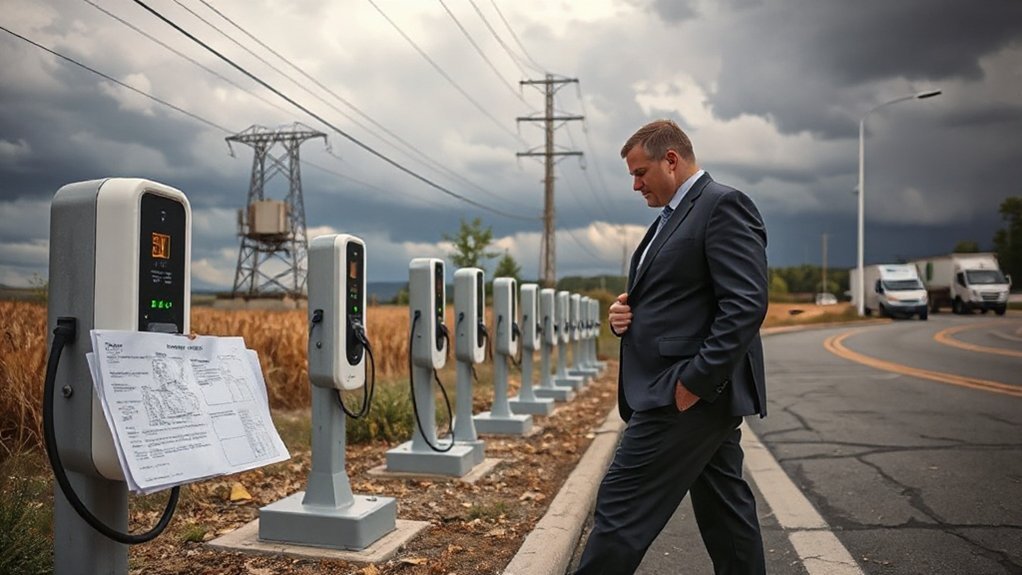
While hardware and uptime set the baseline, risk-adjusted returns hinge on where you build, how policy evolves, and which protections you lock in. You’ll underwrite sites like real estate: traffic, dwell time, grid capacity, interconnection queues, and demand charges. Price policy risk—NEVI timelines, LCFS credits, utility tariffs and mandates—into cash flows. Use leases with step-ups, revenue floors, and relocation clauses. Hedge capex with grants and tax credits; ring-fence operations via SPVs, performance guarantees, and Insurance Strategies. Bake Climate Resilience into design: elevation, flood maps, redundancy, storage, onsite solar. Stress-test DSCR under price caps and downtime.
Returns ride on siting, policy drift, and the protections you hardwire
- High-visibility highway exits glowing at dusk
- Substations humming beside a resilient pad
- Floodwaters deflected by raised conduits
- Contracts stacked neatly in a data room
- DSCR curve holding above 1.5x
Conclusion
You came for easy money; instead, you’ll build a utility-grade microbusiness. You’ll target depots, corridors, and multifamily where dwell-time and grid capacity intersect, stack ITC, make-ready, and state rebates to crush capex, and lock 10–20 year host deals with recorded easements. You’ll model utilization, demand charges, and uptime SLAs like a lender, pick OCPP hardware, and overfund O&M and cyber. Do that, and the punchline’s simple: resilient cash flows, bankable IRR, and scale-ready assets tomorrow.