You’re considering a Hypervolt IEC 62196‑2 Type 2 wallbox delivering up to 7.4 kW, managed under IEC 61851‑1 and aligned with BS 7671. You get RDC‑DD with PEN fault protection, an IP65/IK08 enclosure, dynamic load balancing, and optional solar self‑consumption/export limiting. The app adds scheduling, OTA updates, metering, and fault logs. Before you specify or install, a few choices will determine compliance, safety margins, and total cost.
Key Takeaways
- 7.4 kW (32 A) single‑phase Type 2 charger; IEC 61851‑1/62196‑2 compliant and UK Smart Charge Points Regulations ready.
- Supports smart scheduling, time‑of‑use charging, per‑session amperage caps, and voice control via Alexa/Google Assistant.
- Built‑in safety: A‑type RCD with 6 mA DC detection, RDC‑DD, PEN fault protection, overcurrent limiting, and thermal derating.
- Dynamic load management with CT sensing; integrates with solar PV to prioritize self‑consumption and limit grid export.
- IP65, IK08 enclosure; tethered or socketed Type 2 options with cable lock; installation per BS 7671 with OTA firmware updates.
Key Features at a Glance

Several core capabilities define the Hypervolt EV Charger: a 7.4 kW (32 A, single‑phase) Mode 3 AC supply compliant with IEC 61851‑1 and a Type 2 interface per IEC 62196‑2, designed to meet BS 7671 Section 722 and the UK Smart Charge Points Regulations.
You gain robust safety architecture: integrated RDC-DD per IEC 62955 with A-type RCD, PEN fault protection compliant with BS 7671:722.411.4.1, Type 3 surge protection to BS EN 61643-11, and load management to protect main fuses. The enclosure meets IP65 and IK08, suitable for outdoor installation within manufacturer guidance. Port Compatibility is via Type 2 tethered or socketed options, with cable lock to IEC 61851-1 Annex A. LED Indicators provide status with defined color states, aiding diagnostics without exposing live parts.
Charging Performance and Speed



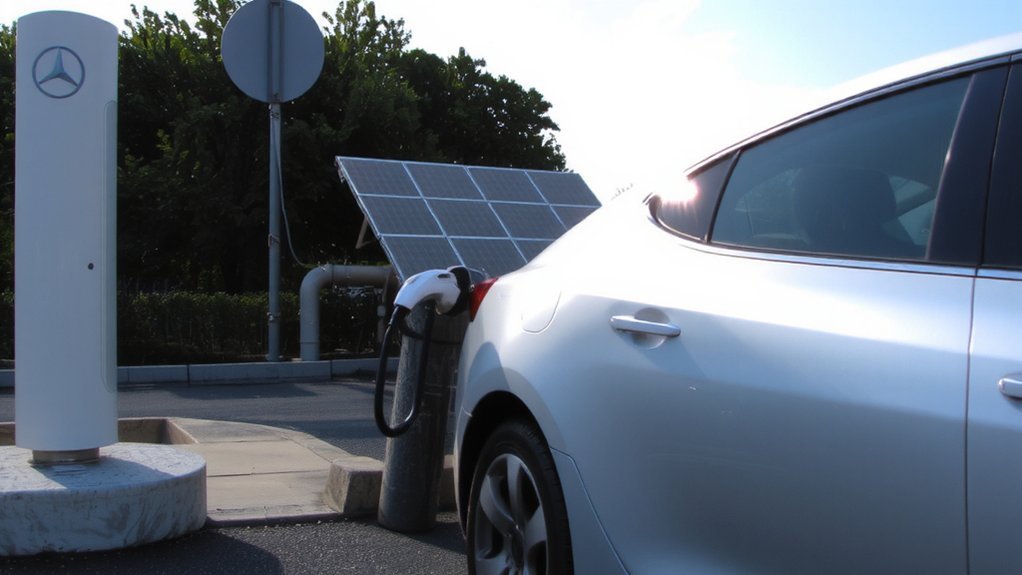

How fast does it charge? On a 230 V single‑phase supply, you’ll deliver up to 7.4 kW (32 A) to a Type 2 vehicle, limited by the car’s onboard charger and its charge curves. With three‑phase 400 V, the unit supports up to 11–22 kW where supply and wiring permit. The EVSE signals current via IEC 61851-1 PWM; the inlet follows IEC 62196-2, ensuring interoperability. Expect full-rate current until the vehicle initiates taper; any reduction before taper indicates thermal throttling from cable, connector, or ambient heat. Continuous-duty ratings assume compliant installation to BS 7671, correct circuit breaker, and RCD Type A with 6 mA DC protection. Temperature, state of charge, and grid voltage variation can derate output. Always verify tight terminations and adequate ventilation.
Smart App, Scheduling, and Voice Control

Why manage charging manually when the Hypervolt app can enforce precise schedules, current limits, and start/stop windows through the IEC 61851-1 control pilot, so the EVSE only energizes when you intend?
Use time-of-use schedules, per-session amperage caps, and departure timers to align charging with your tariff. The app applies setpoints via control pilot duty-cycle modulation, honoring vehicle requests per IEC 61851-1 Mode 3. Invoke voice control through Alexa or Google Assistant to start, stop, or query session status and power without touching the unit. Configure Privacy Settings to restrict telemetry, anonymize analytics, and disable location where appropriate. Approve Firmware Updates over-the-air; signed packages, staged rollout, and rollback safeguards maintain availability. You can export session logs, update Wi‑Fi credentials, and delegate access with role-based permissions.
Safety, Compliance, and Load Management
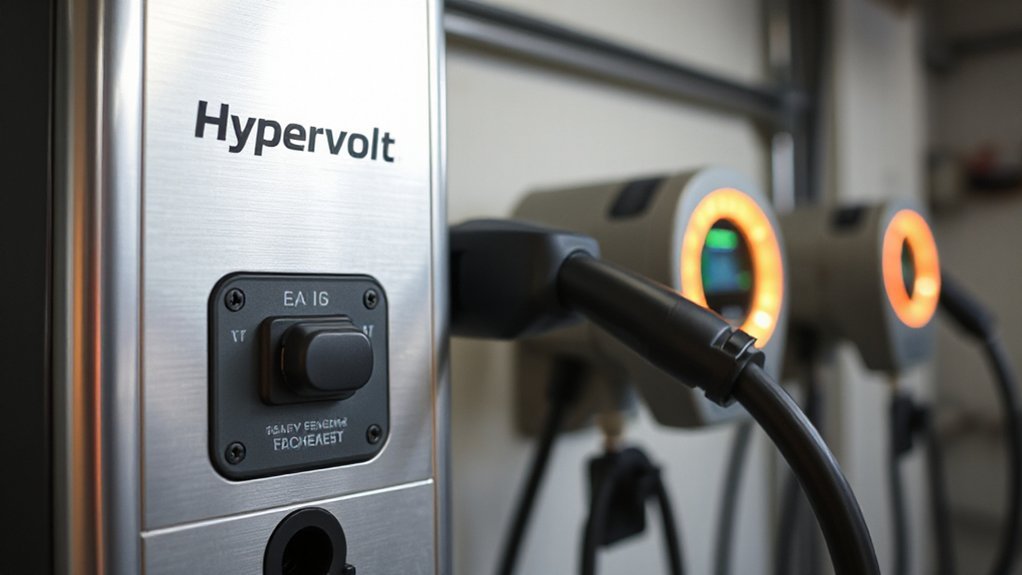
From app-based control, the Hypervolt enforces safety and grid compliance at the hardware layer, meeting IEC 61851-1/-22 and IEC 62196 requirements. You benefit from active Fault Detection, RCBO protection, PEN fault monitoring, overcurrent limiting, and thermal derating to maintain safe operation. Dynamic load management tracks site consumption via CT sensing and caps charging current to keep the main breaker within design margins. You can set per-circuit limits, apply phase balancing on three-phase installs, and log events for Regulatory Compliance audits. Firmware verifies pilot integrity, earthing, and cable ratings before energizing.
| Function | Purpose |
|---|---|
| Dynamic load control | Prevents mains overload |
| Fault logging | Evidence for compliance |
| Temperature monitoring | Pre-empts derating/trip |
Remote updates maintain certificates and test routines. You can export reports to document installations and protective-device settings.
Solar Integration and Energy Cost Savings

Leveraging on-site PV, Hypervolt synchronizes EV charging with surplus generation to cut grid import while preserving protection and compliance. You prioritize self-consumption using export‑limiting controls aligned with IEEE 1547, G99, and IEC 61851 signaling. Smart schedules pair with net metering or dynamic tariffs to minimize delivered kWh cost and demand charges. With a home battery, you can perform battery arbitrage ethically by charging off-peak or from PV, then fueling the vehicle during peak windows without backfeeding. Real-time metering validates savings and verifies anti‑islanding and RCD functionality stay intact. Compliant CT placement ensures accurate import/export accounting and billing.
- Track PV, SoC, and charger load.
- Prefer solar-only before grid draw.
- Cap current to prevent export.
- Use ToU signals; avoid fuse limits.
- Archive sessions for tariff audits.
Design, Installation, and Everyday Use
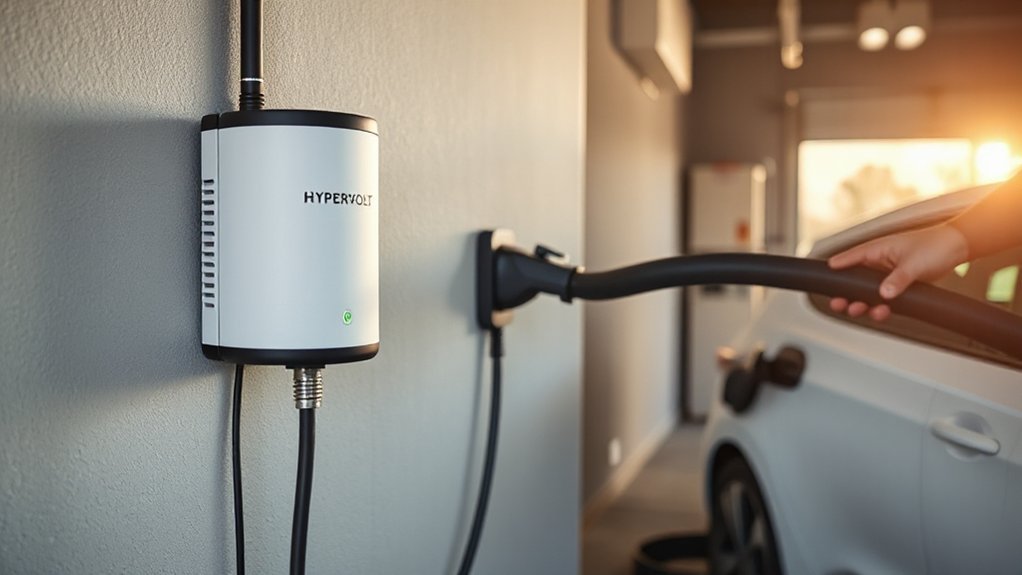
Anchored in IEC 61851 and IEC 62196, with installation to BS 7671:2018+A2:2022 (or NEC 625 in North America), Hypervolt emphasizes correct load design, protection, and reliable daily operation. You size feeders for calculated demand, manage load, and verify PME/PEN fault protection. You specify Type A RCD with 6 mA DC detection, surge protection, and earthing. You mount at 1.2–1.5 m for accessibility and cable reach. You commission via firmware updates, insulation tests, and OCPP checks.
| Aspect | Spec/Action | Why it matters |
|---|---|---|
| Load design | Diversity, 32–40 A radial, 6 mA DC | Prevents nuisance trips |
| Protection | SPD, PEN fault detection, IP54 enclosure | Electrical safety |
| User ergonomics | 5 m cable, angled holster, LED status | Fast, glanceable use |
| Maintenance tips | Quarterly checks, torque terminals, clean vents | Sustains reliable performance |
Conclusion
You’ll slam range anxiety into oblivion with a Hypervolt that sips electrons like a surgeon—precise, compliant, unstoppable. You meet IEC 62196‑2 and IEC 61851‑1 at the socket, satisfy BS 7671 in the board, and sleep as RDC‑DD and PEN protection stand guard. You orchestrate loads, throttle to 7.4 kW, and harvest solar with ruthless efficiency. The IP65/IK08 shell shrugs off weather. Install it, schedule it, audit logs—then charge, every day, as if reliability were overengineered.