
You probably don’t know that Hypervolt and Zappi approach compliance with IEC 61851 and UK OZEV rules differently, which affects safety features and how they manage power. You’ll weigh CT-based export control, PV surplus tracking, PEN-fault protection, Type A + 6 mA DC RCD, and firmware-driven smart scheduling. Add tariff optimisation, installer support, and warranty longevity to the mix. Which one truly matches your PV setup, grid contract, and risk tolerance?
Key Takeaways
- Design and ergonomics differ: Hypervolt sleek with integrated cable cradle; Zappi utilitarian with LCD; prioritize IP65/IK08 durability, UV resistance, and serviceable hardware.
- Smart control varies: Hypervolt offers cloud tariff-aware scheduling; Zappi provides on-device modes and timers; verify offline schedules, OCPP, and secure, signed firmware with rollback.
- Installation and safety are critical: 7.4 kW single-phase; confirm 32 A circuit, Type A RCD with 6 mA DC, PEN protection, CT-based load management.
- Total cost differs: factor breaker upgrades, earthing, commissioning time, any app subscriptions, incentive eligibility, and warranty terms, parts-and-labour coverage, and transferability.
- Operational resilience: compare MTBF, connector wear ratings, thermal throttling, clear fault diagnostics, remote support SLAs, and rapid spares availability for minimal downtime.
Price and Value

While headline RRPs fluctuate, you should assess price with respect to total installed cost and standards compliance. Factor the breaker upgrade, earthing arrangements, load management setup, verification, and any DNO/utility approvals. Confirm each unit’s conformity to IEC 61851-1, IEC 62955, and relevant national wiring rules, because missing functions add retrofit cost and risk. Evaluate commissioning time, firmware support, and subscription costs for app features, dynamic tariffs, or demand-response participation. Check incentive eligibility: many rebates require open smart-charging capability, safety certifications, calibrated metering, and secure communications. Consider warranty length, replacement logistics, and validated installer networks, since downtime carries cost and safety exposure. Finally, compare lifetime energy management value—solar/load balancing, tariff scheduling, and reporting—against ongoing fees, ensuring benefits exceed ownership cost over the charger’s service life.
Design and Hardware Build
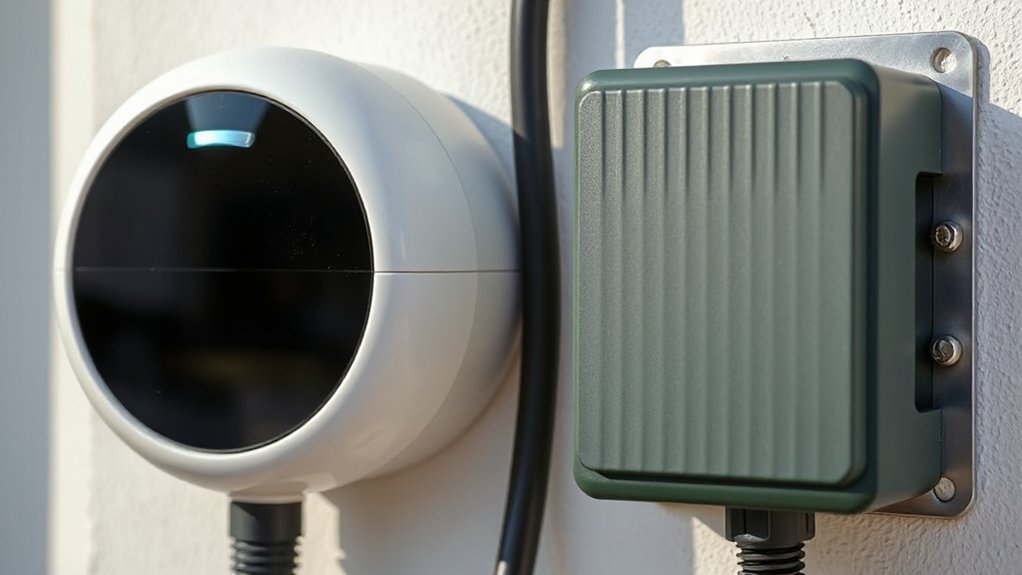
You’ll evaluate aesthetics and form factor—footprint, cable management, and mounting clearances—because they affect ergonomics and installation safety. Confirm the enclosure and connectors comply with IEC 61851-1 and IEC 60529 (IP), include an appropriate IK impact rating, and use UV- and corrosion-resistant materials with UL 94 V-0 flammability. You’ll check build quality—gaskets, strain relief, fasteners, and thermal design—since it governs durability, ingress control, and long-term electrical safety.
Aesthetics and Form Factor
Even before you compare smart features, the hardware design sets distinct expectations: Hypervolt presents a sleek, minimal fascia with an LED halo and integrated cable cradle, whereas Zappi uses a more utilitarian, appliance-like enclosure with a front LCD and tactile buttons. You’ll see a restrained color palette on Hypervolt; Zappi emphasizes legible feedback and physical controls. Both align with IEC 61851 status indication conventions via LED accents. Assess footprint and cable stowage against BS 7671 accessibility guidance. Check mounting height for clear sightlines and safe reach.
- Wall footprint and projection influence doorway clearances and mirror swing.
- Cable route and hook minimize trip hazards and connector strain.
- Status visibility at night: halo vs backlit LCD, glare-managed.
- Button-free vs buttoned operation: gloves, moisture, and mis-press prevention.
Materials and Durability
Materials determine service life and safety in outdoor EVSE, so focus on enclosure chemistry, sealing, and impact resistance. Hypervolt uses a UV‑stabilized polycarbonate/ABS housing with stainless fixings; Zappi opts for ASA/PC with a robust front shell and metal backing. You should verify IP rating (IEC 60529) and IK impact grade; both target IP65 and at least IK08 for drive‑way knocks.
Look for gaskets, drain paths, and breathable membranes to manage condensation from thermal cycling. Fire performance matters: confirm UL 94 V‑0 plastics and segregated wiring per IEC 61851. Corrosion resistance is critical near coasts; stainless A2/A4 hardware and powder‑coated plates help.
Cable strain relief, flap hinges, and gland quality determine longevity. Prioritize replaceable seals and accessible service screws for safe, compliant long-term operation outdoors.
Charging Performance and Speed


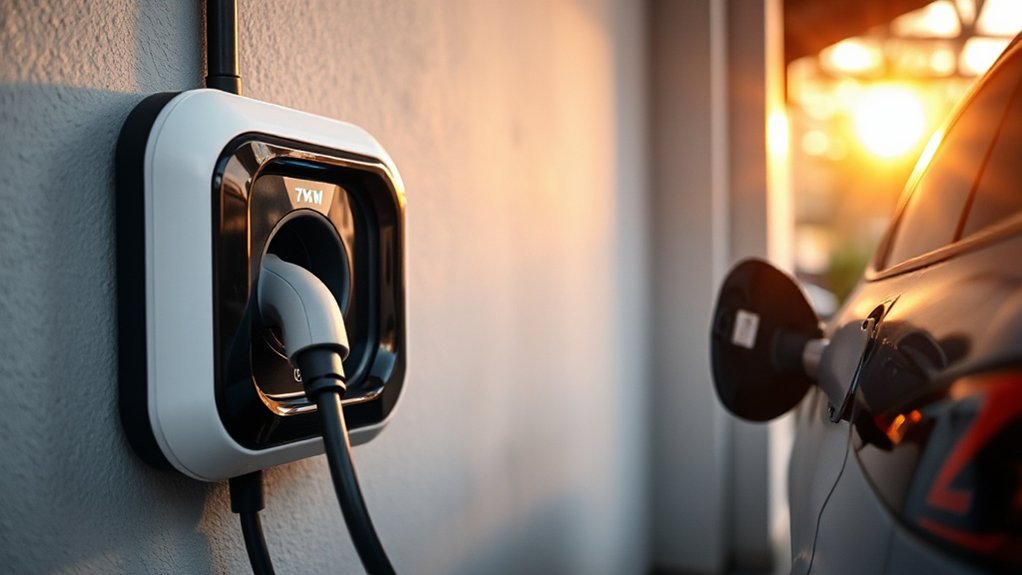

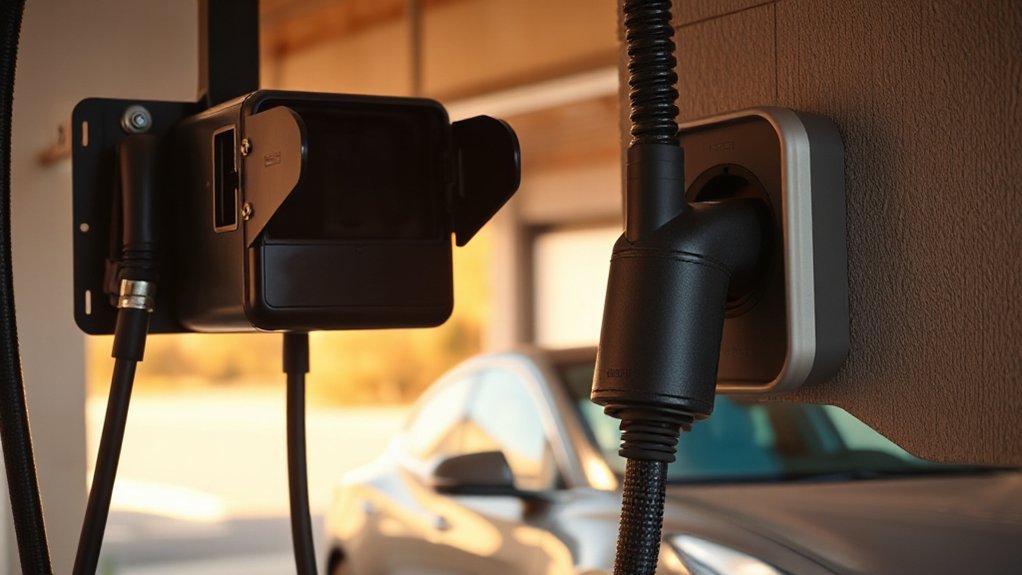
Both chargers deliver up to 7.4 kW on a single-phase 230 V supply and operate as Mode 3 EVSE per IEC 61851-1 with Type 2 connectors per IEC 62196. In use, your EV dictates current via IEC 61851 PWM, but cable and installation limits matter. You’ll see rapid ramp to Peak Power, then moderation to protect wiring and enclosure temperatures. Internal sensors manage Thermal Throttling to keep components within IEC 60364-7-722 safety limits.
- Expect 32 A continuous at 230 V, derated when ambient exceeds design thresholds.
- Verify breaker, RCD Type A/6 mA DC, and cable size to sustain duty without nuisance trips.
- Shorter, thicker leads reduce voltage drop, significantly improving effective charge speed.
- Firmware enforces smooth current steps, minimizing contactor wear and arc risk.
App Experience and Smart Features
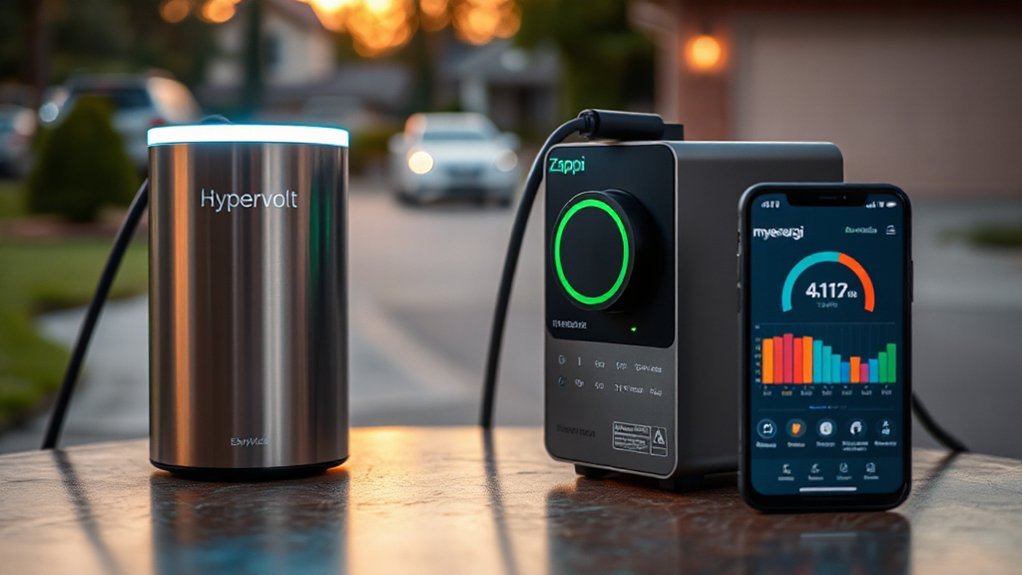
You assess setup and onboarding: secure app provisioning (WPA2/WPA3), authenticated firmware updates, correct EVSE signaling per IEC 61851, and optional OCPP 1.6/2.0.1 back-end, with MFA and GDPR-consent flows. For scheduling and automation, you verify tariff-aware timers, load limits, and demand-response compatibility (ISO 15118 smart charging, OpenADR 2.0b), with failsafes that default to safe stop if comms drop. For solar integration controls, you’ll confirm CT calibration and export limiting, adherence to G99/G100 and anti‑islanding (IEEE 1547), and protections that prevent backfeed to the grid.
Setup and Onboarding
How do Hypervolt and Zappi guide you from first power-on to a compliant, smart-ready install? You scan the QR code, run a welcome checklist, and let the app request access permissions (Bluetooth, Wi‑Fi, location) for secure commissioning. Both walk you through earthing method selection, CT clamp placement, and grid-compliant limits per BS 7671 and IEC 61851. They verify RCD/RCBO type, PEN-fault protection, firmware version, and installer credentials to maintain OZEV eligibility.
- Connect to Wi‑Fi or Ethernet, confirm RSSI, and store fallback hotspot credentials for onsite recovery.
- Pair CTs for whole‑home and solar import/export; calibrate phase rotation.
- Set supply rating, overload protection, and load‑balancing threshold per DNO notice.
- Run insulation, loop, and RCD tests; finalize commissioning report and handover pack with photos and test values.
Scheduling and Automation
While both comply with the UK Electric Vehicles (Smart Charge Points) Regulations 2021, their automation styles differ: Hypervolt centers on tariff-aware calendars and cloud rules, whereas Zappi pivots around on‑device energy modes driven by CT feedback.
Hypervolt lets you build week-by-week schedules, align them with dynamic tariffs, and apply holiday overrides without deleting rules. Firmware scheduling resides in the charger but is orchestrated via the cloud; if connectivity drops, last-known safe plan persists and enforces the mandated randomised delay. You can cap current to respect main fuse limits and BS 7671 diversity, with load-balancing from CTs protecting tails.
Zappi emphasises mode-based timers on the unit, so you can start/stop by clock, grid signals, or kWh targets, all compliant with IEC 61851 charging states. Safely.
Solar Integration Controls
Why does Zappi feel purpose‑built for PV, whereas Hypervolt layers solar awareness onto a generalist smart charger? You get three PV modes on Zappi (Eco, Eco+, Fast) with CT‑based export limiting, aligned to G100 and IEC 61851. Hypervolt tracks surplus via CTs but prioritizes scheduled kWh, so solar follow is less granular. Both apps show live import/export; Zappi coordinates with myenergi to hold site export near 0 kW.
- Grid protection: Configure import/export caps to satisfy ENA G99; fallback disables surplus mode on CT loss.
- Power quality: Current ramps respect IEEE 519; Zappi shows Harmonic mitigation status; Hypervolt reports THD.
- Reactive power: Chargers target unity power factor; neither offers VAR control.
- Integrations: Zappi automates with myenergi; Hypervolt provides Home Assistant support.
Solar Integration and Energy Management

Integrating solar PV with your EVSE exposes the sharpest difference between Hypervolt and Zappi. Zappi natively prioritizes surplus generation, modulating current under IEC 61851-1 to track export, with Eco and Eco+ modes minimizing grid import. Its CT-based metering supports household carbon accounting and enables tariff arbitrage when aligned with time-of-use pricing and home storage. Hypervolt can follow PV via external CTs and schedules, using app logic to ramp current within IEC 61851 limits; brief transients may still import. Both provide dynamic load management to protect the service head (BS 7671:722), and fall back to safe fixed current if telemetry drops. For grid compliance, Zappi’s tighter surplus tracking reduces reverse power flow spikes, while Hypervolt favors user-configured profiles. Both support schedules respecting DNO export limits.
Installation, Compatibility, and Safety
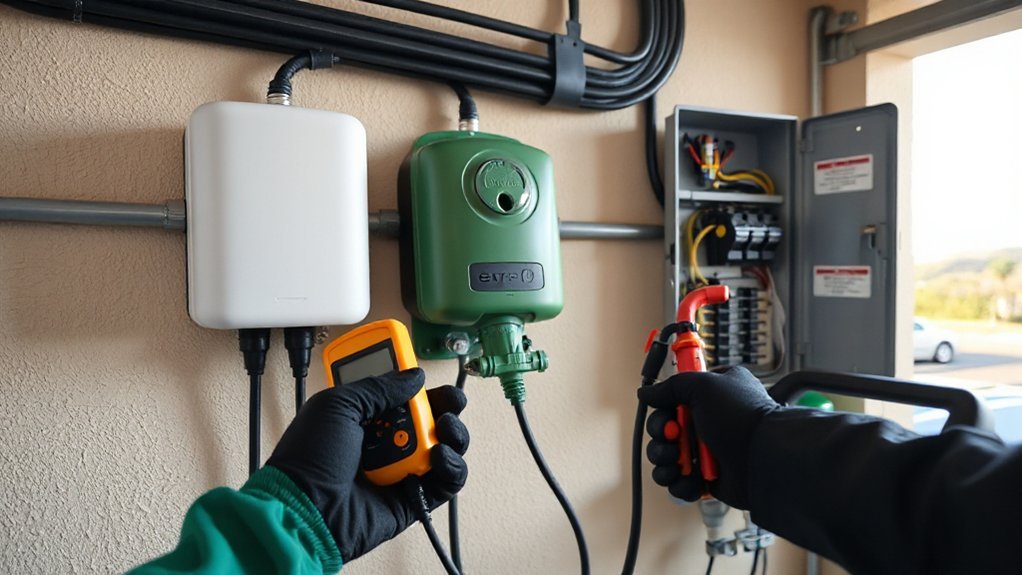
Because EVSE imposes a sustained high load, design and install Hypervolt and Zappi to BS 7671 Section 722 and the IET Code of Practice for EV Charging Equipment Installation, confirming supply capacity, earthing, and protective devices before fixing hardware.
You’ll verify Regulatory compliance via Electrical inspections, test results, and certification (EIC/EICR). Match charger rating to a dedicated final circuit, typically 32 A, with Type A RCD and 6 mA DC protection. For PME supplies, use integrated PEN fault protection or an O-PEN device; provide SPD if risk assessment requires. Confirm Wi‑Fi/Ethernet coverage, CT clamp routing, and space for load‑limiting devices.
- Assess maximum demand and apply load curtailment.
- Check cable sizing and volt‑drop.
- Validate earthing, bonding, and Ze/Zs values.
- Test insulation and RCD trip times.
Reliability, Support, and Warranty

After you’ve installed to BS 7671 Section 722 and the IET Code of Practice, long‑term confidence in Hypervolt and Zappi comes from proven reliability, robust firmware support, and clear warranty terms. Assess real‑world MTBF, connector wear ratings, and IP/IK enclosure grades; these determine uptime under outdoor duty. Check update cadence, rollback capability, and signed firmware to maintain cybersecurity and safety interlocks. You’ll want clear fault diagnostics (PEN loss, RCD trips, over‑temperature) and rapid parts availability. Evaluate Service responsiveness: phone triage times, remote diagnostics, and engineer dispatch SLAs. Demand Warranty clarity: term length, parts‑and‑labour coverage, exclusions on accessories, and transferability to new owners. Verify support for standards changes and smart tariff APIs to avoid obsolescence. Confirm spares logistics, calibration procedures, and documented end‑of‑life policies too.
Conclusion
You should choose based on your grid and goals. If you want app-centric control, tariff automation, and cloud services, Hypervolt fits—meeting IEC 61851 and BS 7671 with PEN-fault protection and 6 mA DC monitoring. If you’ve PV and crave surplus-first charging, Zappi’s CT-led Eco/Eco+/Fast modes and export control shine. As ever, measure twice, cut once: confirm installer competence, firmware update cadence, RCD type, CT placement, and OZEV/SEAI eligibility before you commission the installation and setup.