If you’re considering the 2025–2026 Hyundai Ioniq 5, its 800V architecture can take you from 10 to 80% in about 18 minutes on a 350 kW charger. It also offers a native NACS port and a CCS1-to-NACS adapter for wide access. I’ll walk through how that fast charging works, real-world speed, and what affects it—so you can judge whether it fits your travel needs.
Key Takeaways
- The 2025–2026 Ioniq 5’s 800V architecture enables ultra-fast charging and can reach 10–80% in roughly 18 minutes on 350 kW chargers.
- Achieving ~18 minutes depends on high-power 350 kW DC fast chargers, favorable battery temperature, and starting state of charge.
- Models with the larger 84 kWh pack (RWD) get the longest range and best fast‑charge efficiency for 10–80% sessions.
- The vehicle uses a native NACS port plus a CCS1-to-NACS adapter, allowing broad access to high‑power public chargers.
- Home Level 2 charging is much slower (about 5–7 hours full); reserve 350 kW DC stations for rapid 10–80% top‑ups.
How the 800V Architecture Enables 18-Minute 10–80% Charging
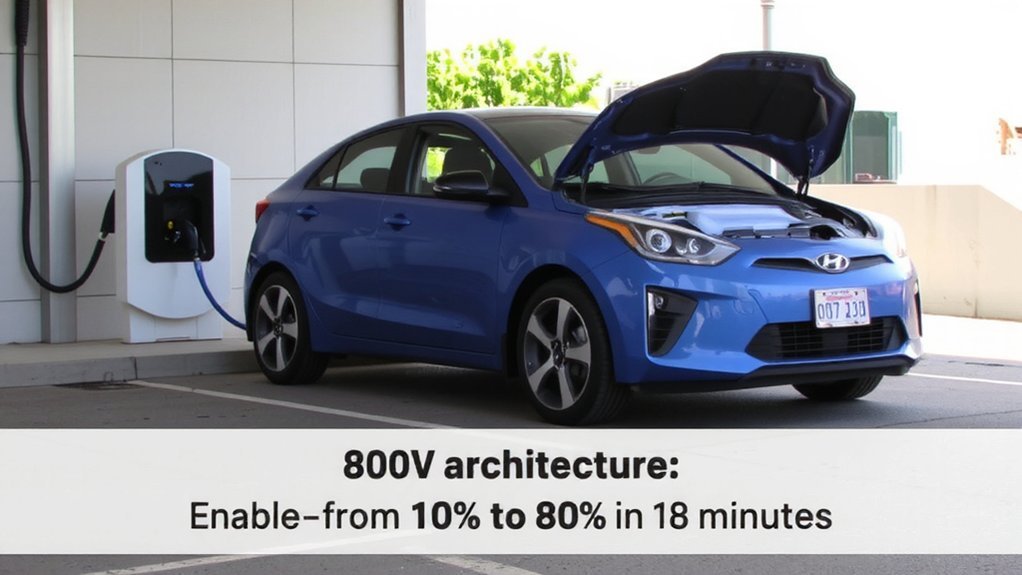
By doubling pack voltage from the common 400V to 800V, the Ioniq 5 moves the same charging power with roughly half the current, which cuts heat generation, lets wiring be thinner and lighter, and lets chargers deliver much higher peak power (up to 350 kW) without overheating components.
You’ll benefit because lower current reduces energy loss and thermal stress, so the battery and electronics stay cooler during rapid fills. The car’s battery pack, cell chemistry, and active thermal management are designed to accept very high input safely, while the inverter and battery management system monitor cells and balance voltages in real time. It also uses an 800V/350kW ultra-fast charging system to achieve those speeds.
That orchestration minimizes degradation and lets compatible DC fast chargers restore 10–80% in about 18 minutes when conditions and charger output allow.
Native NACS Port and Direct Supercharger Access
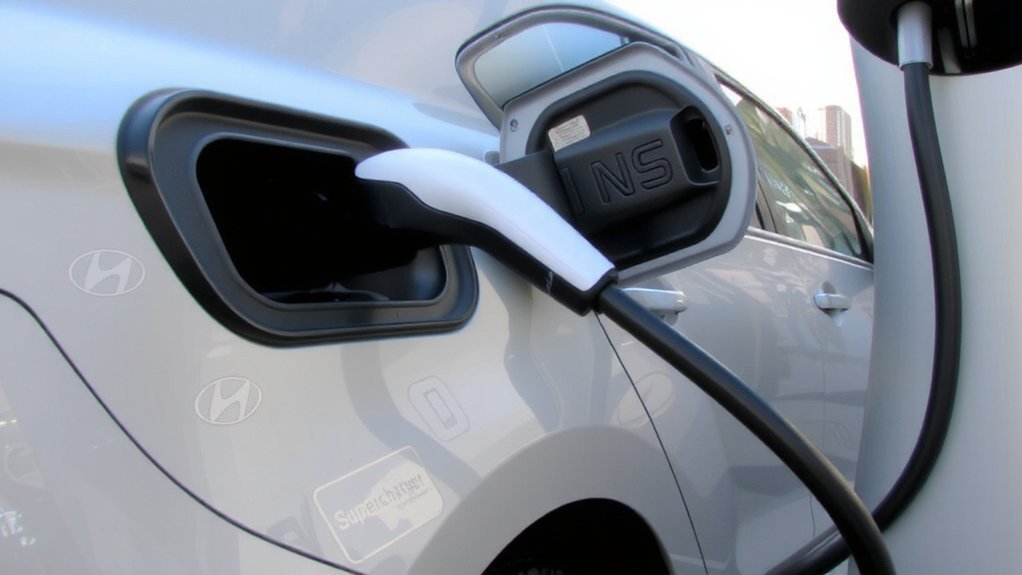
With the 2025 Ioniq 5’s native NACS port, you can plug into Tesla Superchargers directly without an adapter.
Hyundai also bundles a CCS1-to-NACS adapter so you can use CCS fast chargers when you need them. That combination gives you broader, more flexible access across North America’s fast‑charging networks. High-power CCS1 charging can do 10-80% in 20 min.
Native NACS Integration
The 2025–2026 Ioniq 5 comes with a native NACS port that lets you plug into Tesla Superchargers directly—no Tesla adapter needed—and Hyundai still includes a complimentary CCS1-to-NACS adapter so you can use the wider CCS network (about 36,000 fast chargers in the U.S.). Independent testing showed that an Electrify America DC fast charger charged the Ioniq 5 faster, delivering 152 miles versus 90 miles in the same time Electrify America advantage. You’ll benefit from standardized PLC communication that Hyundai validated with Tesla, so chargers and car authenticate cleanly and start sessions reliably.
AC charging uses a NACS-to-J1772 adapter and the onboard 10.9 kW charger, giving safe Level 2 recharge times of roughly 5h40–7h20 depending on battery. Be aware that current Tesla Supercharger voltages limit DC rates to ~135–150 kW; Hyundai expects future 800V Supercharger upgrades to enable faster, vehicle-capable speeds. Follow manufacturer guidance, regularly monitor charging sessions, and protect battery health.
Direct Supercharger Access
Many 2025–2026 Ioniq 5s include a native NACS port, so you can plug into Tesla Superchargers without an adapter and start a session right from the Tesla app—charging starts automatically, payments are handled through your Tesla account, and you can monitor or stop charging remotely. Some models can add about 178 miles of range in approximately 15 minutes on a 350‑kW charger. You locate stations in the Tesla app, select a stall, and connect; the app shows cost, time remaining, and real‑time status so you can plan stops safely.
Peak replenishment hits about 10–80% in 18–20 minutes at compatible high‑power Superchargers, though rates vary with battery temperature and state of charge. Set up your Tesla account before arrival, confirm station compatibility, and follow charging‑station safety guidance while plugging and unplugging. Keep cables dry, avoid overreaching, and watch for nearby vehicles and children.
CCS1 Adapter Included
Hyundai includes a NACS‑to‑CCS1 adapter with the 2025 Ioniq 5, so you can connect the car’s native NACS port to CCS1 DC fast chargers (and expand access beyond Tesla Superchargers). The official adapter is included in the U.S., fits compatible Hyundai models, and meets stringent safety and durability standards for high‑power DC charging. Also available is an optional V2L adapter that converts the EV charging port to a standard AC outlet, providing 15A/120V (1.8 kW) output for powering appliances. You’ll use it between the CCS1 charger cable and the NACS inlet; follow Hyundai’s instructions, start the session on the station UI, then disengage and remove the connector and adapter when finished. It supports around 250 kW on V3 Superchargers and is designed for straightforward installation without tools.
Carry it when you travel so you can safely access both CCS1 networks and Tesla Superchargers. Contact dealers for manuals and in-person guidance.
CCS1-to-NACS Adapter and Broader Station Compatibility
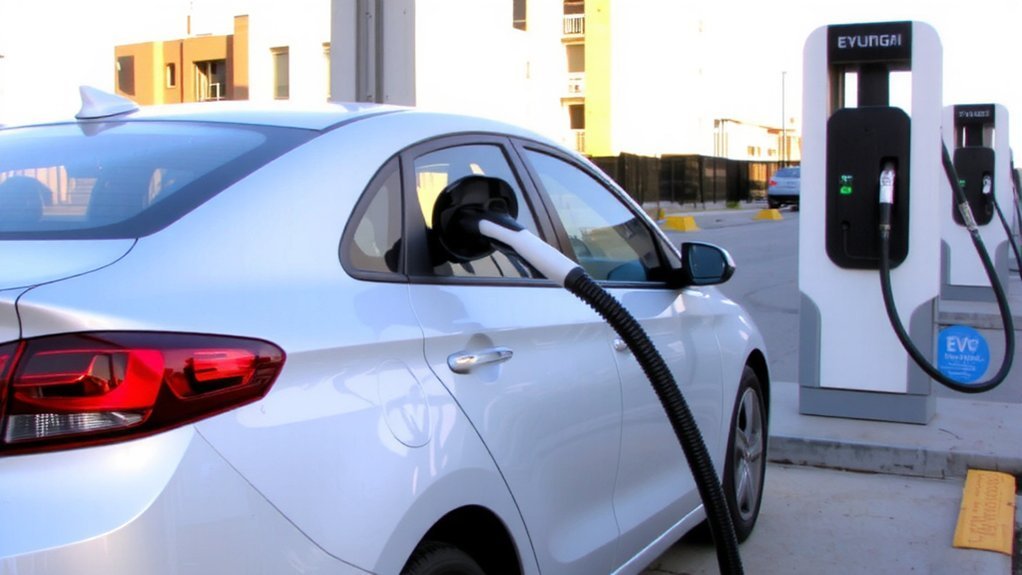
How you connect your Ioniq 5 depends on the model year: pre‑2025 cars need a CCS1‑to‑NACS adapter to use Tesla Superchargers, while 2025 models include a native NACS port plus a complimentary CCS1 adapter for non‑Tesla DC fast chargers.
Model year matters: pre‑2025 Ioniq 5s need a CCS1‑to‑NACS adapter; 2025 models include NACS plus a CCS1 adapter
If you own a pre‑2025 car you’ll buy an adapter from third‑party vendors or some dealers to plug your CCS1 port into NACS chargers; it won’t change charging speed.
With 2025 models you can plug straight into Superchargers and carry the provided CCS1 adapter for Electrify America, ChargePoint, EVgo and similar networks. Use apps to find stations, start sessions, and monitor charging.
Follow manufacturer instructions when attaching adapters and stay mindful of connector alignment and weather precautions for safe charging. Keep clear of traffic while charging. The Ioniq 5 benefits from its 800V architecture, which enables much faster charging than typical EVs.
Battery Options and EPA Range Estimates for 2025–2026 Models
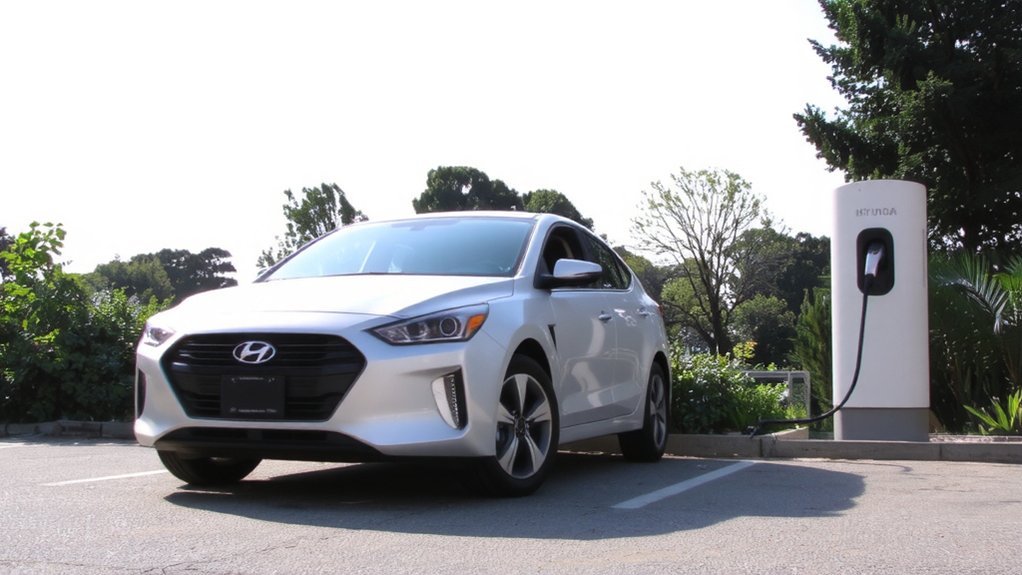

You’ll choose between a 63.0‑kWh standard pack (available on SE RWD, EPA 245 miles) and an 84.0‑kWh pack offered across SE, SEL, Limited, XRT, and N trims. The larger pack provides noticeably improved range and quicker DC fast-charging speeds 84.0 kWh.
EPA estimates for the larger pack range from 318 miles for single‑motor RWD models to 221–290 miles for AWD variants depending on trim and wheel size.
Keep in mind RWD generally yields the highest EPA range while AWD trims and option choices reduce real‑world range.
Battery Sizes and Ranges
Two battery choices—63.0 kWh Standard Range and 84.0 kWh Long Range—power the 2025–2026 Ioniq 5, both upgraded from 2024 and built with lithium‑ion chemistry. The Ioniq 5 also provides class-leading charging alongside comfortable space for five. You can pick the smaller pack for daily safety-focused driving or the larger for longer trips; both use high-voltage architectures (523V and 697V) tailored to their capacities.
Expect roughly 245 miles from the Standard pack and up to about 318 miles from the Long Range in efficient RWD form, with AWD variants returning noticeably less depending on wheels and tires. Charging behavior and real-world results vary, so plan routes with safe charging margins.
- Packs: 63.0 kWh and 84.0 kWh
- Chemistry: lithium‑ion, upgraded cells
- Voltages: 523V (Std), 697V (Long)
- Practical ranges: ~245–318 miles; plan conservatively for safety.
EPA Estimates by Trim
The IONIQ 5’s EPA ranges depend on battery size and trim: the 63.0 kWh Standard pack delivers about 245 miles in SE RWD, while the 84.0 kWh Long Range reaches roughly 318 miles in SE/SEL/Limited RWD; AWD trims reduce range to about 290 miles (SE/SEL), 269 miles (Limited), or 259 miles (XRT).
You should treat these EPA figures as estimates based on a full charge; actual range will vary with driving conditions, load, climate, and your habits. The Standard Range applies to the smaller battery and both model years. The Long Range figures apply to trims equipped with the larger pack.
For safety planning, allow margin for varying conditions, and charge more frequently to maintain reserve and avoid range-related stress. Check the charging network. The interior also features a 12.3-inch touchscreen with built-in navigation.
RWD Vs AWD Range
Although both drivetrains use the same upgraded battery options, your choice between RWD and AWD has a clear tradeoff: RWD maximizes range, while AWD adds traction with a range penalty. There are also two new variants for 2025: the performance-focused N and off-road XRT. You’ll get 318 miles with RWD on the 84‑kWh pack versus 290 miles for AWD — roughly a 28‑mile drop.
The 63‑kWh battery yields about 245 miles in either layout, with AWD often on higher trims. Both support up to 350 kW DC fast charging (10–80% in ~18 minutes).
Choose AWD for winter safety and stronger acceleration; choose RWD for maximum range and fewer charging stops.
- RWD: 318 mi, single motor, efficient.
- AWD: 290 mi, dual motors, more traction.
- 63‑kWh: ~245 mi baseline.
- Fast charge: 10–80% ≈18 min.
Real-World Fast-Charging Performance and Speed Profiles
How fast will your Ioniq 5 actually top up on a road trip? Expect Hyundai’s 10 to 80 percent claim of about seventeen minutes in ideal conditions; independent tests matched that near seventeen minutes while some real sessions ran closer to twenty. It’s also one of the few models with an 800V charging architecture.
Charging speeds vary by network, so plan to use faster public stations when safe and available. In practice you can gain roughly ninety to one hundred fifty miles of range in the first fifteen to twenty minutes, depending on conditions.
Ambient temperature and preconditioning matter, so warm the battery before a fast session when safe, avoid crowded stalls, and don’t feel compelled to charge to 100 percent on a trip. Check charger availability and monitor state of charge for safer planning regularly.
Peak Charging Rates, Plateaus, and Factors That Affect Speed
When you plug a 2025–2026 Ioniq 5 into a capable 800‑volt DC fast charger, you’ll see very high initial power—roughly 140–150 kW from a low SoC—rising into a sustained plateau near 220–230 kW and peaking as high as 250–258 kW (tests show about 231 kW around 50–55% SoC). The Ioniq 5 uses the CCS charging standard for DC fast charging. You’ll get the fastest charging between 10% and 60% SoC, then a sharp taper as you approach 80% to protect the battery. Pay attention to charger capacity, ambient temperature, and pack size; car’s thermal management and firmware will limit power when needed for safety.
- Charger capacity: up to 250+ kW on compatible 800 V stations.
- SoC window: peak 40–60%, plateau 10–60%.
- Temperature: cold or hot conditions reduce power.
- Pack and software: larger packs sustain higher rates.
Home and Level 2 Charging Times and Best Practices
Plugging in at home is the simplest and most cost‑effective way to keep your Ioniq 5 ready each day. For long trips, use DC fast chargers—DC fast charging can achieve a 10 to 80% charge in about 18 minutes under ideal conditions. Use a Level 2 (240V, 7 kW) station for routine charging: expect about 5 hours 40 minutes to 6 hours 43 minutes for 10–100%, or roughly 7–8 hours for 0–100%.
Level 1 (120V) adds about 3–5 miles per hour and can take ~40 hours for 0–100%, so it’s only practical for small daily top‑ups.
Install a dedicated 240V circuit and hire a licensed electrician; choose an outdoor‑rated wallbox if needed. Charge overnight during off‑peak rates, avoid extension cords, inspect cables regularly, and use manufacturer‑recommended equipment. Don’t unplug immediately at full; modern systems manage battery health automatically.
Follow local codes and utility guidance for safe installation.
Planning Long Trips: Network Coverage and Charging Strategy
Map out your route around available DC fast chargers and you’ll avoid surprises on long trips: prioritize stops that offer high‑power CCS chargers, aim to charge up to about 80% for the fastest and most battery‑friendly fills, and use real‑time apps or the Ioniq 5’s nav to preselect stations, check availability, and factor in charger type and user reports. Plan for sparser coverage in Mediterranean and remote regions; favor highways and urban corridors with dense networks. Precondition battery in cold weather and schedule charges during breaks to minimize wait times. Also note that many high‑power DC stations can replenish from 10% to 80% in about 20 minutes. These steps keep you safe, reliably.
- Use PlugShare or ABRP to check real‑time availability.
- Target 10–80% for fastest, healthiest charges.
- Precondition before arrival to maintain peak power.
- Carry adapters and plan alternates for outages.
Conclusion
You’ll appreciate how the Ioniq 5 turns long waits into quick stops: an 800V system and 350 kW peak charging mean you’ll be back on the road after 18 minutes, yet you’ll also notice the patience charging still demands when stations are crowded or temperatures drop. With native NACS access and a CCS1 adapter, you’re flexible; with thoughtful planning, you’ll trade charging anxiety for confident, efficient trips and spend more time enjoying the drive today.