
You’re weighing a Project EV charger for 2025, and you want facts: real 7 kW vs 22 kW performance, safe PEN‑fault protection, calibrated CT clamps, OCPP connectivity, and time‑of‑use logic that actually lowers bills. You also need clarity on single‑phase vs three‑phase compatibility, solar surplus charging, tethered vs untethered hardware, warranty terms, and ongoing firmware costs. Let’s test the claims against installation realities and value under current tariffs—starting with…
Key Takeaways
- Real-world charging: 7.4 kW single-phase/22 kW three-phase, but capped by your car’s onboard AC charger, supply, and thermal conditions.
- Smart charging: TOU schedules, departure targets, OCPP control, dynamic load management, and solar surplus charging reduce costs and protect your main breaker.
- Installation/commissioning: Requires proper CTs, RCDs, breaker sizing, and Wi‑Fi/Ethernet setup; good installers are crucial for reliability and compliance.
- Build and safety: IP65+ enclosure, protections for ground-fault/overtemp/PEN loss, logged events, signed OTA updates, and TLS-secured connectivity.
- Value: Competitive features for the price; app is capable but setup can be finicky—ensure firmware is current and support/warranty meets expectations.
Real-World Charging Performance (7kw Vs 22KW)
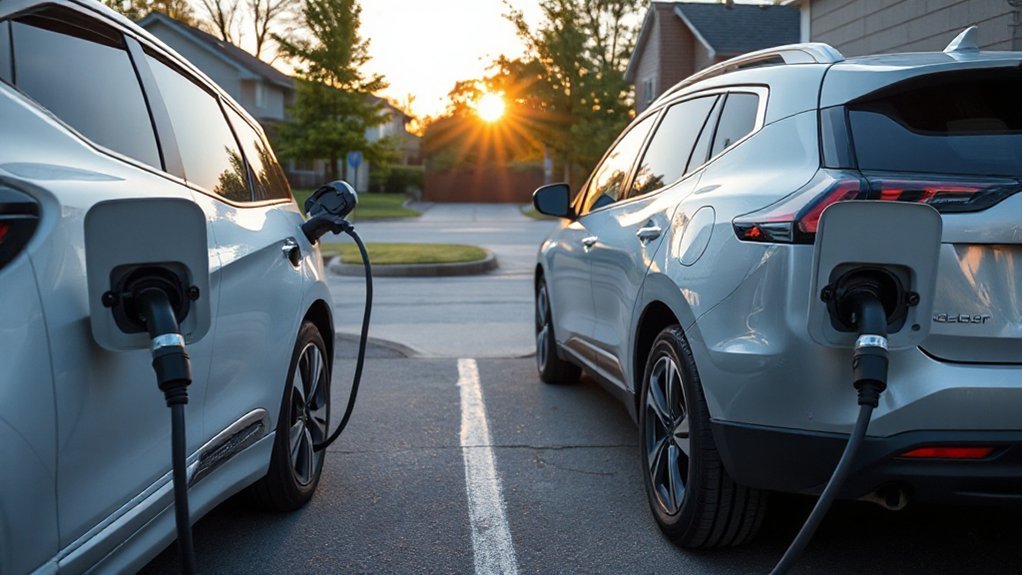
While the spec sheet quotes 7 kW (single‑phase) and 22 kW (three‑phase), real‑world charge rates depend on your supply, the vehicle’s onboard charger limit, and installation quality. In practice, you’ll see current ramp smoothly to the commanded setpoint, then modulate with pack temperature and state of charge. Expect Thermal throttling in hot weather; the unit’s thermal sensors reduce amperage to keep conductors, terminals, and contactors within code limits. Cold packs also limit acceptance, lengthening sessions. Project EV’s firmware holds steady voltage and clean pilot signaling, minimizing session drops. Charging noise is low: brief relay clicks on start/stop and a modest fan under sustained high load. Watch cable warmth, connector latch integrity, and periodic self‑tests; if faults surface, stop, verify, and resume only when safe.
Installation and Compatibility (Single-Phase Vs Three-Phase)
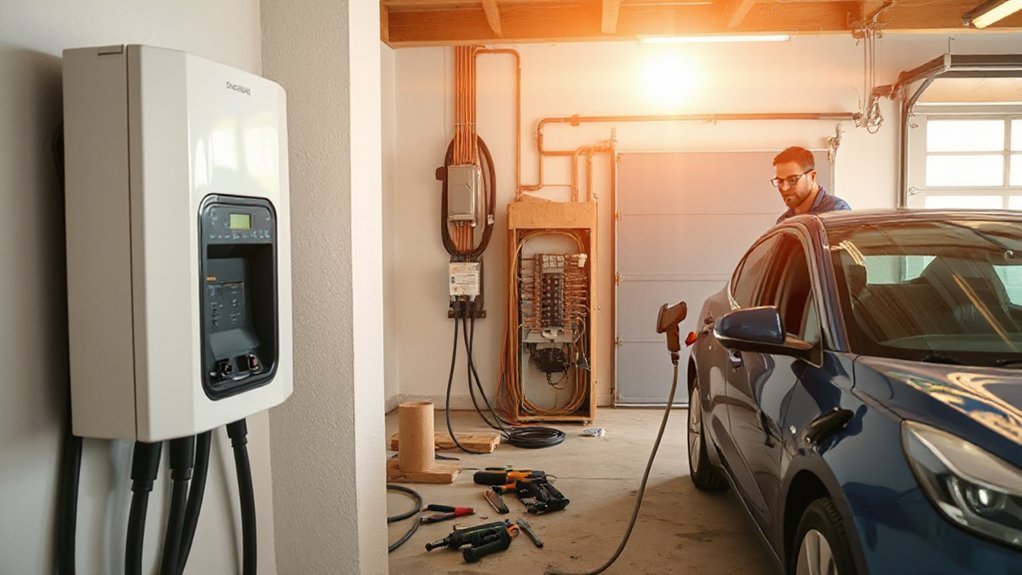
Because grid and vehicle constraints dictate viability, confirm your supply type and capacity before choosing single‑phase (230 V, up to 32 A ≈ 7.4 kW) or three‑phase (400 V, up to 32 A/phase ≈ 22 kW).
Verify supply type and capacity before selecting single‑phase 7.4 kW or three‑phase 22 kW charging.
Match the charger to service head rating, main breaker, and meter tails; many homes are 60–100 A single‑phase.
Check run length, voltage drop under 3%, correct cable size, C‑curve breaker, and Type A or B RCD per spec.
Project EV supports both supplies; charging still caps at your car’s onboard AC rating and cable limits.
Plan the permit process early; some areas mandate utility notification, load assessment, and circuit isolation.
Address earthing requirements: PEN-fault protection on TN‑C‑S, or an electrode for TT; verify Ze, Zs, and test R1+R2.
Smart Features and App Experience
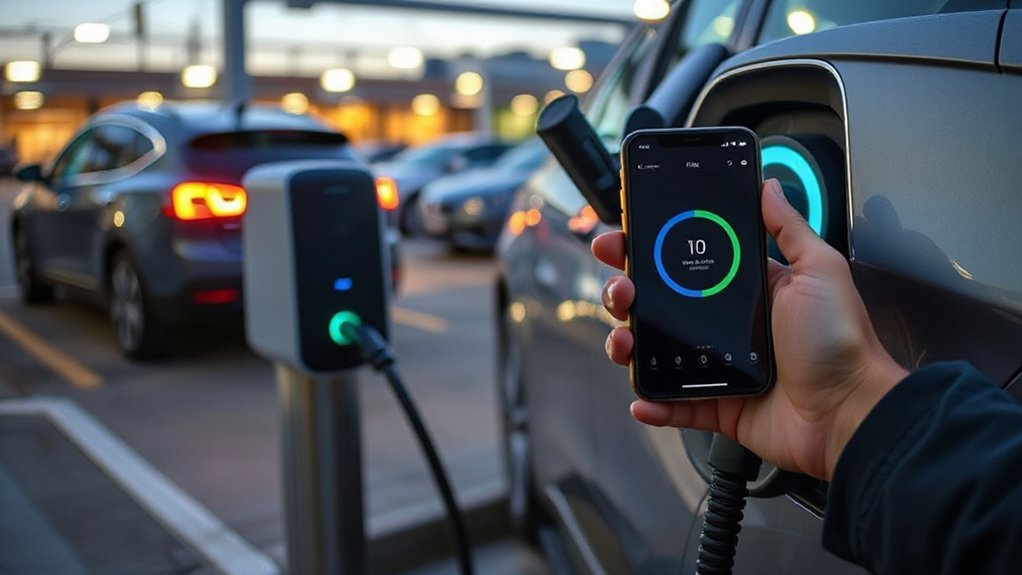
You start by installing the app, creating an account, and pairing the charger over encrypted Bluetooth/Wi‑Fi with two‑factor authentication, then confirm firmware and region settings. You configure charging schedules to match off‑peak tariffs and set current limits to the breaker rating to protect conductors. You enable load management—dynamic balancing and overload protection—to keep demand within service capacity and maintain code compliance.
App Setup and Pairing
How smoothly does the Project EV app pair with the charger in practice? Setup is straightforward if you follow the commissioning steps exactly. Power the unit, enable Bluetooth, and scan the QR code; the app verifies model, firmware, and serial before binding. You’ll confirm Wi‑Fi credentials and location data, then review Privacy Permissions. Grant only what’s necessary; deny contacts and motion unless required. The app exposes Accessibility Options like larger text and high-contrast themes, which aid safe operation in low light. If pairing fails, reset network settings and confirm 2.4 GHz Wi‑Fi.
- Use latest app version and charger firmware always.
- Stand within two meters for stable Bluetooth handshake.
- Select 2.4 GHz SSID; disable band-steering temporarily routers.
- Verify LED status codes before and after binding.
Scheduling and Load Management
Once paired, the Project EV app opens scheduling and load management controls that protect your supply while optimizing cost. You set tariff windows, departure targets, and a hard current limit tied to the main fuse. With a CT clamp or smart meter, dynamic load management reduces charge rate when household load spikes, preventing breaker trips and staying within local code. Priority rules, phase selection, and minimum amperage guarantee stable sessions in cold starts. For multi-charger sites, load sharing allocates amperage fairly, with fleet coordination templates and per-vehicle caps. You can enable solar-only, export limit, and demand-response triggers. User overrides let you start immediate charging within defined safety limits. Logs verify compliance; alerts flag faults, ground issues, or overheating. Remote lockouts prevent unauthorized session starts.
Time-of-Use Scheduling and Intelligent Charging

While electricity tariffs shift by the hour, Project EV’s time-of-use scheduling and intelligent charging let you target off-peak windows to lower cost while protecting the vehicle battery and the supply circuit. You define tariff periods, set max amperage, and apply SoC caps; the charger enforces limits with OCPP-certified controls. It reads live prices, delays start, and throttles current to avoid nuisance RCD trips. Firmware logs events for auditability, addressing privacy concerns and regulatory compliance.
- Map utility rate periods and set start/stop rules; verify local time sync.
- Configure current limits per circuit rating; enable ground-fault, overtemp, and PEN loss protections.
- Use departure-time charging to hit SoC targets without idle fees.
- Review logs, apply signed updates, and rotate API keys regularly.




Test fail-safes after configuration validation.
Solar Integration and Load Balancing Options
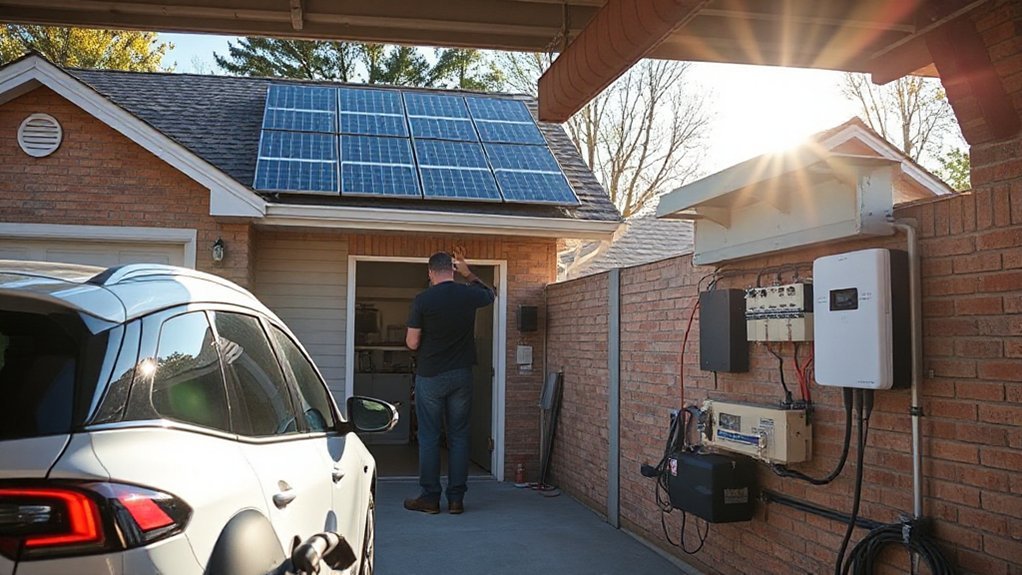
You can enable solar surplus charging to prioritize PV generation and limit grid import, using CT clamps or inverter APIs for accurate export detection. Configure dynamic load management to monitor the main service and throttle EV current in real time, preventing breaker trips and complying with NEC/IEC derating rules. Verify commissioning settings for phase balancing, max circuit ampacity, and ground-fault/overcurrent protection before enabling automation.
Solar Surplus Charging
How well does the Project EV charger handle solar surplus charging? It monitors real-time PV export via CT clamps or a smart meter and ramps charge current so you only consume excess generation, preventing grid import. You can set minimum/maximum amps, schedule windows, and apply export limits to stay within utility rules and protect your main breaker. Integrations support policy incentives and community charging schemes that favor self-consumption.
- Calibrate sensors, verify polarity, and test no-export before enabling surplus mode.
- Set a safe floor (e.g., 6–8 A) to avoid contactor chatter and EV faults.
- Use firmware with anti-islanding compliance and logged metering for audits.
- Configure notifications for solar-only sessions, interruptions, and thresholds.
Document settings and verify installer commissioning reports for compliance.
Dynamic Load Management
At peak household demand, Project EV’s dynamic load management senses aggregate current via CT clamps or a smart meter and throttles the charger in real time to protect the main breaker and prevent grid backfeed. You set an import ceiling; the controller modulates 6–32 A to the vehicle’s limit, honoring cable rating and OCPD. With PV integration, it tracks export and uses only surplus, maximizing self-consumption without reverse power. For multi-charger sites, load sharing allocates amps per socket, enforces priorities, and avoids nuisance trips on constrained supply. Schedule demand caps for TOU periods and apply user quotas for Fleet optimization. Per IEC 61851/BS 7671, RCD, earth, and temperature checks gate ramp-up. Logs support Regulatory compliance. Commission by verifying CT orientation, phases, and breaker sizes.
Connectivity, Firmware Updates, and OCPP Support
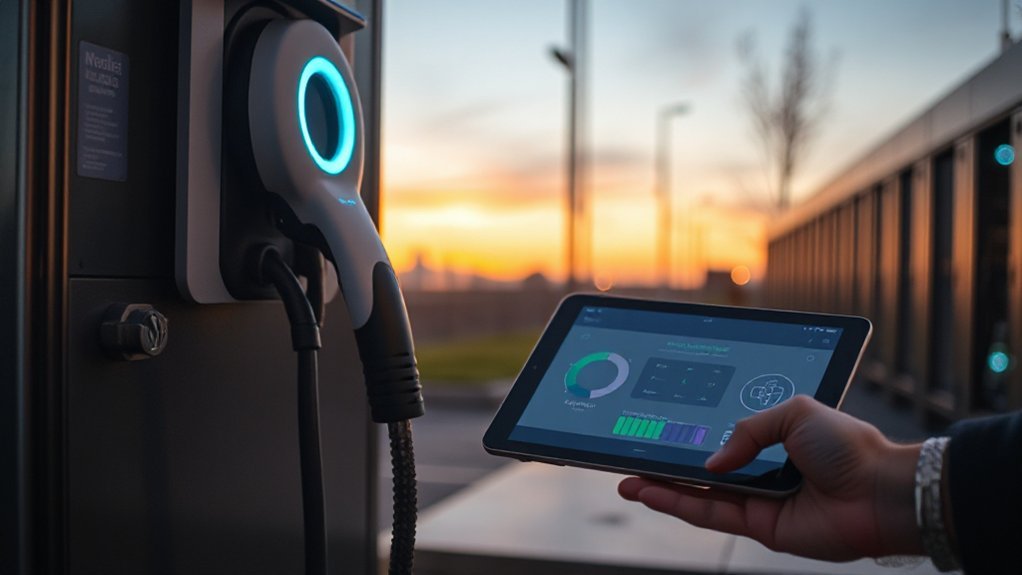
Why do connectivity, firmware update mechanics, and OCPP support matter on a Project EV charger? You depend on stable Wi‑Fi/Ethernet/LTE links to schedule, meter, and bill accurately. OCPP 1.6/2.0.1 compatibility lets you switch networks, run Interoperability Testing, and perform Security Auditing. Secure, signed firmware updates close vulnerabilities and add features without disrupting charge sessions.
Stable connectivity, OCPP flexibility, and signed OTA updates keep Project EV reliable and secure
- Networking: dual-band Wi‑Fi, Ethernet fallback, optional LTE; TLS 1.2+, certificate pinning.
- Updates: OTA with code signing, rollback, staged rollout; verify checksums before install.
- OCPP: smart charging profiles, remote start/stop, meter values, firmware management endpoints.
- Resilience: watchdogs, safe-reboot, local authorization lists for internet loss.
You should verify API logs, error codes, and uptime SLAs; test with your CPO before installation. Confirm data retention, privacy controls, and user-role permissions meet your policy.
Hardware Design: Tethered Vs Untethered and Build Quality
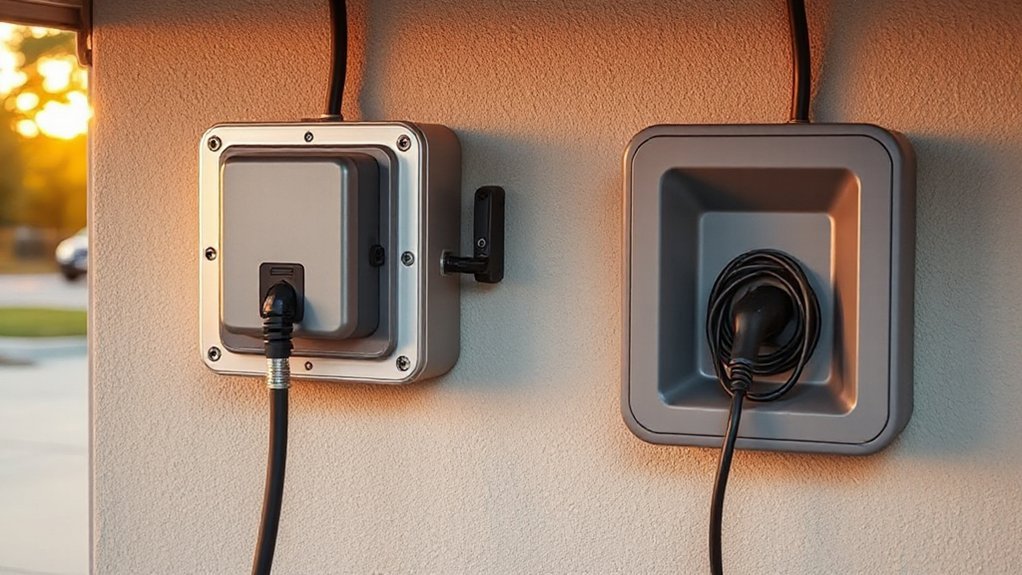
You’ll choose between tethered and untethered based on how you manage and store the cable—integrated holsters, proper strain relief, and tidy routing reduce trip hazards and connector wear. Evaluate housing durability and weatherproofing: specify UV-stabilized or metal enclosures with IP65+ ingress protection, IK10 impact rating, and corrosion-resistant fasteners. Prioritize units certified to IEC 61851/62196 with gasketed seals, locking connectors, and verified temperature ranges to guarantee safe, code-compliant operation.
Cable Management and Storage
Before you choose tethered or untethered, evaluate how cable management affects safety, uptime, and component life. A tethered Project EV unit gives you a fixed-length cable with strain relief, holster, and latch, reducing connector wear. Untethered relies on your portable lead, so you’ll need a dedicated hanger to prevent kinks and ground contact, aiding Garage organization and Trip hazard reduction.
- Specify a wall-mounted hook or reel rated for the cable’s diameter and bend radius.
- Route the lead above bumper height; maintain a clear floor path of at least 36 inches.
- Use a molded holster that fully supports the coupler and protects latch springs.
- Add a magnetic or clip-on keeper to control slack and avoid torsion.
Label storage points and inspect for abrasion weekly carefully.
Housing Durability and Weatherproofing
How the enclosure handles weather and impact determines uptime and safety. You should verify an IP65 or better rating, IK08 impact resistance, and gasketed seams with UV resistance. For coastal installs, look for corrosion protection: stainless fasteners, anodized or powder‑coated aluminum, and sealed cable glands. Tethered units protect the connector in a locking holster, reducing water ingress and dust; untethered models rely on a socket shutter and cap, so check drain paths and a tight cap seal. Demand breathable membranes to relieve condensation, conformal‑coated PCBs, and ferrite‑clamped, strain‑relieved leads. A sloped top, drip edges, and weep holes prevent pooling. Confirm -25°C to 50°C operating range, thermal derating behavior, and UV‑stabilized plastics. Mount on plumb substrate and torque to spec. Reinspect annually for seal integrity.
Reliability, Warranty, and Customer Support
While headline specs draw attention, reliability, warranty, and support determine whether a Project EV charger stays safe and serviceable over years of daily use. You should expect consistent uptime, stable firmware, and clear recovery paths after faults. Verify MTBF data, RMA rates, and how quickly the vendor ships replacements under warranty. Check Claims Transparency and Parts Availability, especially for contactors, RFID readers, and Wi‑Fi modules.
- Specify warranty length, labor inclusion, parts logistics, and exclusions in writing.
- Confirm support SLAs: response time, escalation ladder, and remote triage capability.
- Require signed firmware policy: update cadence, rollback, and security patch timelines.
- Validate installer network competence and access to diagnostics, schematics, and spares.
Ask how faults surface in-app, what logs you can export, and who owns final resolution.
Total Cost of Ownership and Running Costs
Budgeting clarity starts with total cost of ownership, not sticker price. You’ll sum hardware, mounting, permits, and any panel or conduit upgrades. Include dedicated circuit breakers, Type A or B RCDs, surge protection, and inspection fees to remain code-compliant. Model electricity costs by kWh rate, time-of-use tariffs, and smart load balancing gains. Add ongoing expenses: periodic insulation testing, firmware updates, callout labor, and replacement cables or holsters.
Account for Resale Depreciation if you move; hardwired units often convey with the property. Check Insurance Costs; some carriers require professional installation certificates and may adjust premiums. Factor network features: SIM/Wi‑Fi data, OCPP/cloud subscriptions, and uptime SLAs. Consider tax credits and utility rebates as offsets. Plan for safe decommissioning and recycling at end-of-life to meet regulatory rules.
Project EV Vs Popular Rivals: Value and Trade-Offs
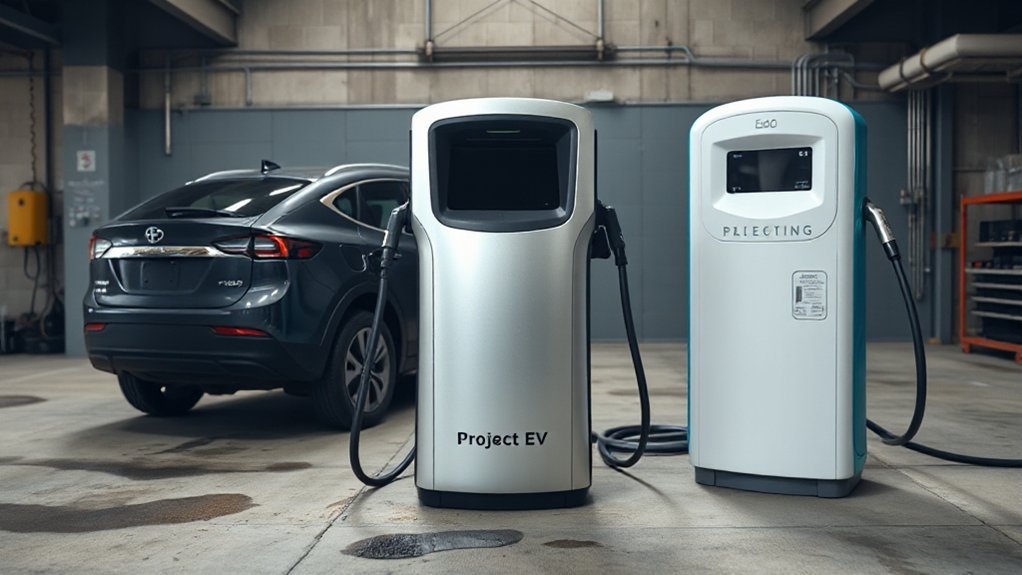
Although headline prices look similar, Project EV’s value shifts once you compare safety architecture and standards compliance and grid codes against rivals like Tesla Wall Connector, myenergi Zappi, Wallbox Pulsar/Commander, and Hypervolt. You should weigh integrated PEN-fault protection, Type A RCD with 6 mA DC monitoring, OCPP 1.6J support, and firmware signing. Project EV’s pricing transparency undercuts opaque bundles, but Tesla’s ecosystem polish and Zappi’s eco-modes may suit you better. Wallbox and Hypervolt win on apps; Project EV wins on core electrical safeguards and installer flexibility, shaping its market positioning.
- Safety/standards: 61851-1, 62955 DC leakage, BS 7671:2022 722, PEN detection.
- Connectivity: OCPP 1.6J-ready, RFID, Ethernet/Wi‑Fi/4G, API.
- Power: 7.4 kW single, 11/22 kW three-phase, dynamic CT load.
- Ownership: spares, replaceable CTs, documented commissioning, audit logs.
Conclusion
You’ve got a capable workhorse in Project EV: 7 kW or 22 kW that hits stated rates, smart ToU and solar‑surplus control, OCPP/cloud hooks, and safety nets like PEN‑fault protection, RCD, and thermal throttling. If you verify service capacity, CT calibration, and cable routing, it runs tight and compliant. Weigh warranty, support, and firmware costs against tariffs. If those line up, this charger earns its keep; if not, shop rivals and match spec to supply.