
You probably don’t know your Jeep 4xe’s onboard charger caps at ~7.2 kW, so a 32–40A J1772 Level 2 EVSE is the practical ceiling. To stay code‑compliant, size a dedicated 40A circuit for a 32A continuous load per NEC, use a UL‑listed unit with integral GFCI and temperature protection, and choose hardwired or NEMA 14‑50. Smart scheduling helps, but panel capacity and installation method should drive your choice—here’s how to decide.
Key Takeaways
- The 4xe uses SAE J1772 Level 2; onboard charger max ~7.2 kW (32A at 240V); higher-amp EVSE won’t charge faster.
- Choose a UL-listed 32–40A EVSE with adjustable current, integral GFCI, NEMA 3R/4 outdoor rating, and 18–25 ft cable.
- Install on a dedicated 240V circuit: 32A needs a 40A breaker; plug-in 14‑50 limited to 40A continuous; hardwire for 48A capability.
- Prefer 40A-rated hardware on a 50A circuit for thermal headroom, cooler operation, and future-proofing, while setting output to 32A.
- Tesla Wall Connector use requires a UL-listed J1772-to-NACS adapter; AC only—Superchargers won’t work with the 4xe.
Key Specs for the Jeep 4xe and Level 2 Charging
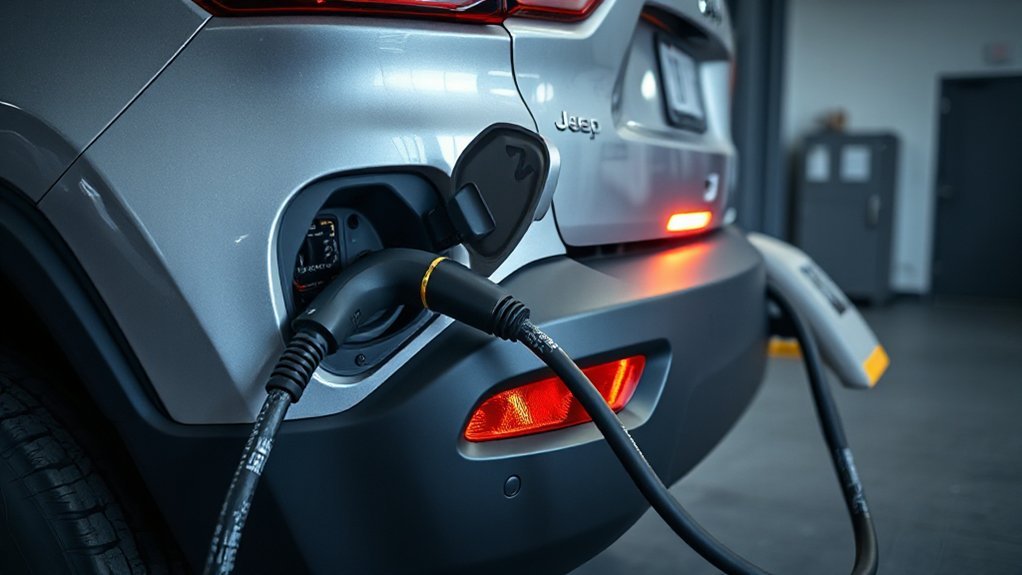
A 240‑volt circuit is the starting point: Jeep 4xe PHEVs (Wrangler 4xe, Grand Cherokee 4xe) use an SAE J1772 inlet for AC Level 2 charging and accept roughly 7.2 kW (about 240 V at 32 A). Plan a dedicated 40‑amp branch circuit per NEC continuous‑load rules (32 A ≤ 80% of 40 A), with copper conductors sized appropriately and a properly bonded equipment ground. Install a listed EVSE with integral GFCI, outdoor rating if exposed, and follow manufacturer torque specs. With Battery Capacity around 17–18 kWh (usable slightly lower), you’ll add about 7 kWh per hour, restoring a typical Electric Range of 20–26 miles in roughly 2–3 hours from low state of charge. Maintain clear ventilation, protect cables from damage, and verify breaker labeling.
J1772 Compatibility and Adapter Notes
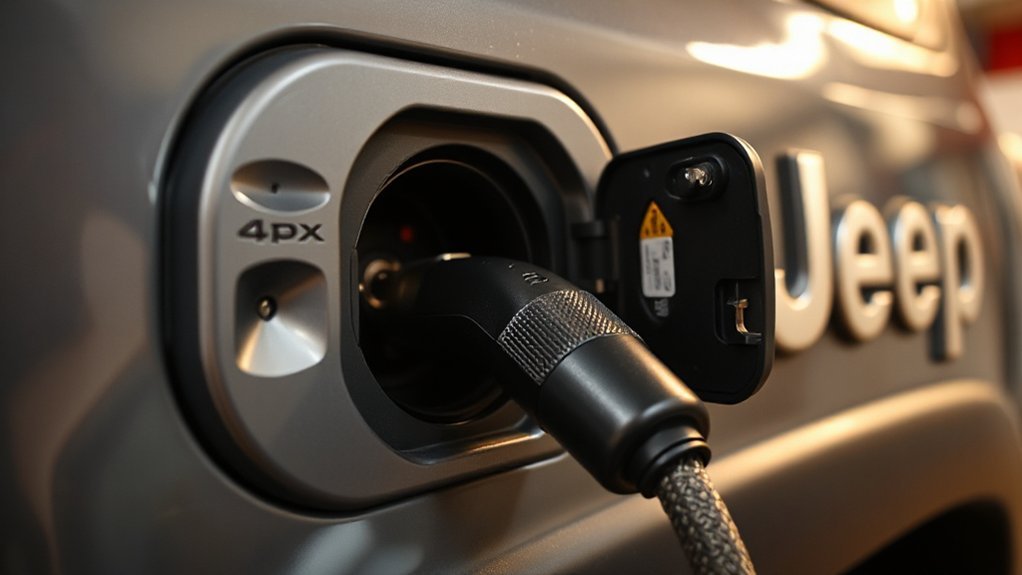
You’ll charge via the SAE J1772 (Type 1) port, which is the North American Level 2 standard and works with most 240 V EVSEs. If you plan to use Tesla AC destination equipment, use a UL/ETL‑listed J1772‑to‑Tesla adapter matched to the EVSE’s current rating, and don’t attempt to charge from Tesla Superchargers. For charging network interoperability, confirm the site provides J1772, check amperage and access method (app/RFID), and follow posted safety instructions to stay within SAE and NEC requirements.
Standard J1772 Port
The Jeep 4xe uses an SAE J1772 (Type 1) AC inlet for Level 1 and Level 2 charging in North America. This standardized interface stems from SAE J1772-2017, with Connector history tracing back to early 2000s collaboration among automakers and suppliers to unify AC charging. You can safely accept 120 V or 240 V, typically up to 32–40 A depending on the EVSE’s rating and circuit.
Pinout overview: two power pins (L1/L2 or L1/N), a protective earth, a Control Pilot for PWM current negotiation, and a Proximity Pilot for latch detection. The pilot circuits enforce safe sequencing, verify ground continuity, and trip if faults occur. Use only UL/CSA-listed EVSEs, dedicated circuits, and conduct periodic inspection for heat, corrosion, damaged latches, or deformed pins. contacts.
Tesla Adapter Considerations
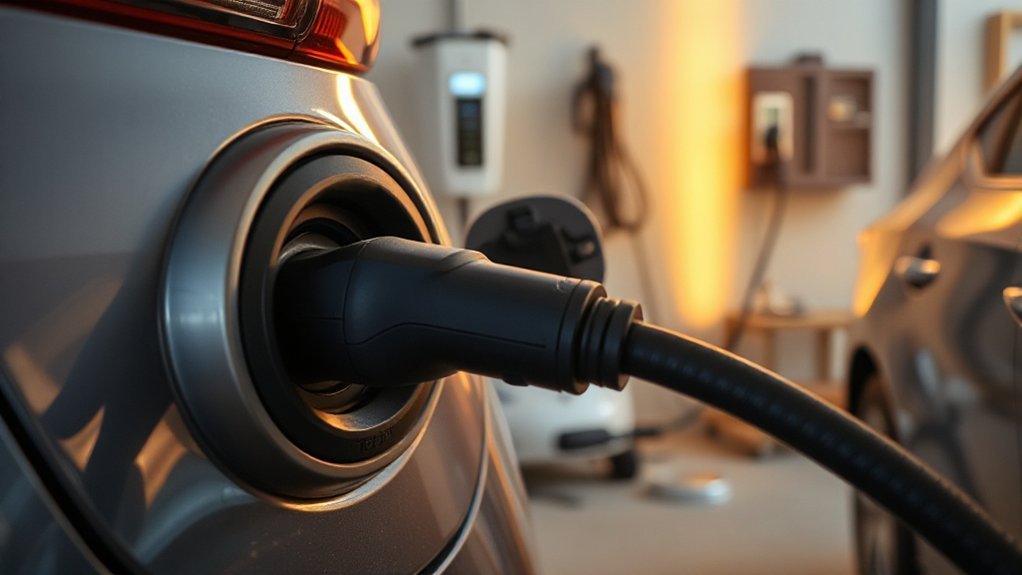
How do Tesla AC connectors fit into a J1772‑only Jeep 4xe workflow? Your Jeep uses an SAE J1772 inlet, so you’ll need a NACS‑to‑J1772 adapter to use Tesla Wall Connectors or Destination Chargers that permit non‑Tesla vehicles. Choose a UL‑listed, 48‑amp‑rated adapter; the 4xe’s onboard charger draws ~32 A (≈7.7 kW) at 240 V, so headroom improves reliability. Verify the adapter’s IP rating, strain relief, and thermistors, and avoid DC‑only equipment.
For safety, inspect pins, keep contacts dry, and don’t use extension cords. Secure the adapter with an inlet lock or cable loop for theft deterrence. Some Tesla Wall Connectors enforce access control; if not authorized, the pilot won’t enable. Use holsters and dry bags as storage solutions; coil cables to prevent stress.
Charging Network Interoperability
Beyond Tesla AC adapters, charging‑network interoperability hinges on SAE J1772 compliance, station access rules, and proper signaling.
Your Jeep 4xe’s onboard charger expects J1772 pilot duty-cycle, proximity detection, and ground continuity before energizing. Verify the EVSE advertises correct pilot current and honors SAE J1772-2017 states A–F. Use only listed adapters that preserve proximity and CP/PP resistances; avoid hacked extensions that bypass temperature sensing. Check network Roaming Agreements and Payment Integration (ISO 15118-2) for seamless access. Confirm breaker sizing, GFCI protection (20–80 mA per UL 2231/UL 2594), and intact diode on the control pilot to prevent DC leakage faults. If the station enforces membership, enable guest mode or pre-authorize in-app. In rain or snow, inspect for cracked latches, debris, and secure strain relief before connecting.
Choosing Amperage: 32A Vs 40A Vs 48A
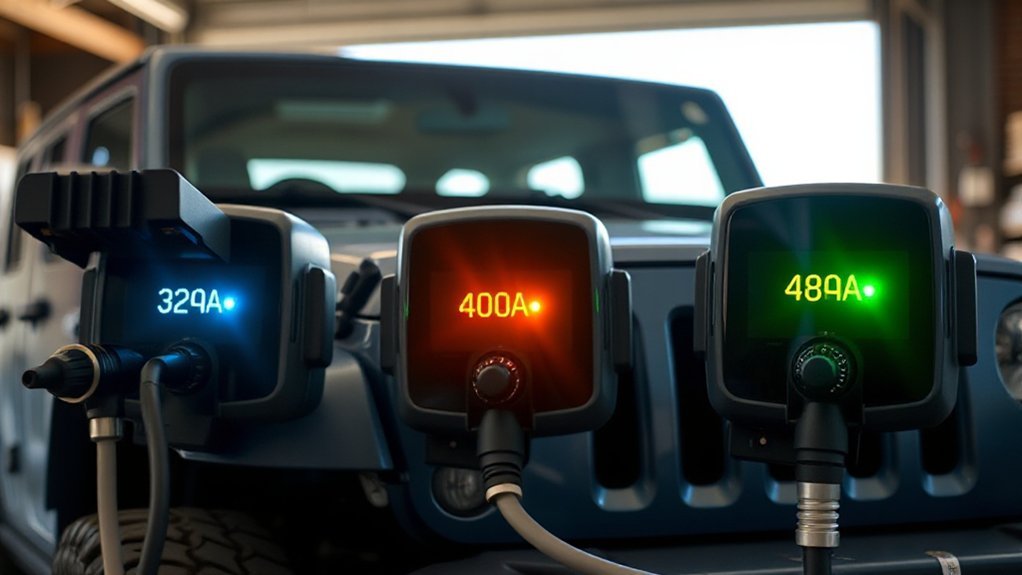
Which amperage makes sense for a Jeep 4xe Level 2 EVSE? You’ll balance charge rate, conductor heat, and Battery longevity. The Wrangler 4xe accepts about 7.2 kW, so 32A delivers full Charging efficiency; 40A and 48A won’t charge it faster. Follow SAE J1772 signaling and treat EV charging as a continuous load; set current conservatively and verify connector and cable temperature during initial sessions.
| Setting | Power/Notes |
|---|---|
| 32A | ≈7.7 kW EVSE; meets 4xe limit; cooler operation |
| 40A | ≈9.6 kW EVSE; no speed gain on 4xe; thicker conductors |
| 48A | ≈11.5 kW EVSE; no gain on 4xe; heaviest hardware |
Prefer adjustable EVSEs; reduce amps in high ambient or confined enclosures. Use UL-listed EVSE, 105°C-rated conductors, and NEMA 3R or better enclosures; monitor for nuisance trips indicating overheating during operation. events.
Matching a Charger to Your Electrical Panel Capacity
Start by confirming your service and panel capacity with a proper load calculation per NEC Article 220, then verify bus rating and available spaces. Size the breaker using the 125% continuous-load rule per NEC 625/210.20(A) (e.g., 32A EVSE→40A breaker, 40A→50A, 48A→60A). Install the EVSE on a dedicated 2‑pole circuit with appropriately sized conductors, required GFCI/AFCI, and clear labeling per NEC 625 and local amendments.
Panel Amperage Assessment
Before you pick a Level 2 charger for your Jeep 4xe, verify your panel’s available capacity and size the circuit per NEC requirements. Confirm the service rating and read panel labeling to identify bus rating, breaker spaces, and any restrictions. Perform an NEC Article 220 load calculation and treat EVSE as a continuous load at 125% of its maximum output. Use thermal imaging during typical household demand to spot overheating that suggests capacity is already constrained.
- Verify neutral/ground integrity and service disconnect rating.
- Record main breaker size, bus ampacity, and fill.
- Note dedicated space and wiring method options.


Document results and select a charger current limit that fits the calculated spare amperage, preserving clearances, conductor temperature ratings, protective device duty, and overall safety margins.
Breaker Sizing Guidance
With your available capacity documented, size the EVSE breaker so the branch-circuit rating is at least 125% of the charger’s maximum continuous output per NEC 625 and 210.20(A), meaning the charger’s set current must not exceed 80% of the breaker (e.g., 32 A on a 40 A breaker, 40 A on a 50 A, 48 A on a 60 A).
Confirm the bus and feeder support the selected breaker without exceeding ratings. Apply ambient derating and temperature-correction factors from NEC 110.14(C) and 310 when conductors run through hot spaces or bundled conduits. Match the EVSE’s adjustable current to the breaker after these corrections. Use listed, common‑trip two‑pole breakers panel‑compatible. Torque lugs to spec and schedule Breaker maintenance. Verify SCCR rating matches available fault current.
Dedicated Circuit Requirements
Confirm the Jeep 4xe EVSE is supplied by an individual, dedicated branch circuit—no other outlets or loads—per NEC 625.40 and 210.23. Treat EVSE as a continuous load; size the breaker and conductors at 125% of the nameplate current per NEC 625.41/210.20(A). Verify your panel’s spare capacity and bus rating before adding a 40A or 50A circuit. Use copper conductors, proper torque, and an enclosure with Corrosion mitigation and EMI shielding for reliability.
- Select wire gauge that matches the overcurrent device (e.g., 8 AWG Cu for 50A) and temperature ratings.
- Provide GFCI protection where required; follow manufacturer instructions for hardwired vs. receptacle installs.
- Install a lockable disconnect within sight per NEC 625.43 when required, and maintain clear working space per 110.26 safely.
Plug-In Vs Hardwired: Which Setup Fits Your Garage or Driveway
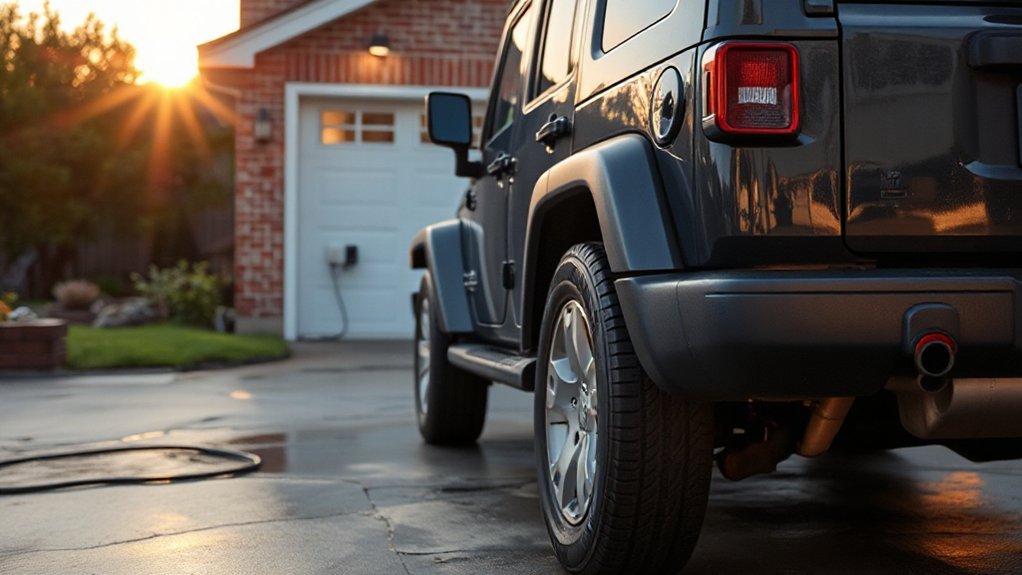
How do you decide between a plug-in NEMA 14-50 EVSE and a hardwired unit for your Jeep 4xe’s Level 2 charging? Choose based on electrical capacity, code compliance, and serviceability. A 14-50 plug-in is limited to 40A continuous (NEC 625/210, 80% rule), requires a GFCI-protected receptacle in garages (NEC 210.8(F)), and offers easy removal—great for Rental Compatibility and Resale Value. Hardwired units can deliver up to 48A on a 60A dedicated circuit, eliminate receptacle heat points, and reduce nuisance tripping.
For either, use a UL-listed EVSE, copper conductors sized per NEC 310, and install on a dedicated circuit per NEC 625. Perform load calculations (NEC 220), pull a permit, and have it inspected. Verify proper bonding, torque lugs to spec, and label the disconnect.
Cable Length, Build Quality, and Weather Ratings

You’ll size the cable to reach your Jeep 4xe’s charge port without strain—typically 20–25 ft—using proper conductor gauge to limit voltage drop per NEC 625. You should specify rugged construction: UL-listed EVSE, SAE J1772 connector, robust strain relief, and an abrasion-resistant jacket for repeated flexing. For outdoor installs, require NEMA 3R/4 or IP54+ weather ratings and an operating range around -30°C to 50°C to guarantee safe, reliable charging in rain, snow, and heat.
Optimal Cable Length
Cable length drives safety, usability, and electrical performance for a Jeep 4xe Level 2 setup. Select a length that reaches your charge port with slack, avoids strain, and keeps the cable off walk paths. Most codes and listings (NEC 625, UL 2594) cap EVSE output cords at about 25 ft; 18–25 ft fits typical garages without excess voltage drop at 32–48 A. Shorter runs reduce resistance, heat, and nuisance trips while improving cable management and garage aesthetics cited in owner testimonials.
- Map parking positions and port location; verify reach with 10–15% slack.
- Minimize loops and crossings; keep cord off the floor to reduce trip and tire hazards.
- If outdoor reach is needed, place the EVSE closer rather than exceeding cord limits.
Verify code compliance.
Rugged Build Quality
A storm-soaked driveway and winter mornings expose your 4xe Level 2 charger to impact, moisture, and thermal stress, so rugged build quality isn’t optional. Specify housings that pass IK08+ Impact Testing and meet UL 2594 and UL 2231 leakage-protection requirements. Look for SAE J1772 connectors rated for 10,000+ mating cycles, with glass-filled nylon shells and stainless latch hardware. Demand Vibration Isolation for wall-mount brackets and PCBs to survive garage door shock and vehicle bumps. Choose cables with fine-strand copper, cold-rated elastomer jackets, and molded 360° strain relief to manage bend radius and tug loads. Verify potting or gasketing around high-voltage components, conformal coating on control boards, and captive fasteners. Document torque specs, ground continuity, and periodic inspection intervals. Record serial numbers for warranty traceability.
All-Weather Protection
Often, all‑weather readiness hinges on matching cable length, enclosure integrity, and verified weather ratings to your install environment. For a Jeep 4xe, spec a 20–25 ft UL-listed cable that reaches the charge port without strain, avoiding trip hazards and minimizing connector stress. Choose NEMA 4X or IP66 enclosures with UV-stable housings, gasketing, and stainless hardware for Corrosion Resistance. Verify UL 2594/UL 2231 certification, GFCI protection per NEC 625, and -30°C to 50°C operability. Demand watertight cord grips, drain paths, and Freeze Mitigation features like low-temp flex jackets and heater-supported contactors.
- Mount 18–48 in above grade; maintain drip loops; slope conduit to shed water.
- Use anti-seize on terminals; inspect seals, vents, and latches annually.
- Bond grounds, torque lugs to spec, and label disconnects per code.
Smart Features: Wi‑Fi, Load Sharing, and Energy Monitoring
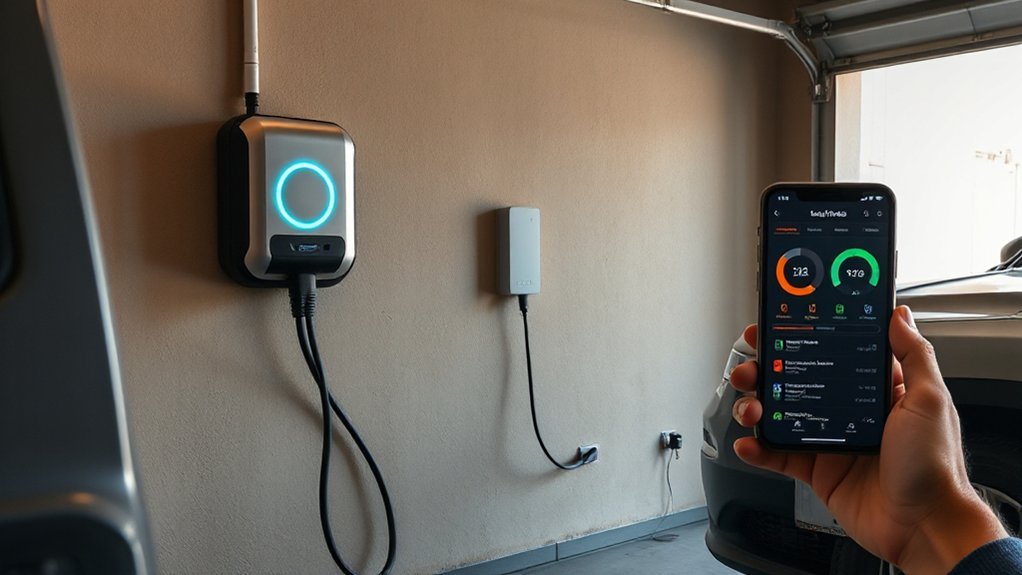
Modern 4xe‑ready Level 2 EVSE add Wi‑Fi, load sharing, and metering to improve safety, uptime, and code compliance. With Wi‑Fi, you manage charging current, schedules, and alerts remotely; insist on TLS encryption, WPA2/WPA3, role‑based access, and clear Privacy implications. Load sharing lets multiple EVSE on one circuit balance amperage in real time, honoring NEC 625 continuous‑load limits and breaker ratings. Priority rules and fail‑safe defaults prevent overcurrent if a unit drops offline. Metering with revenue‑grade CTs enables accurate kWh tracking, demand management, and fault diagnostics; look for ANSI C12 accuracy. Firmware updates should be signed, automatic, and rollback‑capable to address CVEs without downtime. OCPP or local APIs help integrate utility TOU, demand response, and home energy management. Verify UL 2594 and SAE J1772 compliance.
Recommended Level 2 Chargers for Jeep 4xe
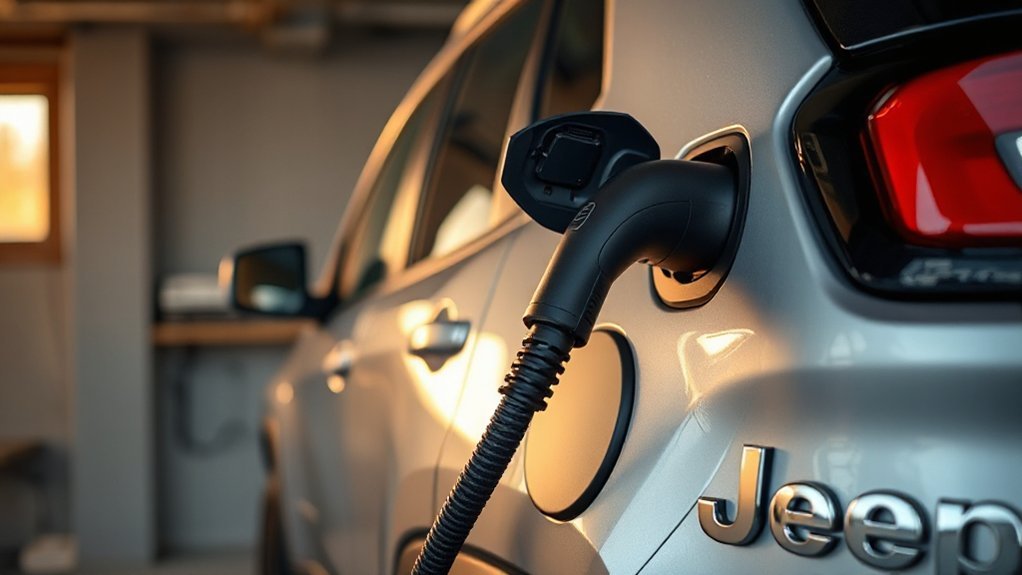
Choose units that meet UL 2594/2231, use the SAE J1772 connector, and deliver at least 32 A at 240 V to fully support the 4xe’s onboard charger; a 40 A EVSE on a 50 A circuit adds headroom and future‑proofing. For vetted picks, weigh brand comparisons, enclosure ratings, cable durability, and app reliability validated by user reviews. Favor NEMA 4 enclosures, 20–25 ft cables, and OCPP or robust native apps for uptime and auditability.
- ChargePoint Home Flex: 16–50 A configurable, UL listed, solid app telemetry, extensive user reviews.
- Grizzl‑E Classic 40: UL, NEMA 4, thermal derating, field‑proven durability, simple controls.
- Emporia 48/40: UL, load management capable, clear energy data, strong brand comparisons across cost.
Prioritize ground‑fault detection, temperature sensing, and replaceable cables for safety.
Installation, Permits, and Safety Considerations
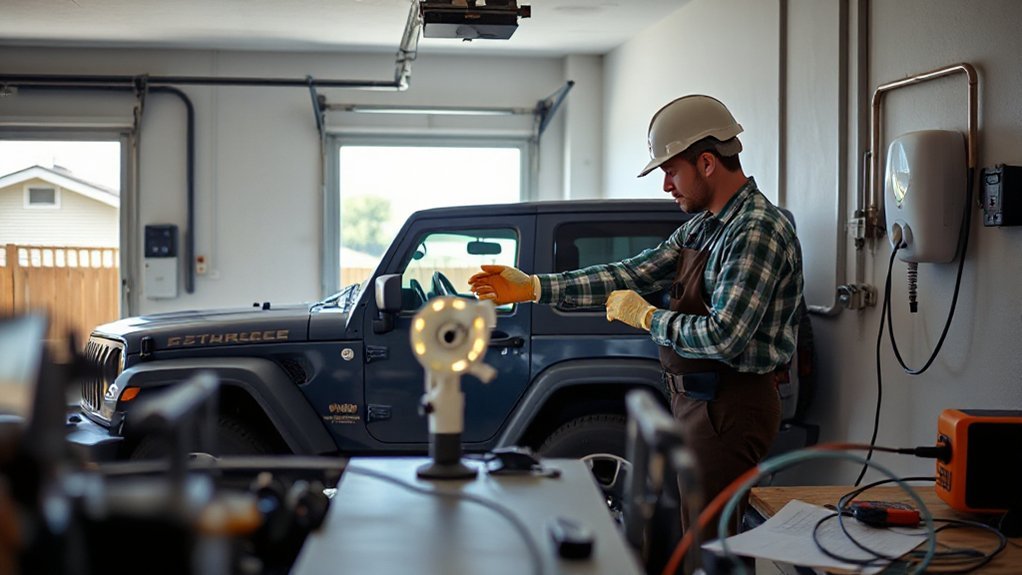
Before energizing a Level 2 EVSE for your Jeep 4xe, pull an electrical permit and confirm requirements with your Authority Having Jurisdiction (AHJ) under NEC Article 625. Use a licensed electrician, perform a load calculation per NEC 220, and install a dedicated circuit sized for continuous load (e.g., 40A breaker for 32A EVSE). Provide GFCI protection where required, proper bonding, and a readily accessible disconnect per 625.43. Choose hardwired or NEMA 14-50 per manufacturer, using copper conductors, correct gauge, and wet‑location wiring methods outdoors. Maintain working clearances (110.26), seal penetrations with firestop, and coordinate fire inspections when applicable. In multifamily housing, obtain HOA and tenant permission, mark assigned parking, manage cord strain, and verify enclosure rating (NEMA 3R/4). Label the circuit at the panel.
Rebates, Incentives, and Total Cost of Ownership
How do incentives change the true cost of adding a Level 2 EVSE for your Jeep 4xe? Federal and state rebates, utility make-ready credits, and tax credits can offset hardware, permitting, and electrician labor, especially for NEC 625-compliant installations. Prioritize UL-listed, ENERGY STAR units; incentives often require those standards.
Total cost of ownership spans charger price, wiring, panel upgrades, kWh rates, maintenance, and Insurance Costs. TOU plans can reduce charging costs if you schedule off-peak with the EVSE’s load management.
- Verify eligibility windows, caps, and form W-9/receipt requirements; keep serials and photos for audits and fire-safety documentation.
- Model 5-year TCO, including warranty, expected repairs, and Resale Value impacts, and disposal planning.
- Ask your insurer about EVSE coverage, liability, and discounts for permits and inspections.
Conclusion
You’re the steward of a high-voltage ship; choose a charger like a lighthouse—UL-listed, J1772, 32–40A—with adjustable current, GFCI and thermal guards. Plot your course by the NEC: a dedicated 40A circuit, continuous-load sizing, and permits. Match panel capacity, decide plug-in or hardwire, and prefer smart scheduling. Hire a licensed electrician to anchor the install. With rebates as tailwinds and a 25‑foot cable as your bridge, you’ll dock safely and charge efficiently, day after day, reliably.