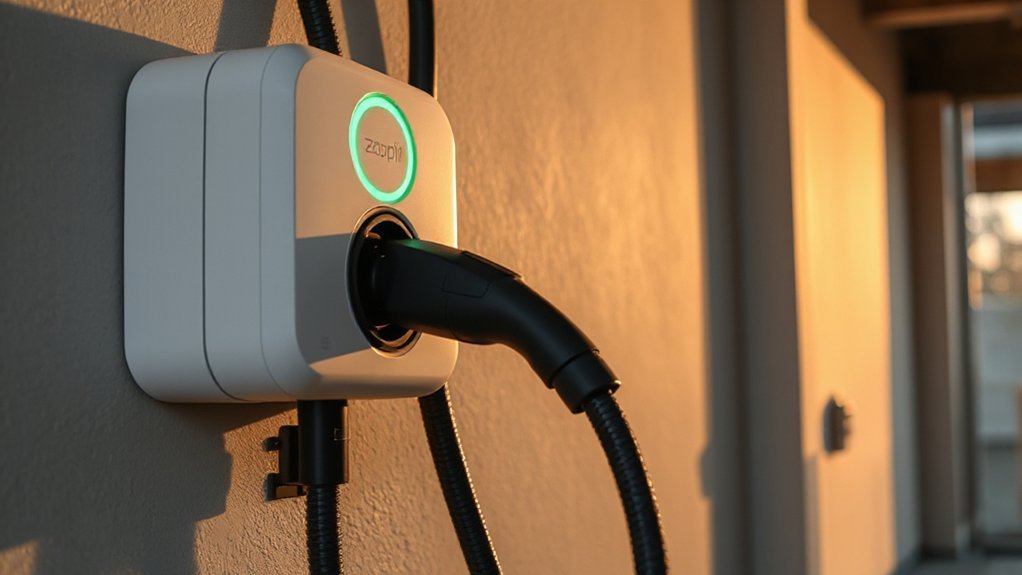
It’s lightning-fast yet sips the grid: you deliver 50 kW (≈125 A at 400 V), adding ~35–45 kWh in 45–60 minutes. You use active PFC and >96% efficient DC‑DC, speak ISO 15118/DIN 70121 over CCS/NACS, and manage load via OCPP with demand‑charge controls. You specify IP65 enclosures and UL/IEC compliance for uptime and safety. The real challenge is how you size power, orchestrate networking, and justify ROI—now decide what matters most.
Key Takeaways
- Delivers up to 50 kW DC (300–1000 V, 125 A), suitable for most EVs’ sustained 40–70 kW charging window.
- Typical 10–80% charge in 35–60 minutes, depending on battery size, temperature, and vehicle charging curve.
- Supports CCS1/CCS2/NACS (plus CHAdeMO legacy), with ISO 15118/DIN 70121 communication for reliable BMS‑controlled CC–CV charging.
- High efficiency (>96%) SiC power stage, PFC PF≥0.99, THD<5%, IP65/IK10 enclosure for urban or corridor deployments.
- Site input around 54 kW at 0.98 PF; size a 480 V three‑phase feeder ~100 A per NEC for one dispenser.
Why 50 Kw Hits the Sweet Spot

Why does 50 kW hit the sweet spot? You balance charge speed, grid impact, and capex using a power level most vehicles can accept continuously. Typical EVs sustain 40–70 kW between 20–60% SOC, minimizing taper loss. At ~50 kW, you add ~35–45 kWh in 45–60 minutes, aligning with realistic dwell times for groceries or dining. You meet IEC 61851-23 and ISO 15118 requirements while avoiding costly utility upgrades and extreme demand charges. For urban fit, you can deploy on 400 V three-phase with manageable transformer sizing and load-sharing. From user psychology, predictable, non-queueing sessions and clear time-to-energy expectations increase satisfaction. You also optimize site throughput: 2–4 ports per 150–300 kVA service, high utilization, and stable thermal/acoustic envelopes for mixed-use locations, with minimal operational complexity.
How DC Fast Charging Works at 50 Kw

You connect via CCS (IEC 62196) or CHAdeMO; the station rectifies AC and supplies regulated DC per IEC 61851/ISO 15118, e.g., 200–500 V at up to ~125 A capped at 50 kW. The charger closes the control loop with your BMS, adjusting current to meet requested limits while maintaining P=V×I ≤ 50 kW. You see a CC–CV charging curve: near-constant power from ~10–60% SoC, then current tapers to hold pack voltage, so 10–80% is rapid while the last 20% slows.
Power Conversion Process
Although the vehicle ultimately needs regulated DC, a 50 kW fast charger first draws AC from the grid (typically 208–480 Vac), performs active rectification with power‑factor correction (PF ≥0.99, THD <5%), and builds a high‑voltage DC link. You then convert through an isolated DC‑DC stage, regulate output per BMS setpoints, and enforce protections to UL 2202 and IEC 61851. Semiconductor selection (SiC MOSFETs, fast diodes) minimizes switching loss at 50–100 kHz; EMI mitigation uses LISNs, CM chokes, X/Y capacitors, and shielded layouts. Control loops hold ripple <1% and current accuracy ±1%. Include safety interlocks.
| Stage | Key parameters |
|---|---|
| AC-DC PFC | PF ≥0.99; THD <5% |
| DC link | 700–900 Vdc; low ripple |
| DC-DC isolated | >96% η; reinforced isolation |
Charging Curve Behavior
While a station may be rated 50 kW, delivered power follows a BMS‑controlled CC–CV profile negotiated over CCS or CHAdeMO per IEC 61851‑24 and ISO 15118. You’ll see max power only when pack voltage and allowed current intersect near 50 kW. In constant‑current, the BMS commands, for example, 125 A at 400 V (≈50 kW), bounded by cable, connector, and thermal limits. As cell voltage rises, constant‑voltage begins; current tapers exponentially, extending charge time. Temperature gates limits via ISO 15118 messages. Pack chemistry, internal resistance, and voltage hysteresis shift the curve. Higher state‑of‑charge shortens CC duration; capacity fade reduces attainable current and accelerates taper. Expect roughly 10–80% in 30–45 minutes; above 80%, power may fall below 20 kW to protect longevity and thermal stability.
Charge Times Across Different EVs

On a 50 kW DC fast charger, your 10–80% time scales with usable battery capacity and the vehicle’s DC acceptance per CCS (SAE J1772 Combo). As a rule of thumb, 10–80% adds ~0.70×usable capacity (kWh)—so a 60 kWh pack needs ~42 kWh; at an average 40 kW (taper from 50 kW), you’ll wait ~63 minutes. Model-specific limits and thermal control can shift the average power by roughly ±15–25%, so nominally similar packs post different charge times.
Battery Size Impact

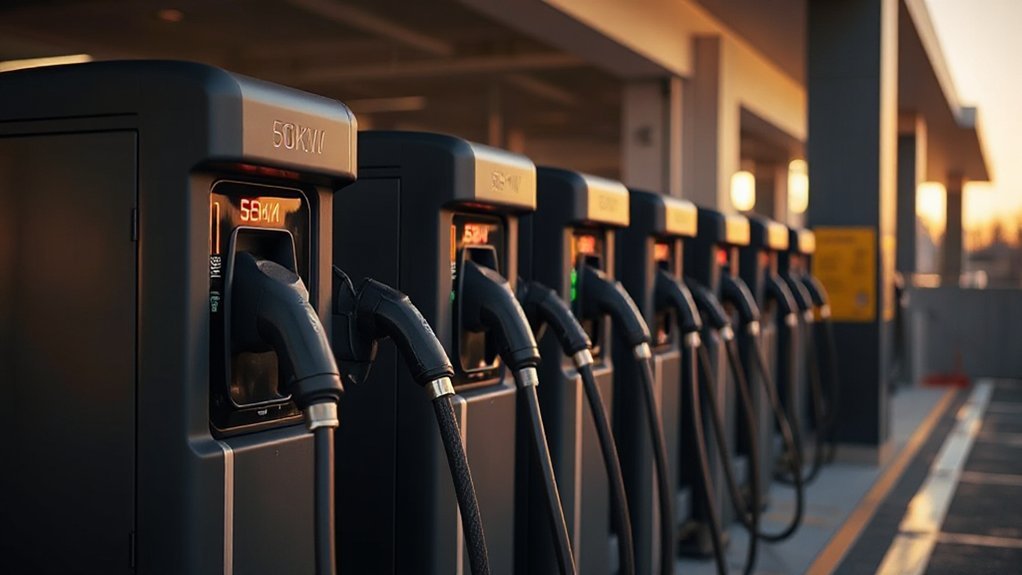

Capacity dictates time at a 50 kW DC fast charger: larger usable battery energy requires proportionally longer sessions within the same state‑of‑charge (SOC) window.
At constant power, time ≈ ΔE/P; for a 10–80% window, ΔE = 0.70×usable capacity. A 60 kWh pack needs ~42 kWh, ~50 minutes; a 90 kWh pack ~76 minutes. Your sessions deviate due to current limits, controls, and taper starting near 60–70% SOC. Pack voltage and allowable C‑rate govern acceptance; higher‑voltage systems (e.g., 800 V) draw less current for the same power, reducing heat. Heavier packs alter vehicle dynamics and efficiency, increasing energy per mile and extending dwell to recover equivalent range at fixed power. Larger packs also carry a higher manufacturing footprint, so optimize capacity to the duty cycle.
Model-Specific Charge Times
Beyond pack size, charge time at a 50 kW DC dispenser depends on each model’s charging curve, thermal strategy, voltage architecture, and interface (CCS/NACS/CHAdeMO) per IEC 61851-23/ISO 15118 limits. You’ll see variance: some 400 V sedans hold ~47 kW to 50% SoC, while 800 V SUVs may downrate to 35–40 kW via buck stages. Your outcome hinges on preconditioning behavior, cooling capacity, and firmware differences that set current limits and taper onset.
| Segment | 10–80% time (50 kW) | Notes |
|---|---|---|
| Compact 50–60 kWh | 35–45 min | Flat curve to ~55% SoC |
| Sedan 70–80 kWh | 45–60 min | Earlier taper if hot battery |
| SUV 90–100 kWh | 55–75 min | 800 V may current-limit |
To optimize, arrive warm, target 10–60% SoC, and verify charger–EV handshake versions for consistent, standard-conformant session behavior.
Site Power Requirements and Grid Impact
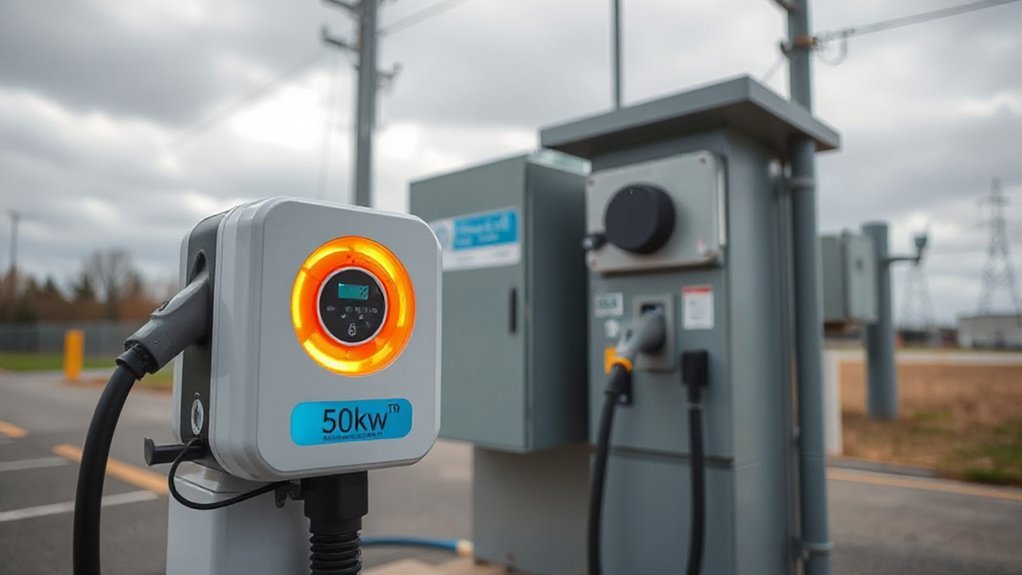
While the charger’s nameplate is 50 kW DC, you should size site power for its AC input and continuous-duty treatment under code. Assume 95% conversion efficiency and 0.98 power factor: input ≈ 53.7 kW (≈64.6 A at 480 V, three‑phase). Apply NEC continuous-load sizing at 125%: design for ≈81 A; select a 100 A feeder and appropriately rated disconnect. Coordinate OCPD and SCCR with available fault current (NEC 110.9/110.10). Keep voltage drop under 3% to the unit. For harmonic mitigation, specify rectifiers meeting IEEE 519 (<5% current THD at PCC) or add filters. Address grounding/bonding per NEC 250. For utility interconnection, verify transformer capacity, flicker limits (IEEE 1453), and protective relay requirements. Aggregate multiple dispensers with realistic diversity only if justified by measured data.
Costs, Incentives, and ROI

Although hardware prices keep trending down, budget with line-item rigor: a 50 kW DC fast charger typically totals $35,000–$120,000 installed, split among hardware ($12,000–$30,000), make‑ready/construction ($15,000–$70,000), and soft costs such as design, permits, commissioning, and utility fees ($5,000–$20,000). You should include utility service upgrades, trenching, switchgear, and NEC/UL compliance testing in installation costs. Capture O&M: $500–$2,000/year for preventive maintenance, plus parts and warranty extensions. Model energy at $0.12–$0.35/kWh and potential demand charges of $5–$25/kW-month. Apply incentives: 30% IRA ITC (with prevailing wage), NEVI up to 80% eligible costs, and utility rebates. Assume 10%–35% utilization, $0.35–$0.55/kWh retail. Your payback timeline typically spans 3–7 years; sensitivity-test utilization, tariffs, capital stack, and uptime to validate ROI. Include payment processing fees, signage, ADA compliance, and site restoration contingencies.
Connectivity, OCPP, and Load Management

Engineer robust connectivity first: provision reliable IP backhaul (hardwired Ethernet where possible; LTE/5G with external antenna as fallback) with encrypted tunnels (TLS 1.2+ over WebSocket) and target >99% network uptime, sub‑2 s command latency, and -90 dBm or better cellular RSSI. Implement OCPP 1.6J or 2.0.1 over secure WebSocket for remote monitoring, smart charging, and firmware management. Use signed images, version pinning, and rollback. Enforce mutual TLS and rotate certificates at least every 12 months. For data interoperability, normalize telemetry via JSON schemas and export meter values using OCMF. Orchestrate load management with OCPP SmartCharging profiles: set per‑connector limits, station caps, and ramp rates (kW/s) to avoid breaker trips and demand charges. Integrate utility signals via OpenADR 2.0b to enable automated peak shaving responses.
Connectors, Standards, and Compatibility

With secure OCPP and load controls established, align the hardware interface to vehicle ecosystems by implementing standards-based connectors and protocols. Provide CCS1/CCS2 per IEC 62196-3 and SAE J1772; support NACS; retain CHAdeMO only if legacy demand exists; assess GB/T for target regions. Engineer 50 kW delivery at 300–1000 VDC with 125 A continuous; enable 500 A paths only with liquid-cooled leads. Implement ISO 15118-2/-20 and DIN 70121 over PLC; support CHAdeMO CAN messaging. Verify IEC 61851-23/-24 compliance, UL 2251, and CISPR 11 EMC. Optimize Plug ergonomics, latch force <75 N, cable OD and bend radius for 1-handed use. Specify Environmental sealing to IP54 minimum at mated interface, IP65 enclosure, IK10 impact. Perform CharIN conformance and multi-OEM interoperability tests. Document pinouts, tolerances, and labeling requirements.
Reliability, Uptime, and Scalability Planning
Since field availability drives revenue and user trust, set quantifiable targets and design to meet them: ≥99.5% measured site uptime (per SAE J2953-1 style availability accounting), MTTR ≤4 hours, and power-module MTBF ≥200,000 hours.
Specify modular power stacks, hot-swappable rectifiers, and a Redundant Architecture (N+1) on coolant pumps and comms to isolate faults. Instrument with IEC 61850/IEC 62955 telemetry, fault codes, and predictive alerts. Enforce Preventive Maintenance: filter replacement ≤2,000 hours, torque checks quarterly, firmware CI/CD with rollback. Plan scalability via shared DC bus, 1000 V class components, and grid-integration per IEEE 1547.
| Metric | Target | Method |
|---|---|---|
| Site uptime | ≥99.5% | SAE J2953-1 logs |
| MTTR | ≤4 h | Onsite spares, RMA SLAs |
| MTBF (module) | ≥200,000 h | Weibull analysis |
Conclusion
By coincidence, your duty cycles, grid constraints, and budgets align at 50 kW. You deliver ~125 A at 400 V, add 35–45 kWh in 45–60 minutes, and keep efficiency >96% with active PFC. You meet ISO 15118/DIN 70121 over CCS/NACS, OCPP networking, IP65 enclosures, and UL/IEC safety. You manage demand charges with smart load control, hit predictable O&M, and scale in 50 kW blocks. It’s precise, interoperable, and ROI‑positive—exactly when and where you need it.