
It’s not impossible to install a Level 3 DC fast charger at home; you just need utility capacity, code compliance, and permits. You’ll need commercial‑grade, UL/ETL‑listed DC gear (CCS/NACS/CHAdeMO) and NEC 625 compliance. Expect a service‑capacity study, utility coordination, a lockable disconnect, and working clearances. Upgrades and commissioning can trigger demand charges—so should you do it, or choose safer, cheaper alternatives?
Key Takeaways
- Level 3 means DC fast charging; bypasses the car’s onboard AC charger and uses CCS/CHAdeMO/NACS connectors.
- Not a bigger Level 2 or portable; requires listed DC equipment, commissioning, visible lockable disconnect, and NEC 625 compliance.
- Often needs utility coordination and service upgrades; perform NEC 220 load calculations and secure permits before specification and installation.
- Choose UL 2202/2231 listed hardware with proper signaling (ISO 15118/Tesla), rated current, ground-fault protection, isolation, and emergency shutoff.
- For most homes, a 240‑V Level 2 EVSE or battery‑buffered solution is safer, cheaper, and avoids demand charges.
What “Level 3 at Home” Really Means

Although marketers call it “Level 3,” what you’re really asking about is DC fast charging at home—a fundamentally different system than Level 1/2 AC charging. You’re bypassing the car’s onboard charger and delivering regulated DC straight to the battery through a standards-compliant connector (CCS, CHAdeMO, or NACS). The station performs rectification, isolation, ground-fault detection, contactor control, and handshake communications with the BMS. Proper installations follow NEC Article 625, use listed equipment, provide a lockable disconnect, and maintain clear working space. You’ll also coordinate cable management, ventilation clearances, and thermal limits specified by the EV and the charger. Don’t trust safety perceptions shaped by marketing. Common consumer misconceptions: it’s just a “bigger Level 2,” it plugs into existing outlets, or it’s portable. It requires commissioning.
Power and Utility Requirements

You’ll first assess service panel capacity—available ampacity, spare breaker spaces, short-circuit rating, and feeder/conductor sizes—against the charger’s kW, voltage, and phase requirements, using an NEC 220 load calculation. If the calculated demand exceeds the panel or service rating, you’ll plan a service upgrade (often higher kVA and, where available, three-phase) to maintain code compliance and safe fault-current margins. You’ll initiate the utility upgrade process with a formal load request, utility load study, transformer/metering changes, and required permits, accounting for lead times and possible trenching or easement work.
Service Panel Capacity
Before you spec a Level 3 charger, confirm your service can supply it safely and code-compliantly. Perform a NEC 220 load calculation and verify the main service rating accommodates the charger as a continuous load at 125%. Check panelboard ampacity, short-circuit current rating, and available spaces for a properly listed breaker. Inspect for busbar corrosion, heat discoloration, loose lugs, and damaged insulation. Verify conductor size, insulation rating, and temperature terminals (75°C) match the breaker and feeder. Apply manufacturer-specified breaker torque with a calibrated wrench, and record settings. Confirm grounding and bonding per NEC 250, neutral isolation in subpanels, and working clearances per NEC 110.3/110.26. Label the disconnecting means, circuit directory, and maximum OCPD. Document test results and photos. Include thermal scans under representative load.
Utility Upgrade Process
Because Level 3 DC charging often exceeds typical residential capacity, coordinate with your electric utility at project inception to determine feasible voltage/phase (e.g., 480Y/277, 208Y/120, or 240 V), available fault current, and required service kVA. Submit a load letter, one-line diagram, site plan, and NEC 220/625 load calculations. Request fault-duty data to size service equipment, OCPD, and grounding per NEC 110.9, 110.10, 250.
Expect a utility study for transformer sizing, secondary/service upgrades, metering class (e.g., 320 A or CT-rated), and possible medium-voltage extensions. Clarify timeline expectations, costs, and easements. Plan trenching, clearances, and working space per utility standards and NEC 110.26. Coordinate outage windows and inspections. Maintain stakeholder coordination among utility, AHJ, charger vendor, and contractor. Don’t energize until approvals and make-ready are complete.
Equipment Options and Standards (CCS, NACS, CHAdeMO)
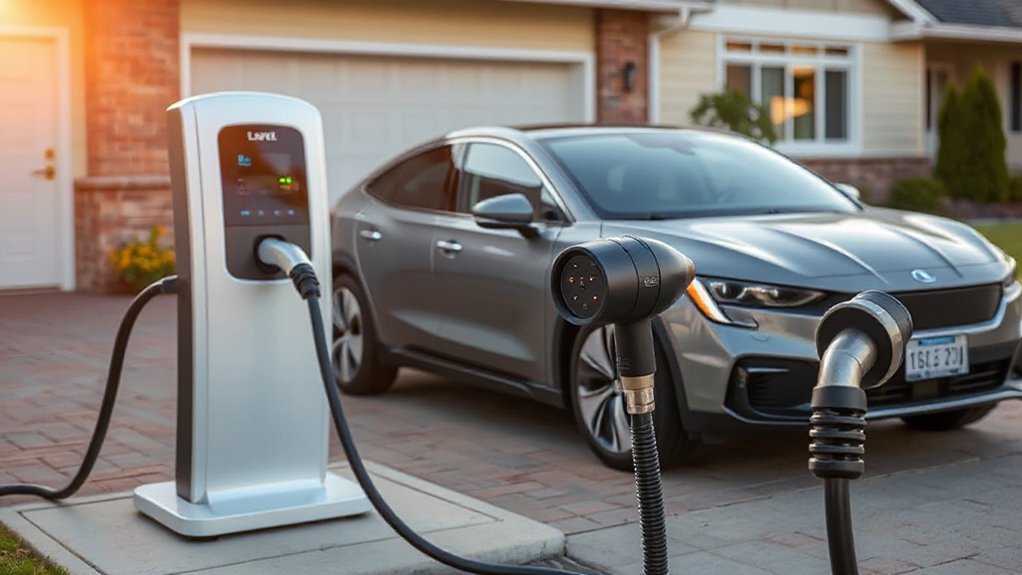
You’ll choose between CCS and NACS based on your vehicle inlet, site wiring, and code-listed DC fast charger hardware; both handle high-current DC, with NACS becoming the North American default while CCS remains widely deployed. Verify the dispenser, cable, and connector are UL listed, rated for the target current (e.g., 250–500 A), and compatible with your EV’s communication protocol and voltage range. For CHAdeMO vehicles, use only manufacturer-permitted, certified adapter solutions, and confirm adapter power limits, thermal protection, isolation, and interoperability before commissioning.
CCS Vs NACS
While both CCS and NACS deliver DC fast charging, they differ in connector geometry, signaling, current/voltage envelopes, and market adoption—factors that drive equipment selection and code compliance for a Level 3 installation. You’ll weigh marketing narratives against hard specs and manufacturer alliances against local code realities. Verify UL listings, NEC Article 625/705 interfaces, fault monitoring, and site load limits before you commit.
| Aspect | CCS | NACS |
|---|---|---|
| Connector | Larger, dual-DC pins plus AC | Compact, integrated DC/AC |
| Voltage/Current | Up to 1000 V, 500 A+ | Up to 1000 V, 615 A typ |
| Signaling | PLC (ISO 15118/ DIN 70121) | Tesla protocol; ISO 15118 underway |
| Cable/Cooling | Liquid-cooled common | Liquid-cooled common |

Coordinate load management, OCPD sizing, ground-fault protection, interlocks, and commissioning tests with your utility and authority having jurisdiction AHJ approval.
CHADEMO Adapter Options
After comparing CCS and NACS, address CHAdeMO via adapter strategies for legacy vehicles and certain V2X use cases. If you own a CHAdeMO-only EV, prioritize native CHAdeMO DC equipment or a bi-directional inverter (e.g., CHAdeMO V2H), then consider adapters only when listed and certified. Verify UL/ETL listing, NEC 625 compliance, proper grounding, interlock, and isolation. Confirm power limits; most CHAdeMO-to-Tesla adapters cap near 50 kW and may not support V2X. Locking latches, IP54+ enclosures, strain relief, and firmware update paths are essential.
Review brand reviews and user experience reports for handshake reliability, thermal performance, and overcurrent behavior. Check vehicle firmware compatibility matrices. Avoid uncertified passive dongles; DC requires active protocol translation and safety checks. Document utility notification and warranty impacts before commissioning the system.
Site Readiness, Permitting, and Inspections
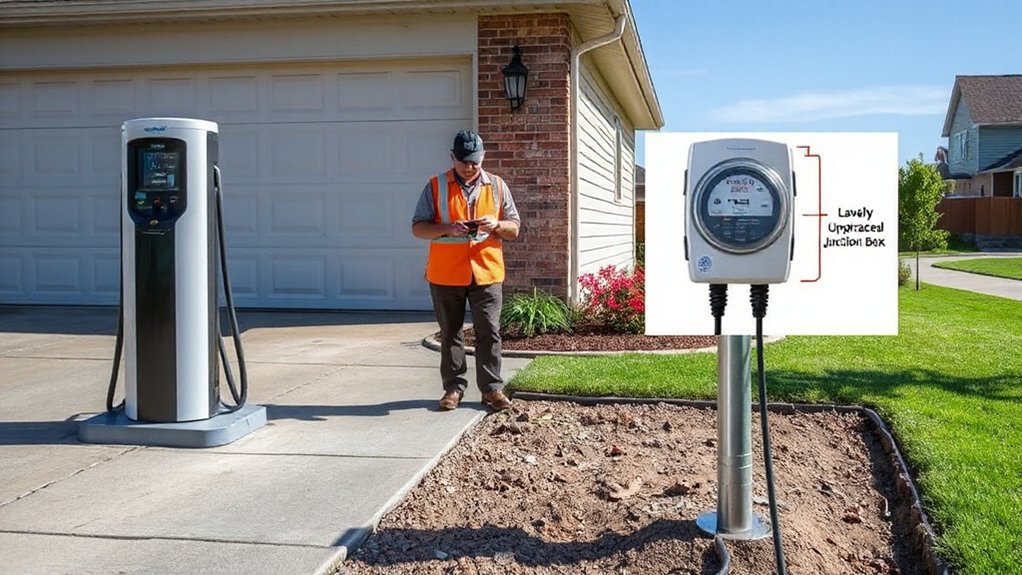
How do you ready a site for a Level 3 home charger? Verify service capacity with your utility and complete NEC load calculations. Plan equipment placement for code clearances, vehicle approach, and Neighbor coordination on noise and access. Provide a level pad, trench routes, and adequately sized, sunlight-resistant conduit with expansion fittings. Bond and ground per NEC 250, add a visible, lockable disconnect, and install bollards for impact protection. Include Weatherproofing details: NEMA 3R/4X enclosures, gasketed penetrations, in-use covers, drip loops, and sealed raceway entries.
Obtain permits from your AHJ with a one-line diagram, site plan, fault-current data, and manufacturer cut sheets. You’ll have rough and final inspections: conductor sizing, torque, labeling, GFCI/SCR, surge-protection, insulation tests, commissioning results. Verify working clearances and emergency labeling.
Installation Costs and Ongoing Bills

Because DC fast charging demands high fault current and continuous-load capacity, you should budget for substantial one-time installation costs and recurring utility and maintenance charges. Expect service upgrades, possibly a dedicated transformer, new switchgear, protective relays, grounding, trenching, and bollards. Factor engineering, utility interconnection, metering, and commissioning. Hardware isn’t all: demand charges, time-of-use rates, and power-factor penalties can dominate monthly bills. Budget preventive maintenance, cooling-system service, firmware support, uptime monitoring, and calibration to keep warranties valid. Include Insurance costs for added liability and equipment replacement; premiums often rise. Document arc-flash labels, fault studies, and periodic inspections. Consider equipment depreciation and end-of-life removal. Model Resale impact—some buyers value a compliant DCFC, others discount for energy expense and space loss. Obtain quotes to validate total exposure.
Smarter Alternatives for Faster Home Charging
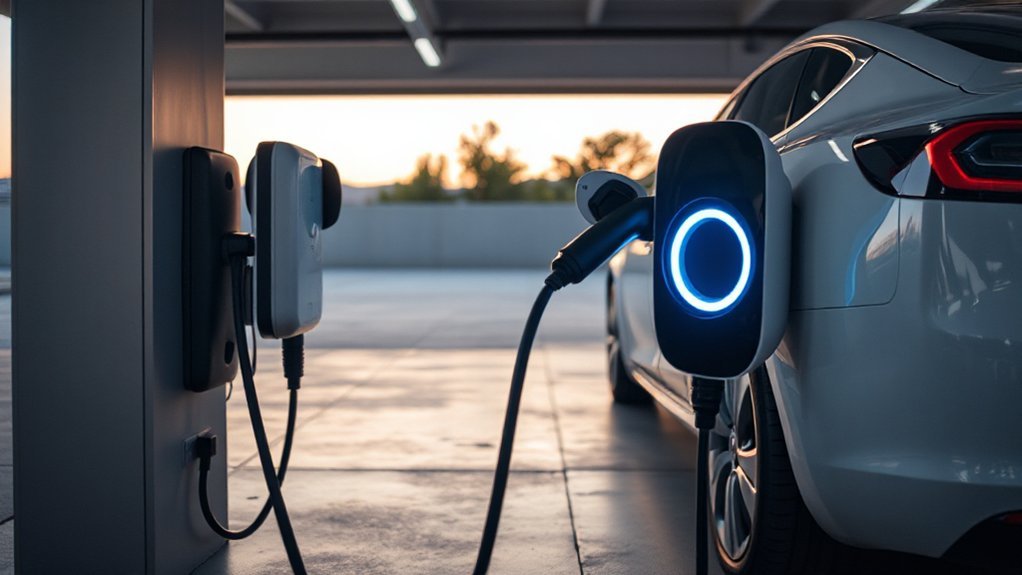
Why chase DC fast charging at home when safer, code-compliant options deliver similar convenience with far less risk and cost? Install a 240‑V Level 2 EVSE (40–80 A) listed to UL 2594 and follow NEC 625 for branch-circuit sizing, GFCI, and ventilation markings. Use panel‑integrated load management or an energy management system with CTs to respect service limits. Smart Scheduling charges during low‑rate windows, completes before departure, and coordinates with HVAC preconditioning to maximize battery acceptance. Add Battery Buffering via a stationary storage system (UL 9540) to deliver short bursts of higher kW while keeping the grid draw within your main rating. Integrate solar per NEC 705/706 to offset energy. Enable dynamic load sharing across multiple EVSE without nuisance trips and maintain conductor temperatures.
Real-World Scenarios and Who It Makes Sense For
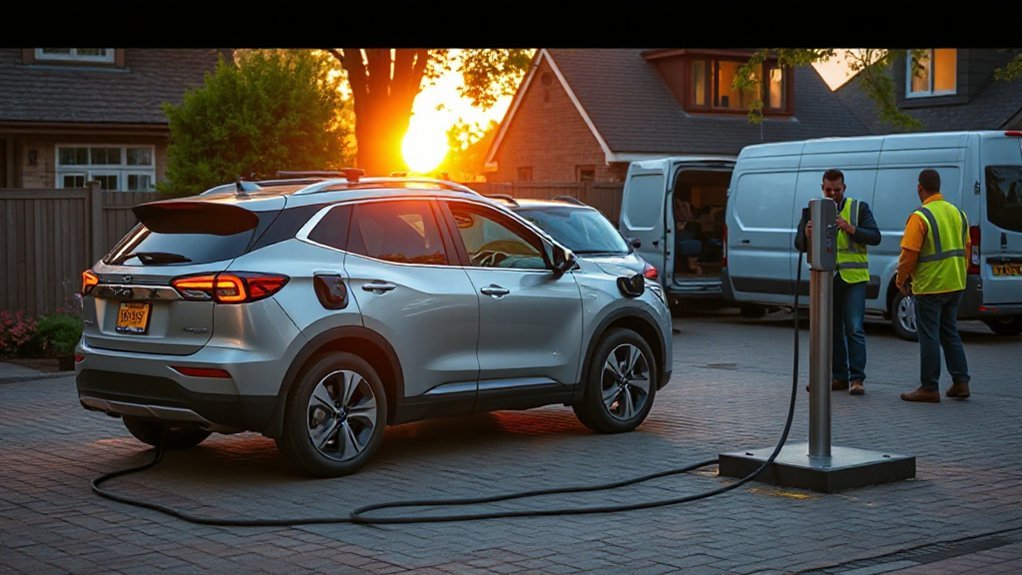
While most homes meet daily needs with a smart Level 2 EVSE, at‑home DC fast charging only makes sense in narrow cases where you can meet code and service constraints and you truly need rapid turnarounds.
For you, it fits when vehicles cycle hard and downtime costs money: home‑based fleet owners running multiple shifts, medical or utility responders staging at a residence, or rural operators lacking DCFC. You’ll need service capacity, dedicated overcurrent protection, cable runs, outdoor‑rated equipment, clearances, and emergency shutoff marking. Apartment dwellers almost never qualify due to shared metering and nuisance-load issues. Also confirm your EV’s charging curve; many pack chemistries taper early, so 50–80% top‑ups yield most benefit. If you can’t sustain that duty cycle, stick with managed Level 2.
Incentives, Codes, and What’s Coming Next

Even as incentives can trim hardware and upgrade costs, codes and utility rules ultimately determine what you can build at home. You’ll need permits, a load calculation, and utility approval before any DC fast equipment lands on your wall. Align design, metering, and fault protection with current standards, then leverage tax incentives without compromising safety.
- Confirm NEC Article 625, local amendments, working clearances, ventilation, and short-circuit ratings.
- Coordinate with your utility on service capacity, transformer availability, demand charges, and interconnection.
- Specify listed hardware (UL 2202/2231), rapid shutdown, grounding, and emergency power-off labeling.
- Watch policy forecasts: managed charging, V2G pilots, and cybersecurity may become conditions for rebates.
Document everything, commission the system, and enroll in rates that cap peak demand spikes.
Conclusion
You may picture a fire hose of electrons, but you don’t just plug in and go. You confirm service capacity, coordinate with the utility, secure permits, and install UL/ETL‑listed DC equipment to NEC 625 clearances with a lockable disconnect. You trench, upgrade panels or transformers, commission and test. If that sounds like pouring concrete, it is. Choose Level 2 or battery‑buffered DC for safer, code‑clean speed—unless your fleet, duty cycle, and budget demand Level 3.