
Plan the power, size the infrastructure, manage the load. Level 3 DC fast charging hinges on vehicle charge-acceptance, site capacity, and NEC 625-compliant design. You’ll balance peak kW vs real-world taper, choose CCS/CHAdeMO/NACS per SAE specs, and select UL 2202/2231-listed hardware. Expect utility studies, transformer/feeder sizing, ADA/civil work, permits, and commissioning. Demand charges and load management can make or break ROI—so the choices you make next matter.
Key Takeaways
- Level 3 DC fast charging delivers 50–350+ kW; fastest from about 10–60% SOC with a preconditioned battery due to tapering.
- Advertised kW is peak, not guaranteed; negotiated power is limited by vehicle BMS, cable current (often 500–600 A), temperature, and site sharing.
- Support CCS, NACS, or CHAdeMO; use ISO 15118/DIN 70121 (CCS/NACS) or CAN (CHAdeMO); Plug & Charge needs certificates, firmware, and adapter planning.
- Plan 480Y/277V three‑phase service, transformer kVA, fault duty, and voltage drop; size as 125% continuous load per NEC 625; coordinate early with utility.
- Budget $35k–$100k per dispenser plus $50k–$250k for make‑ready/utility upgrades; ensure UL 2202/2231 listing, ADA access, bollards, signage, and commissioning tests.
What Is Level 3 DC Fast Charging
What, exactly, is “Level 3” DC fast charging? You connect to an off‑board charger that converts AC to regulated DC and delivers it directly to your EV’s battery via EVSE compliant with IEC 61851-23/-24 and NEC Article 625. Connectors include CCS (IEC 62196‑3), CHAdeMO, and NACS (SAE J3400). The EV and EVSE negotiate voltage, current, and safety using PLC per DIN 70121 or ISO 15118, enabling features like Plug & Charge. Certified systems meet UL 2202, UL 2231, and IEC 61851 safety interlocks and isolation.
You should follow User etiquette: queue fairly, move when charging completes, and keep cables tidy. Consider Environmental impact: prefer renewable‑backed sites and avoid unnecessary sessions that increase peak demand and upstream losses. This is direct current, not onboard charging.
Charging Speeds and Real-World Factors

You’ll notice the “peak kW” rating isn’t your “average kW”—per IEC 61851-23 and ISO 15118, the EVSE supplies only what your BMS requests in real time. As state of charge rises, your BMS tapers current to maintain cell voltage and safety limits, so the charge curve falls from peak to a lower sustained level. Battery temperature also governs charge acceptance; in cold or hot conditions the car will derate or precondition per SAE J1772/CCS and OEM thermal limits, extending session time.
Peak Vs Average Speed
While many stations advertise a “350 kW” or “150 kW” figure, that’s the peak DC power the dispenser and your vehicle can negotiate—not the average power you’ll actually see over a session.
You experience instantaneous power negotiated via CCS (DIN 70121/ISO 15118) within limits set by your BMS, cable, and hardware.
Average speed equals delivered energy divided by session time, including ramp-up, authentication, and thermal derates or power-sharing events.
Driver Perception often equates the headline rating to guaranteed throughput; that gap creates tangible Marketing Implications and potential dissatisfaction.
Real power depends on pack voltage window, station current ceiling (e.g., 500–600 A), and site capacity or utility curtailments.
Look for stations listing both max kW and max A, clear derating policies (per UL 2202/IEC 61851).
State-Of-Charge Tapering
Approaching higher state of charge, DC fast charging shifts from a current-limited (CC) phase to a voltage-limited (CV) phase as cell voltages near their upper limits, forcing the BMS to taper current to protect the pack. You’ll see power drop past a knee, typically 50–80% SOC, per the vehicle’s charge curve. IEC 61851-23/-24 and ISO 15118 define messages so EV and EVSE negotiate limits and present accurate, timely interface feedback. Plan sessions around the plateau, not the tail, to align driver expectations and optimize time per kWh.
- Stop near the knee to maximize average power and minimize diminishing returns.
- Use SOC-based targets (e.g., 10–60%) rather than minutes to accurately predict dwell.
- Verify charge curves from OEM docs; charger kW ratings don’t override vehicle limits.
Battery Temperature Impacts



Beyond SOC tapering, charge power also hinges on pack temperature—cell impedance and safety limits vary with thermal state, so the BMS adjusts permissible current accordingly.
At low temperatures, ion mobility drops and internal resistance rises, elevating lithium plating risk; the BMS limits C-rate and may require preheat via active thermal management. Near 20–40°C, cells accept peak current within manufacturer curves, aligning with IEC 61851-23 power envelopes and ISO 15118 negotiated limits. Above ideal, the BMS reduces current to protect electrolytes, limit SEI formation growth, and maintain UL 2580/ISO 6469 thermal safety margins. Plan for on-route preconditioning triggers via navigation; this minimizes cold-soak delays and maximizes kW delivery under SAE J1772/CCS charge profiles. For site design, consider HVAC load, heat rejection, and NEC 625 capacity.
Connectors and Vehicle Compatibility

How do DC fast chargers interface with vehicles? You match connector standards to your EV: CCS1/CCS2 (IEC 62196-3), NACS (SAE J3400), or CHAdeMO. Communication runs via ISO 15118 or DIN 70121 over PLC for CCS/NACS, and CAN for CHAdeMO. The inlet’s latch, proximity, and control pilot provide safe engagement per SAE J1772 signaling. Verify adapter compatibility, firmware, and certificate handling for Plug & Charge. Evaluate plug ergonomics, cable reach, strain relief, and IP rating for your site and climate. Confirm interlocks, ground fault protection, and labeling per NEC 625 and UL standards, and check your vehicle’s connector list.
- Map your fleet to supported DC connectors and protocols and maintenance.
- Test adapters for rise and handshake reliability under load.
- Specify cable management minimizes bend radius.
Power Levels and Modular Scalability
Define deliverable power as Vdc × Iout within connector, cable, and thermal limits, then scale it with modular rectifier blocks that parallel on a shared DC bus. Use 15–30 kW power modules with hot‑swap capability to increment capacity and N+1 fault tolerance. The control architecture supervises phase balancing, DC bus sharing, current ripple, and pack‑requested limits via IEC 61851-23 and ISO 15118/SAE J1772-Combo. Implement closed‑loop thermal management: liquid‑cooled cables permit 500–600 A; air‑cooled leads derate earlier. Enforce connector and contact temperature limits per UL 2251 and UL 2231. Monitor module health, isolate faults, and reallocate current granularity by module. Advertise available current through PLC, then ramp using slew‑rate constraints to avoid oscillations and meet EMC and safety listings, per applicable electrical codes and standards.
Site Assessment and Electrical Capacity
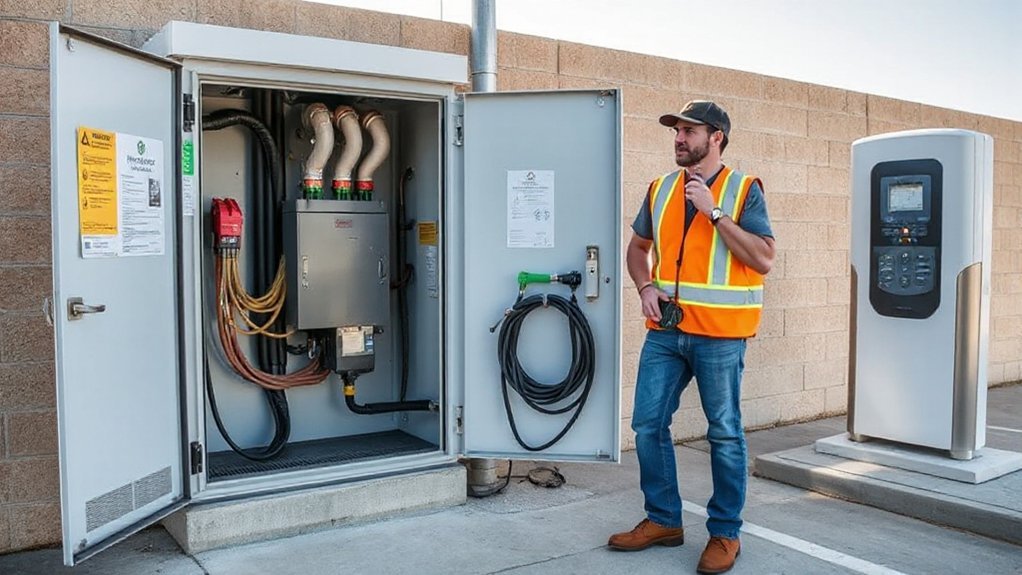
You verify utility service availability and short-circuit duty with the utility, confirming transformer capacity, service voltage, and fault current per NESC and NEC 110.24. You perform load calculations per NEC 220 and Article 625, classify DC fast chargers as continuous loads at 125%, and model diversity and load management to control peak demand. You plan upgrade pathways—new service, transformer, switchgear, and feeders—per NEC 230/240/310 with protective coordination (IEEE 242) and secure permits and interconnection approvals from the AHJ and utility.
Utility Service Availability
Before siting DC fast chargers, verify utility service availability and electrical capacity through a formal site assessment. Coordinate early with the utility to confirm three‑phase service at 480Y/277V, available kVA at the point of interconnection, short‑circuit current, and upgrade lead times. Request feeder topology, SAIDI/SAIFI reliability data, and tariff options to support Outage Resilience and cost control. Validate compliance with NEC Article 625, UL 2202/2231, IEEE 519 harmonic limits, and utility metering standards. Assess space for pad‑mount transformers, switchgear clearances, and fault‑duty ratings. Document make‑ready incentives and queue status to advance Access Equity across underserved corridors.
- Obtain utility service letters, depicting capacity, voltage, and protection schemes.
- Confirm metering, CT/PT requirements, and backhaul.
- Align construction phasing with utility design, permitting, and energization milestones.
Load Calculations and Demand
While final utility capacity drives design, perform load calculations to establish coincident kW/kVA and required service ampacity for the site. Determine charger nameplate kW, PF, and maximum simultaneity. Treat EVSE as continuous load per NEC 625; apply 125% to branch, feeder, and service calculations per NEC 210, 215, and 220. Use diversity and coincidence factors derived from measured 15‑minute intervals or forecasted duty cycles. Include transformer K‑factor, harmonic current, voltage drop (<=3% branch, <=5% feeder), and short‑circuit/arc‑flash duties (NFPA 70E). Validate with Simulation validation: queueing or Monte Carlo to stress peak concurrency. Document Safety margins and operating setpoints for load management. Confirm kVA demand, available fault current, and minimum PF for utility coordination. Reference IEC 61851‑23 for DC charger characteristics and IEC 60364 guidance.
Upgrade Pathways and Permits
From the coincident kVA and service ampacity you established, assess upgrade pathways with the utility and AHJ to confirm service size, interconnection, and permit scope. Request a service study (transformer kVA, feeder capacity, fault duty) and determine whether a dedicated service or primary metering is required. Develop NEC-compliant documents: Article 220 load summary, 625 EVSE details, 110.26 clearances, short-circuit/coordination studies, and grounding per 250. Verify voltage drop, arc-flash labels (NFPA 70E), and layouts. Build Stakeholder Engagement and Policy Advocacy into timelines to address tariffs and make-ready incentives.
- Submit sealed one-line, site plan, load letter, and protective device settings to utility and AHJ.
- Obtain electrical, civil, and right-of-way permits; schedule inspections and commissioning.
- Define OCPD, service disconnect, and signage; verify short-circuit ratings and working space.
Utility Coordination and Service Upgrades
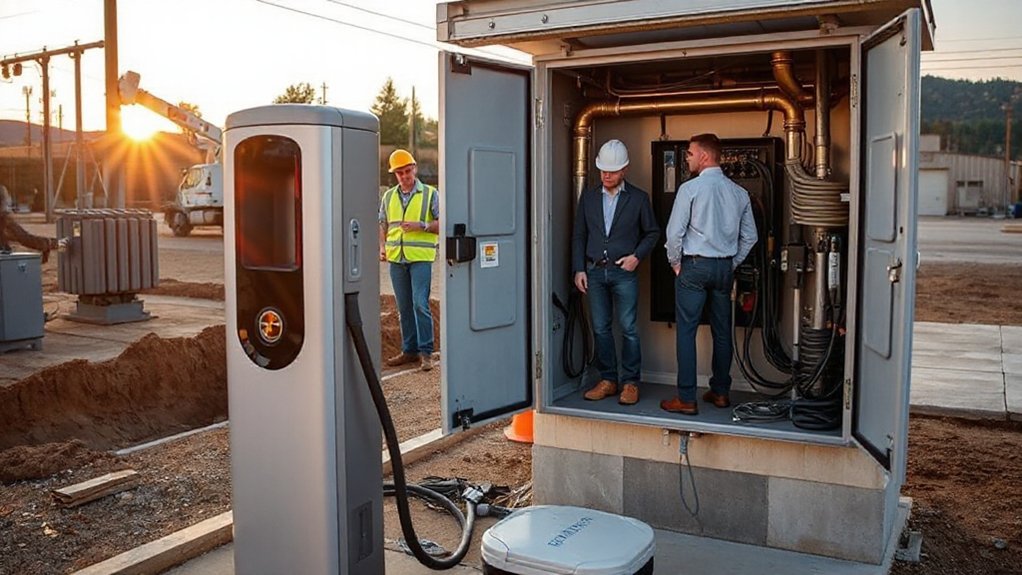
Because Level 3 DC fast chargers impose large, continuous, nonlinear three‑phase loads, you must engage the utility early to confirm available capacity, service voltage, and interconnection requirements. Conduct stakeholder engagement with distribution planning, metering, and tariffs teams; start contract negotiation for line extensions, make‑ready scope, and cost responsibility. Request a load‑addition study addressing transformer sizing, feeder headroom, fault duty, voltage drop (ANSI C84.1), flicker (IEEE 1453), and harmonics (IEEE 519). Clarify required service class, phase count, and short‑circuit current at the service point for switchgear ratings. You’ll evaluate primary vs secondary service, meter placement, and dedicated feeders. Align charger power levels with tariff options, demand charges, and capacity subscription programs. Plan outage windows and commissioning tests with utility protection and metering crews on site.
Permitting, Codes, and Safety Standards
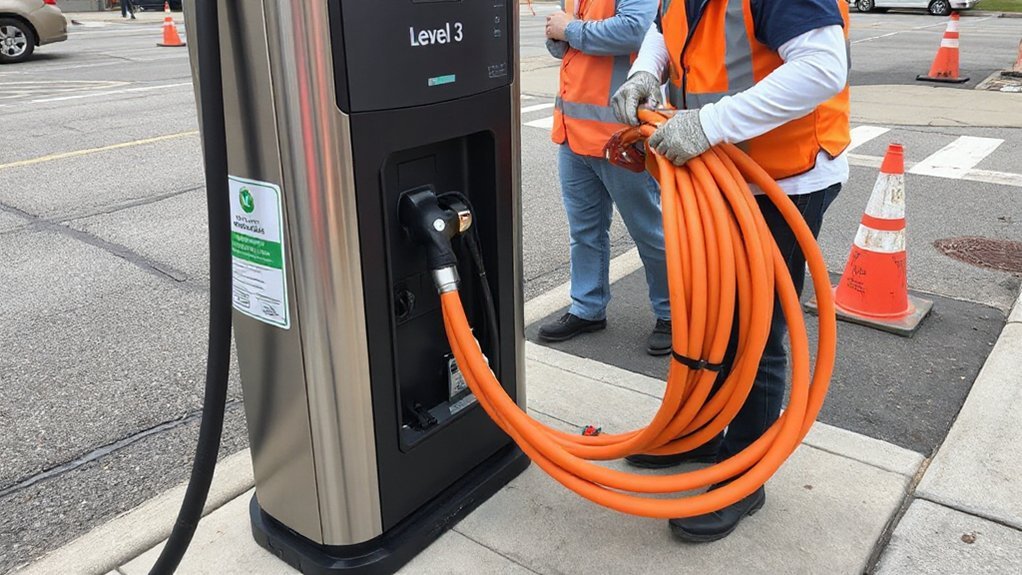
Although AHJ requirements vary, you must secure permits and design to adopted codes and listings: comply with NEC 2023 Article 625 for EV power transfer systems; apply NEC 110.3(B) (listed/labeled equipment), 110.9/110.10 (interrupting and short‑circuit withstand ratings), 110.24 (available fault current marking), 110.26 (working space), 240 (overcurrent protection), 250 (grounding/bonding), and 300 (wiring methods). Coordinate Fire Codes (e.g., IFC 1204), bollard/clearance plans, and egress. Specify chargers listed to UL 2202 and personnel protection to UL 2231-1/-2. Provide one-lines, load calcs, SCCR documentation, arc-flash labels per NFPA 70E, and site signage per MUTCD.
- Submit civil/electrical sheets, fault-current letters, and manufacturer installation/Inspection Protocols.
- Perform torque, IR, GFCI, and ground-resistance tests; document commissioning results.
- Maintain NEC 110.26 working space, ADA access routes, and durable, visible equipment labels.
Hardware, Installation, and Civil Work Costs
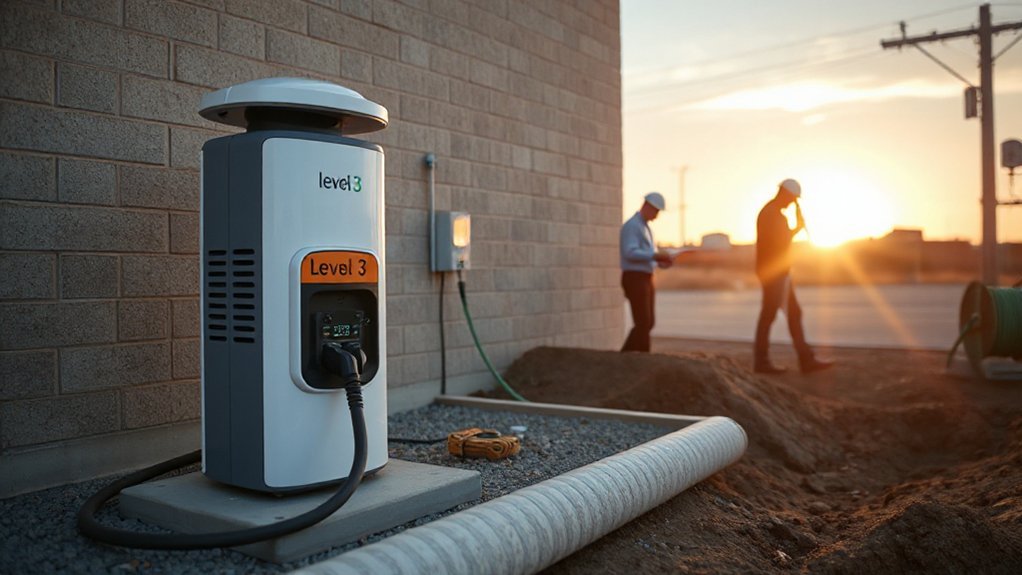
While site conditions vary, you should budget DC fast charging projects by breaking costs into hardware, electrical installation, and civil work aligned with NEC, UL, and IFC requirements. Hardware includes dispensers, power cabinets, rectifiers, switchgear, communication controllers, payment terminals, and labels—listed to UL 2202/2231 and installed per NEC 625. Electrical installation covers service entrance, utility CT cabinet, transformer pad space, main/distribution gear, grounding and bonding per NEC 250, conductors in listed raceways, overcurrent protection, surge protection, and commissioning. Civil work includes concrete pads, bollards, ADA-compliant access, trenching, backfill, paving, striping, drainage, Aesthetic integration, and Landscaping restoration, coordinated to IFC clearances. Include design, surveying, geotech, traffic control, and as-builts. Verify fault current, short-circuit ratings, clearances, and working space per NEC 110 and equipment labeling accuracy.
Demand Charges, Tariffs, and Load Management
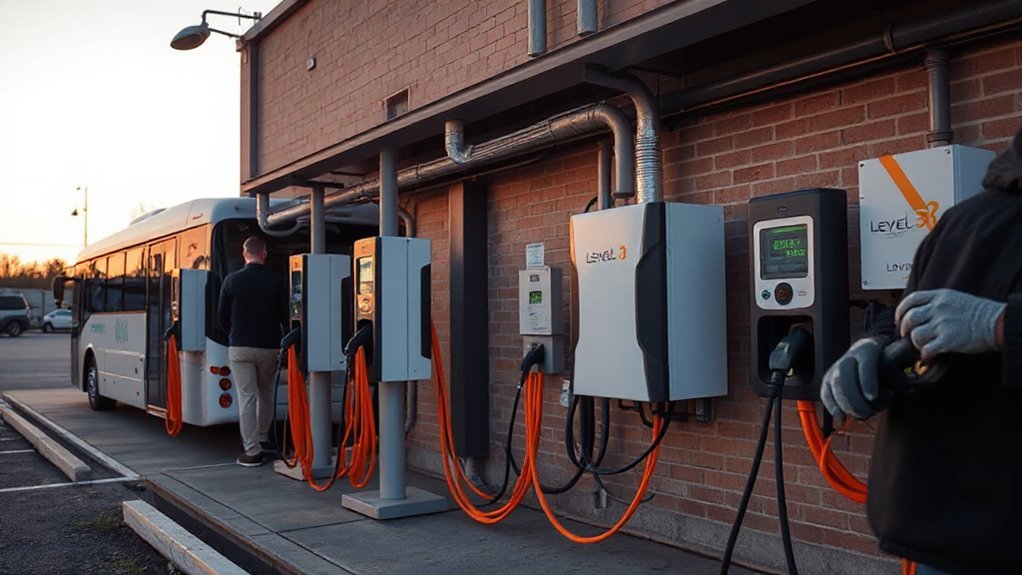
Even as hardware choices lock in capacity, your operating cost hinges on the utility tariff—especially demand charges assessed on peak kW demand. You should profile interval data, identify coincident peaks, and implement load management per NEC 625 and ISO 15118 control. Use OCPP smart charging and IEEE 1547/UL 1741 compliant DERs to shave peaks with storage or PV. Align charger setpoints with TOU windows, and cap site demand via kW limits.
Operating cost hinges on tariffs: profile peaks, smart-charge, and cap kW with TOU-aligned setpoints.
Revenue modeling must reflect tariff tiers, ratchets, and seasonal multipliers. During Contract negotiation, request EV-specific rates, demand holidays, or non-coincident demand metrics. Validate calculations with utility meter data.
- Deploy dynamic setpoint control and stagger sessions by SoC.
- Add battery buffering sized to N-1 feeder constraints.
- Monitor kW in real time; alert at 90%.
Incentives, Rebates, and Total Cost of Ownership

Rigor turns incentives from marketing bullets into hard reductions in total cost of ownership. You should model TCO as: net CAPEX (equipment, construction) minus rebates, Tax credits, and accelerated depreciation; plus OPEX (energy, demand charges, maintenance, networking). Validate program rules for Incentive stacking: federal §30C, state grants, and utility make‑ready; avoid double-dipping, satisfy prevailing wage and Buy America, and retain documentation. Align specifications with NEC 625 (NFPA 70), UL 2202/2231, SAE J1772, ISO 15118, and OCPP 1.6/2.0.1 to qualify. Plan cash flow: some incentives are reimbursements, some reduce basis, some are transferable. Time in-service dates, interconnection, and permit closeout to meet milestones. Track kWh throughput for M&V. Include warranty, uptime SLAs, spare parts, and software updates in lifecycle cost, and cybersecurity patch management obligations.
Conclusion
You’re ready to deploy Level 3 DC fast charging when you align vehicle charge-acceptance with site capacity, code, and cost. Expect average power to taper; a 350 kW dispenser often delivers ~150–200 kW across a session, cutting dwell yet managing heat. Design to NEC 625, list to UL 2202/2231, meet ADA, and verify with commissioning. Use load management to cap demand charges, and model tariffs, incentives, and modular kW growth for lowest cost of ownership.